

A conversation that felt private suddenly becomes a countdown. Someone you met online says they have something personal and will send it to people you know.
The demand may arrive while you are still trying to understand what happened. Here is how to regain control without letting the stranger set your next move.
Overview
This is a threat built around real private material
An intimate image extortion scam starts with a seemingly ordinary connection on a dating app or social platform. The stranger gradually steers the conversation somewhere more private.
They may invite a video call or ask for a photograph. If they capture that material, they can threaten to share it unless the person pays.
That differs from a mass sextortion email claiming a hacker recorded you. In this version, the offender may possess an actual image, video, chat, or social profile.
Do not assume every threat proves they have access to your contacts. Equally, do not dismiss a threat because the sender uses an anonymous account.
What recent police reports establish
The Singapore Police Force reported at least 52 cyber extortion cases and at least Singapore $134,000 in losses from August 2026 through its September 3 advisory.
Police described approaches through dating apps and social media, followed by private messaging, intimate calls or photographs, and demands backed by threats of exposure.
The same advisory warned that extortion can continue after a payment. Paying once does not give the victim control over the captured file.
A separate Surrey Police account described a young man moved across multiple platforms before a gift-card demand followed his sharing intimate photographs.
Those reports describe particular cases and trends, not a universal script. The offender’s platform, payment method, and claimed audience can all differ.
The important distinction before you act
There are three practical questions: what material actually exists, what access the offender has, and whether any payment or account information has already been shared.
- Real material: A screenshot, photograph, or recorded call may be genuine, altered, or presented out of context.
- Contact access: A visible friend list is not the same as control over your account, although it can make threats feel credible.
- Money trail: A bank transfer, crypto payment, or gift-card code calls for different immediate recovery steps.
- Account security: If you sent a login code or clicked a suspicious link, securing the account becomes urgent.
The clearest immediate response is to stop negotiating, preserve the evidence, and use trusted reporting channels. You do not have to solve everything in one minute.
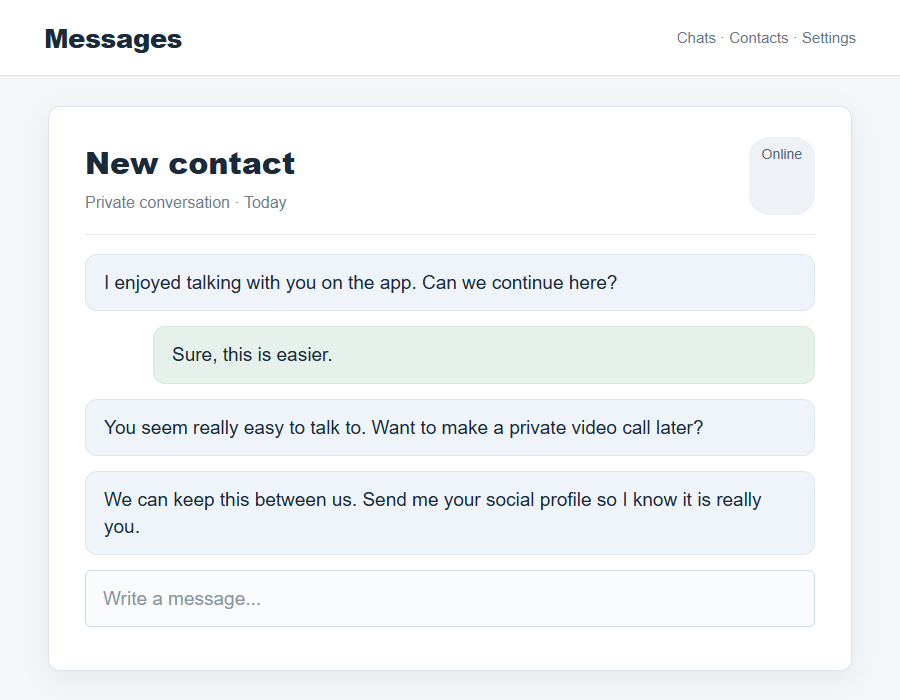
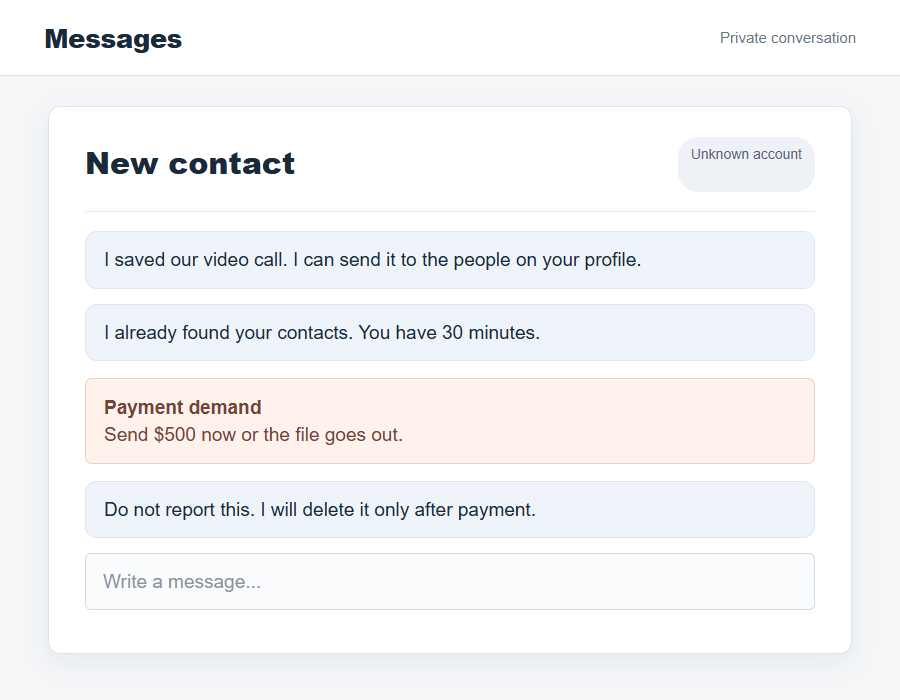
The message images illustrate the reported pattern. They are not copies of a particular victim’s private conversation.
Why the Conversation Can Feel So Convincing
The offender does not usually begin with a demand. A friendly exchange creates a sense of normality, and the move to another app can feel like a natural next step.
On a dating platform, moving to a message app may seem more convenient. In practice, that move can reduce the platform’s visibility into the conversation.
Someone may also share a flattering image or suggest a private call first. That apparent vulnerability can pressure the other person to reciprocate.
The scam depends on trust arriving before scrutiny. By the time the threat appears, the offender may know the victim’s name, employer, school, or public contacts.
None of this means the victim was careless. An ordinary conversation can become coercive when one person secretly records or misuses what was shared.
How the Intimate Image Extortion Scam Works
Step 1: A new account starts a warm conversation
The approach may come through a dating match, a social-media direct message, a comment, or an apparently accidental contact. The profile looks personable enough to invite a reply.
The stranger asks everyday questions and mirrors the victim’s interests. Fast replies and personal attention can make the connection feel unusually easy.
Some profiles are fabricated, but the mechanism does not require a sophisticated fake identity. A real-looking account can still be controlled by an extortionist.
Step 2: The conversation moves to a private channel
After some rapport, the person suggests switching to a messaging app or video service. They may say notifications work better there or the dating app is inconvenient.
The move matters because the offender can continue outside the original platform, even if the first profile is later reported or removed.
They may ask for a public social-media account too. That gives them a way to identify friends and make later threats sound specific.
Step 3: The offender obtains an image or recording
A private photograph may be shared voluntarily in a relationship that seemed genuine. A video call may be recorded without the other person’s knowledge.
Police reports describe both retained photographs and secretly recorded sexually explicit calls. They do not establish that every offender has a usable recording.
At this stage, the victim often believes the exchange remains private. The offender is preparing to convert that trust into leverage.
Step 4: The tone changes into a deadline and threat
The friendly contact suddenly claims they will publish the material or send it to family, friends, or colleagues. They may display names or profile pictures.
A short deadline makes it hard to think. The first amount may be framed as a quick way to make the problem disappear.
Threats may include a cropped image, a contact list, or a draft message. Treat them as evidence of coercion, not proof that payment will stop distribution.
Step 5: Payment becomes a moving target
The offender may demand a transfer, gift card, or cryptocurrency. Payment methods vary, but each aims to move value before the victim can verify the claims.
After a first payment, another reason can appear: a deletion charge, a second person involved, or a larger fee to keep the file private.
The Singapore Police Force explicitly warns that extortion often continues after victims pay. There is no safe price that guarantees deletion.
Step 6: The offender uses fear to block outside help
They may insist that contacting police or telling a friend will trigger immediate release. That instruction protects the offender’s control over the conversation.
Some threaten to message one contact as a demonstration. Others merely claim they already have. Verify independently when safe, without arguing with the extortionist.
The less isolated you are, the harder this pressure becomes to sustain. A trusted person can help preserve evidence and make calls while you recover.
What the Threat Proves, and What It Does Not
A real image in the chat proves the sender has at least that copy. It does not prove they can access every contact or erase copies after payment.
A screenshot of a social profile proves that profile is visible to them. Public followers and friends can be collected without hacking your account.
A message claiming your phone is compromised is still only a claim. If no suspicious download or credential disclosure occurred, do not assume a device infection.
Conversely, if you did install an app or enter a password on a link they supplied, treat that as a separate security incident. Change access from a trusted device.
Edited images can add confusion. Preserve the original messages and files rather than trying to judge authenticity from a blurry preview during a countdown.
Warning Signs Before the Demand
No single sign proves malicious intent. The combination of rapid intimacy, secrecy, and a move across platforms deserves a slower pace.
Some offenders also ask whether you live alone or who can see your messages. Those questions can be ordinary, but they become concerning beside repeated pressure for secrecy.
You can protect your privacy without treating every new contact as a criminal. Keep public profiles separate from intimate conversations until trust is earned over time.
If a person becomes angry when you decline a private call, take that response seriously. Respecting a boundary is a better sign than any flattering profile description.
- A new contact quickly asks to leave the dating or social platform.
- They request an intimate image or explicit call before you know them well.
- They ask for your main social profile or contact list early.
- They pressure you when you decline to share a photo or turn on video.
- The conversation becomes urgent or controlling once a file is shared.
It is reasonable to stop a conversation at any point. A genuine person may be disappointed, but they should not make privacy a condition of kindness.
What to Do if You Have Fallen Victim to This Scam
- Stop paying and end the negotiation.
Do not send a second payment to make the first one “work.” Additional money rarely reduces the offender’s leverage and may bring more demands.
If you feel physically unsafe or the threat involves a child, contact local emergency services or police promptly. You deserve practical help, not blame.
- Preserve evidence before blocking.
Capture the account name, profile URL, messages, threats, payment instructions, transaction IDs, and any visible contact lists. Keep original files when possible.
Record dates and platforms in a short timeline. You can block or report the account after collecting what investigators or platforms may need.
- Report the account and the threat.
Use the platform’s extortion or intimate-image abuse reporting path, then report the incident to local police. In Singapore, follow the Police Force’s reporting guidance.
State whether the content was actually shared or only threatened. Both matter, and you do not need to provide a perfect legal description.
- Secure your accounts.
Change passwords for any account the offender may know, enable multifactor authentication, review active sessions, and restrict public visibility of friends or followers.
If you shared a one-time code or clicked a login link, contact the platform’s official support. Do not use a link supplied by the extortionist.
- Contact payment providers immediately.
If you paid by bank transfer or card, ask the provider about recall, dispute, or fraud-report options. Give exact transaction information and explain the extortion.
For gift cards, keep the card and receipt and contact the issuer. For cryptocurrency, preserve wallet addresses and transaction hashes for police.
- Ask for support with the exposure risk.
A trusted friend can help you decide whether to warn a small circle not to open or forward messages. Avoid broadcasting the private material yourself.
Where available, use trusted intimate-image removal services and platform reporting tools. Eligibility can vary by age and whether the material has been shared.
- Reject recovery offers from strangers.
People promising to hack back, delete the file, or guarantee silence for a fee may be running a second scam. Do not give them access or payment.
Keep one record of any later contact and report new accounts. Repeated threats are a reason to update your police or platform report.
Practical Questions About Screenshots, Blocking, and Deletion
Blocking can stop direct messages, but it cannot retrieve a copy already made. Preserve the evidence first, then report and block through the platform.
When saving proof, include the full screen with timestamps where possible. A cropped threat can lose context that helps a platform connect several abusive accounts.
Keep evidence in a private folder rather than sending it around to prove your story. Anyone helping you can usually work from a written summary first.
Deleting your account may reduce contact visibility, yet it can also erase useful records. Export or capture relevant information before a permanent deletion.
If material is posted, record the exact page address before reporting it. Avoid repeatedly opening or sharing the post, which can spread it further.
Ask the platform to remove posted intimate material if it appears. Do not pay someone who claims they can remove every copy from the internet.
Different platforms have different removal forms. Use the help pages reached from the official app or website, not a removal link sent by the person threatening you.
If the offender names an employer or family member, consider a brief warning to that person. You do not owe them a detailed account of your private life.
A simple request not to open, save, or forward unexpected private content is enough. You can choose how much context to share with each person.
It can help to set a simple plan: one person for emotional support, one platform report, one police report, and one payment-provider call.
Frequently Asked Questions
Is this the same as a sextortion email claiming my webcam was hacked?
No. A mass email may bluff about a recording. This scam can involve a real chat, voluntarily shared photograph, or secretly recorded video call.
Will paying make the offender delete the image?
There is no reliable way to verify deletion. Police warn that demands often continue after payment, so do not treat payment as a safety plan.
What if the offender shows my friends’ names?
Public profile information can make a threat look credible without account access. Preserve the screenshot, restrict visibility, and report the threat.
Should I block them immediately?
First preserve the account and threat details you can safely capture. Then report and block the profile so the conversation does not continue.
Could a malware scan solve this problem?
Not if the image was shared or recorded during a call. Scan a device only if you opened suspicious files, installed software, or saw other compromise signs.
Can I still report it if I already paid?
Yes. Save the payment record and messages, contact the provider promptly, and report the extortion. Paying does not make you responsible for the crime.
The Bottom Line
An intimate image extortion scam turns a private exchange into pressure for money. The offender’s deadline is meant to keep you isolated and reacting.
Preserve proof, stop negotiating, secure your accounts, and seek help from the platform, payment provider, police, and someone you trust.








