

The listing looks ordinary, the registration check looks clean, and the seller has a plausible reason to move quickly. You are close to buying the car.
Yet one question remains harder than the online search suggests: does the vehicle in front of you truly belong to the identity in its paperwork?
Overview
A stolen vehicle can borrow a genuine identity
A cloned vehicle scam involves a stolen car or van given the registration and identifying details of another, legitimate vehicle. It is then offered to an unsuspecting buyer.
The copied identity can make a search return normal information. The record belongs to the genuine vehicle, not necessarily the one being sold.
Avon and Somerset Police warned in September 2026 that cloning can involve altered VINs, replacement labels, and reprogrammed electronic systems.
This is not simply a counterfeit license plate. A careful buyer can still be misled when the physical vehicle and digital record appear consistent.
Why the buyer can lose twice
The buyer may pay for a stolen vehicle and use it for months or years. If police identify it, the vehicle can be seized and returned to its lawful owner.
The buyer has spent money but has no legal ownership of the stolen vehicle. Recovery from a private seller may be difficult, especially if the seller disappears.
Police described a Bristol woman’s van that was seized after records showed other vehicles using the same identity. Examination found a stolen, extensively altered van.
The original owner can be harmed too. They may receive penalty notices or be linked to incidents involving the clone.
The safe buying question is broader than a search result
An online history check is useful, but it does not prove the seller owns the physical vehicle. It is one part of a wider verification process.
- Check the seller’s identity and whether their story fits the documents.
- Compare the VIN in several physical locations with the log book.
- Ask why the price is low and why the sale is urgent.
- Be wary of cash-only payment or a meeting away from the seller’s home.
- Walk away if reasonable ownership checks are refused.
Those checks reduce risk, not eliminate it. Sophisticated alterations may require professional examination to uncover.
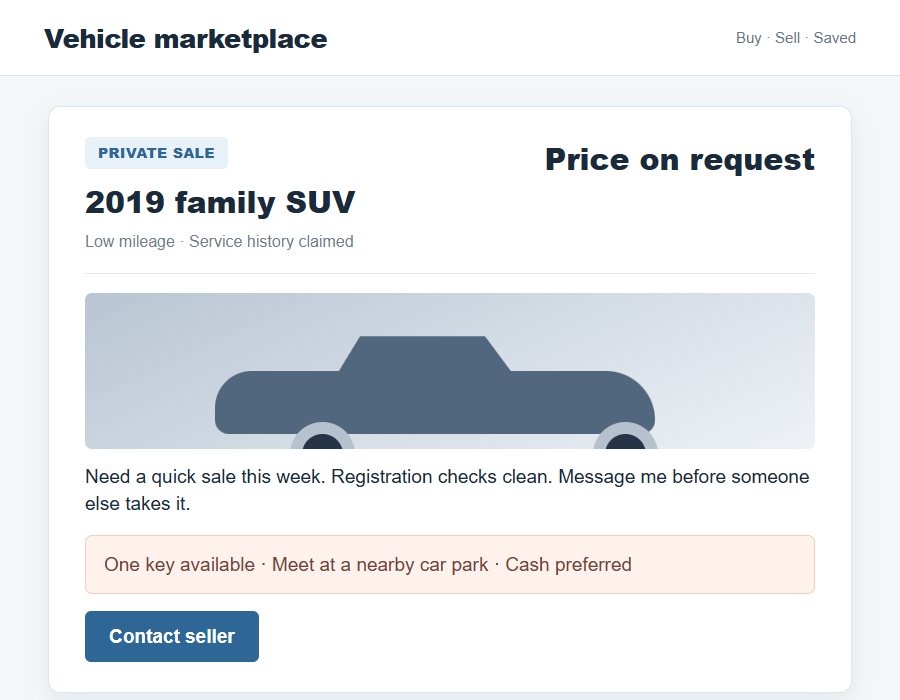
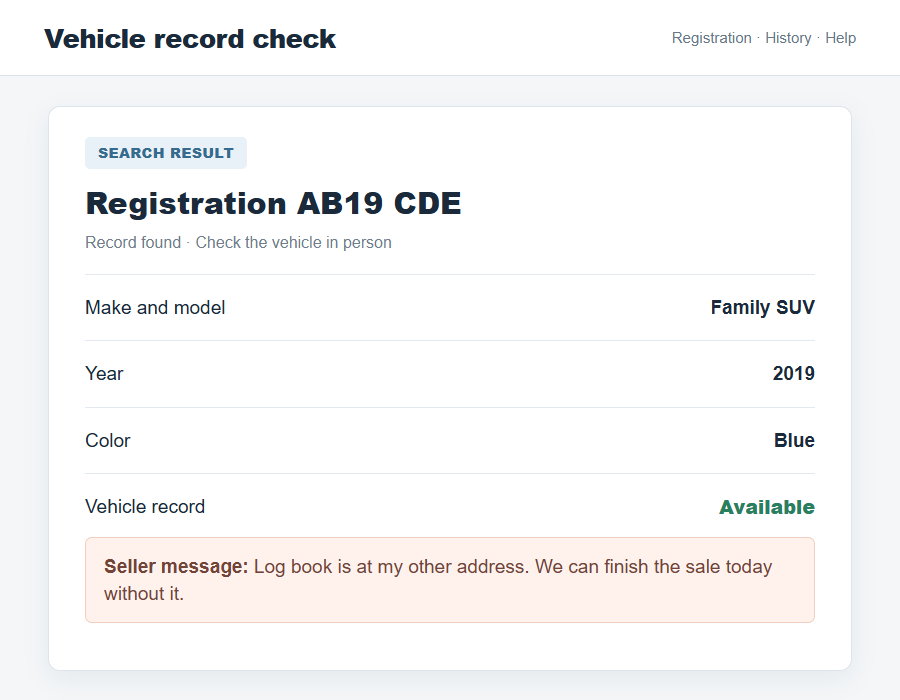
The listing and search panels shown here illustrate the problem. They do not identify a real seller or a specific cloned vehicle.
Why a Clean Registration Result Can Mislead
A cloned vehicle carries details copied from a legitimate one. A search may therefore retrieve the genuine car’s tax, inspection, and history information.
The digital record cannot inspect metal, labels, or hidden identifiers. It answers questions about a registration, not about the seller’s right to sell.
Police have found false VINs and replacement labels in some cases. The visible number may have been made to match a legitimate log book.
Some electronic systems can also be reprogrammed, according to the police warning. That raises the difficulty for buyers who rely on a quick dashboard check.
None of this makes official checks pointless. A mismatch can still reveal trouble, and an absent or inconsistent record is a reason to stop.
The problem is false reassurance. A clean check should invite the next question, not end the investigation.
How the Cloned Vehicle Scam Works
Step 1: A vehicle is stolen and assigned another identity
Criminals obtain a stolen vehicle and copy the identity of a genuine vehicle with similar characteristics. The exact methods vary between cases.
That identity can include registration plates, a VIN, labels, or electronic data. Police say some recent alterations go well beyond switching plates.
The real vehicle still exists elsewhere. Its records provide the cover the stolen vehicle needs during superficial checks.
Step 2: The seller creates a plausible private listing
The cloned car may appear on an online marketplace or social platform. A lower price and a quick-sale story attract buyers who want a good deal.
The listing itself may use real photographs of the offered vehicle. A clear photograph does not reveal whether its identity has been copied.
Police list an unusually low price as a warning sign, not proof. A seller’s explanation still needs independent support.
Step 3: Paperwork and checks appear to line up
A buyer searches the registration and finds a normal-looking record. The seller may show a log book and point to visible numbers on the vehicle.
In a sophisticated clone, those details can be engineered to agree. The buyer may feel reassured precisely because the check was performed.
Do not assume a printed document or online result independently verifies the seller. Both can reflect the copied identity.
Step 4: The sale is pushed toward a hard-to-reverse payment
Police warn about sellers who demand cash only or meet away from their home. Those choices can make later tracing and recovery more difficult.
A rushed buyer may accept one key, missing ownership papers, or vague answers because the apparent bargain might disappear.
Pause if the payment destination or person receiving money does not match the claimed owner. Ask questions before money leaves your control.
Step 5: The clone is discovered after the buyer takes possession
Another police force, the real owner, or a later examination may reveal multiple vehicles using the same identity. That can happen long after purchase.
The vehicle may be seized for examination. If confirmed stolen, the buyer cannot simply keep it because they purchased it in good faith.
The Bristol case shows how painful a delayed discovery can be. The buyer had built years of family memories with a van she did not know was stolen.
Seller Checks That Matter Before Payment
Ask to see the log book, known as the V5C in the United Kingdom, and the seller’s identification. The name and address should make sense together.
A missing V5C is a clear reason to pause. Police also advise not applying for a replacement log book on a seller’s behalf.
Meet at an address linked to the seller rather than a random parking area if it is safe to do so. The location should not be the only proof.
Ask how long they have owned the car and request supporting documents or dated photographs. A genuine owner should be able to explain the vehicle’s history.
Check how many keys are available. Police list a single key as a warning sign, although a one-key car is not automatically stolen.
Compare vehicle details physically and on paper. VIN plates, stamped numbers, model specifications, and service documents should not tell conflicting stories.
A knowledgeable mechanic or independent vehicle examiner can help, but professional checks are not a guarantee against every sophisticated clone.
Warning Signs During the Conversation
The seller’s behavior can be more revealing than the listing. A normal question should not make them evasive or hostile.
- The price sits far below comparable vehicles without a credible explanation.
- The seller refuses to show identity or proof of ownership.
- They insist on a public meeting place but will not explain their address.
- Only one key is available and the history is vague.
- The log book is missing, or you are asked to request a replacement.
- They demand cash and push you to finish immediately.
One clue may have an innocent explanation. Several clues together are a strong reason to stop, even if a registration check looks clear.
How to Weigh a Deal That Looks Almost Right
Imagine the registration matches, but the seller says the V5C is at another address. That mismatch deserves a pause, not a promise to collect papers later.
A seller might offer a discount to keep the transaction moving. A lower price does not repair missing ownership evidence.
If they say the car belonged to a relative, ask who is legally selling it and how that person can establish the right to do so.
Do not let a clean online check answer a different question. It can help establish recorded vehicle details, but it cannot vouch for the person taking your money.
Look closely at whether the model, color, year, and equipment agree with the paperwork. An inconsistency can be innocent, but it requires an explanation.
Inspect identifiers in daylight if possible. Avoid accepting a photograph of a VIN instead of looking at the number on the vehicle itself.
Be cautious if the seller refuses a reasonable inspection or insists you decide before another buyer arrives. Pressure is not evidence of demand.
A request for a deposit before you have seen the vehicle adds another risk. You could lose that money without ever learning whether the car existed.
Ask about the second key and service records. A long-term owner may be able to explain missing items, but unexplained gaps add weight to other concerns.
If the seller proposes a payment account in someone else’s name, ask why. Do not transfer funds merely because the listing and registration match.
Bring another person to view the vehicle. A second set of eyes can notice a rushed answer or a document discrepancy you missed.
Do not photograph or handle anyone’s identity document without consent. Record the verified name and transaction details in a lawful, respectful way.
When doubts remain, leave and research from home. A legitimate vehicle will not become safer because the seller promises a better price for immediate payment.
Used-car buying always involves judgment. These checks are designed to expose inconsistencies, not to accuse every private seller with missing paperwork of a crime.
If you later learn of a cloned vehicle in the area, do not identify a seller publicly based only on suspicion. Give the evidence to police.
What to Do if You Have Fallen Victim to This Scam
- Do not confront the seller yourself.
If you suspect the vehicle is stolen or cloned, contact police through a non-emergency route. Explain the evidence and follow their instructions about the vehicle.
Do not try to hide, sell, or alter the vehicle. That can complicate the investigation and put another buyer at risk.
- Preserve the sale record.
Save the listing, messages, seller profile, phone number, vehicle details, payment receipt, and all paperwork. Note the meeting place and people present.
Photograph the vehicle’s visible identifiers without disturbing anything. Police or an examiner may need to inspect the original condition.
- Contact your payment provider promptly.
If you paid by bank transfer or card, ask about available recall or dispute options. Explain that police suspect a fraudulent vehicle sale.
Cash is harder to recover, but still document when and where it changed hands. Your provider cannot promise a refund.
- Tell your insurer and finance company.
If the vehicle is insured or financed, report the concern and any police reference number. Ask what documentation they require.
Do not assume coverage or repayment rights. Those depend on your policy, agreement, and facts of the case.
- Respond to identity-related notices.
If you own the genuine vehicle and receive penalties you did not incur, report suspected cloning to police and the issuing authority.
Keep dated evidence of where your vehicle was. Do not ignore notices while the identity issue is being investigated.
- Watch for paid recovery promises.
Someone offering to “clear” a cloned VIN or guarantee the car’s return for a fee may create another problem. Work through police and legitimate advisers.
Use official vehicle and consumer guidance rather than a link sent by the seller or an unsolicited helper.
Before You Buy: A Slower Final Check
Run an official vehicle information check and compare it with the physical car. A matching result is useful, but do not confuse it with proof of ownership.
Read the V5C carefully. It records a registered keeper, which is not always the same thing as legal ownership.
Ask the seller to explain any gap in service history, ownership timeline, or payment details. Write down answers instead of relying on a hurried conversation.
Consider an independent inspection when the purchase is substantial. Tell the examiner if you are specifically concerned about cloning.
Keep payment traceable where possible. A seller insisting that only cash will do deserves a closer look, especially beside other warning signs.
The safest choice can be walking away. Losing a supposed bargain is easier than losing the purchase price and the vehicle.
Frequently Asked Questions
Can a cloned car pass an online history check?
Yes. Police say the copied identity can produce normal-looking records belonging to the genuine vehicle. A clean result does not prove this physical car is genuine.
Is a V5C log book proof the seller owns the vehicle?
No. It is an important document to inspect, but it does not by itself establish that the seller has legal title to the car.
What happens if police identify my purchase as stolen?
Police may seize it for examination. If confirmed stolen, a good-faith buyer generally cannot keep someone else’s vehicle, even after paying for it.
Does one key mean the car is definitely a clone?
No. Police list one key as a red flag to consider alongside price, documents, seller identity, payment method, and the rest of the history.
Should I pay a service that promises to correct the VIN?
No unsolicited service can make a stolen vehicle legally yours. Speak with police and use legitimate professional or legal advice for your situation.
What if my own car’s registration has been copied?
Report suspected cloning and contest any incorrect notices promptly. Keep evidence showing where your genuine vehicle was when the incident occurred.
The Bottom Line
A cloned vehicle scam exploits the gap between an official record and the car in front of you. Modern alterations can make that gap hard to see.
Check the seller, vehicle, documents, price, and payment route together. If the story stops making sense, leave the deal before money changes hands.

Join the discussion
0 commentsShare your experience or ask a question about this article.
Discussion
Start the conversation
Have a question or something useful to share? Add the first comment.