

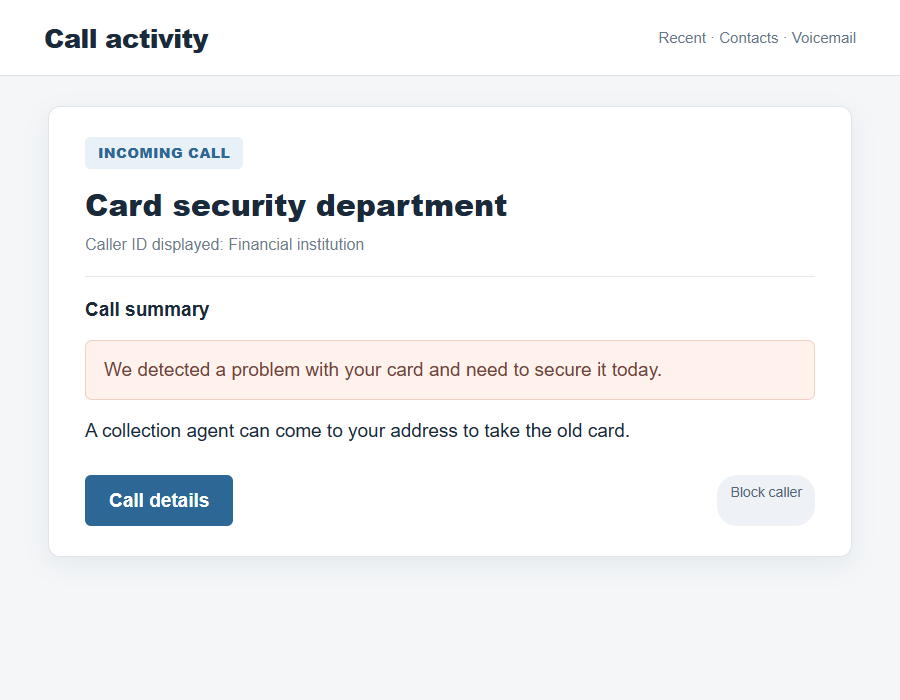
The caller sounds like a fraud specialist. They know something about your account and say your bank card is no longer safe to keep.
Then comes an unusual offer: someone can collect the card from your home. That small change in an ordinary fraud alert is the warning.
Overview
The call turns a security concern into a handover
In a bank card pickup scam, a fraudster poses as a bank or card-company representative. They claim an account compromise requires the physical card to be collected.
The goal is not to help replace a compromised card. It is to get the card, information, or both into the hands of people outside the bank.
Maple Ridge RCMP warned in September 2026 that local residents had reported multiple calls arranging pickup of bank or credit cards directly from homes.
Police described pressure, urgency, and callers who may already know some account details. A few residents may also have had genuine card issues when contacted.
That coincidence makes the story believable, but it is not proof the caller is legitimate. The proposed pickup is the point where verification must stop the handover.
What is known about the reported cases
The RCMP advisory confirms the impersonation and attempted home pickup. It does not publish a script, a total loss figure, or the identity of each caller.
Some variants of financial fraud ask for a PIN, one-time code, or online banking password. Do not assume those requests occurred in every Maple Ridge report.
What matters for a reader is the decision in front of them: an unsolicited caller wants a valuable payment card removed from their control.
- The caller may say your card or account is compromised.
- They may refer to partial account information to sound informed.
- They create urgency around a supposed collection or replacement.
- The person arriving at the home is not proof of bank authority.
The bank’s real route looks different
Maple Ridge RCMP states that financial institutions and card companies do not send someone to a customer’s home to pick up cards, cash, or information.
If you suspect a real compromise, end the incoming call. Contact your institution using the number printed on the card or reached through its official app.
Ask the bank to block or replace the card through its normal process. Do not let the original caller keep you on the line during verification.
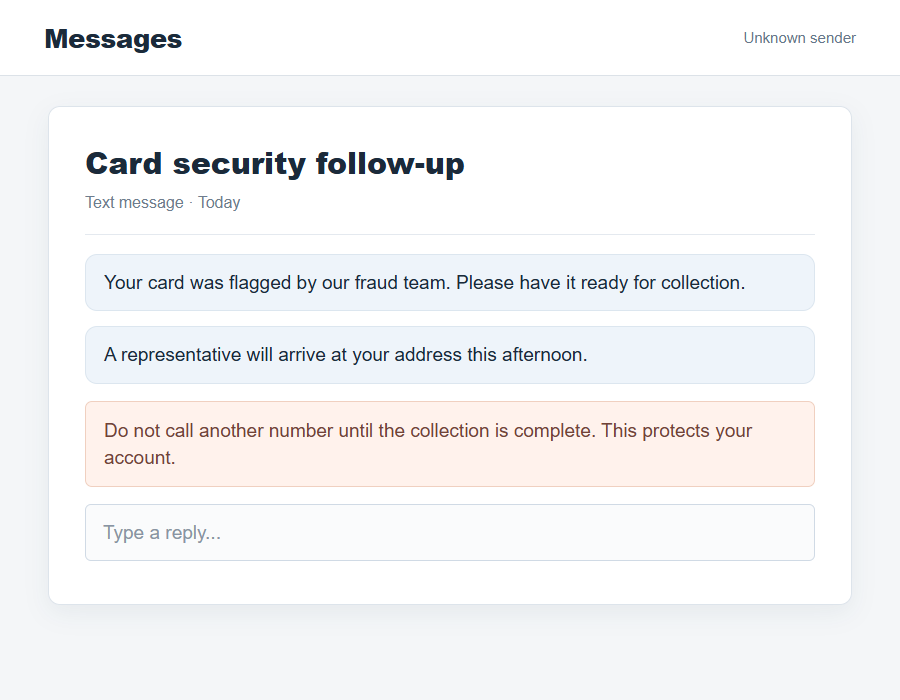
The pictured call and message are reconstructions of the warning pattern, not messages released by police from these cases.
Why Partial Account Details Are Not Proof
A caller who knows your name, address, or last card digits can sound convincing. Those details may come from prior transactions, data exposure, or social research.
Even information that is not public can be misused. The right question is whether you initiated contact through a trusted channel, not whether the stranger knows a fact.
Caller ID can be manipulated. A familiar institution name or local number on screen does not authenticate the person speaking.
A real card problem can also exist at the same time as a scam call. Resolve it directly with the bank instead of accepting the caller’s proposed process.
Be especially careful if the person says you must not call the bank yourself. A legitimate institution should welcome independent verification.
How the Bank Card Pickup Scam Works
Step 1: The caller impersonates a financial institution
The conversation begins as an apparent fraud alert from a bank or card company. The caller may describe suspicious activity or say a card has been compromised.
That is an effective opening because real banks do call about suspicious transactions. The scam borrows a familiar security routine.
It also places the recipient in a defensive mindset. The person wants to prevent loss, so the caller frames every next instruction as protection.
Step 2: Urgency crowds out an independent check
The caller may imply that waiting could allow more transactions. They may speak with confidence, refer to account details, or claim a replacement is already arranged.
Police say the pressure tactics are part of the pattern. The offender needs a decision before the cardholder hangs up and calls the real institution.
A genuine fraud problem rarely requires surrendering control to the person who first contacted you. You can pause and verify.
Step 3: Home pickup is presented as a bank service
Instead of asking the customer to destroy a disabled card or follow official replacement instructions, the caller says someone will collect it at home.
The proposed collection can feel more formal than mailing details to a stranger. That appearance is exactly what makes this variation dangerous.
Police specifically warn that banks and card companies do not use this home-pickup process. A visitor’s presence does not change that rule.
Step 4: The cardholder is pushed to hand over control
The caller may seek the physical card, cash, or information. In any variation, the customer loses the safe distance provided by an official bank channel.
Do not test the visitor by asking for a badge or reference number. Those can be displayed, invented, or misunderstood under pressure.
Keep the card inside and contact the bank directly. If a person is already at the door and you feel threatened, call local police.
Step 5: Fraud can follow the handover
A card in criminal hands can be used or paired with information obtained during the call. The exact outcome depends on what the offender captured.
That is why a prompt bank call matters even when you are unsure whether anything was taken. The institution can check activity and block the card.
Keep a record of the call and visit attempt. Details such as time, stated institution, callback number, and description of the approach may help investigators.
The Important Difference Between Replacing and Collecting a Card
Banks can freeze, cancel, and replace cards. That does not mean every instruction delivered by an incoming caller is part of a real replacement.
The safest route begins when you initiate contact. Use the card’s printed number, the bank’s established app, or a branch you know.
If the printed number is unavailable because you already surrendered the card, find the institution through a statement or its official website.
Ask whether there is a fraud alert, what transactions are pending, and what the bank wants you to do with the old card.
Do not use a callback number supplied during the suspicious call. That number may lead straight back to the same group.
Signals That the Caller Is Steering You
Urgency alone is not definitive. The requested action matters more. A caller who wants your card physically delivered to them is crossing a clear boundary.
- They insist a collector must visit today.
- They discourage you from calling the number on the card.
- They ask you to prepare cards, cash, or documents for handover.
- They use partial account details as their main proof of identity.
- They become impatient when you say you will visit a branch.
If the message contains one of these signs, end the conversation. You can still protect the account through the bank’s verified channel.
How to Verify an Alert Without Helping the Caller
First, separate the claim from the requested action. A compromised card may be real; the stranger’s collection plan can still be fraudulent.
Hang up fully. If you are using a landline, allow the connection to clear or place the verification call from another phone.
Open the banking app you normally use, not a link in a text. Look for transaction alerts and the secure message center.
If you call, read the number from a card or statement you already possess. A search result advertisement is not necessarily your bank’s real contact page.
Tell the bank you received an unsolicited collection request. Ask whether it originated any such call and whether there is a genuine fraud hold.
Give the bank the displayed caller ID and time, but do not expect those details to identify the offender. Spoofed numbers can point to innocent organizations.
Ask what to do with your current card. A real representative can explain a normal cancellation and replacement process without asking you to surrender it at home.
Check transactions yourself rather than repeating a payment description supplied by the stranger. The caller could have invented the supposedly suspicious charge.
If a transaction is real, tell the bank whether you recognize it. A genuine dispute can proceed separately from the attempted pickup scam.
Record the bank’s case number in your notes. It helps if you call again, but never treat a reference number as proof on an incoming call.
What a Home Visit Changes
A planned visit makes the fraud feel immediate. It also creates a moment when someone at home might hand over a card without hearing the original call.
Tell other household members not to give cards, cash, or documents to a visitor claiming to be from your financial institution.
If you have already provided an address, you do not need to confront the person. Stay inside and call the bank or police as appropriate.
Even a polite-looking collection agent cannot validate the first caller. The visible visitor may be only one participant in a larger fraud.
There is no benefit in arranging a meeting to gather evidence yourself. Preserve the messages and let the institution and police handle an attempted collection.
After the incident, consider asking your bank about alerts for card-not-present purchases and transfers. This creates an early warning if your details were exposed.
Keep an eye on statements for more than one day. Not every unauthorized charge appears instantly, and small test transactions can be easy to miss.
What to Do if You Have Fallen Victim to This Scam
- Call your bank immediately.
Tell the fraud team whether the card was collected, whether you shared a PIN or code, and when the interaction happened. Ask them to block the card.
Request a review of recent and pending transactions. Ask how to dispute unauthorized activity and what replacement arrangements are available.
- Secure online banking access.
If any login detail, one-time code, or password was shared, reset credentials through the official app or website. Review devices and active sessions.
Ask the bank whether additional account protections or a temporary transfer limit are appropriate. Do not follow password-reset links sent by the caller.
- Preserve the timeline.
Write down the caller’s words, displayed number, date, pickup arrangement, and any description of a visitor. Keep texts, voicemails, and transaction notices.
Do not delete a suspicious message just because you blocked the sender. Its details may help the bank or police connect the attempt.
- Report the incident to police.
If someone came to your home, tell local police promptly. The RCMP specifically asks victims to report the incident as well as contacting their institution.
In Canada, you can also report fraud to the Canadian Anti-Fraud Centre. Provide the case number to your bank if requested.
- Watch for follow-up contact.
The same group may call again pretending to be the bank, police, or a recovery team. Treat each incoming call as unverified.
Use a fresh official number and never hand over another card or send a “verification” payment to fix the first incident.
- Tell someone who can help.
If the call left you shaken, ask a trusted person to sit with you while you contact the bank. This can make the next steps easier.
Share the warning with people in your household, especially anyone who might answer the door while a collection attempt is expected.
If the Card Has Not Been Collected Yet
Keep it. You do not need to prove the scam to the caller, and you do not need to argue about their claimed authority.
End the call, then reach the bank through a trusted route. Ask whether the card is actually compromised and whether it should be frozen.
If a pickup was scheduled, do not open the door for the purported collector. Tell the bank and local police about the attempted visit.
A bank can handle replacement without a stranger receiving your payment card. Follow the institution’s verified instructions for cutting up or returning an old card.
Check your account for unfamiliar transactions even if you refused the handover. The caller may have had other information worth reporting.
Frequently Asked Questions
Will a bank ever send someone to my home for a compromised card?
Maple Ridge RCMP says financial institutions and card companies do not send home collectors for cards, cash, or information. Verify through your bank directly.
What if the caller knows the last digits of my account?
Partial details do not authenticate an incoming call. End it and use the number on your card or the bank’s official app.
Should I give the card to someone who shows identification?
No. A badge or document offered by a visitor cannot replace independent verification with your bank, and police have warned against the pickup itself.
What if I already gave away the card but not my PIN?
Call the bank immediately anyway. Explain exactly what was shared, request a block and replacement, and review recent and pending transactions.
Can I call the number that appeared on caller ID?
Do not rely on caller ID or a callback number supplied during the call. Use contact information you found independently.
Do I need a malware scan after a phone call?
Usually not if you only spoke by phone. A scan is relevant if you installed software, opened a suspicious attachment, or followed a malicious link.
The Bottom Line
The bank card pickup scam wraps a physical handover in the language of fraud prevention. The claimed urgency is designed to stop you checking with your bank.
Keep the card, end the call, and contact your institution yourself. If a handover happened, block the card and report the incident quickly.

Join the discussion
0 commentsShare your experience or ask a question about this article.
Discussion
Start the conversation
Have a question or something useful to share? Add the first comment.