

A caller says you have won a life-changing prize. The voice sounds certain, and a formal-looking letter soon appears to back up the story.
Before the supposed winnings arrive, there is one small obstacle: you must send money first. That is where this promise becomes dangerous.
Overview
The prize was invented, but the payment route was real
A Jamaican lottery scam tells people they have won a prize and must pay taxes, fees, or processing costs before collecting it.
In a U.S. federal case, callers in Jamaica directed victims to send money to Christopher Gibbon in the United States. He admitted receiving the payments.
The case illustrates how an international phone pitch can use a domestic payment receiver to make the demand seem safer.
No genuine prize was waiting at the end of that route. The payment request was the purpose of the call.
What the guilty plea established
The U.S. Department of Justice says Gibbon pleaded guilty to conspiracy to commit mail and wire fraud involving the lottery scheme.
He admitted receiving about $96,302 from eight victims between December 2016 and July 2018, then forwarding most of it to co-conspirators.
He kept 20% of the proceeds. The victims used cash, checks, money orders, and at least one wire transfer.
The government also says fake letters claiming U.S. official support were sent from within the United States to make the fraudulent lottery look legitimate.
This is a specific criminal case, not evidence that every suspicious prize call uses the same people, location, or payment method.
The red flags a recipient can spot
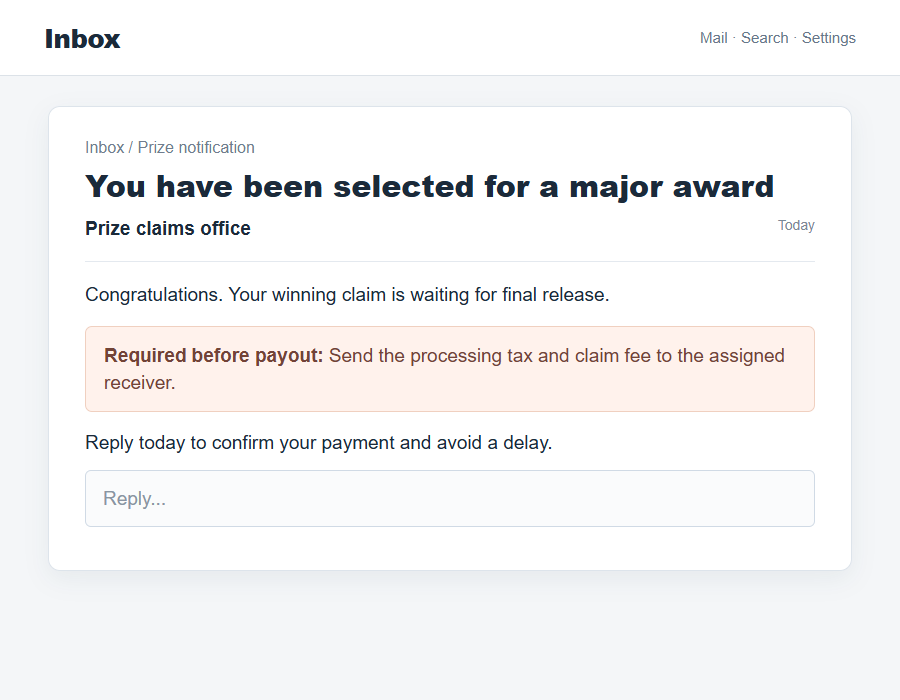
The strongest clue is the need to pay before receiving winnings. A prize that requires an advance tax or fee payment is not the gift it claims to be.
- You are told you won a lottery you do not remember entering.
- A caller demands money before releasing the award.
- The payment goes to a person rather than a verified prize administrator.
- A government-style letter is offered as reassurance.
- Further payments appear after the first fee is sent.
Do not let a mailed letter or U.S. address override those basic facts. Paper can be used to reinforce a false story.
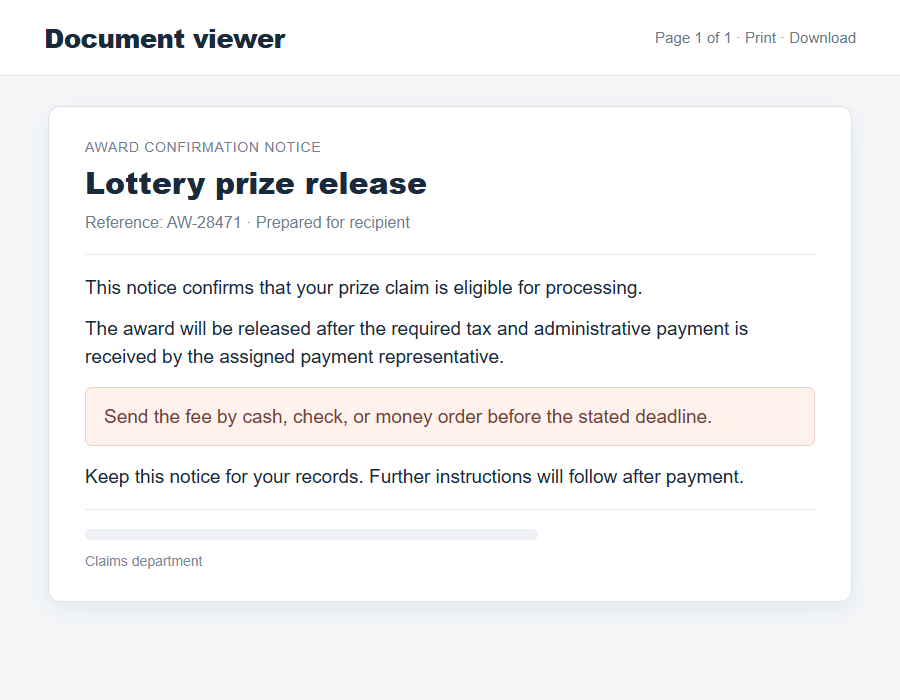
The on-screen message and letter are reconstructions of the reported tactic, not exhibits from Gibbon’s criminal case.
Why a U.S. Mailing Address Made the Pitch Stronger
International fraud can look suspicious when money is requested overseas. A domestic receiver changes the surface of the transaction without changing the deception.
Gibbon admitted collecting victim payments in the United States and forwarding most proceeds electronically to people involved in Jamaica.
He also received fake official letters through WhatsApp and mailed them domestically, according to the DOJ. The location of the postmark helped the fiction.
A U.S. stamp is not proof a letter came from the government. It shows only where someone placed it into the mail system.
Likewise, a recipient with a U.S. address can be part of a foreign-directed scheme. Verify the reason for payment, not just the destination country.
How the Jamaican Lottery Scam Works
Step 1: A caller announces an unexpected win
The scam begins with a claim that the person has won a large lottery or sweepstakes. The news is framed as exceptional but already confirmed.
Someone who did not enter may be told they were selected automatically. That explanation avoids the obvious question of how their name was chosen.
The caller wants the recipient imagining the prize before examining the rules. A large promised amount can make a smaller requested fee seem trivial.
Step 2: Taxes and fees become conditions
The caller says the award cannot be released until taxes, insurance, or processing charges are paid. The language sounds administrative rather than criminal.
In the case described by the DOJ, victims were told to send taxes and fees to Gibbon before collecting their supposed winnings.
A real prize does not require the winner to send advance money to an individual collector. The demand is the mechanism that takes cash.
Step 3: Official-looking material supplies false credibility
When someone hesitates, a letter or document may arrive claiming a government agency confirms the lottery. A formal heading can soften doubt.
Gibbon admitted mailing fake U.S. government letters that conspirators had supplied to him. The letters were not genuine government approval.
Do not call a telephone number printed on such a document to verify it. The same group can answer and repeat the story.
Step 4: Money is sent through ordinary channels
Victims in this case sent cash, checks, money orders, and a wire transfer. Those familiar methods can make the transaction feel routine.
One New Jersey victim mailed multiple packages after saying she was sending money to become a millionaire, according to court records cited by DOJ.
Each payment gives the group real value. The promised prize remains a story that cannot be independently verified.
Step 5: A domestic receiver passes funds onward
Gibbon kept 20% and sent the rest to co-conspirators electronically. His role was a bridge between victims and callers outside the country.
The person receiving the package may sound like an administrator or agent. That description does not make the transaction legitimate.
Follow the money rather than the title. If your payment is required before a surprise prize, stop regardless of the receiver’s address.
Step 6: The next request may follow the first
Advance-fee fraud commonly produces additional conditions once someone pays. In this case, the DOJ documents several packages from one victim within days.
Do not interpret a new fee as evidence that a prize is almost ready. The earlier payment can simply reveal that the caller found a responsive target.
Ending contact is safer than negotiating the amount. No realistic discount makes an invented prize real.
How to Verify a Prize Claim Safely
Ask yourself when and where you entered. A legitimate promotion should have rules, a sponsor, and a verifiable selection process.
Find the sponsor through its own official website or public contact information, not through a number provided by the caller.
If the letter claims government approval, verify with the agency using a known government address. Do not rely on the seal, signature, or postmark alone.
Do not send a copy of your identification or banking information to “claim” a surprise prize. That can add identity theft to the money loss.
Discuss the offer with someone who has no stake in the payment. Scam callers often want secrecy because an outside person can spot the contradiction.
Pause even if the caller knows your name and address. Those details do not prove an award exists.
Five Claims That Should Not Settle the Question
The caller may say your name was drawn from a national database. That does not explain a valid entry, published rules, or a real sponsor.
They may say the letter is confidential and must not be shown to anyone. Secrecy keeps an independent person from questioning the demand.
They may claim the fee is refundable after the prize clears. A promise to repay does not put money back in your account.
They may insist a government official confirmed the award. In the DOJ case, fake government-style letters were deliberately used to create that impression.
They may say the receiver is in the United States for your protection. The documented receiver kept a share and sent the rest onward.
Each claim is designed to make an advance payment feel reasonable. None replaces independent confirmation from a legitimate prize sponsor.
Different Payments Require Different First Calls
If you mailed cash, get the tracking number and ask the carrier whether delivery can be interrupted. Do not assume the package can be retrieved.
If you wrote a check, call the bank about a stop payment and account monitoring. Share the check number, amount, payee, and mailing date.
If you purchased a money order, contact the issuer with the receipt and serial number. Ask what investigation or cancellation process applies.
If you wired money, ask the sending institution for a recall immediately. Provide the receiver’s details and explain that the lottery claim was fraudulent.
For a card payment, ask the issuer about a dispute and card replacement if the number was exposed. Keep the merchant descriptor and authorization date.
Some scammers accept cryptocurrency or gift cards in other prize schemes. For crypto, preserve the wallet address and transaction hash; for gift cards, keep receipts.
Recovery options differ because a package, bank transfer, and redeemed code move through different systems. Speed matters, but no channel guarantees reversal.
When calling a provider, explain what happened plainly. You do not need to know whether the law calls it wire fraud, mail fraud, or another offense.
Ask for a case number and written confirmation of the next steps. That record can help if additional payments or identity misuse appear later.
If you paid from a joint account, tell the other account holder. They may notice new transactions or receive follow-up contact from the same fraud group.
Do not send another payment because someone claims it will trigger a refund. That request repeats the original advance-fee logic.
How to Help Someone Who Believes the Prize
Ask which company runs the lottery and where its official rules are published. Avoid opening by calling the person gullible or dishonest.
Offer to verify the sponsor together using a separately found website. If the caller objects to that check, note the objection without getting drawn into an argument.
Look at the amounts already sent, the payment receipts, and the latest deadline. A clear list can reveal how each new fee followed the last.
Suggest a pause on payments while the bank or postal service is contacted. The priority is preventing the next loss, even if the person remains hopeful.
Stay available after a report is filed. Shame can make victims hide later calls, and scammers may resume contact under a different name.
What to Do if You Have Fallen Victim to This Scam
- Stop sending money.
Do not pay a final tax, clearance, or release charge. A new requirement is not proof that earlier payments brought you closer to a prize.
End calls and save voicemails. You can report the contact without continuing the conversation.
- Contact the payment channel quickly.
For a wire, call the bank’s fraud department and request a recall. For a mailed check, ask whether a stop payment is still possible.
If a package is still in transit, contact the carrier or postal service promptly. Recovery depends on timing and is never guaranteed.
- Preserve every letter and receipt.
Keep envelopes, tracking numbers, money-order stubs, checks, bank records, texts, emails, and notes from calls.
The envelope and postmark may help investigators understand how the fake official document reached you.
- Report the fraud.
In the United States, report the matter to the FTC and to local law enforcement. Postal payments or mailed letters can also be reported to postal inspectors.
Provide the caller’s claims, payment destination, dates, and copies of the fake paperwork. An accurate timeline is more useful than a guess about identities.
- Protect your identity.
If you supplied a Social Security number, bank details, or identity documents, follow official identity-theft guidance and alert the relevant institutions.
Review accounts for unfamiliar activity. Change passwords if you created an account on a site connected to the supposed prize.
- Prepare for follow-up scams.
Someone may later claim to be a lawyer or recovery agent who can retrieve the prize or your fees for another payment.
Verify any case update through an official channel. Do not pay to be added to a victim list or to unlock restitution.
Why a Victim Might Keep Paying
Once money has been sent, it is natural to want the promised prize to be real. The caller can exploit that hope with a new explanation.
A fake official letter can make an additional fee seem like routine paperwork rather than another loss. The document is part of the persuasion.
Multiple small payments can feel easier than confronting the first payment. That does not make the person foolish; it shows how the trap is designed.
Stopping now is worthwhile even if you already sent several packages. Past money does not obligate you to risk more.
If a relative is involved, approach them calmly. Ask to see the letters and payment records without arguing about whether they should have believed the call.
Help them contact the bank and reporting agencies. Practical support often works better than criticism when someone is embarrassed.
Frequently Asked Questions
Can I win a Jamaican lottery I never entered?
An unexpected win with an advance payment demand is a hallmark of prize fraud. Verify any claimed promotion through the real sponsor independently.
Does a U.S. mailing address make the claim legitimate?
No. The DOJ case shows a domestic receiver collected victim payments and forwarded most proceeds to co-conspirators abroad.
What if the letter looks like it came from the government?
Do not rely on a seal or postmark. This scheme used fabricated U.S. government-style letters to make the false lottery seem credible.
Are taxes ever collected before a prize is delivered?
Do not send advance “taxes” to a caller or private receiver to release a surprise prize. Confirm any real tax obligation independently.
Can a mailed payment be recovered?
Possibly, if action is fast enough. Contact the carrier, postal service, bank, or money-order issuer immediately, and keep the tracking information.
Was Christopher Gibbon sentenced in this case?
The September 2026 DOJ release says he pleaded guilty and was scheduled for sentencing later. It does not report a completed sentence.
The Bottom Line
The Jamaican lottery scam used a false prize, advance fees, a U.S. payment receiver, and fake official letters to turn hope into repeated payments.
If a caller says you must pay to collect an unexpected award, stop. Verify outside the caller’s channels and report any money already sent.








