

An immigration question can make a quick message from a legal assistant feel like good timing. The account has a lawyer’s name and an office address you can find online.
Those details may be real. The person behind the chat is a different question, and it is the one to answer before paying.
Overview
The WhatsApp approach
A WhatsApp profile has been using the name of solicitor Manuel Padilla Behar and details associated with Cross Border Legal Limited Solicitors.
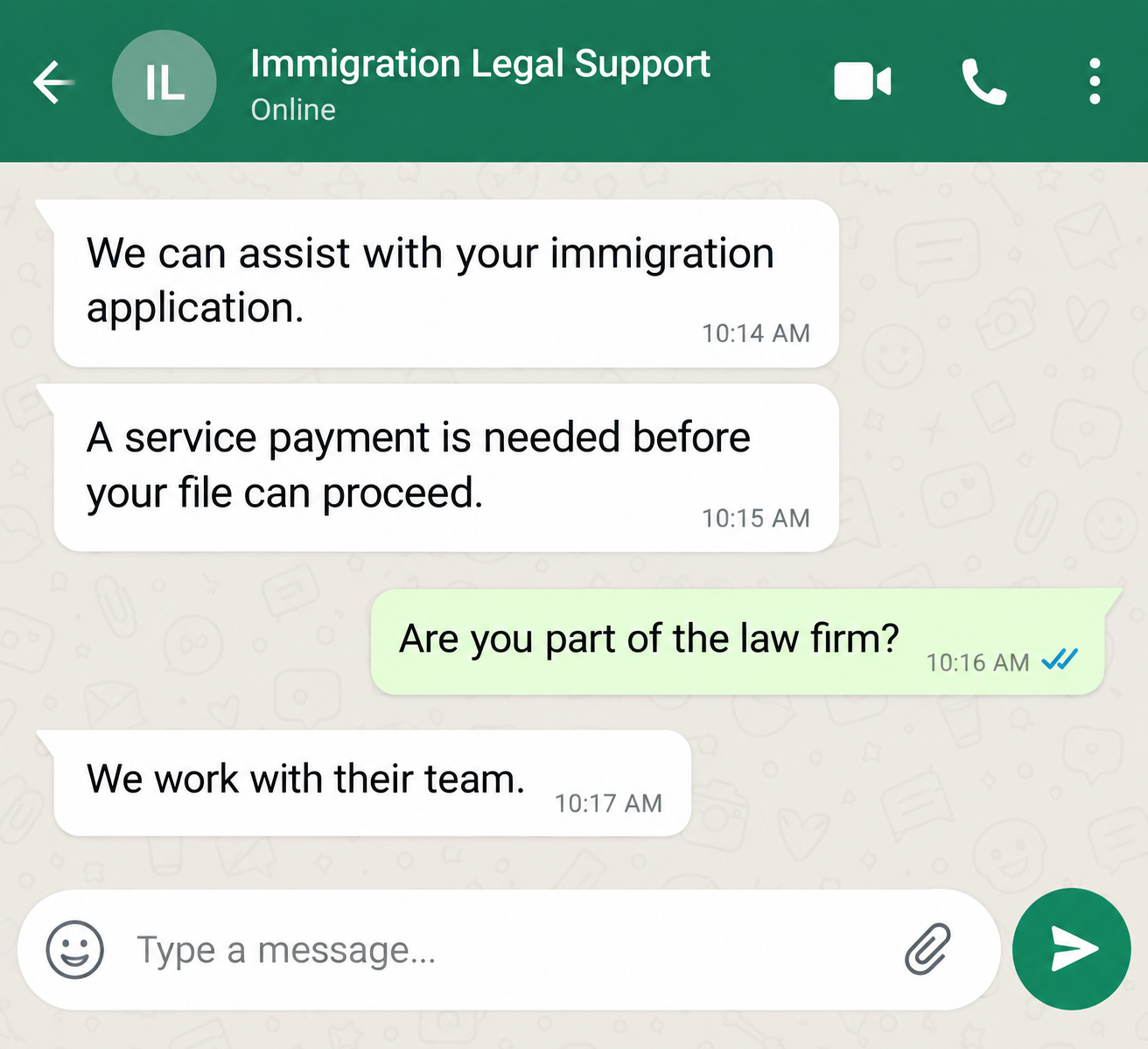
The account offers immigration-related assistance and asks members of the public for payment. The sender may describe itself as an assistant or referral partner.
Because immigration matters can be urgent and personal, a helpful-sounding private message may arrive when a recipient is eager for reliable advice.
What the regulator verified
The UK’s Solicitors Regulation Authority issued an alert on September 25, 2026 about the profile and its payment solicitation.
Cross Border Legal Limited Solicitors is a real regulated firm. Manuel Padilla Behar is also a real regulated solicitor, according to the SRA.
Both confirmed they had no connection to the WhatsApp messages. The firm says it does not work through agents or referral partners offering immigration services on its behalf.
The important distinction
This is a scam that abuses a legitimate legal identity. It is not evidence that the real firm or solicitor is running a scam.
The profile’s displayed name and address can be copied. Verification must happen outside the conversation, using a number found through the SRA register.
- The suspicious messages came through a WhatsApp profile, not a verified firm channel.
- The sender offered immigration help and solicited payment.
- The real firm denies using agents or referral partners for this service.
- No payment amount or successful immigration outcome is established by the alert.
The documented contact number may change. The behavior, especially a payment request from an unverified “partner,” is the more durable warning sign.
Why an Address and Lawyer’s Name Are Not Enough
The SRA alert identifies a Leicester office address used in the messages. It closely matches the genuine firm’s location, which could reassure a reader.
That is the point of identity cloning. A scammer may borrow real details precisely because an online search confirms they exist.
Imagine receiving a chat that cites a real hospital address. The hospital’s existence would not prove the sender works there.
The same rule applies here. A real firm’s website, registered address, and SRA number confirm the firm, not the ownership of a separate WhatsApp account.
The sender may also claim to be an assistant, consultant, or referral partner. That story avoids having to impersonate the solicitor’s voice directly.
But the firm told the regulator it has no such agents or third parties offering immigration services for it. That contradiction is decisive.
Immigration cases often involve identity documents, family details, deadlines, and legal status. A scammer does not need a large first payment to cause harm.
Copies of passports, residence documents, or bank statements can support further impersonation. The SRA alert does not say which files were requested in every chat.
That uncertainty is why a recipient should not fill gaps with guesses. Preserve the exact message received and compare its claims with the real firm.
One more detail matters: a WhatsApp “Business account” label does not mean a law firm verified the sender. It is not a professional license.
Nor is a profile photograph evidence that the depicted person controls the account. Images can be copied from public pages without permission.
A safe decision depends on independent contact, not on how many accurate details the sender has assembled in one chat.
How the Cross Border Legal WhatsApp Scam Works
Step 1: The profile reaches someone seeking immigration help
The documented route is WhatsApp. A profile presents itself as connected to legal professionals who can assist with immigration matters.
The SRA has not identified a single source for all targets. Some may be approached unexpectedly; others may encounter the profile while searching for assistance.
Either way, the account’s identity needs checking before a case history is shared. A message alone is not an introduction from the real firm.
Step 2: Real legal details create confidence
The account misuses the genuine solicitor’s name and the firm’s details. It also gives a Leicester address resembling the real office.
A recipient might search the name, see a real regulated professional, and assume the chat is authentic. That conclusion skips a vital step.
The missing step is verifying the phone number or account directly with the firm. Public facts can be copied; account control cannot be inferred from them.
Step 3: The sender claims an assistant or partner role
The SRA says the messages represented the sender as an assistant, referral partner, or otherwise acting on the firm’s behalf.
This can explain away a mismatch between the chat number and the firm’s official contact details. The recipient is told the intermediary handles first contact.
The real firm says it does not use agents, referral partners, or third parties to offer its immigration services. That answer removes the claimed bridge.
Step 4: The conversation turns to payment
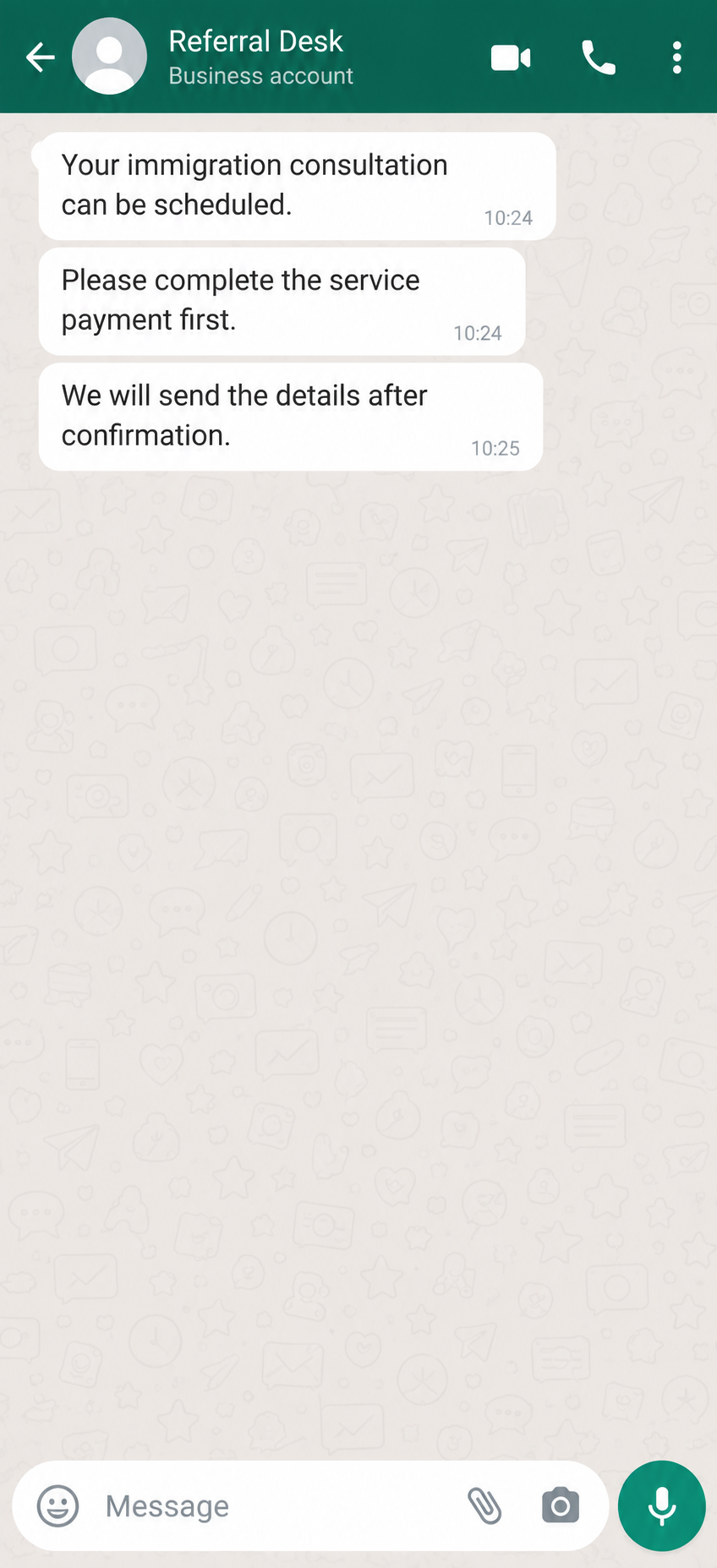
The purpose of the WhatsApp approach was to solicit money, according to the regulator. The warning does not publish a universal fee.
Do not assume a small charge is safe. An initial payment can establish trust and expose bank details before any genuine legal work is confirmed.
Ask for an engagement letter from the regulated firm through its official channel. Do not accept a PDF sent by the same unverified account as independent proof.
Step 5: The real firm can be checked separately
The simplest interruption is to stop replying and contact Cross Border Legal Limited Solicitors using details obtained from the SRA register.
Ask whether the specific WhatsApp account, claimed assistant, and payment request belong to them. The firm’s published response to this alert is already no.
If the profile changes its name or number, the verification method remains useful. The real firm, not the chat sender, should confirm any instruction.
The Real Firm Versus the Impersonating Profile
The SRA regulates the genuine firm under ID 628303. It also lists Manuel Padilla Behar as a regulated solicitor under ID 433252.
These are useful identifiers when checking legal services. They should be retrieved from the regulator’s own site rather than copied from a message.
The genuine firm has an office at West Walk House on Princess Road East in Leicester. The suspicious profile mentioned that address in abbreviated form.
The closeness of the address is not a defense for the sender. It shows how little effort it takes to make an account look familiar.
The SRA alert says the messages came from a number ending 5915. The genuine firm’s listed contact is a separate office line.
Numbers can be changed or spoofed. Use them as evidence about this alert, not as the only test for future attempts.
The solicitor told the SRA they are not connected to the profile. The firm separately denied the messages and the claimed referral arrangement.
That is stronger than a vague denial of responsibility. It addresses the exact mechanism the sender uses to explain why it is messaging people.
A genuine legal client relationship should have a named regulated professional, clear scope of work, verified contact route, and written fee terms.
None of those safeguards is created by a borrowed profile image or a plausible street address. The recipient must confirm them with the firm itself.
What to Check Before Sharing an Immigration File
Begin with the SRA register. Search the exact firm and solicitor, then use the contact details listed there to ask about the proposed service.
Do not click through a link supplied by the WhatsApp profile to reach that register. Open the regulator independently.
Ask who will provide the advice, whether that person is regulated, and how the firm receives instructions. A genuine receptionist should not resist those questions.
Confirm how payment is made. A bank account or card link sent through a third-party chat is not the same as an invoice from the verified firm.
Request a written explanation of fees and services before paying. Immigration help may be valuable, but it should not depend on a hurried transfer.
Keep passport scans and application numbers out of the chat until verification is complete. Once sent, those documents cannot be recalled.
Be especially careful if the sender promises a guaranteed visa or a special route around normal processing. The alert does not report those claims here.
They are examples of additional claims that would warrant separate checks. Do not attribute them to this profile without seeing them in your own messages.
Look for the firm’s own appointment confirmation from its verified address. Even then, call back through an independently obtained number if payment details changed.
Fraud often survives because each individual detail seems plausible. Verification works by connecting the details to the institution that should control them.
When an Immigration Deadline Makes You Feel Rushed
A visa or residence deadline can make even a cautious person feel that there is no time to verify a new contact.
That pressure should change the order of your actions, not remove the checks. Call the genuine firm first, before sending a payment.
If you have a real deadline, tell the verified office exactly when it falls. Ask whether anyone there can review the matter in time.
Do not let the WhatsApp sender be your only source of deadline information. Check the official notice from the immigration authority or your existing adviser.
A scammer can invent a short window to force a transfer. A real deadline will usually be documented in a notice you can inspect independently.
If the firm cannot help, you can seek another regulated professional. That is safer than relying on an unverified partner who borrowed the firm’s name.
Ask whether the quoted fee covers consultation, document preparation, representation, or government charges. The answer should be clear before any payment.
Keep government fees separate from professional fees. A person promising to “handle everything” should still explain which organization receives each payment.
If the WhatsApp profile claims its payment account belongs to the firm, ask the firm’s verified office to confirm the exact beneficiary in writing.
Do not be embarrassed to double-check. Lawyers routinely handle confidential and high-stakes information; identity verification is a reasonable first step.
You can also ask a trusted friend to compare the chat number with the SRA alert. A second reader may notice the mismatch more easily.
If you have already shared a passport image, do not keep sending more documents to “complete” an uncertain file. Verify who holds the first copy.
Record any official reference number connected to your immigration case, but do not post it publicly while seeking help online.
The goal is not to delay a real application. It is to prevent an impostor from using your urgency to gain payment and personal records.
What to Do if You Have Fallen Victim to This Scam
- Stop paying the WhatsApp contact. Preserve the full conversation, profile page, payment request, receipts, and any files you sent.
- Contact your bank or card issuer quickly. Explain that the payment was solicited by a profile impersonating a regulated firm and ask about recovery options.
- Inform the genuine firm. Use the SRA-listed contact route so its staff can confirm the impersonation and advise whether your details were misused.
- Protect immigration and identity documents. Record exactly what the account received and ask relevant authorities about monitoring or replacement where appropriate.
- Report the profile. Submit the chat to WhatsApp, the SRA, and local police or fraud reporting services.
- Reject follow-up payment demands. A message saying another fee will rescue the first transfer is not independent proof of a genuine case.
If you only exchanged messages, this alert does not establish a malware infection. Prioritize payment recovery and document protection over a routine device scan.
If you downloaded software or opened a suspicious attachment during the contact, scan with Malwarebytes and review any new app permissions.
Frequently Asked Questions
Is Cross Border Legal Limited Solicitors a fake firm?
No. The SRA says it is a genuine regulated firm. The scam is a separate WhatsApp profile misusing its identity.
Is Manuel Padilla Behar involved in the messages?
The solicitor told the SRA they have no connection to the profile described in the alert.
Can the office address prove the chat is authentic?
No. The profile used an address resembling the real firm’s location. Public addresses can be copied into messages by anyone.
Does the firm use immigration referral partners?
The firm told the SRA it does not work through agents, referral partners, or third parties offering its immigration services.
What if I already paid the account?
Contact the payment provider promptly, preserve the chat, notify the genuine firm through verified details, and report the impersonation.
Can I still seek legitimate immigration advice?
Yes. Find a regulated professional independently, verify them through the SRA, and discuss fees through the firm’s confirmed contact channel.
The Bottom Line
A real law firm and real solicitor are being used as cover for an unrelated WhatsApp payment request. The genuine parties have denied any connection.
Do not judge a chat by the accuracy of its borrowed details. Verify the account with the firm through a number you found independently before sharing money or documents.








