

A caller says they represent Vehicle Service Group and needs to discuss your vehicle. The number looks familiar enough to make hanging up feel awkward.
That hesitation is exactly why this warning matters. Before you answer a question or follow an instruction, there is one important distinction to make.
Overview
The real company has warned about impersonators
Vehicle Service Group’s June 2026 notice says unauthorized callers are falsely claiming to represent the company.
Some use 800-640-5438 as a callback number. Others may spoof a company number or employee name, making an unexpected call appear more credible.
VSG says it did not authorize these callers and has no affiliation with them. The company also says it does not make telemarketing calls to individual consumers.
That is the central fact. The scam is the impersonation, not Vehicle Service Group or the legitimate equipment businesses it operates.
What the warning does and does not establish
VSG warns that it will not ask for sensitive information, passwords, or payment through an unsolicited call. Recipients should not provide those details.
The company has not published a complete recording of every fraudulent call, a list of every spoofed number, or a confirmed total loss figure.
Its warning also does not prove that every vehicle-warranty letter or robocall uses VSG’s identity. Similar-sounding names can refer to different senders.
Do not use one warning to label an unrelated company or service contract fraudulent. Identify the exact caller and verify any claim independently.
- An unsolicited caller claiming to represent VSG is inconsistent with the company’s stated practice.
- A displayed phone number is not proof that VSG placed the call.
- Do not share account credentials, personal details, or payment information during the call.
- Use a verified VSG channel if you need to report or check the contact.
The safest response is a separate conversation
End the incoming call. If you have a genuine reason to contact VSG, find its official website yourself and use the contact details published there.
VSG’s notice gives 1-812-273-1622 and info@vsgdover.com for reporting and verification. These are different from an instruction delivered by the suspicious caller.
If the caller claims your vehicle warranty is ending, check your purchase documents or contact the manufacturer or dealership through a number you already trust.
You do not have to settle a supposed account issue while an unknown person is waiting on the line. An authentic issue will survive a careful callback.
Why the Vehicle Service Group Name Is Convincing
Vehicle Service Group is a real company in the automotive service-equipment industry. Its official company history describes equipment brands and professional automotive markets.
That background is very different from a stranger calling individual vehicle owners with an urgent sales pitch. A familiar industry name can still be borrowed.
Someone receiving the call may hear “vehicle service” and assume it relates to their car, warranty, or recent repair. That association does not authenticate the caller.
The similarity between VSG and vague labels such as “vehicle service department” can also blur the issue. The exact name and reason for contact matter.
For a driver, the question is not whether the words sound automotive. It is whether the claimed organization actually initiated this specific communication.
VSG answered that question for unsolicited consumer telemarketing: it says it does not do it. A caller presenting it as routine company outreach conflicts with the notice.
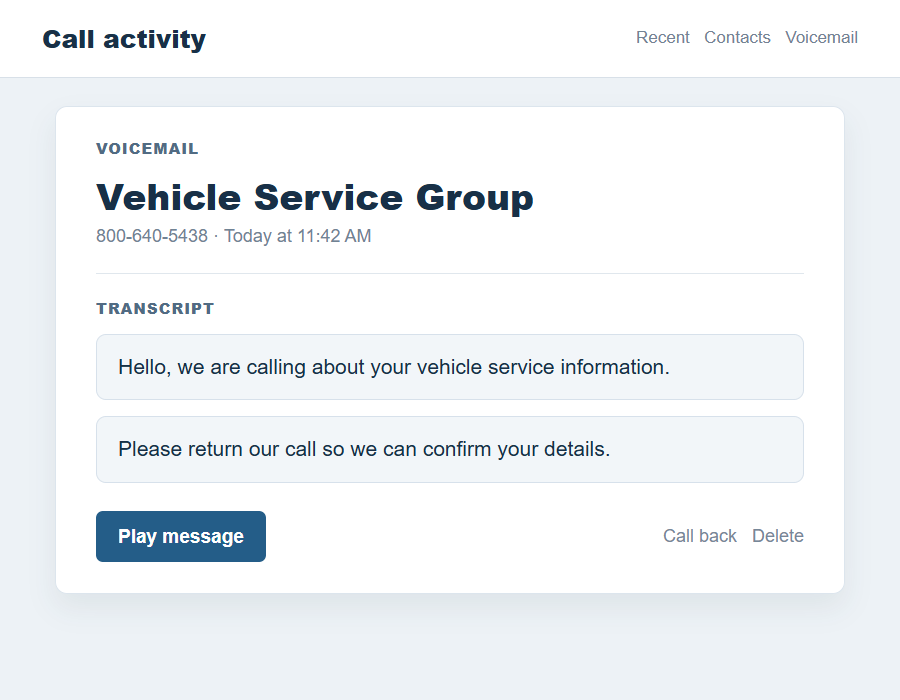
The illustration above is a non-functional reconstruction of the reported call pattern. VSG has not published that precise screen or a transcript of that conversation.
How the Vehicle Service Group Scam Calls Work
Step 1: An unexpected call borrows a legitimate name
The approach begins with a phone call to an individual consumer. The caller claims a connection to Vehicle Service Group or a related brand.
Because VSG is a real automotive company, the name can sound plausible even if the recipient has never purchased anything from it.
That is a form of authority borrowing. The person on the line hopes the name will do the work that real verification would otherwise require.
VSG has confirmed the impersonation. It has not said exactly how every number was obtained or which consumers were chosen.
A call landing on a number registered with the National Do Not Call Registry is not proof that the registry leaked anything. VSG merely notes those consumers were contacted too.
Step 2: Caller ID or a callback number supplies false reassurance
VSG says the impostors have used 800-640-5438 as a callback number. In some instances, they may also spoof a company number or employee name.
Spoofing changes what the recipient sees on the caller-ID display. It does not give the caller authority to act for the organization shown.
A scammer can also recite a genuine number. Knowing that number is easy; proving control of the real company’s systems is something else entirely.
The safest test is not to call the number offered during the conversation. End the call and reach the company through a channel you locate independently.
If you look up a number online, check that it belongs to the official company website. Search ads and directory listings can be misleading.
Step 3: The conversation moves toward a decision
The unauthorized caller needs more than attention. They want the recipient to keep talking and accept an instruction before independent verification occurs.
VSG’s notice specifically warns against giving sensitive personal information, passwords, or payment through an unsolicited call. It does not publish a universal script.
One version may focus on personal data. Another might try to collect a payment. The exact request is less important than the false identity behind it.
Be cautious if a caller asks for a card number, account login, one-time code, vehicle details, or a payment method while claiming to represent VSG.
Even seemingly ordinary details can help a stranger sound more informed on a later call. You are allowed to decline questions and verify first.
Step 4: The impostor may use urgency to keep you engaged
Scam calls often turn a routine question into something that supposedly cannot wait. A caller may imply you will lose a benefit by hanging up.
VSG has not confirmed that every impersonator used an expiration warning or a specific warranty pitch. Treat those as possible variations, not established case details.
The pressure itself is useful evidence. A legitimate company should not prevent you from ending a call and contacting it through published channels.
If the caller says a supervisor must approve your refusal or that you cannot call back, you have an additional reason to stop.
Do not argue about whether the number is real. The number displayed and the person speaking can be separated by caller-ID manipulation.
Step 5: The real harm depends on what you provide
If you hang up without sharing anything, this may remain only a nuisance call. Save the time and displayed number if you want to report it.
If you gave a card number, the risk is unauthorized charges. If you shared a password or code, the risk moves to account access.
If you sent money, the available recovery path depends on the payment method. Contact the card issuer, bank, or payment provider quickly.
There is no evidence that every recipient of these calls suffered the same outcome. Respond according to what actually happened in your conversation.
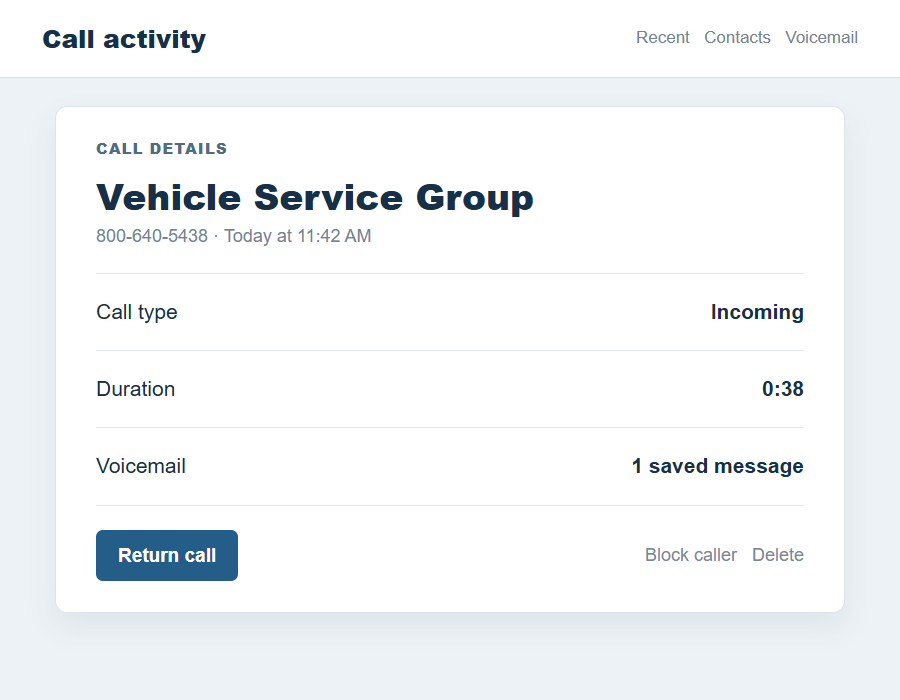
The pictured call-details screen is also a non-functional reconstruction, not a record released by VSG or attributed to a particular victim.
How to Check a Vehicle-Related Call Without Trusting the Caller
A familiar number in the caller-ID field feels reassuring. It should be treated as a clue to investigate, not a stamp of approval.
First, ask yourself whether you expected Vehicle Service Group to contact you. A consumer telemarketing call would contradict the company’s published notice.
Second, listen for the claimed purpose. A broad warning about your “vehicle file” is not the same as a documented issue with a real purchase.
Third, avoid confirming details that the caller supplies. Saying “yes, that is my address” or correcting a VIN gives the caller more usable information.
Fourth, separate the organizations. Your automaker, dealer, repair shop, insurer, and VSG are not interchangeable just because all work around vehicles.
Fifth, use paperwork already in your possession if the issue concerns a warranty. Your original warranty booklet and purchase agreement identify the proper provider.
Finally, allow the real organization to explain the issue from a fresh start. Do not lead it with every claim the stranger made.
If the official representative cannot find the alleged matter, that is strong reason not to resume contact with the original caller.
You can also report the suspicious call to VSG using the contact information in its warning. That helps the company investigate impersonation patterns.
Do Not Confuse This Warning With Every Vehicle Warranty Offer
Vehicle service contracts exist, and some are sold by real businesses. Their existence does not make a caller using VSG’s name legitimate.
Likewise, a poor or expensive contract is a different question from impersonating a company. Keep the two judgments separate.
The FTC’s robocall examples include auto-warranty pitches. That broader pattern is useful context but does not identify every VSG impostor.
Do not assume VSG sent a letter merely because the sender uses phrases like “vehicle services.” Compare the exact legal name, return address, and contact route.
If a physical notice arrives, keep the envelope. A postmark and printed company details may help you understand who actually sent it.
A legitimate offer should allow you to read the full contract, exclusions, cancellation terms, and seller identity without a live caller pressuring you.
Before buying any optional coverage, compare it with your existing factory warranty and ask your dealer or insurer what is already included.
Those buying checks are general consumer precautions. VSG’s June warning is narrower: unauthorized telemarketers are using its identity.
What to Do if You Have Fallen Victim to This Scam
- End the contact and write down what happened. Record the time, caller-ID number, callback number, claimed employee name, and any instructions you received. Save voicemails or messages. Do not call the number again to demand an explanation. A short record will help the real company, your bank, or investigators understand your exposure.
- Contact the real organization independently. If the caller claimed to represent VSG, use the contact route in VSG’s official notice. Ask whether anyone there initiated the call. If the story concerned your vehicle warranty, separately contact your manufacturer or dealer using documents you already have. These checks should be two separate calls.
- Protect any payment account you disclosed. Tell your bank or card issuer that an impostor may have your payment information. Ask about blocking the card, monitoring transactions, and disputing unauthorized charges. If you sent a bank transfer, ask immediately whether it can be recalled. Speed matters, but recovery is not guaranteed.
- Change exposed passwords and secure related accounts. If you shared a password, change it through the official website or app. Change reused passwords elsewhere too. Enable multifactor authentication where available. If you disclosed a one-time code, tell the affected service because a password change alone may not end an active session.
- Respond to identity-data exposure proportionately. An address alone does not require the same response as a Social Security number or bank login. If you gave sensitive identity information, follow the personalized steps at IdentityTheft.gov. Watch for follow-up calls that reuse the details you disclosed.
- Check the device only if the call led to a link or download. The VSG notice does not say malware was part of every call. If you installed software or opened a suspicious link, disconnect any remote-access session, review installed apps, and run a trusted Malwarebytes scan. Browser protection such as AdGuard can reduce exposure to malicious follow-up pages, but neither tool replaces account recovery.
- Report the impersonation. Notify VSG through the official contact details in its notice. You can also file a fraud report at ReportFraud.ftc.gov. If money was stolen or your identity was used, consider a local police report. Share facts you observed, not guesses about who called.
- Ignore anyone offering guaranteed recovery. A second caller may claim they can retrieve your payment if you pay a fee or provide another code. That is a common follow-on trap. Work directly with your financial institution and official reporting channels instead.
Frequently Asked Questions
Is Vehicle Service Group itself a scam?
No. Vehicle Service Group is a real automotive equipment company. Its warning concerns unauthorized callers impersonating it. Do not confuse the legitimate business with those callers.
Does 800-640-5438 prove the caller works for VSG?
No. VSG says impersonators have used that callback number, and numbers can be spoofed on caller ID. End the call and use an independently verified company channel.
Does VSG cold-call individual car owners?
VSG says it does not make telemarketing calls to individual consumers. An unexpected consumer sales call claiming to be from VSG conflicts with that published policy.
What if the caller knew my vehicle or address?
Knowing a detail does not prove authority. Do not confirm more information. Ask the real company or your warranty provider about the matter through a separate, trusted route.
Should I call back to ask the caller to remove my number?
Do not use a suspicious callback number. Report the contact through VSG’s official channels and consider blocking the displayed number, recognizing that a spoofed number may change.
What if I already gave a card number or password?
Call your financial institution through its official number, change affected passwords, and follow the specific response steps above. Do not wait for an unauthorized charge to appear.
The Bottom Line
The Vehicle Service Group scam call works by borrowing a real company’s identity. VSG says these callers are unauthorized and that it does not telemarket to individual consumers.
Hang up, verify through an official channel you found yourself, and protect any account details you shared. The displayed number is not a substitute for that check.








