

A startup shows investors polished financial statements and an impressive valuation. The numbers suggest momentum, and the paperwork appears to settle the obvious questions.
When those records are controlled by the same person asking for money, the most reassuring page can become the weakest part of the deal.
Overview
A real company was used to sell a false financial picture
CaaStle was a retail-technology business, not a fake online store. Its founder, Christine Hunsicker, pleaded guilty to securities fraud involving its investors.
Federal prosecutors said she raised nearly $300 million while concealing the company’s financial distress and supplying falsified records that exaggerated revenue, profit, and cash.
In August 2026, a judge sentenced Hunsicker to five years in prison. She was also ordered to pay restitution and forfeiture of $283,291,940 each.
The company filed for Chapter 7 bankruptcy in June 2025. That outcome adds urgency for investors, but it does not define every person’s recoverable loss.
Fake audits and invented share sellers helped close the gap
According to the Justice Department, investors received falsified income statements, fake audits, fictitious bank records, and sham corporate documents.
Some were told their money would buy discounted shares from existing shareholders. Prosecutors said those supposed sellers were fabricated and the funds instead supported company operations.
This was not merely an optimistic forecast that missed its target. The public case describes documents and transactions presented as real when they were not.
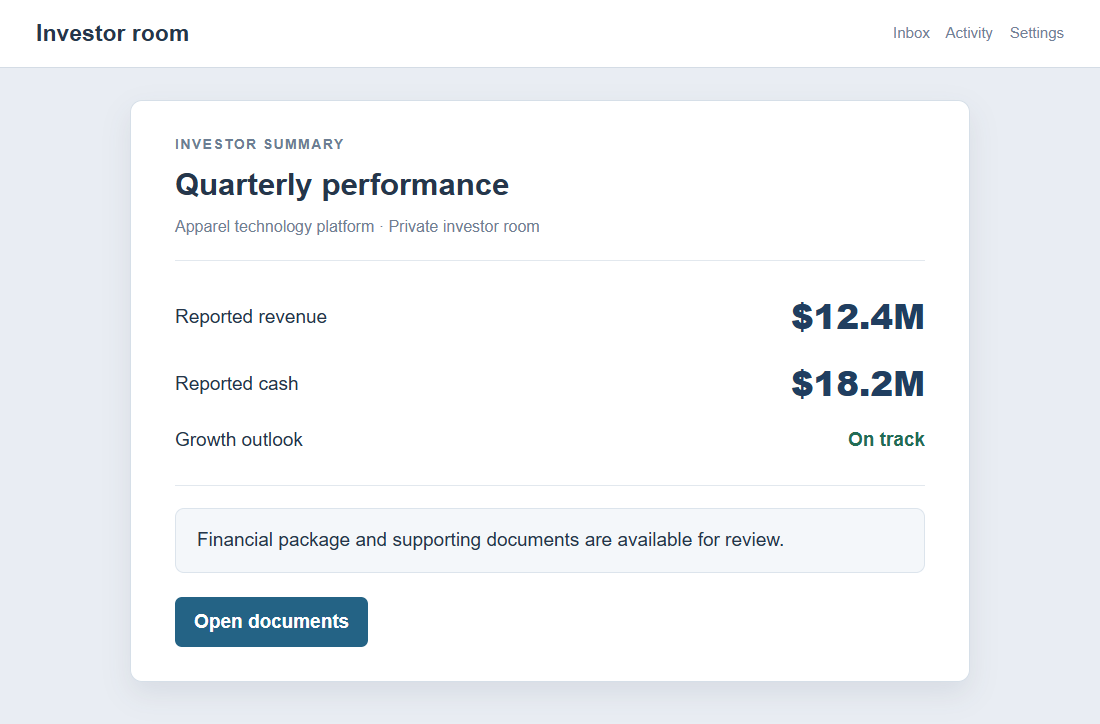
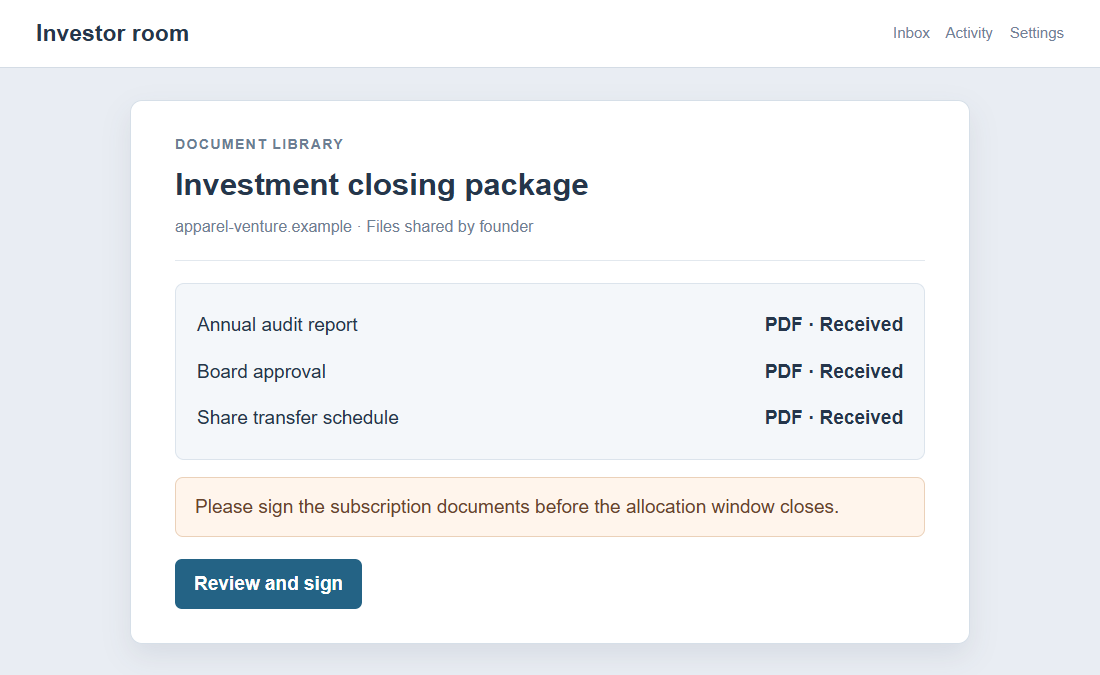
The two images here are fictionalized, non-functional reconstructions of an investor dashboard and document review. They are not CaaStle screens or evidence exhibits.
- A company can exist and still present fraudulent financial information.
- An audit is only useful after the auditor confirms it issued the exact document.
- A secondary-share purchase needs proof that the seller and shares exist.
- Board approval should be verified through the board or counsel, not a forwarded signature page.
- A valuation headline cannot replace current, independently confirmed cash and revenue records.
The legal outcome is established, but investor recovery is separate
Hunsicker pleaded guilty and was sentenced. The conduct described in the federal announcement is not just an untested allegation.
Yet a restitution order does not mean every investor has already received money. Bankruptcy, available assets, and legal claims affect the actual recovery process.
The case is about investor deception. It should not be rewritten as proof that ordinary CaaStle shoppers were scammed in the same way.
What Happened Inside the CaaStle Fundraising Story
Hunsicker founded and led CaaStle, which presented itself as a fast-growing retail-technology company valued at more than $1.4 billion.
Prosecutors said the business was in financial distress, with limited cash and significant expenses, while investors saw records suggesting stronger performance.
From 2019 through 2025, she provided documents that overstated operating profit, revenue, and available funds, according to the DOJ.
Falsified financial statements can change an investor’s whole decision. Revenue affects growth expectations, while cash levels affect whether the company can keep operating.
The fabricated audit was particularly potent because an audit implies an independent professional examined the numbers. That implication vanishes if the report was forged.
In October 2023, an audit firm confronted Hunsicker about a fake audit sent to an investor. Prosecutors said she offered a false explanation.
She later repaid that investor, avoiding public exposure at that point, while continuing to send false financial information to others.
In 2024, prosecutors said she forged the signatures of two board directors to make a stock-option grant appear authorized. That helped raise more than $20 million.
Another investor received a fake draft audit later that year. Hunsicker attempted to pay that investor back too, but the investor refused, the DOJ said.
The board removed her as chair in December 2024 and prohibited her from soliciting investment. Prosecutors said she continued seeking capital after that restriction.
The timeline matters: outside objections and internal restrictions did not automatically end the fraudulent fundraising described by federal authorities.
How the CaaStle Investor Fraud Worked
Step 1: A real startup attracted serious investor interest
CaaStle had a founder, operations, investors, and a business story in a sector where growth can be difficult to measure from the outside.
That reality made the fraud harder to reduce to a simple fake-website warning. Investors needed to evaluate financial documents and ownership claims.
A familiar entrepreneur and a high valuation can make deeper checks feel unnecessary. Neither confirms the company’s current cash or the truth of a specific deal.
The DOJ did not say every investor encountered the same pitch. The common issue was materially false information used to raise capital.
Step 2: False financials made distress look like momentum
Prosecutors said statements and bank records overstated revenue, profit, and available cash. Those are the figures investors use to judge runway and value.
If cash is much lower than reported, an investment may fund ordinary survival rather than the growth plan described in the pitch.
Ask for records delivered directly from the bank, accountant, or auditor through a channel you verified yourself. A document forwarded by the fundraiser is easier to manipulate.
Review dates and coverage carefully. A genuine historical statement does not prove the present balance, especially during a rapid fundraising process.
Step 3: An apparent independent audit supplied authority
A polished audit can reassure even experienced investors. Here, prosecutors said Hunsicker circulated fake audit material.
Contact the named audit firm independently. Ask whether it issued the report, for which entity, and for which period. Avoid contact details embedded in the document.
If an audit is labeled draft, determine what remains unfinished. A draft should not be treated as a final assurance opinion.
The October 2023 confrontation shows why direct confirmation matters. The firm itself challenged the document that had reached an investor.
Step 4: A secondary-share story changed the expected use of money
Some investors were told they would buy discounted shares from existing holders who wanted liquidity. Prosecutors said those sellers did not exist.
Instead, the capital went to CaaStle while the company concealed its cash needs. The investor was assessing one transaction while the money funded another.
For a secondary purchase, confirm the seller’s identity, ownership, transfer restrictions, price, and closing mechanics with independent counsel and company records.
A believable cap table or signed letter is not enough if the underlying holder and authorization cannot be verified separately.
Step 5: Forged approval kept deals moving
Prosecutors said signatures of two directors were falsified to support an apparent stock-option grant. The resulting fundraising exceeded $20 million.
Board approvals can be critical in private-company investments. If a transaction needs one, a screenshot of signatures should not end the inquiry.
Request confirmation from the directors, company counsel, or an independently verified corporate secretary. A genuine person may not know their name was used.
The case shows how false documents can stack: financials, audit, shareholder records, and board approval each reinforce the next.
Step 6: Warning signs did not immediately stop fundraising
After the audit challenge and board action, prosecutors said Hunsicker continued pursuing investment for CaaStle and a related venture called P180.
She also discussed a proposed sale of $19 million in CaaStle shares in February 2025, after the board had restricted her activities.
A restriction can matter only if a prospective investor learns about it. Ask the company and counsel directly who is authorized to solicit and sign.
CaaStle filed for bankruptcy months later. That filing did not create the earlier deception; it exposed the depth of the financial problem.
Why the Paper Trail Looked Stronger Than It Was
Private-company investing often involves many documents: statements, cap tables, audit letters, board approvals, and transaction agreements.
Each document can appear to confirm another. If they all originate with one fundraiser, however, the apparent independent checks may be an illusion.
Separate the source of every claim. A bank should confirm cash, an auditor should confirm the audit, and counsel should confirm securities authorization.
Ask whether the figures are consolidated, audited, unaudited, forecasts, or management estimates. Those labels describe very different levels of assurance.
Do not accept a valuation as proof of liquidity. A startup can have an impressive paper value and still struggle to meet payroll or operating costs.
Likewise, a former investor’s willingness to sell does not prove the company is healthy. Verify both the seller and the company’s current condition.
A founder’s public reputation can be relevant background, but it is not a control over document authenticity. Good due diligence checks claims, not charisma.
If a firm refuses direct contact with its auditor or custodian, ask why. Confidentiality can be managed through professional channels without abandoning verification.
Questions Investors Should Ask Before Sending Funds
- Who holds the company’s cash, and can the bank confirm the account directly?
- Did the named audit firm issue this exact report and opinion?
- What is the latest verified revenue and operating cash burn?
- Is this a primary investment or a purchase from an existing shareholder?
- Can the seller’s ownership and transfer authority be independently confirmed?
- Who on the board approved the deal, and can they confirm it?
- What restrictions, litigation, or financial distress has the company disclosed?
These questions do not make a prospective investor difficult. They make the terms of a high-risk investment understandable before money changes hands.
Independent legal and accounting advice is especially valuable when documents arrive with a deadline or a story about a rare discounted share opportunity.
If any answer depends solely on a person who benefits from closing the deal, keep investigating. That is a concentration of information risk.
What Investors Should Not Assume From the Headlines
The fundraising total, restitution order, and company bankruptcy are different figures. Treating them as interchangeable can produce an inaccurate picture of individual losses.
Likewise, a Chapter 7 filing does not prove every product sold by the company was fictitious. The federal case concerns securities and investor disclosures.
Do not assume every CaaStle employee knew the records were false. The DOJ announcement identifies Hunsicker’s conduct and the documents she supplied.
The public release does not state how much each investor paid or recovered. A named victim should not be assigned an invented amount.
Some investors may have received returns or repayments before the collapse. Those transfers require their own accounting and may affect later claims.
The company valuation was a claim made during fundraising, not cash available to repay investors. A high valuation can coexist with severe financial distress.
An audit firm’s challenge in 2023 did not mean every prospective investor learned of it immediately. Information can remain siloed in private markets.
The board restriction in 2024 is also case-specific. Investors should verify who can legally speak for any company at the time of their own transaction.
Keeping these limits clear makes the warning stronger. The verified fraud is serious enough without adding imagined victims, losses, or product claims.
What to Do if You Have Fallen Victim to This Scam
- Stop additional funding. Do not send bridge capital or a release fee based on a promise that earlier money will be recovered.
- Preserve the investment file. Keep agreements, pitch decks, audits, bank records, cap tables, board approvals, wires, emails, and the timeline of each representation.
- Verify holdings and claims. Ask independent counsel to compare promised shares, actual ownership records, bankruptcy filings, and any recovery notices.
- Contact appropriate authorities. Report securities concerns to the SEC and financial cyberfraud to IC3 where relevant. Mention the existing federal case accurately.
- Follow official proceedings. Use verified court, bankruptcy, or victim-notification channels. Do not rely on an unsolicited recovery email.
- Protect remaining accounts. If you shared login details or sensitive documents, secure those accounts and monitor for identity misuse.
- Reject guaranteed recovery offers. A court order is not a payment schedule. Anyone promising priority restitution for an upfront fee deserves immediate skepticism.
Investors may have different contractual rights and loss amounts. A qualified attorney can help determine how the criminal case and bankruptcy affect a particular claim.
Keep communication factual when speaking with other investors. Sharing verified documents can help; circulating untested allegations can create confusion.
A device scan is useful if suspicious files were opened or software installed. The central issue in this case was falsified records, not malware.
Frequently Asked Questions
Was CaaStle a fake company?
No. CaaStle was an operating retail-technology business. The fraud concerned false financial and investment representations made by its founder.
Was Christine Hunsicker convicted?
She pleaded guilty to securities fraud and received a five-year prison sentence in August 2026.
Did every investor lose the full $300 million?
No. Nearly $300 million describes capital raised in the scheme. Individual investments, distributions, and recoveries differ.
Why was a fake audit so important?
An audit appears to add independent credibility to company numbers. If the named firm did not issue it, that reassurance is false.
What happened to CaaStle?
The company filed for Chapter 7 bankruptcy in June 2025, according to federal prosecutors.
Does restitution mean investors have already been repaid?
No. The order creates an obligation, but actual recovery depends on available assets and legal proceedings.
The Bottom Line
The CaaStle investor fraud shows that a real company can raise enormous sums through a false paper trail. A valuation and an apparent audit are not independent proof.
For any private investment, verify the bank, auditor, shareholder, and board claims through channels outside the fundraiser’s control before sending money.








