

One online conversation feels intensely personal. Another feels like the start of a future together. Both can lead to an urgent request for money.
A federal case shows how those different pressures can feed the same financial network. Understanding the split helps you recognize what to do next.
Overview
One prosecution connected two kinds of exploitation
In September 2026, Olamide Shanu pleaded guilty to conspiracy to commit money laundering tied to sextortion and romance-fraud schemes.
The Justice Department said the schemes affected approximately 150 Americans and generated more than $2.5 million for Shanu.
Court documents describe co-conspirators who used intimate-image threats in some cases and fake romantic relationships in others. Victim payments were moved through payment apps and cryptocurrency.
Shanu admitted the money-laundering conspiracy. His sentencing was scheduled for December 15, 2026; no sentence had been announced at the time of this article.
The two approaches create different kinds of pressure
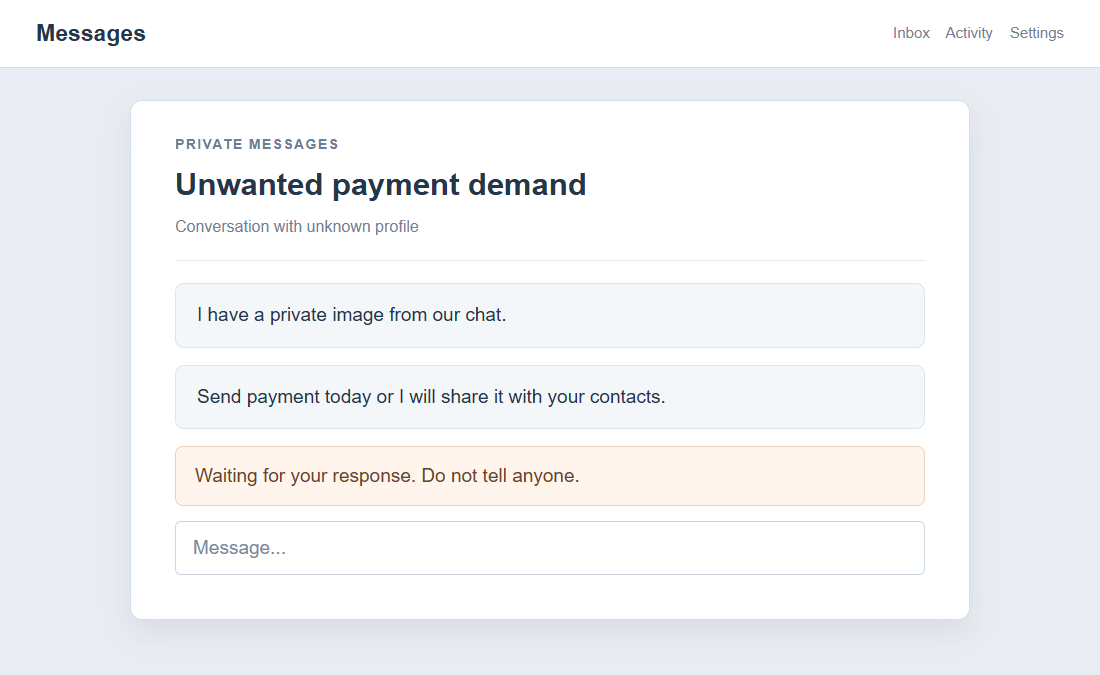
In the sextortion branch, a target was persuaded to share a sexual image. The criminals then threatened to show it to friends or family unless paid.
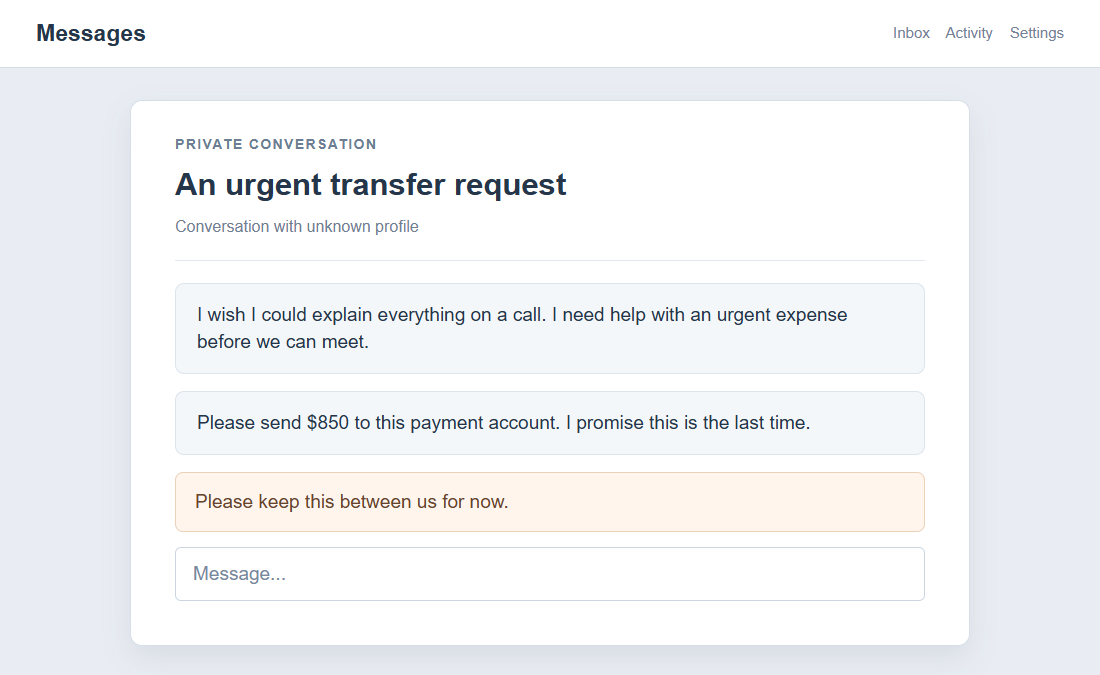
In the romance branch, fake identities built emotional trust over time. The eventual money request was framed as an urgent need within a supposed relationship.
Both paths exploit the victim’s reluctance to seek outside advice. Shame drives one; affection and fear of letting someone down drive the other.
Our images are fictionalized, non-functional reconstructions of these pressure points. They are not messages from the investigation and contain no real victim material.
- A demand to pay to prevent image sharing is extortion, not a normal relationship dispute.
- A romantic contact who repeatedly needs money should be independently checked.
- Payment apps and cryptocurrency can move proceeds quickly across accounts.
- Paying a threat rarely gives you control over copies of an image.
- Preserving messages and reporting promptly can help investigators follow the trail.
The confirmed plea has a precise legal scope
It would be inaccurate to say Shanu had already been sentenced or convicted of every underlying extortion act. His guilty plea was for money-laundering conspiracy.
The descriptions of sextortion and romance fraud come from court documents as summarized by prosecutors. They explain where the money came from.
That distinction does not soften the victims’ harm. It keeps the article faithful to the record and avoids assigning every message to one individual.
What the Idaho Case Reveals
Shanu and co-conspirators operated an international, financially motivated scheme, the DOJ said. The investigation began with a report to Boise police.
Local officers developed the initial case, and federal partners later traced a broader operation. That sequence shows why even a single report can matter.
In sextortion contacts, the group typically targeted male victims and persuaded them to share intimate images. Threats followed, demanding payment to prevent disclosure.
The romance contacts generally used fabricated identities on social media to approach older women and men. Trust was built before urgent requests for funds.
Prosecutors said proceeds moved through peer-to-peer payment applications and several cryptocurrency wallets before reaching co-conspirators in Nigeria.
That route is not proof that every cryptocurrency payment is fraudulent. It describes how money moved in this particular network.
The announcement gives an approximate victim count and proceeds figure. It does not publish each victim’s individual loss, conversation, or platform.
Be wary of anyone who claims to have an exact script from this case without providing evidence. The public record supports a mechanism, not a transcript.
Shanu was extradited to the United States and pleaded guilty. A judge still had to determine his sentence after considering applicable law and guidelines.
How the Sextortion and Romance Scam Network Works
Step 1: A stranger starts a private relationship
Initial contact may appear on social media or another online channel. The person’s profile can look ordinary, and the conversation may move quickly into private messages.
In the romance branch, the invented identity offers attention and a believable personal story. In sextortion, intimacy may be accelerated toward an image exchange.
The case does not establish that every victim met the same persona or used the same app. The common element is the false relationship.
Do not judge a contact only by profile age, photographs, or mutual followers. Those clues can be copied or manufactured.
Step 2: Trust or vulnerability is created
A romance fraudster may spend weeks appearing patient and attentive. That effort makes an eventual emergency feel like a request from someone who cares.
A sextortion actor creates a different dependency: the victim fears that a private image could be exposed to family, colleagues, or friends.
Neither pressure is a sign of weakness in the victim. The criminal has deliberately chosen a personal lever that makes clear thinking harder.
If the contact asks you to keep the relationship secret, pause. Secrecy can make it easier to escalate demands without anyone else testing the story.
Step 3: The conversation turns into a money demand
In the romance branch, the claimed emergency might involve travel, medical costs, or a frozen account. Those are common examples, not verified case-specific scripts.
In the sextortion branch, the demand is explicit: pay or the image will be shared. That threat is coercive, regardless of how the image was obtained.
A deadline may be used to prevent a conversation with a trusted person. The exact countdown is less important than the demand for money under pressure.
Stop before paying. A payment can confirm you are reachable and may invite another demand, while leaving the criminal’s copies untouched.
Step 4: Payments pass through several hands
Shanu’s case involved peer-to-peer apps and cryptocurrency wallets, prosecutors said. Moving money through several places can make tracing more difficult.
The person chatting with a victim may not be the same person receiving or laundering the proceeds. That division helps a network operate across borders.
Save the destination username, wallet address, transaction ID, date, and amount. Those details can be more useful than a profile name alone.
If a bank transfer or app payment was recent, contact the provider immediately. Reversal may be difficult, but waiting reduces the options.
Step 5: The demand can continue after the first payment
A person threatening disclosure may ask for more after receiving money. The first payment does not prove an image was deleted.
A romance contact may invent a new obstacle just before a promised meeting. The victim is encouraged to treat each request as the final one.
The DOJ did not detail the repeat-payment pattern for every victim. These are practical risks of the two mechanisms, not quotes from the case.
End the financial channel, preserve the record, and get support. Isolation is useful to the scammer and harmful to the person being targeted.
If Someone Threatens to Share an Intimate Image
Do not send more money or images. Paying does not create a reliable agreement with a person already using threats.
Save the threatening messages, account handles, payment requests, and URLs. Avoid forwarding the intimate image widely while trying to prove what happened.
Report the account and threat through the platform’s safety tools. If material is posted, report the specific post or URL as non-consensual intimate imagery.
Adults who have the image may use StopNCII.org to create a digital fingerprint on their own device for participating platforms.
The image itself is not uploaded to that service. Its protection is limited to participating platforms, so it cannot promise removal everywhere.
If the image was taken when you were under 18, use Take It Down instead and seek help from a trusted adult or local authority.
Tell someone you trust what is happening. You deserve support even if you sent the image voluntarily before the threat began.
If you feel in immediate danger or overwhelmed, contact local emergency or crisis support. Your safety matters more than the criminal’s deadline.
If an Online Romance Turns Into a Payment Request
Ask to verify the person through a method they do not control. A video call alone can be manipulated or avoided with excuses.
Search the profile photographs and check whether the claimed occupation, location, and timeline make sense. A match or mismatch is evidence to examine, not a final verdict.
Do not move a discussion about money to a private app simply because the contact says the original platform is unsafe.
Discuss the request with a trusted friend who has not been part of the relationship. They can evaluate the claimed emergency without the emotional buildup.
Never allow an online contact to use your account to receive and forward money. That can turn you into an unwitting part of a laundering chain.
If you have already sent money, stop the next transfer first. You can address the relationship question after protecting your finances.
What Evidence to Keep Without Spreading the Harm
Record the account name and profile URL before blocking the person. Usernames can change, so screenshots with dates help preserve the original contact.
Export the chat if the platform permits it. Keep the file in a private location, and avoid posting threats publicly to warn others.
For a romance case, save the requests for money alongside the story used to justify them. The relationship between promise and payment matters.
For sextortion, preserve the threat and any demand, but do not repeatedly send the intimate image to friends or investigators through insecure channels.
Ask police or a victim advocate for a safe submission method if evidence contains sensitive material. You can describe what exists before transferring it.
Write down each payment method separately. A card charge, app transfer, bank wire, and cryptocurrency transaction have different identifiers and possible remedies.
Save wallet addresses exactly as displayed. One missing character can make a report less useful when investigators compare transfers across a network.
Keep a list of the platform reports you filed and any case numbers received. This makes follow-up easier when an account is removed or renamed.
Do not contact other apparent victims through the criminal’s friend list. Some of those accounts may be controlled by the same group.
It is also reasonable to ask a trusted person to hold copies while you take a break. Evidence preservation should not require rereading threats all night.
If an image is posted, record the URL and report it immediately. Avoid downloading new copies from unknown sites, which may introduce additional risks.
A documented report may not bring instant relief, but it turns a private threat into a traceable complaint with dates, accounts, and payment destinations.
What to Do if You Have Fallen Victim to This Scam
- Stop payments and contact. Do not negotiate a final fee. Save evidence before blocking the account, and avoid further private exchanges.
- Alert the payment provider. Give the bank, app, or crypto exchange transaction identifiers and explain the deception or threat. Ask whether funds can be frozen or recalled.
- Preserve the digital trail. Keep usernames, profile links, chat exports, threats, wallet addresses, receipts, dates, and any image-sharing URLs in a secure location.
- Report the crime. Contact local police and submit a detailed IC3 report in the United States. The Shanu investigation began with a local report.
- Protect accounts and images. Change exposed passwords, enable multifactor authentication, report harmful posts, and use StopNCII or Take It Down when eligible.
- Seek trusted support. Tell a friend, family member, counselor, or victim advocate. Shame and isolation are part of the attack, not a reason to face it alone.
- Reject recovery pitches. A stranger promising to delete an image or retrieve crypto for an upfront fee may be continuing the exploitation.
Do not delete all messages before you have preserved them. The details can help a platform, payment provider, or investigator connect related accounts.
If you opened a link or installed software, check the device with reputable security tools. Do not assume an ordinary chat compromised your device.
Recovery of funds is uncertain, especially after transfers across apps and wallets. Reporting remains important even when an immediate refund is unlikely.
Frequently Asked Questions
Was Olamide Shanu convicted of sextortion?
He pleaded guilty to money-laundering conspiracy. Prosecutors connected the proceeds to sextortion and romance-fraud schemes described in court documents.
Has Shanu already been sentenced?
No sentence was announced in the September 2026 release. Sentencing was scheduled for December 15, 2026.
Will paying stop someone from sharing an image?
There is no reliable guarantee. The person making the threat may retain copies and demand more, so preserve evidence and seek help instead.
Can StopNCII remove an image from the whole internet?
No. It creates a fingerprint that participating platforms can use to detect and remove matching content under their policies.
Were all 150 victims targeted in the same way?
The DOJ described approximately 150 victims across several schemes. It did not publish one identical script or loss amount for every person.
Why report a scam after sending cryptocurrency?
Wallet addresses, transaction IDs, and messages can help investigators trace a network. Reporting also documents your loss, even if recovery is uncertain.
The Bottom Line
The sextortion and romance scam network in this case used different emotions to reach the same outcome: money leaving victims and moving through a laundering chain.
If a private relationship becomes a threat or urgent transfer demand, stop paying, preserve the evidence, and tell someone you trust. The shame belongs to the criminal.

Join the discussion
0 commentsShare your experience or ask a question about this article.
Discussion
Start the conversation
Have a question or something useful to share? Add the first comment.