

Your bank says a replacement card is on its way. There is just one problem: you never asked for one.
That single notification may be the first visible sign of a fraud that began long before the envelope was sent.
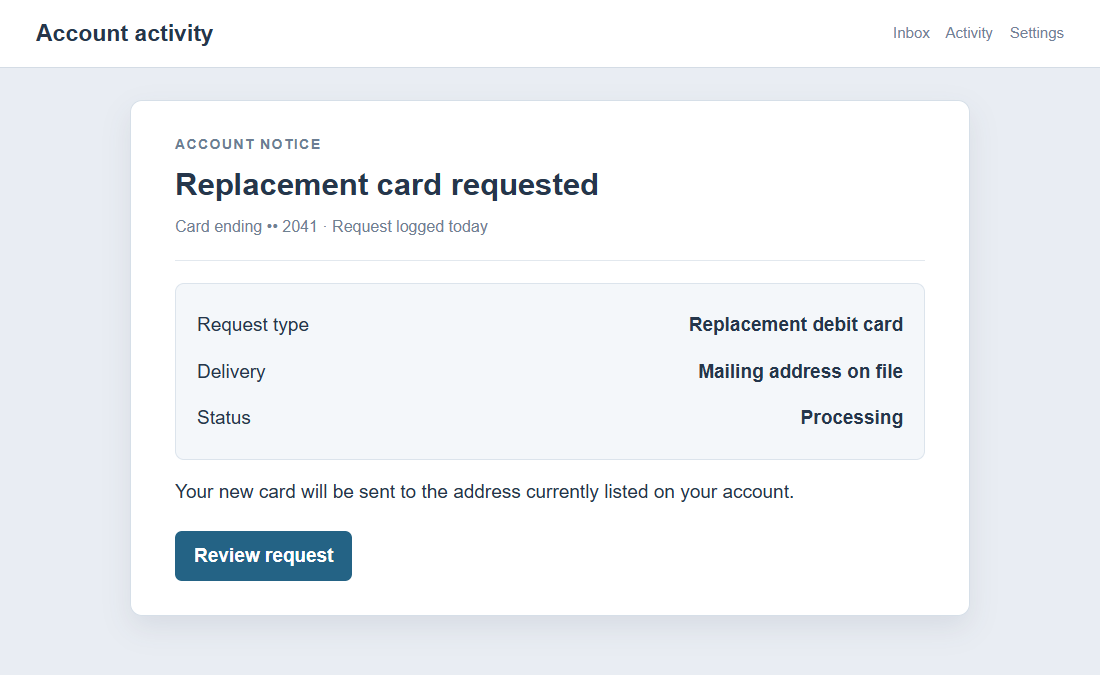
Overview
Criminals used stolen identities to request new cards
A North Carolina bank fraud case shows how dangerous a fraudulent replacement card request can be. At least 10 people had their identities misused.
According to the Justice Department, Cordara Mattox called financial institutions while pretending to be the account holders.
He requested replacement debit and credit cards. Once the cards were obtained, the conspirators used them for retail transactions exceeding $650,000.
Jacob Lawson and Mattox pleaded guilty to conspiracy to commit bank fraud. Lawson received 15 months in prison; Mattox had previously received 30 months.
The warning sign can look like ordinary account service
A new card arriving unexpectedly, or an alert about a replacement request, may seem like a bank error. It may instead mean someone passed an identity check.
Victims do not have to click a phishing link or speak to a scam caller for this particular fraud to begin. Existing stolen information may be enough.
The public case summary does not identify how the conspirators first obtained each person’s data. It also does not describe every bank’s verification process.
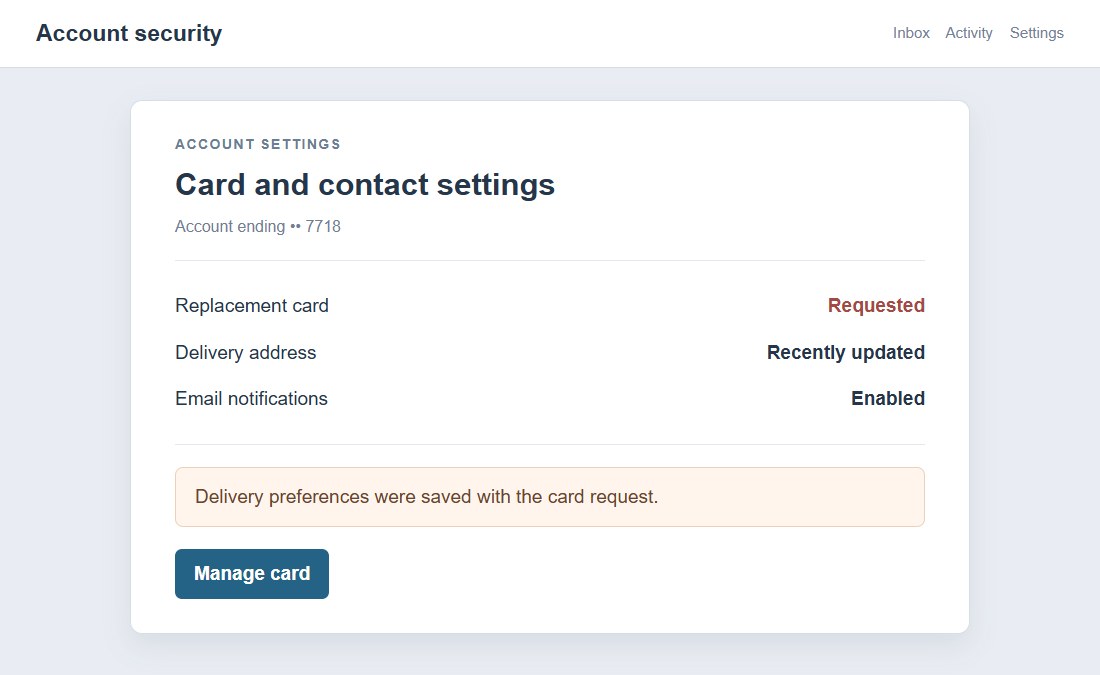
Our images are non-functional reconstructions of the warning and response path. They are not actual bank screens or evidence from the criminal case.
- An unrequested replacement-card notice deserves immediate verification.
- Unknown mailing-address or contact-detail changes increase urgency.
- Card activity can occur before a victim realizes a new card exists.
- The correct response is to call the bank through its independently verified channel.
- Ask the bank to review all active cards, delivery addresses, and recent requests.
This is identity theft, not proof the bank sent a phishing email
The deception in this case was directed at financial institutions. The criminals impersonated customers to obtain replacement cards and spend money.
A genuine bank notification about a replacement could be the warning that exposes the scam. Do not automatically label every such email fraudulent.
Instead, verify the account through the bank’s app, a prior statement, or the number on your existing card. Avoid the contact details inside a suspicious message.
What the Lawson and Mattox Case Reveals
From July 2021 through April 2025, Lawson conspired with Mattox and others, according to court records summarized by federal prosecutors.
The group obtained personal identifying and banking information for victims in North Carolina and elsewhere. The precise source of that information was not disclosed.
Mattox then contacted banks as if he were the account holders. He asked for replacement debit and credit cards, which gave the group a path to purchases.
Retail transactions made with those cards exceeded $650,000. The restitution amount announced for the case was $656,781.46.
The records establish a specific identity-theft operation, not merely a theoretical vulnerability. Both named defendants admitted their roles through guilty pleas.
It is important not to fill the gaps with guesses. The DOJ did not say whether cards were mailed to altered addresses, intercepted, or collected another way.
The public announcement also does not explain how each bank approved the request. Different institutions may have different identity checks and fraud controls.
For a reader, the useful lesson is simple: an unexpected card event can be a security alert even if no unauthorized purchase has appeared yet.
If the bank confirms that no request came from you, ask it to lock the replacement card and investigate how the request was authenticated.
How the Replacement Bank Card Scam Works
Step 1: The criminal acquires enough account information
The fraud starts before the victim sees a replacement notice. Someone has information that may help them pose as the account holder to a bank.
That may include personal identifiers and banking details. The Lawson-Mattox announcement confirms they possessed both categories, but not their exact source.
Do not assume a single data breach caused the event. A bank’s investigation should examine the specific request and any changes made to the account.
A victim can be careful online and still be targeted. Identity theft often exploits data beyond the victim’s immediate control.
Step 2: The criminal contacts the bank as the customer
Mattox posed as victims when contacting financial institutions, prosecutors said. That is the central impersonation in this case.
The criminal’s objective is not to persuade the victim directly. It is to make a bank representative or system accept a fraudulent service request.
Questions about address, account history, or verification codes may be part of a bank’s process. We do not know which checks were bypassed here.
Never share a one-time code with a stranger who says it will cancel a card request. Contact the bank independently instead.
Step 3: A replacement card is issued without authorization
Once the request succeeds, a new debit or credit card enters the process. It may be shipped or otherwise delivered, depending on bank procedures.
In this case, the conspirators obtained replacement cards. The DOJ did not disclose the exact route by which each card reached them.
An alert that a card has been ordered is therefore meaningful. It can give the real customer time to stop a card before activation or use.
Ask whether the old card remains active, what address was used, and whether phone numbers or email addresses were changed at the same time.
Step 4: Retail spending converts identity theft into loss
Prosecutors say the conspirators used the replacement cards for retail transactions exceeding $650,000. That was the money-making stage.
A new card can appear legitimate to a store because it was issued by the real bank. The fraud lies in who requested and controlled it.
Do not wait for a monthly statement if you receive an unrequested-card alert. Some transactions can be completed before paper statements arrive.
Activate account notifications for card creation, address changes, online access, and transactions where your bank offers them.
Step 5: The victim must unwind both the card and identity misuse
Blocking one card is essential, but it may not address the stolen information used to obtain it. Ask the bank what else changed.
Review other accounts, credit reports, and any new financial products opened in your name. Keep a list of institutions contacted and actions taken.
If the bank finds a fraudulent request, ask for a written summary. That record can help with disputes, police reports, and later identity-theft remediation.
Recovery is not always instant. A calm, documented response gives the customer a stronger trail if the issue has to be escalated.
How to Tell a Genuine Bank Notice From a Phishing Message
A notification about a card request might be real, fraudulent, or a phishing lure that only pretends a request exists. The appearance alone cannot settle it.
Open your bank’s app directly or call the number on an existing card. Ask whether a replacement was actually requested and when.
If the bank has no record, the message may be phishing. Do not click its “cancel” button or provide personal information through the linked page.
If the bank confirms a request you did not make, treat it as account compromise. Ask for immediate blocking and an investigation of contact changes.
Do not rely on an email sender name, a logo, or polished design. Those elements are easy to copy into a fraudulent message.
Even an authentic notification can be missed if a criminal has altered the account’s email or mailing address. Periodic direct account review remains useful.
Some banks allow travel or card controls in the app. These can reduce exposure, but they do not replace reporting an unauthorized issuance.
When speaking with the bank, distinguish “I lost my card” from “someone impersonated me and ordered a replacement.” The second statement identifies the full problem.
Practical Safeguards for a Household
Make sure the bank has your current email, phone, and mailing address. Outdated details can delay alerts and make unusual changes less obvious.
Use unique passwords for financial accounts and enable multifactor authentication. These steps do not guarantee protection against phone impersonation, but they close other routes.
Consider a credit freeze if identity information was exposed or new accounts appear. A freeze is not the same as blocking an existing debit card.
Review statements for small test purchases as well as large ones. An unfamiliar transaction can be the first clue that another card exists.
If you assist an older relative, ask whether they want help setting up account alerts. Respect their control while making it easier to notice unusual requests.
Never tell them a breach was their fault. In the documented case, the criminals used stolen data and impersonated customers without their consent.
Keep a trusted bank number in a secure place. That reduces the chance of following a malicious number during a stressful alert.
Finally, ask how your bank verifies replacement requests. It may offer additional account notes, alerts, or controls that suit your situation.
What This Case Cannot Tell Us About Every Account
The prosecution describes a particular criminal group and period. It is not a measurement of how often replacement-card fraud happens at every bank.
It also does not identify the institutions involved in every transaction. Naming a bank without evidence would unfairly imply it had a documented role.
The source of the stolen information remains an important unknown. Victims should resist claims that one company or data breach is responsible without proof.
Likewise, the public summary does not say every victim received an email alert. Some may have discovered the problem only after transactions appeared.
The restitution figure is not automatically the amount an individual customer will recover. Banks and courts handle different parts of the financial aftermath.
A replacement card request can have innocent explanations, including a scheduled expiration or an earlier request by an authorized account holder.
That is why verification matters. You do not need to accuse anyone before asking the bank to confirm a request and explain its origin.
Keep notes from the first call. A precise timeline can reveal whether the replacement, address change, and spending occurred in a connected sequence.
If several institutions report similar unauthorized changes, widen the response beyond one card. Identity theft may affect credit, loans, and other accounts.
If only one message is suspicious and the bank finds no request, focus on the phishing attempt and any information you may have entered.
Both paths begin with the same safe action: reach the real bank through a channel you control, then follow the evidence from its records.
What to Do if You Have Fallen Victim to This Scam
- Call your bank immediately. Use an established number or the official app. Explain that a replacement card was requested without your permission and ask it to block every affected card.
- Review account changes. Check shipping addresses, email addresses, phone numbers, authorized users, payees, and recent access. Ask the bank to preserve the request record.
- Dispute unauthorized purchases. Identify both pending and posted transactions. Request a case number, confirmation in writing, and the applicable dispute deadlines.
- Secure identity records. Change account credentials and review credit reports. Consider a credit freeze if the bank confirms personal information was misused.
- Document the timeline. Save messages, envelopes, card mailers, account screenshots, and names of bank representatives. Record when each alert or transaction appeared.
- File reports. Use IdentityTheft.gov, local police when appropriate, and IC3 for an online or interstate element.
- Watch for follow-up contact. An impostor may call pretending to resolve the case. Do not disclose codes or use a callback number from an unsolicited message.
If a replacement card arrives at your home, do not activate it while the incident remains unexplained. Ask the bank whether it is part of a legitimate remediation plan.
If no card arrives, do not dismiss the alert. The question is whether a request occurred and where the resulting card was sent.
Scanning your device can help if you entered credentials on a suspicious page. It does not fix the identity records or block a card by itself.
Frequently Asked Questions
Can someone order my replacement card without taking my old one?
Yes. The documented scheme involved impersonating customers to request new cards. A missing old card is not required for the request itself.
Does an unexpected replacement email always mean a card was ordered?
No. The message could be phishing. Check through your bank’s official app or phone number to confirm whether a request exists.
How did Lawson and Mattox get victims’ information?
The DOJ says they obtained identifying and banking information, but its public summary does not specify the original source for each victim.
Were the defendants convicted?
Both pleaded guilty to conspiracy to commit bank fraud. Their prison sentences and restitution were announced by federal prosecutors.
Should I freeze my credit or just cancel the card?
Cancel the unauthorized card immediately. A credit freeze may also help if identity information was stolen or new accounts were opened.
What should I ask the bank to investigate?
Ask when the replacement was requested, how it was authenticated, where it was sent, what account details changed, and which transactions used it.
The Bottom Line
The replacement bank card scam turns stolen identity data into a legitimate-looking card under a criminal’s control. The Lawson-Mattox case shows the scale possible.
If you receive a card alert you did not initiate, verify it directly with your bank. Stopping the card quickly is only the first step; investigate the identity misuse too.








