

The Paraclara page opens with a startling statistic about parasites. If you arrived there while searching for an explanation for bloating, it is designed to feel personal.
We checked the story, the product offer, and the refund language. Several important details become clearer only after leaving the dramatic sales narrative.

Overview
What the visitor is shown
Paraclara is a herbal supplement marketed by Serene Herbs. A long advertorial presents it as a parasite cleanse for bloating, fatigue, cravings, and brain fog.
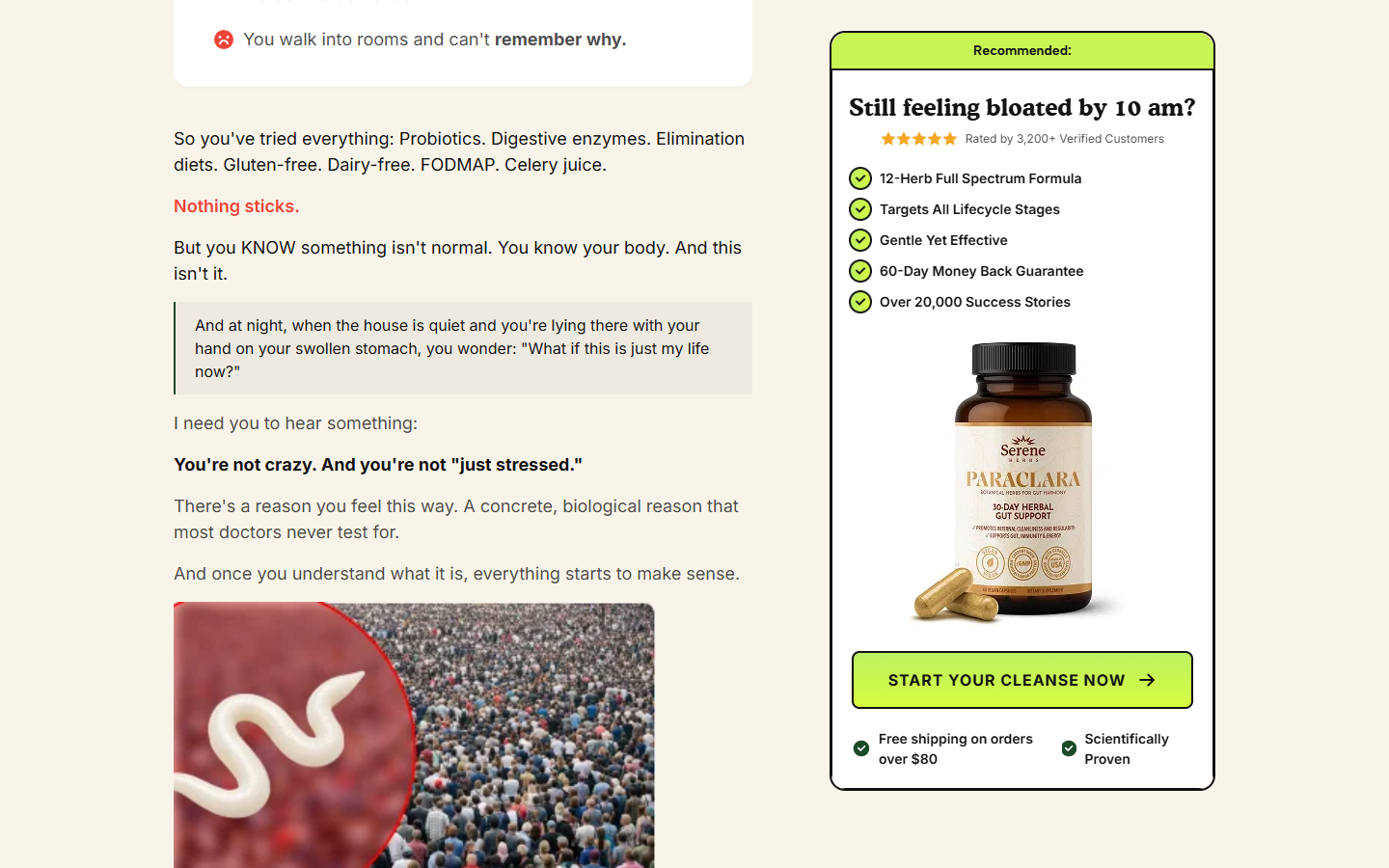
The opening claims that 90% of people have parasites without knowing it. It then links common experiences to a single hidden cause.
A practitioner-style byline and personal recovery story give the page the shape of medical advice. The article ultimately leads to Paraclara packages.
Where the offer becomes more complicated
The advertorial offers one-time pricing beside Subscribe and Save choices. The product page describes monthly delivery plans with a discount and other perks.
The large 60-day guarantee badge does not describe every route to a refund. The formal policy distinguishes ordinary returns from results-based refund requests.
We also found leftover promotion language. A sales box said an order would ship “today, November 27” during a September review, making the urgency appear stale.
Our verdict on the evidence
This is a working store, not proof that customers receive nothing. The stronger concerns are unsupported medical-sounding claims, pressure to order, and contract details easy to miss.
- The advertorial’s 90% parasite statistic needs independent support.
- Common symptoms are treated as clues to one specific condition.
- A personal practitioner narrative funnels readers toward a supplement.
- One-time and recurring purchase choices appear beside each other.
- The subscription option promises monthly deliveries and a discount.
- Ordinary returns require unopened products within 30 days of delivery.
- A separate results-based refund route runs to 60 days.
- At least one urgency message was visibly out of date.
Someone who suspects a genuine infection needs an appropriate medical test, not a diagnosis inferred from a polished advertisement.
How the Paraclara Sales Journey Works
Step 1: The headline turns discomfort into an epidemic
The opening question is broad enough to catch many readers: could bloating, fatigue, and cravings mean a hidden parasite problem?
The 90% figure raises the stakes. A person who believed the number would naturally think that an unrecognized infection is more likely than other explanations.
The page attributes a global parasite burden to health authorities. A global estimate, however, would not show that 90% of visitors have an active infection.
Prevalence differs by location, exposure, organism, sanitation, and medical history. A headline should not erase those differences.
The phrase “don’t know it” adds another emotional layer. It implies a doctor may have missed the answer, even when no examination occurred.
That possibility can be frightening. It should prompt better questions, not automatic acceptance of a seller’s proposed diagnosis.
Step 2: The story feels like a consultation
A named “integrative health specialist” describes years of bloating, expensive appointments, and the moment she supposedly discovered parasites as the answer.
That first-person voice is powerful because it starts where a frustrated reader may be. It also bypasses the questions a real examination would ask.
We did not independently verify the byline holder’s professional registration, patient history, or relationship to the seller. The page itself is a sales destination.
Readers should separate an appealing story from clinical evidence. Similar symptoms can arise for unrelated reasons, some requiring very different care.
A byline may still be genuine, but a claimed credential needs an independently identifiable professional record and a clear explanation of any commercial relationship.
Step 3: Every symptom is gathered under one explanation
The advertorial discusses brain fog, bloating, cravings, fatigue, skin changes, and bowel symptoms as if one organism category can connect them all.
That simplicity is emotionally attractive. It saves the reader from navigating multiple possible causes and offers one neat product in return.
The CDC describes several parasite tests selected according to symptoms, other conditions, and travel history. No single symptom checklist can replace that process.
A reader with persistent abdominal complaints should not be reassured merely because a seller says a cleanse targets the root cause.
Step 4: Herbs are framed as a complete lifecycle solution
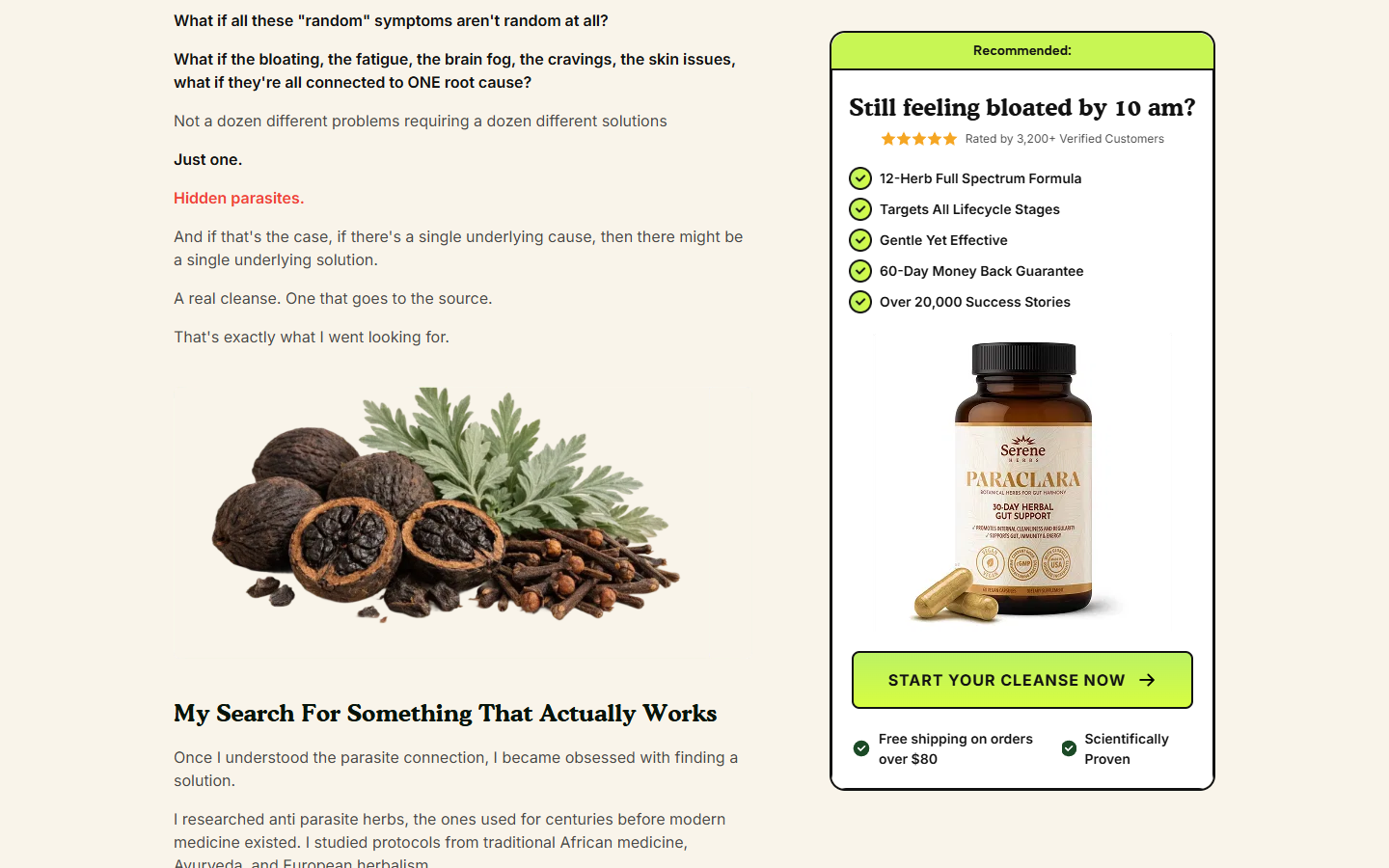
Paraclara’s narrative describes wormwood, black walnut, clove, neem, and other herbs attacking parasites, larvae, and eggs in different ways.
Those explanations mix traditional use with confident biological claims. The offer does not present a clinical trial showing this exact formula clears diagnosed infections.
A claim about an isolated compound acting in a laboratory cannot establish that a capsule reaches the right concentration inside a person.
Herbal ingredients can also interact with medication or cause unwanted effects. Natural origin does not provide a safety pass for every age or health condition.
Nor does a long ingredient list make a product broader acting. If no dose is established for the finished mixture, the number of herbs proves little.
Step 5: The page moves from education to package pricing
After the long story, the reader meets one-, two-, and three-bottle plans. Higher quantities receive stronger savings labels and recommendation language.
Each plan includes a one-time choice and a Subscribe and Save choice. On the product page, the recurring selection advertises monthly delivery and 25% savings.
That discount should be compared with the cost of every future shipment, not just the initial package. Capture the final checkout selection before paying.
We did not place an order, so we cannot say which option every visitor sees selected in their personal checkout.
A careful shopper should calculate the cost if the offer renews once, twice, or not at all. Those are three different budgets.
Compare the product title in the cart with the advertorial, too. Promotion pages and storefront products sometimes use slightly different descriptions for the same package.
Step 6: Urgency tries to shorten the buyer’s review
Purchase boxes refer to limited-time savings and an order shipping “today, November 27.” That fixed date remained in the material we examined later.
A stale shipping countdown is not proof a parcel will never arrive. It does show why timed sales copy should not be treated as reliable logistics information.
When urgency appears beside a health claim, visitors have less incentive to read the subscription and return policies with care.
Pause, save the offer, and look for the same price tomorrow. A real medical concern should never be decided by a countdown timer.
Ask for a realistic dispatch estimate from support. A fixed date left in old copy cannot reliably tell you when your own parcel will ship.
Step 7: Refund language splits into two paths
The advertorial uses a 60-day satisfaction message. Serene Herbs’ policy also describes standard returns of unopened products requested within 30 days after delivery.
For a lack-of-results complaint, the policy says a refund may be available within 60 days of delivery, subject to its stated conditions.
These are not interchangeable rights. A customer who opens a bottle and later changes their mind may not qualify under the ordinary return route.
Before buying, ask which written rule applies to your chosen package, including subscription renewals, partially used bottles, and any return-postage cost.
Keep the date of delivery, because the policy measures both timelines from arrival. A shipping email alone does not establish when the clock began.
What the Medical Story Leaves Out
Unexplained symptoms deserve investigation
Some parasitic infections are real and require treatment. That fact does not validate a broad claim that ordinary fatigue or cravings reveal an infestation.
Depending on the case, a clinician may order stool testing, blood work, or another examination. The CDC notes that multiple specimens can improve detection.
Persistent diarrhea, blood in stool, fever, dehydration, or unintended weight loss calls for prompt professional advice. Those signs should not wait for a supplement trial.
“Die-off” can mask a side effect
The page describes headaches and fatigue during a cleanse as potentially positive evidence that parasites are dying. That interpretation is not established for Paraclara.
Feeling worse could have many explanations, including an ingredient reaction, dehydration, the original illness, or something unrelated to the supplement.
Do not increase a dose or continue an unpleasant regimen solely because an advertorial calls discomfort a good sign.
If a reaction is severe or unusual, stop and get medical advice. Save the bottle and ingredient panel so a clinician can review exactly what was taken.
Seller testimonials cannot prove treatment
Before-and-after narratives often omit diagnostic results, other treatments, diet changes, and the time course of natural symptom fluctuation.
The presence of thousands of reviews on a sales page does not tell us how the sample was collected or whether negative experiences were represented.
Clinical evidence needs a defined condition and outcome. An anecdote about “feeling lighter” cannot show that eggs, larvae, and adult parasites were eliminated.
Check the actual label before swallowing anything
Ask for the complete Supplement Facts panel, ingredient amounts, serving size, warnings, and responsible distributor. Product photography is not an adequate substitute.
Discuss herbs with a clinician or pharmacist if you take prescriptions, are pregnant, have liver disease, or have a known allergy.
The FDA distinguishes supplements from drugs: the agency does not evaluate their effectiveness before they reach stores. A factory badge cannot validate Paraclara’s infection claims.
Company, Address, and Fulfillment Checks
The site names a seller, but the byline is not the merchant
Serene Herbs operates the store and publishes terms under that name. The advertorial’s practitioner-style author is not automatically the entity charging your card.
Confirm the seller on the final checkout and bank statement. A compelling personal narrative does not provide return instructions or billing control.
Contact channels should answer a specific question
The formal refund policy lists phone support. The store also has a contact page, giving buyers a route to ask about their particular package.
Before ordering, ask whether your chosen deal renews, the next charge date, and how to cancel without losing access to an existing order.
Keep the answer in writing. We did not test the phone line or claim that support never replies.
If you call, note the time and representative’s name. Follow up by email summarizing the promised cancellation or refund terms.
A returns destination is not manufacturing proof
Shipping from a fulfillment operation would not prove where the capsules were made. The public advertorial does not establish a Chinese origin either.
Request a responsible manufacturer or distributor name and lot-specific quality information if those facts are important to you.
A warehouse address, if supplied after approval, identifies where a parcel goes back. It does not by itself identify the factory.
Policy pages need a human read
Serene Herbs’ terms still contain generic template references to a refund-policy link. That is a quality-control concern, though a separate refund page exists.
Save the policy as it appears when you buy. Review the 30-day unopened-return rule beside the 60-day results-based provision.
Also ask how subscription orders are treated, because a one-time satisfaction promise should not be assumed to govern every automatic shipment.
What to Do If You Ordered Paraclara
- Find the exact order confirmation. Check how many bottles were purchased, the total charged, and whether it says one-time purchase or a recurring delivery.
- Save the advertisement and policy. Capture the price, shipping promise, guarantee, and checkout terms. Pages and sale banners can change after a purchase.
- Cancel an unwanted subscription promptly. Use the account control if available, and send a written request asking for no further shipments or charges.
- Choose the correct refund path. For an unopened return, note the 30-day deadline. For a results complaint, ask whether the separate 60-day provision applies.
- Get return instructions before mailing bottles. Ask which items qualify, whether opened bottles are accepted, and whether you must pay postage.
- Compare the bank charge with your intended order. If the quantity or renewal differs, contact the merchant immediately and retain the full correspondence.
- Talk to a healthcare professional about symptoms. Mention any product already taken, particularly if symptoms persist or worsen. Do not use a detox story as a diagnosis.
If a recurring charge was not authorized and the seller cannot resolve it, the FTC recommends contacting your card issuer to dispute it promptly.
Frequently Asked Questions
Is Paraclara a proven parasite treatment?
We found no product-specific clinical trial demonstrating that it treats a diagnosed infection. A clinician can determine whether testing or approved treatment is appropriate.
Does bloating mean I have parasites?
No. Bloating has many possible causes. A sales-page symptom list cannot identify an infection or its organism.
Is the 90% parasite headline reliable?
We found no support for applying that figure to the page’s readers. Global disease burden is not the same as individual diagnosis.
Will Paraclara renew automatically?
It can if you choose the subscription option. The store also presents one-time purchases, so verify what your final checkout selected.
Can I return an opened bottle?
The ordinary return policy requires unopened products. A separate results-based refund provision may apply within 60 days, subject to its conditions.
Does an old countdown make the store fake?
Not by itself. It is a warning that promotional urgency may be templated or outdated, so check current shipping and pricing independently.
The Bottom Line
Paraclara’s strongest pitch is a story that makes a complex medical question feel settled. Its website has not shown evidence that the capsules can diagnose or treat an infection.
Separate the health question from the shopping decision. Verify symptoms with a professional, then read the exact refill and refund terms before paying.








