

When a dog keeps scratching, scooting, or waking at night, an owner wants a reason. PawsyLabs presents one that can sound surprisingly simple.
We examined the parasite-cleanse drops, the two Pawsy websites, and their billing and support information. The details are worth checking before a bottle reaches your dog.
Overview
What PawsyLabs sells
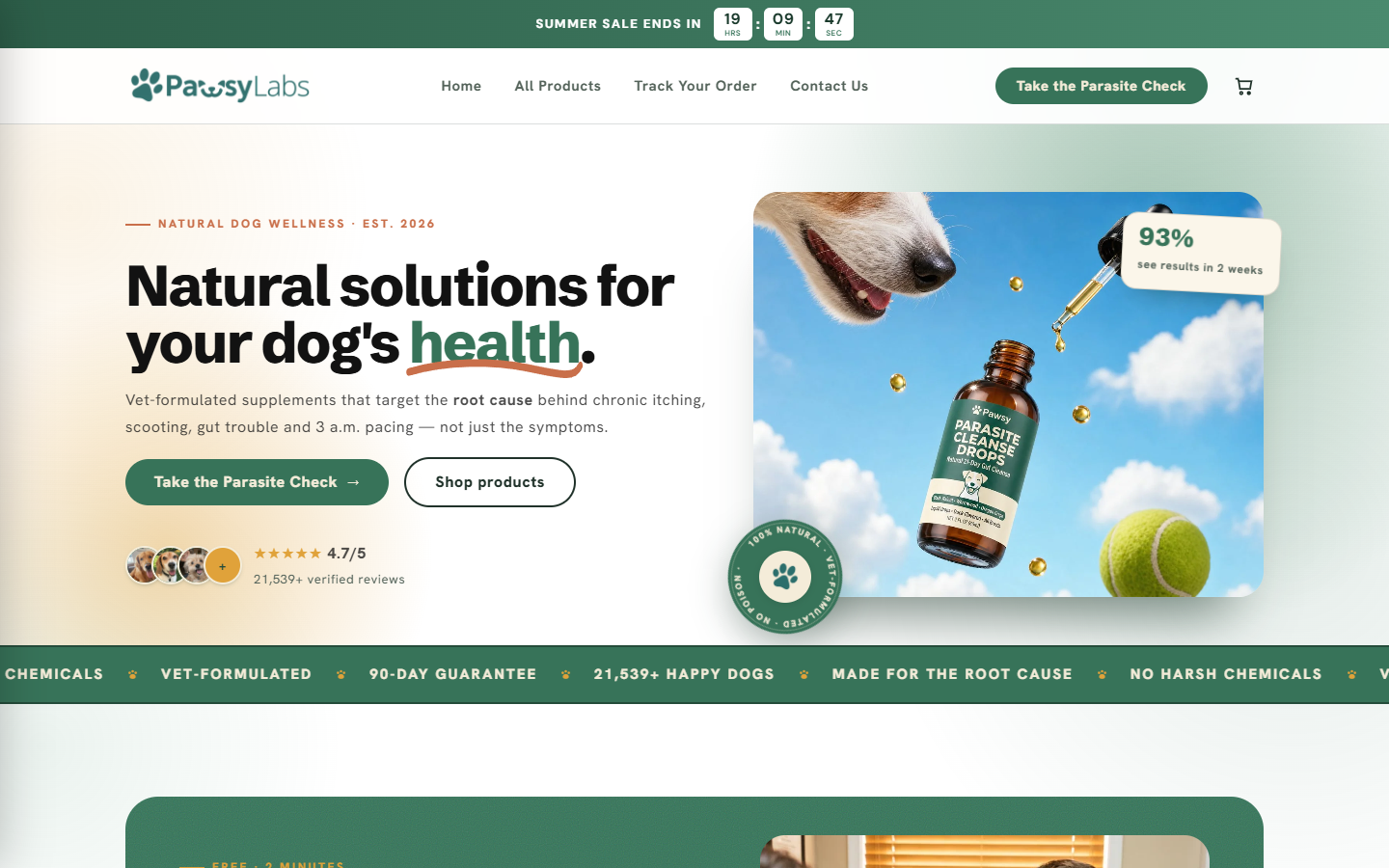
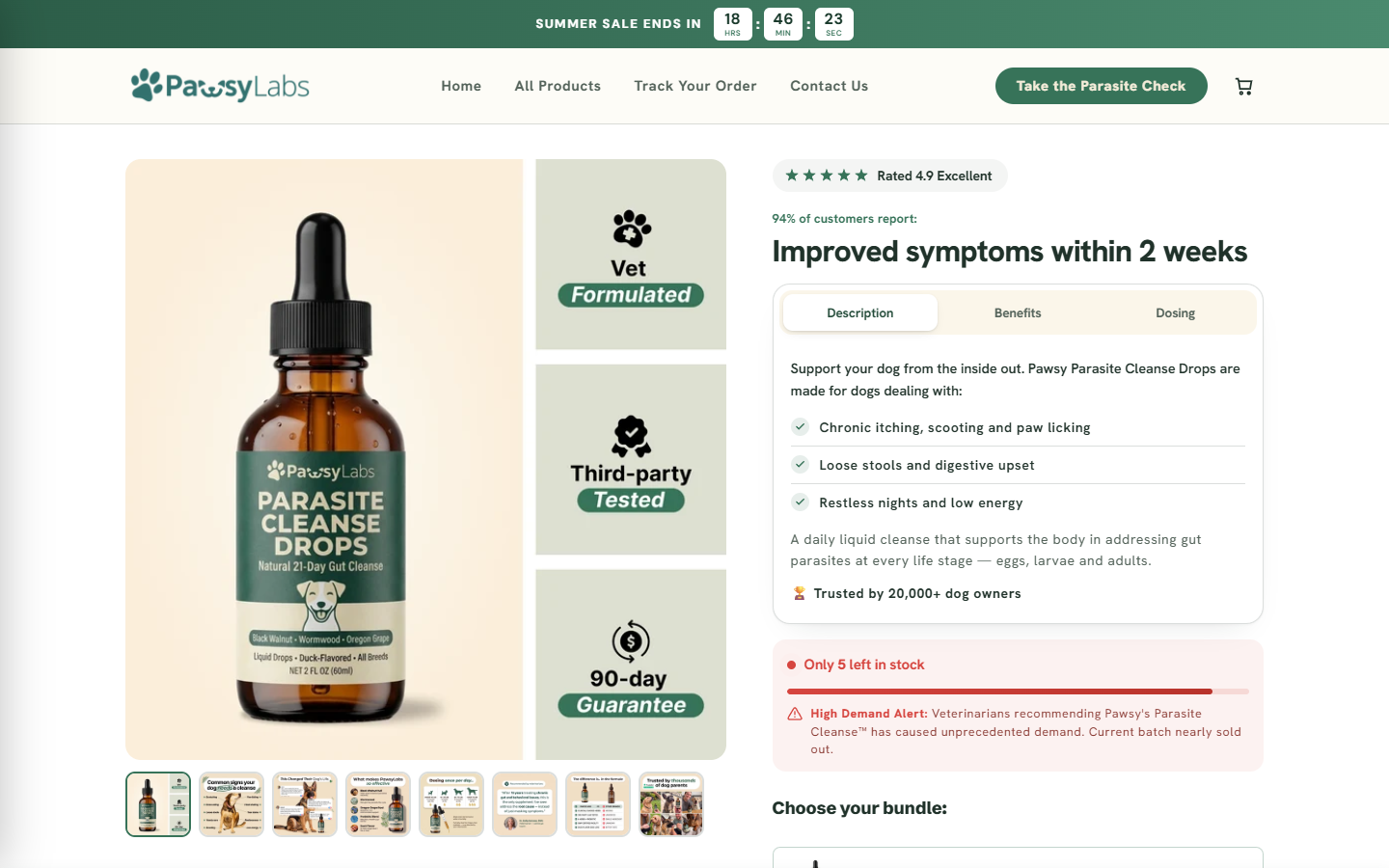
PawsyLabs sells liquid drops promoted for dogs with itching, scooting, loose stools, and restlessness. The marketing calls the product a gentle parasite cleanse.
The company describes a 21-day routine using botanicals and postbiotics. It advertises a quiz that can suggest a plan based on a dog’s symptoms.
Its product page also offers recurring delivery at a discount. The site says a subscription can be paused or canceled through an account portal.
Why the pitch concerns us
The homepage tells readers that itching may not be allergies and that gut parasites could be the root cause. That is an unusually strong diagnostic suggestion for a sales page.
Scratching and scooting have many possible causes. A supplement quiz cannot examine skin, collect a stool specimen, or identify an organism.
There are commercial questions too. Pawsy pages show different review counts and contact addresses, while a support FAQ specifically addresses recurring orders customers did not expect.
Our evidence-based assessment
We found a real storefront with named support routes and a published first-order guarantee. We did not establish that the company fails to ship or that every subscriber is trapped.
The medical framing is the larger issue. Owners should not replace parasite testing or veterinary treatment with a botanical product based on an advertisement.
- The site connects several nonspecific dog symptoms to parasites.
- It advertises a “parasite check” quiz, not a laboratory test.
- The drops are sold with a 30-day Subscribe and Save option.
- A support FAQ explains why some buyers see unexpected repeat orders.
- Two related domains show different headline review counts.
- One page lists a virtual-assistant phone line and two support emails.
- The guarantee appears to apply to the first order, not every renewal.
These observations justify a careful buyer review. They do not justify declaring the seller a confirmed criminal operation.
How the PawsyLabs Sales Funnel Works
Step 1: A worrying symptom becomes a hidden-root-cause clue
A dog that licks its paws or drags its rear across the floor may have an owner already searching for answers.
PawsyLabs names those behaviors and suggests a gut parasite load that ordinary explanations have missed. The message feels tailored to the frustrated owner.
Yet allergies, fleas, anal-gland problems, skin infection, diet, anxiety, and other conditions can produce overlapping signs. A veterinarian must sort them out.
The Companion Animal Parasite Council recommends appropriate parasite screening and preventive care. Its approach does not treat an online symptom list as a diagnosis.
Step 2: The quiz makes a purchase feel personalized
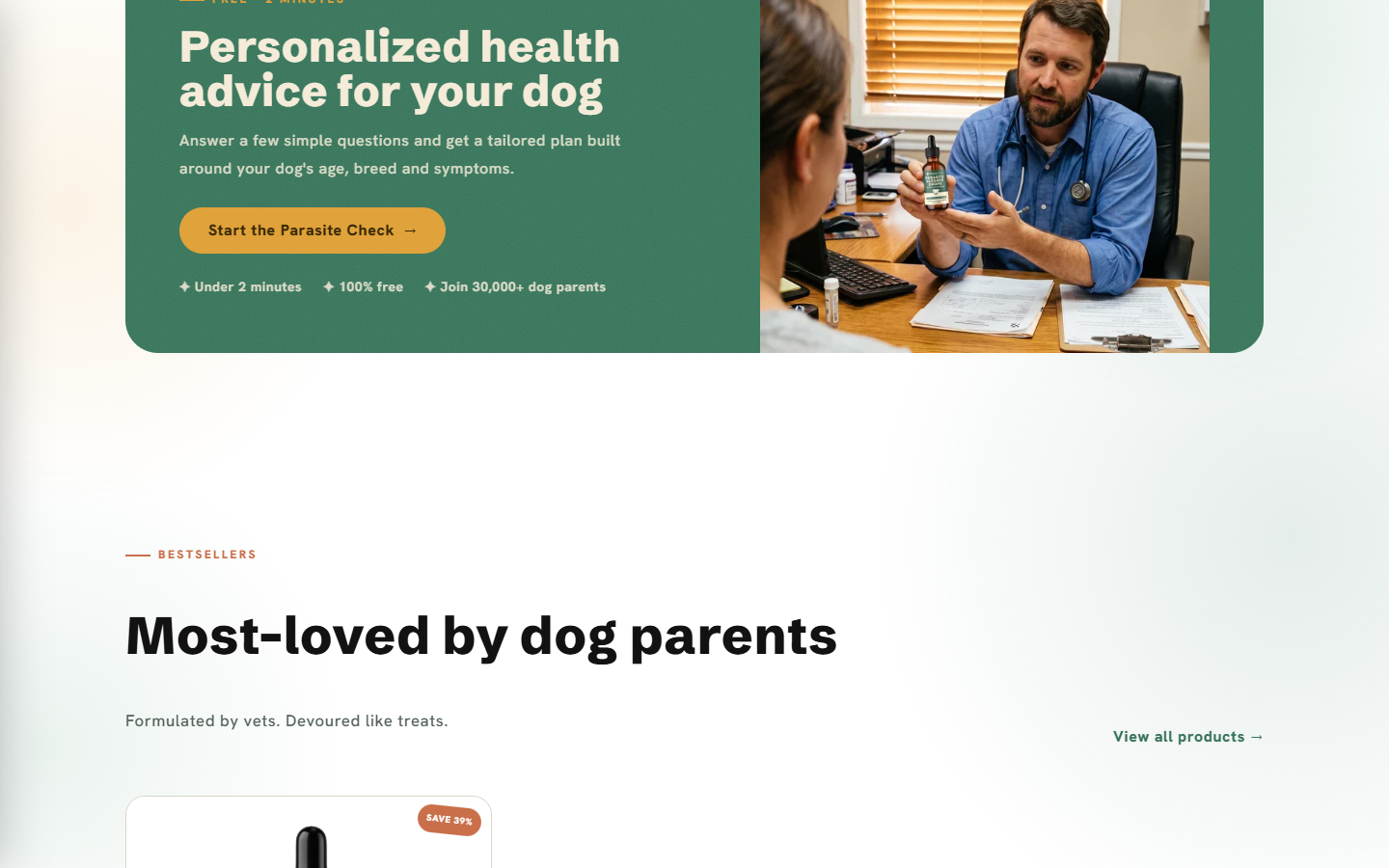
The homepage invites owners to take a short “parasite check.” A few answers about age, breed, or symptoms can make a generic offer feel medically individualized.
Personalization is useful when it helps choose a proper appointment or test. It becomes risky when the conclusion is mainly a link to a bottle.
We did not submit a full quiz or make a purchase. The visible page does not show that the quiz collects a biological sample.
Ask what the quiz can actually determine. If the answer is a product recommendation, that is not equivalent to a fecal examination.
Step 3: Botanical language stands in for parasite evidence
The pages highlight black walnut, wormwood, Oregon grape, pumpkin seed, and postbiotic ingredients. They describe a staged cleanse and ongoing defense.
One page suggests the drops address parasite eggs, larvae, and adults. Another describes “breaking down biofilm” during a 21-day routine.
Those mechanisms would need product-specific studies in dogs with confirmed infections. An ingredient’s traditional reputation cannot establish this bottle’s effectiveness.
The FDA’s discussion of an approved Giardia treatment explains why veterinary diagnosis and monitoring matter. An herbal supplement is not the same as an approved antiparasitic drug.
Step 4: Social proof reduces the urge to ask for testing
The marketing shows ratings, thousands of claimed happy dogs, and stories about itching or nighttime pacing disappearing after use.
These are seller-controlled testimonials. They do not show which dogs had documented parasites, what else changed, or whether symptoms later returned.
We also saw differing review totals on related Pawsy domains. Counts may reflect different stores, systems, or update times, but the discrepancy deserves an explanation.
A shopper should ask for a published study of the exact formula rather than treating a before-and-after story as proof of deworming.
Even a sincere customer story can have another explanation. A dog might improve after a food change, flea treatment, seasonal shift, or ordinary recovery.
Look for records that begin with a positive parasite test and end with a verified negative one. We did not find that evidence in the testimonials.
Step 5: The discounted order can renew every month
The site advertises 20% savings for Subscribe and Save, with deliveries every 30 days. A lower displayed price can distract from the future charge.
The support center includes a question about receiving orders a customer did not authorize. Its answer says an active subscription is usually the cause.
That FAQ does not prove improper billing. It does show that recurring deliveries can surprise buyers often enough for the seller to address the question.
Before payment, confirm whether the cart is one-time or recurring, the next billing date, and the exact product quantity that will repeat.
Take a screenshot of the final checkout, not only the product page. A discount tile selected earlier may remain active when you reach payment.
If your receipt mentions a subscription, set a reminder before the next processing date. Waiting for a shipping notice may leave too little time to stop that shipment.
Step 6: Cancellation and refunds follow different clocks
Pawsy says subscriptions can be managed through a portal or by email. The first-order guarantee is advertised as lasting 90 days.
One product page says the owner may seek a refund even after using the bottle if the dog shows no meaningful improvement during the protocol.
A separate FAQ says the 90-day guarantee covers the first order, including a subscription’s first delivery. That does not promise a refund on every renewal.
Canceling future boxes does not necessarily reverse a processed shipment. The support page says it will try to stop an order before it leaves.
Why the Veterinary Question Comes First
Itching and scooting do not identify a parasite
These signs are clues, not a diagnosis. An irritated paw may point to a skin problem while scooting may involve anal glands.
Loose stools can arise from food changes, infection, stress, or parasites. A clinician can decide whether testing, medication, dietary changes, or another examination is appropriate.
The American Veterinary Medical Association explains why fecal testing matters. Many intestinal parasites cannot be identified by casually looking at a dog’s stool.
Delay may have a cost
If a parasite is present, a dog may need an effective treatment selected for that organism. If no parasite is present, a cleanse can delay the real diagnosis.
Some conditions worsen while an owner waits for a promised two-week change. Puppies, elderly dogs, or dogs with blood in stool need particular caution.
Do not stop prescribed prevention or deworming simply because a supplement claims to defend the gut.
Ask the clinic which sample to collect and when. Testing can be imperfect, so the veterinarian may recommend repeat testing or a different examination.
That process may feel slower than clicking a quiz result, but it avoids guessing at the cause of symptoms and choosing the wrong remedy.
Natural ingredients still require safety checks
The product page warns about pregnancy, nursing, medications, and tree-nut allergy connected with black walnut. Those cautions deserve attention.
Ask for the complete label, active amounts, lot number, and independent batch test if the seller claims third-party testing.
A pet’s size changes dose exposure. Never use a human parasite cleanse on a dog or double an animal supplement after missing a day.
Claims of veterinary design need specificity
Pawsy describes the formula as vet-formulated. A protocol page names a veterinarian, but a byline is not a published trial.
Ask what role the professional had, whether the formula was tested in dogs, and whether the claims concern symptom support or documented parasite removal.
Being manufactured in a controlled facility, if verified, addresses production quality. It does not prove that the product treats an infection.
Read any study citation closely. Research on a single botanical, another species, or a different concentration cannot validate Pawsy’s finished mixture.
A clear seller response would identify the tested formulation, dose, animals, measured outcome, and independent reviewer. A broad phrase like “backed by science” does not answer those questions.
Company, Address, and Fulfillment Checks
The seller does identify an operator
A support page names Elevator LLC doing business as PawsyLabs and gives a Delaware mailing address. This is more concrete than an anonymous storefront.
A privacy page also refers to a Netherlands address. The pages do not explain the different business roles fully, so ask which entity charges your card.
Two addresses do not automatically mean either is fake. One may be a registered, support, or regional contact.
The contact details are not perfectly aligned
One area of the site promotes support@trypawsy.com. Other FAQs direct order and refund requests to help@pawsylabs.com.
Those may both reach the same team, but a customer should use the address printed on their receipt and request acknowledgment.
The listed phone number uses a virtual assistant to take messages. That is a real contact method, though it is not live human support.
Fulfillment is not a manufacturing certificate
The company says orders leave a fulfillment center and claims U.S. manufacturing in audited facilities. The visible shipping statement does not name the plant.
Ask for an actual lot-specific certificate if safety claims influence the purchase. We cannot establish the country of every bottle from a delivery estimate.
We found no basis for saying this product is mass-produced in China. A missing factory address is a transparency question, not proof of origin.
Keep the exact domain and order record
Trypawsy.com and pawsylabs.com display related branding, but review counters and some commercial details differ. The exact seller page matters to a return.
Save the URL, product variant, price, subscription cadence, receipt, and policy shown when you paid. Do not rely on a screenshot from another domain.
If support sends you to a different portal, verify it against the order confirmation before entering account or payment information.
For a first-order guarantee, request the return authorization and destination in writing. The place that ships a bottle is not necessarily the place that accepts returns.
Keep the tracking number if you send anything back. A dated delivery record helps resolve disagreements about whether a return arrived within the promised window.
What to Do If You Bought Pawsy Parasite Cleanse Drops
- Check on your dog first. If symptoms persist, worsen, or include blood, vomiting, or lethargy, contact a veterinarian instead of waiting for the cleanse timeline.
- Save the product label and receipt. Record the lot, ingredient list, dose instructions, website, payment total, and whether the order included a subscription.
- Open the subscription portal. Confirm the next scheduled charge and delivery. If you wanted a single bottle, cancel future orders and capture the confirmation.
- Write to the seller as well. Use the contact address on your receipt, state your order number, and ask for written confirmation of cancellation.
- Clarify the refund’s scope. The advertised 90-day satisfaction route appears focused on the first order. Ask whether your specific shipment qualifies.
- Compare website promises with the delivery. If the quantity, label, or charge differs, document it before opening more bottles or discarding packaging.
- Escalate billing problems with records. If an unwanted renewal continues after confirmed cancellation, contact the merchant and your card issuer promptly.
Your pet’s health and a billing dispute are separate problems. Resolve both, and do not let the refund process delay appropriate veterinary care.
Frequently Asked Questions
Is PawsyLabs a confirmed scam?
Our review does not establish that. The company identifies an operator and publishes support channels. Its parasite claims and recurring-order presentation still need scrutiny.
Can the quiz diagnose worms in my dog?
No. A short online questionnaire cannot collect or examine a stool specimen. Ask a veterinarian whether testing is indicated.
Are Pawsy drops the same as a dewormer?
No. They are marketed as a supplement. Do not replace a veterinarian’s parasite treatment or prevention plan with the drops.
Does the product create an automatic refill?
The seller offers Subscribe and Save on a 30-day schedule. Check your own checkout and receipt to see whether you selected it.
Does the guarantee cover every bottle?
The seller’s FAQ describes a 90-day guarantee for the first order. Ask about later subscription shipments before assuming the same refund protection.
Why are there two Pawsy websites?
They present related branding, but some counts and contact details differ. We did not establish that either is an impersonator. Keep records of the exact site used.
The Bottom Line
PawsyLabs packages a plausible worry about dog parasites into a convenient drops offer. The marketing does not show that an itchy or restless dog has an infection.
Get the veterinary answer first. If you still consider the product, verify the label, seller, renewal choice, and first-order refund terms before payment.








