

The sound of a dog shaking its head at night can send an owner searching for relief. Amblora’s ear-cleaner page says that relief might begin tonight.
We checked the promise, the product options, and the terms behind the order. A few details deserve attention before any liquid goes near a sore ear.
Overview
The promise on the product page
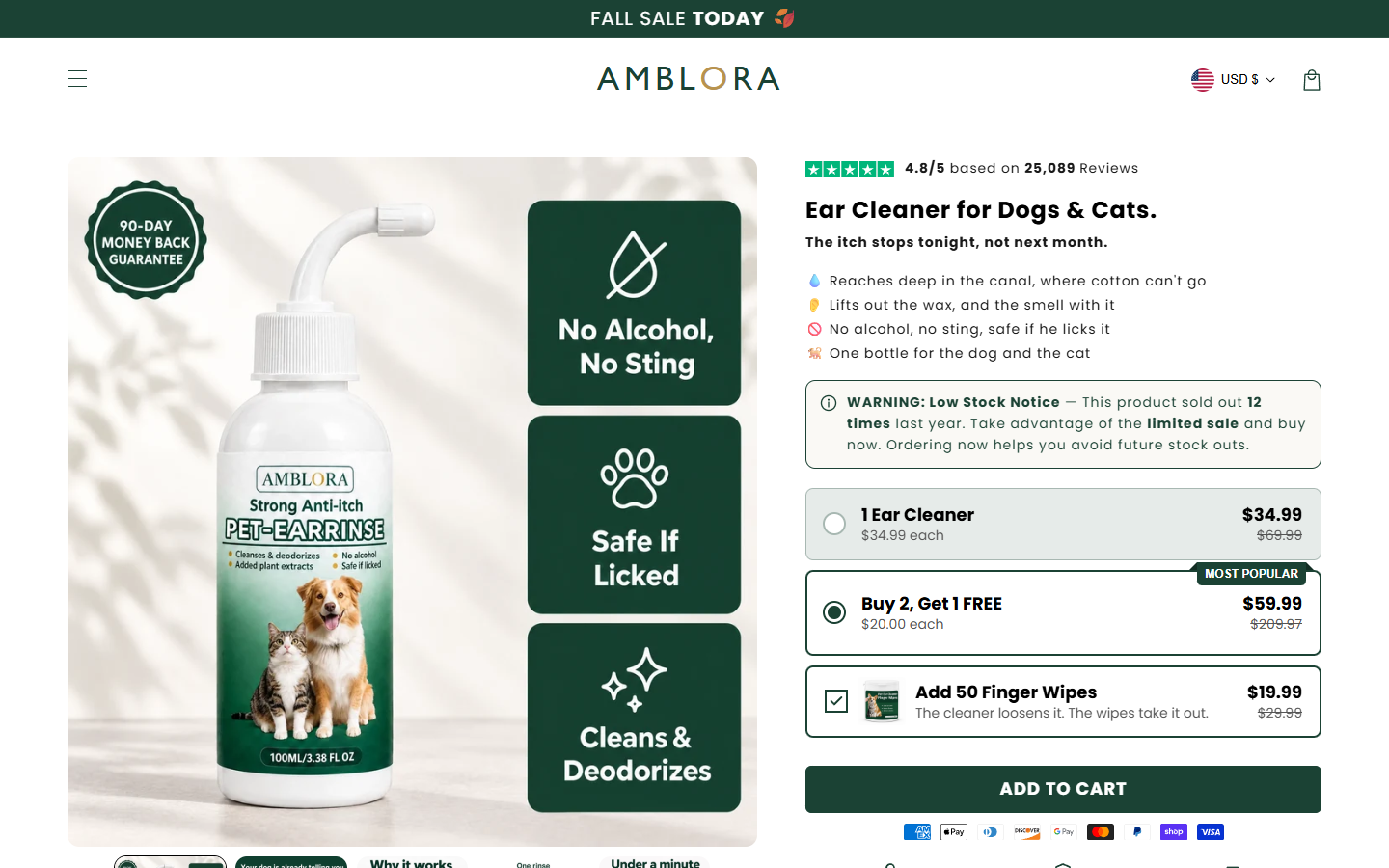
Amblora sells an ear-cleaning liquid for dogs and cats. Its page describes quick relief from itching, odor, wax, and head shaking.
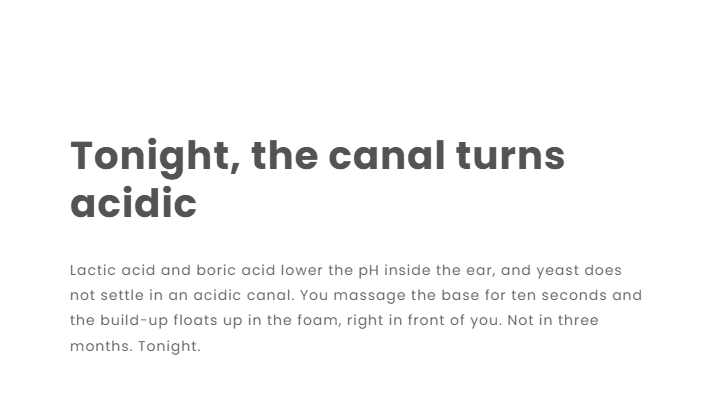
The marketing says lactic and boric acids make the ear canal less hospitable to yeast. It also calls the formula alcohol-free and safe if licked.
The page’s strongest message is about timing. It suggests an owner can see debris lift out and notice comfort the same evening.
What the current offer shows
At our September 30, 2026 review, one bottle was displayed at $34.99. The product page had a three-bottle $59.99 option selected.
A $19.99 finger-wipes add-on was also checked in the page state we observed. Buyers can change those selections before checkout.
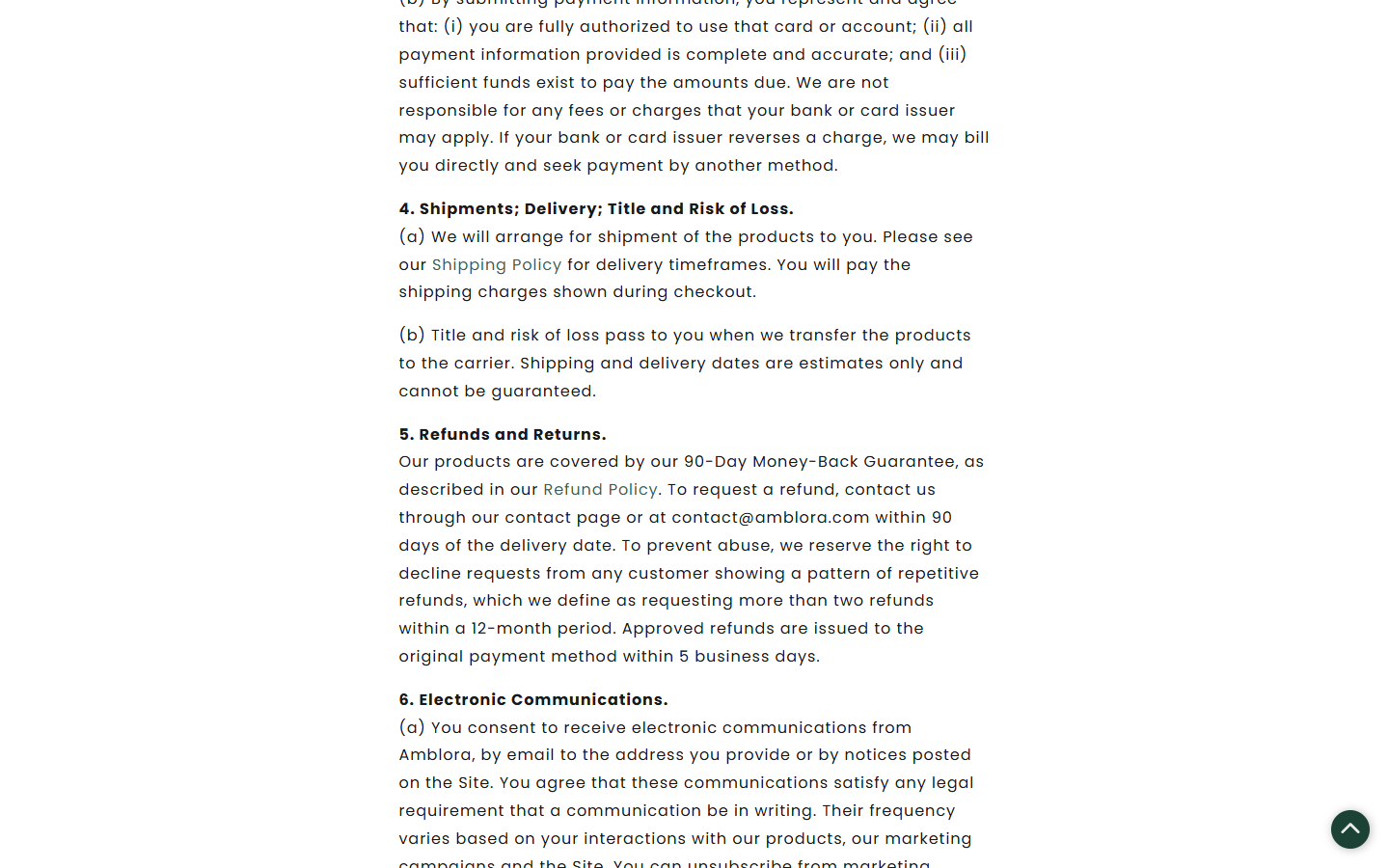
The store advertises a 90-day money-back guarantee. Its current written refund policy also says return shipping is paid by the seller.
Our assessment
This is an operating storefront with policies and a named business operator. We found no evidence of an automatic refill subscription in this offer.
The concern is that a confident, rapid-relief pitch can blur the difference between cleaning an ear and diagnosing the reason it hurts.
- The sales page promises visible relief on an unusually short timetable.
- Redness, odor, scratching, and discharge can have several causes.
- A selected bundle and checked add-on can raise the initial cart total.
- The site displays a large seller-controlled review count.
- Current policies state a 90-day refund window and seller-paid return shipping.
Calling Amblora a proven scam would go beyond the evidence. The safer conclusion is that buyers should question the medical certainty and review their cart carefully.
When an Ear Cleaner Is Not the Answer
Similar symptoms can point to different problems
A dog may shake its head because of yeast, bacteria, mites, allergies, a foreign object, inflammation, or a problem deeper in the ear.
Those possibilities are not interchangeable. A rinse that loosens wax cannot identify an organism, remove every foreign object, or show whether an eardrum is damaged.
The Merck Veterinary Manual describes an ear examination and, when needed, a sample examined under a microscope.
That is why “yeasty smell” should not become a diagnosis made from a sales video. Smell and dark debris can be clues, not a lab result.
Inflamed ears need extra care
Amblora says the cleaner does not sting, including in red or sore ears. We could not independently verify that promise for every animal.
Merck warns that even products normally safe in healthy ears can irritate inflamed ears. A pet that cries, pulls away, or keeps shaking needs assessment.
Do not push an applicator deeper because the page says it reaches where cotton cannot. The animal’s pain level and eardrum condition matter.
If an ear is bleeding, swollen, very painful, or producing heavy discharge, contact a veterinarian before trying another over-the-counter liquid.
One-sided symptoms may be especially important. A vet can check for an object, growth, or other cause that routine cleaning cannot address.
Cats are not small dogs. An owner should not assume a shared bottle means the same amount, frequency, or technique is appropriate for both species.
Ask the clinic to demonstrate cleaning if you have never done it. Correct technique can matter as much as the solution chosen.
The acid explanation needs context
Lactic and boric acid can appear in veterinary ear products. Their presence alone does not establish that this particular bottle treats an active infection.
Concentration, full formulation, intended use, and the condition of the ear all affect whether a product is appropriate.
We did not find a product-specific clinical trial on the page showing that Amblora resolves diagnosed infections overnight in dogs or cats.
The site’s “tonight” timeline is marketing. It should not replace a treatment plan if a clinician has already prescribed medication.
A claim of no alcohol also does not prove a formula cannot irritate. Other ingredients, existing injury, and individual sensitivity can change the experience.
Keep the label available when speaking with the veterinarian. A clear ingredient list lets the clinician check for duplication or interaction with prescribed drops.
How the Amblora Sales Funnel Works
Step 1: A familiar pet problem opens the pitch
The page describes head shaking, ear odor, scratching, and a dog unable to sleep. Those are familiar frustrations for owners who have already tried wipes.
It suggests the problem is sitting in the canal, while previous attempts worked in the wrong place. The story makes one cleaner feel unusually targeted.
Some ear problems do involve material in the canal. Others also involve allergies, parasites, inflammation, or a damaged eardrum.
Before accepting the sales diagnosis, ask whether a veterinarian has actually looked into the ear and identified what needs treatment.
Step 2: A visible rinse becomes an implied cure
The page describes foam lifting debris so an owner can see something happen. A visible change can feel like proof that the underlying problem is solved.
Removing wax may help some ears, but it does not demonstrate that bacteria or yeast have been cleared. Symptoms can return when the cause remains.
Consider the owner’s objective: is it routine cleaning, or is a pet painful and repeatedly infected? Those are different questions.
The latter calls for a diagnosis. Repeatedly buying cleaner may cost more than identifying an allergy or treating a persistent infection properly.
Step 3: Review numbers and testimonials strengthen confidence
The product page displayed a 4.8/5 rating tied to 25,089 reviews during our check. That number is controlled by the seller’s storefront.
Testimonials describe quieter nights and less head shaking. We could not verify how the reviews were collected or whether any pet had a confirmed diagnosis.
A review can tell you how an individual owner felt about a purchase. It cannot prove that a specific formula is safe for every inflamed ear.
Look for the complete ingredient list and veterinary directions. An impressive review counter is not a substitute for those basics.
Step 4: The default package is larger than one bottle
The buying panel showed the three-bottle choice selected as “most popular.” Its $59.99 price differs substantially from the $34.99 single-bottle option.
That difference is easy to overlook if someone arrives from an ad and presses the large cart button without reviewing the radio selection.
The three-bottle option may be useful for some households. It should still be an informed decision, especially before an owner knows whether the product suits a pet.
Changing to one bottle in the product page does not guarantee the final checkout will preserve it. Confirm the order summary at payment.
Step 5: A checked extra can change the total again
The page also had “Add 50 Finger Wipes” checked, priced at $19.99. In the observed default state, the selected merchandise totaled $79.98 before shipping or taxes.
That calculation uses the listed $59.99 bundle and $19.99 add-on. We did not submit an order, so the final checkout amount remains unverified.
An add-on can be a legitimate offer. The issue is whether someone notices it before authorizing the charge.
If you want to try one bottle first, deselect the three-bottle option and the wipes. Then pause long enough to read the revised total.
A bundle discount loses its appeal when unused bottles remain after a veterinarian recommends a different treatment.
Take a screenshot of every line item on the final payment screen. Do not rely on a headline “from” price or the price in a social ad.
Step 6: The guarantee requires a written request
Amblora currently says an order may be returned within 90 days of delivery. The refund policy asks customers to email or use the contact page.
The policy says support will provide return instructions after approval and cover return shipping. It also says some refunds may not require shipping the item back.
Do not send a package before receiving those instructions. Keep the delivery date, request date, and written reply together.
The page’s “returns are on us” language is meaningful only when the seller supplies a usable prepaid method. Confirm that process for your location.
The terms page was updated recently. Policy wording can change, so save the version in force when you place an order.
Company, Address, and Fulfillment Checks
RISE GROUP LAB LLC is named in the current terms
The live terms page identifies RISE GROUP LAB LLC as the operator. Older indexed versions used slightly different wording.
Use the current terms and your receipt when identifying the merchant. A brand name on a bottle is not necessarily the same as the card descriptor.
We did not verify the company’s incorporation record or any separate laboratory ownership. The published operator name should not be mistaken for proof of veterinary testing.
The Miami address has a limited meaning
Current policies list 7950 NW 53rd Street, Suite 337, Miami, Florida. They do not show that ear cleaner is manufactured or returned there.
It may be a business mailing address. We cannot classify it as a factory, warehouse, or virtual mailbox from the site listing alone.
If returning a bottle, obtain the authorized destination and shipping label from support rather than mailing it to the legal-notice address.
Support promises should be testable
The refund policy directs buyers to contact@amblora.com and says the team will reply within 24 to 48 hours. We did not test that timeline.
Ask in writing whether opened bottles qualify, how a three-bottle bundle is handled, and whether the wipes add-on can be refunded separately.
If a pet reacts badly, ask for the full formula and lot information. Save the packaging even if you stop using the product.
Note the date and amount applied, plus any immediate change in behavior. That timeline helps a veterinarian assess a possible adverse reaction.
Product sourcing is not established by the storefront
The reviewed sales page does not identify a named manufacturer or provide a complete independent clinical report for this exact product.
That does not prove an unsafe formula or a particular country of origin. It means the strongest safety and efficacy assertions remain seller claims.
A careful buyer can request the full ingredient list, concentrations, expiration date, batch or lot number, and any safety testing relevant to cats and dogs.
Those details matter more than whether a product photograph looks polished. A pet’s ear is not the place to experiment with an unknown formulation.
What to Do If You Ordered Amblora Ear Cleaner
- Confirm what was purchased. Compare the receipt with the single-bottle and three-bottle options. Check whether finger wipes were included and record the final total.
- Pause before using it on a sore ear. If your pet has pain, swelling, strong odor, discharge, or repeated infections, ask a veterinarian whether cleaning is appropriate.
- Watch the pet’s response. Stop applying the product if discomfort worsens. Keep the bottle, label, and lot details for a veterinary discussion.
- Request cancellation quickly if needed. The policy permits cancellation before shipment. Send the order number in writing and save the timestamp.
- Use the 90-day process if dissatisfied. Contact the seller within the stated window, request return instructions, and confirm that return shipping will be covered.
- Escalate a billing or refund problem. Keep correspondence and tracking. If the charge differs from what you authorized or a promised refund stalls, ask your card issuer about dispute options.
We found no verified recurring charge on this product page. Routine card monitoring is sensible, but there is no basis to tell every buyer to cancel a subscription.
Frequently Asked Questions
Is Amblora Ear Cleaner a confirmed scam?
No such conclusion follows from the pages reviewed. The concerns involve rapid medical-style claims and product options a rushed buyer could overlook.
Can an ear cleaner cure a diagnosed infection overnight?
The site offers that impression, but we found no product-specific clinical study proving it. An infected ear may need examination and treatment chosen by a veterinarian.
Why did the cart start with three bottles?
The reviewed product page had its “Buy 2, Get 1 FREE” option selected. Check the current selection and final checkout before paying.
Are the $19.99 finger wipes required?
They appeared as a checked add-on in our snapshot, not as a stated requirement. Remove the option if you do not want them.
Does the current policy really offer 90 days?
Yes, the live terms and refund page at our check stated 90 days from delivery. Save a copy because online policies may change.
Can I use the same bottle for a dog and a cat?
The seller says so. Ask your veterinarian first if either animal has ear pain, inflammation, a damaged eardrum, or an uncertain diagnosis.
The Bottom Line
Amblora presents an ear cleaner as a fast answer to a distressing pet problem. The page does not establish that every itchy ear needs this product.
Check the selected bundle and wipes, and treat persistent or painful symptoms as a veterinary question. Keep written proof of the 90-day guarantee.
A careful order starts with the right diagnosis and an understood total, not just an attractive promise about tonight.








