

You lost money to an online scam. Then an email bearing a respected law firm’s name says someone may be able to help recover it.
Hope is understandable here. Before sending a single document, check who is really behind the message.
Overview
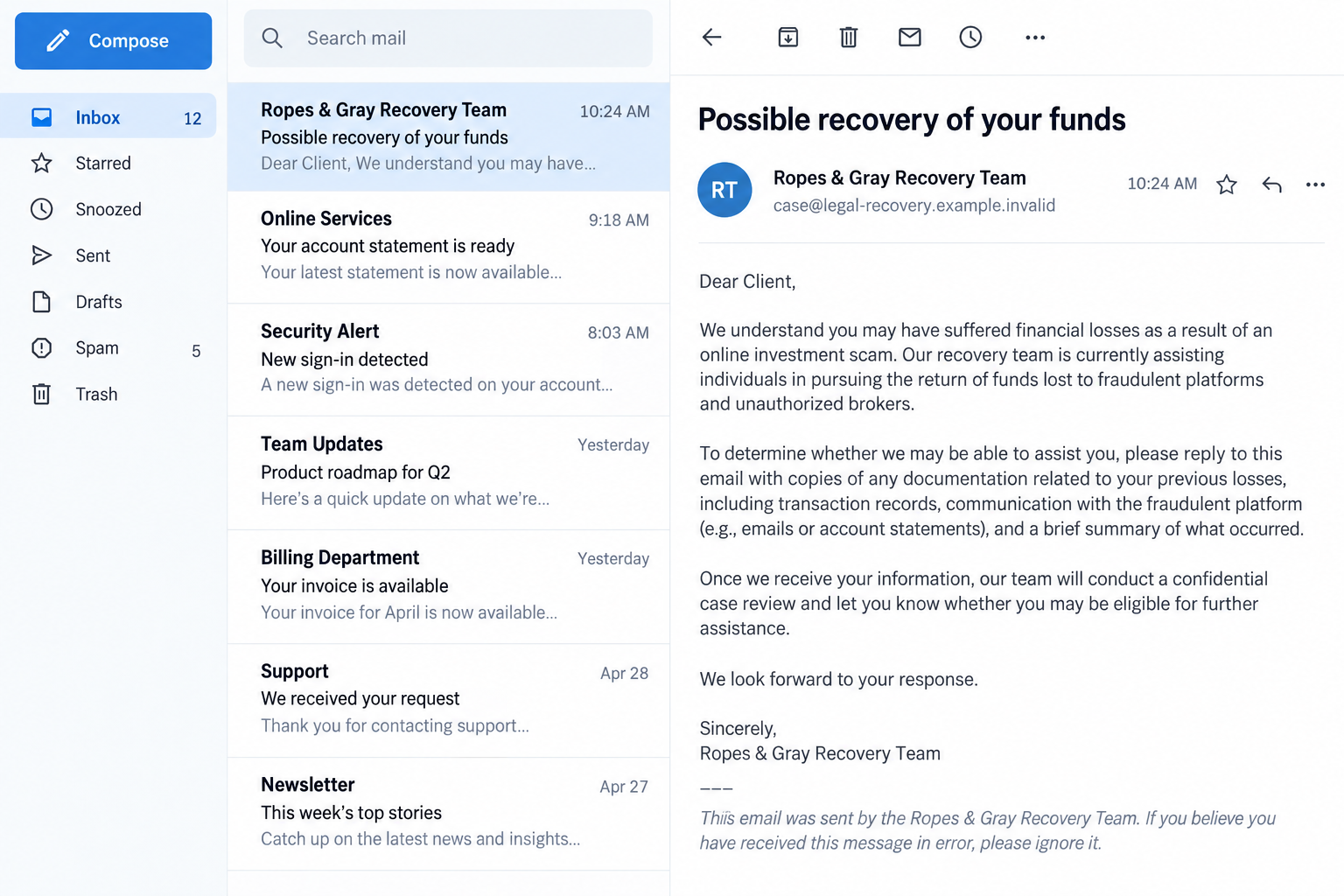
The Ropes & Gray recovery email
Scammers have misused the name of Ropes & Gray International LLP in messages about recovering funds lost to earlier scams.
The Solicitors Regulation Authority alert documents emails using lookalike domains, names of purported firm representatives, and a stamped document presented as a legal contract.
The regulator also reported an Instagram advertisement promoting recovery help under the firm’s name. The genuine firm said it was not connected to the contacts.
This is an impersonation scam. It is not evidence that Ropes & Gray itself is fraudulent or that every person who discusses loss recovery is dishonest.
Why the approach is especially harmful
The recipient may already be dealing with the stress of a stolen investment or other loss. A legal-looking email can make relief seem finally possible.
The sender may ask for documentation about the earlier scam. That can include transaction records, identity details, wallet addresses, and correspondence.
Those materials can help an impostor tailor a second fraud. The request deserves verification before you reveal anything sensitive.
The verification test
Look up the firm through its own website and the regulator’s register. Do not use the phone number, link, or reply address in the unexpected message.
- Inspect the full sender domain, not only the display name.
- Ask the firm through its published contact route whether it sent the message.
- Do not pay an upfront recovery fee to an unsolicited contact.
- Do not send old scam records before an independently verified engagement exists.
A real firm’s name, attorney name, or registration number can be copied. Those details make verification more important, not less.
What the Regulator Actually Reported
The SRA’s warning is specific. It describes emails from addresses using domains that resemble the genuine firm’s web address but are not the same.
Examples in the alert include `ropesgray.international` and `ropesgray.center`. The regulator said the listed contacts were not undertaken by a genuine authorized solicitor.
Some messages purported to come from people whose names sound credible in a legal context. A name can be real, invented, or borrowed.
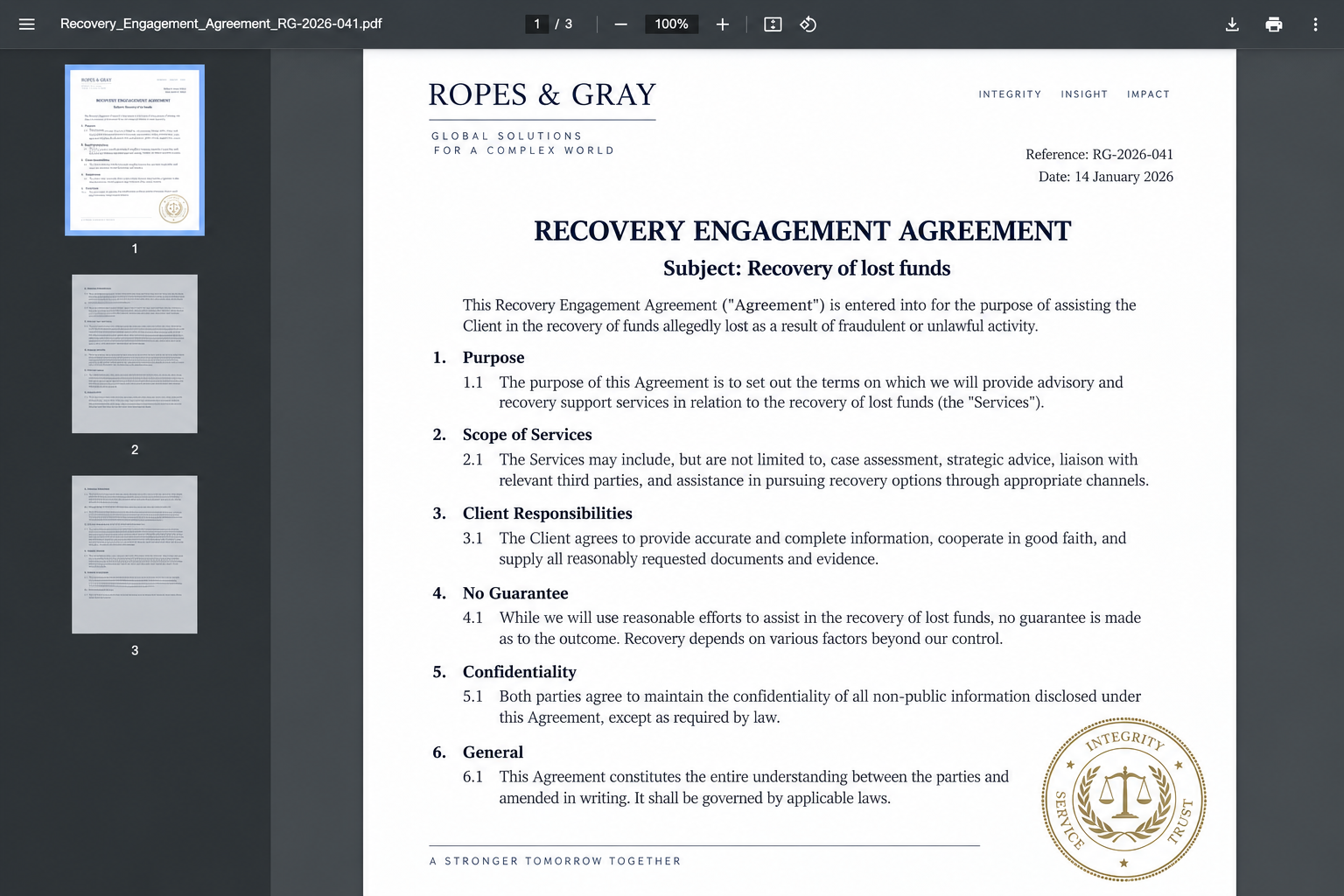
In one example, an email included a stamped document that misused the firm’s name and genuine SRA ID. A stamp does not authenticate a sender.
The regulator said the messages concerned supposed recovery of money lost in scams. It did not establish that funds had been recovered for the recipients.
Ropes & Gray International LLP confirmed it had no connection to the specific emails and phone numbers described in the alert.
The firm’s contact policy warns that sending information does not create a lawyer-client relationship. It asks people not to send confidential material before a written engagement exists.
That policy is a useful reminder even when an inquiry is genuine. An unsolicited recovery pitch should not receive your files first and answer questions later.
There may be other unrelated messages using the firm’s name. The SRA alert documents a recovery theme; it should not be stretched to prove every possible allegation.
For this article, the focus is the documented recovery impersonation and the practical steps for someone who received a similar approach.
How the Ropes & Gray Recovery Scam Works
Step 1: The scammer identifies someone with a prior loss
A person who lost money may have complained publicly, joined a recovery group, or shared details with a fraudulent platform. That information can circulate.
The FTC warns that recovery scammers sometimes use lists of prior victims. They may know a name, amount, or type of fraud.
That familiarity can feel like proof of a legal investigation. It is not. Someone who bought or copied the data can repeat it.
The sender may contact you through email, social media, messaging apps, or a phone call. The exact channel can change while the recovery promise stays.
Step 2: A respected firm name supplies authority
The email uses Ropes & Gray’s reputation as a shortcut to trust. A display name can say the firm name while the address uses a lookalike domain.
Some versions borrow an attorney name or regulator number. Readers may search the name, find a real professional, and stop checking the sender.
That is precisely the gap an impostor exploits. A real person’s biography does not authenticate an email sent by someone else.
Compare the full address character by character. Then contact the firm using the address or telephone information published on its genuine website.
Step 3: The pitch turns hope into a document request
A recovery-themed email may ask for transfer receipts, correspondence with the original scammer, identity records, or a summary of what happened.
Those documents can be genuinely useful in a lawful complaint. They can also expose sensitive information when sent to an unknown party.
One SRA update described a purported representative asking for all documentation about previous scammers and losses. The regulator linked that approach to impersonation.
Do not send a passport image, bank statement, seed phrase, or full account record because a stranger claims to review a case.
Even if the first request seems harmless, it can build a detailed profile for later pressure.
Step 4: Legal styling makes the relationship appear real
The SRA saw a stamped document presented as a legal contract. A seal, signature block, or regulator number can be copied into a PDF.
An agreement may use formal language and still come from an impostor. Verify the sender and the engagement before treating the file as authoritative.
Do not click a document link if it unexpectedly asks you to sign in, install software, or enable macros. A recovery conversation does not require those actions.
The illustration above is a reconstruction, not the document the SRA examined. Its purpose is to show how familiar legal design can lend false confidence.
Step 5: The impostor seeks money or further information
Recovery scams commonly ask for a retainer, processing fee, tax, or transfer charge before returning money. The FTC warns that upfront requests are a major sign.
Others ask for banking information, supposedly to deposit recovered funds. Sharing that data can lead to additional theft.
We do not have evidence that every Ropes & Gray impersonation email used the same payment demand. Treat this as a risk pattern, not a documented outcome for all recipients.
If someone insists recovery is guaranteed once you pay, stop. Real recovery depends on facts, legal process, and whether assets can be traced.
Step 6: Follow-up contacts try to defeat hesitation
A hesitant target may hear from another supposed attorney or case manager. The new name and number can make the operation appear larger.
The SRA documented multiple names and contact details in updates to its alert. That is a reason to verify the organization, not just one sender.
A caller may say the case is confidential or that verification would cause you to miss a deadline. A legitimate firm should tolerate independent checking.
Keep the conversation paused until the genuine firm confirms contact through its own published channel.
How to Verify a Law Firm Recovery Offer
Begin with the exact sender domain. Do not stop at the display name, a logo, or a signature that includes a real office address.
Look up the firm in the regulator’s public register. The SRA lists Ropes & Gray International LLP and the firm’s genuine website.
Then contact the firm from the website you opened yourself. Ask whether the named person and particular recovery matter are real.
If you are in another jurisdiction, check the relevant bar or legal regulator too. Registration in one place does not verify a message from an unknown address.
A genuine lawyer may ask for documents after taking on a case. The order matters: verified contact and engagement should come before broad disclosure.
Do not send cryptocurrency to “activate” a legal recovery. A transfer to a private wallet is especially difficult to reverse.
Do not accept a screenshot of funds in an escrow account as proof. Ask the actual institution holding the money, using independently found contact details.
Check whether the proposed service matches the firm’s publicly described practice. The SRA said the genuine firm did not offer the advertised recovery service in that alert.
Finally, get a second opinion from a lawyer you choose yourself if the potential recovery is substantial. Do not let the unsolicited sender select your verifier.
Why a Real Attorney Name Is Not Enough
Impersonators do not need to invent a person. They can copy a public biography, office phone number, or professional registration from a real website.
That creates an uncomfortable situation: a search may confirm the attorney exists while the message is still fake.
Focus on the communication path. Did you initiate contact through the firm’s official site? Does the actual firm confirm this matter?
Lookalike domains can add words such as “international” or use different endings. A similar spelling is not a match.
The SRA’s alert is unusually useful because it names specific mismatched addresses. It also records that the genuine firm denied involvement.
However, scammers can register new domains tomorrow. An old list should not be your only protection.
What a Real Legal Engagement Would Require
A genuine law firm does not become your lawyer just because someone sent an email or you replied with a question.
Ropes & Gray’s published contact policy says a lawyer-client relationship requires the firm to agree in writing to handle a matter.
That written acceptance is not a magical seal. You still need to confirm it came from the real firm.
Ask for a clear description of who will work on the matter, what work is proposed, how fees are calculated, and what is uncertain.
A professional should be able to discuss the limits of recovery. No one can guarantee that an unknown scammer’s money remains available.
The earlier fraud may involve banks, exchanges, payment processors, or jurisdictions with different procedures. A realistic assessment considers those facts.
Do not let a stranger pressure you to sign an agreement before you have verified their identity and understood the terms.
Be especially cautious if payment instructions arrive from a different email address after the initial conversation. Confirm any change by calling a verified number.
Keep a copy of every document you receive, but do not treat a PDF as independent evidence of authorization.
If you decide to seek legal help, choose the professional yourself. The regulator’s register and the firm’s site are better starting points than an unsolicited pitch.
What to Do if You Have Fallen Victim to This Scam
- Stop the conversation and preserve it. Save the full email, headers, attachments, chat messages, phone numbers, and transfer instructions. Do not forward sensitive documents to anyone else while you investigate.
- Verify the firm independently. Use Ropes & Gray’s genuine website and the SRA register. Explain the sender address, name, and claim without using contact details supplied by the suspect.
- Tell your bank or payment provider if you paid. Act quickly. Ask whether the transfer can be recalled or disputed and what account protections are needed. The answer depends on the payment method and timing.
- Protect documents you sent. If you shared identity papers, bank records, or login details, ask relevant institutions how to flag misuse. Change compromised passwords from a trusted device and monitor accounts.
- Inspect the device if you opened a risky file. An ordinary email is not proof of malware. If you downloaded software, enabled macros, or entered credentials on a linked page, run a trusted scanner such as Malwarebytes and seek professional help as needed. AdGuard can reduce malicious-ad exposure but does not recover funds.
- Report the impersonation. Send the suspicious legal contact to the SRA if it concerns a regulated solicitor. Report financial loss to local police and, in the United States, the FTC.
- Return to legitimate recovery channels. Continue any bank dispute, police report, exchange complaint, or legal consultation you initiated yourself. The impostor’s failure does not decide whether another lawful remedy exists.
- Expect another approach. Someone with your loss details may contact you again. Treat every unsolicited promise of guaranteed recovery as a new claim requiring independent verification.
Frequently Asked Questions
Is Ropes & Gray a fake law firm?
No. Ropes & Gray is a genuine firm. The documented scam involves people misusing its name and contact details.
Did the SRA confirm recovery scam emails?
Yes. Its alert describes emails about supposed recovery of lost funds and says the genuine firm had no connection to the listed contacts.
Can a scam email use a real attorney’s name?
Yes. A public biography is easy to copy. Confirm the particular message with the firm using independently obtained contact information.
Does a stamped legal contract prove the case is genuine?
No. The SRA described a stamped document misusing the firm’s name and regulator ID. Verify the sender before trusting the paperwork.
Should I send my earlier scam records for a free review?
Not to an unsolicited, unverified sender. Those records can contain sensitive financial and identity information.
Can a real lawyer help recover scam losses?
Sometimes, depending on the facts and jurisdiction. Choose and verify a lawyer yourself, get written terms, and be skeptical of guaranteed results.
The Bottom Line
The Ropes & Gray recovery scam borrows a real firm’s credibility to approach people already harmed by fraud. The law firm’s name does not authenticate the email.
Check the sender through the firm’s official channels before sending documents or money. A genuine route to recovery will withstand that basic verification.








