

A stranger claims to know something serious about your passport. They speak with official confidence and insist that your next decision cannot wait.
For someone living away from their home country, that kind of message can make every ordinary travel plan suddenly feel uncertain.
Overview
The threat aimed at people living abroad
The FBI warns that criminals impersonate foreign law enforcement or diplomatic officials. Some threaten expatriates or international students with extradition or home-country passport cancellation.
These are not ordinary requests to update a travel document. The caller claims control over a legal or consular process and uses fear to demand money or personal information.
The FBI recorded 1,809 complaints in this specific variant from January 2025 through July 2026, with reported losses exceeding $140 million.
Those are complaint figures, not a count of every attempt. They also do not prove that every message mentioning a passport belongs to one network.
The reported losses are substantial, but a person reading one threatening email should not assume the message itself has any legal force.
The offender’s claim and the government’s records are separate things. That distinction is the foundation for checking the situation safely.
Why the claim can feel hard to check
A person may not know how a foreign police agency communicates with citizens abroad. The scammer exploits that uncertainty and claims the matter is confidential.
Caller ID, employee names, and government-looking credentials can be spoofed. The FBI says some operators use fake uniforms or office sets during video calls.
A screen that resembles an official office does not establish authority. The person who initiated the unexpected contact still needs independent verification.
The call may happen outside office hours, when a recipient cannot immediately reach an embassy. That delay can make the imposed deadline seem more urgent.
Keep the message overnight if necessary. A short verification wait is safer than a payment to someone whose position has not been confirmed.
The safest immediate move
End the conversation without paying or providing an identity document. Locate the relevant embassy, consulate, or agency through its official website.
- Do not use a callback number or link supplied by the threatening contact.
- Ask the genuine office whether the named officer and case exist.
- Keep the message, caller details, and any payment instructions.
- Seek qualified immigration or legal advice if an independently confirmed matter exists.
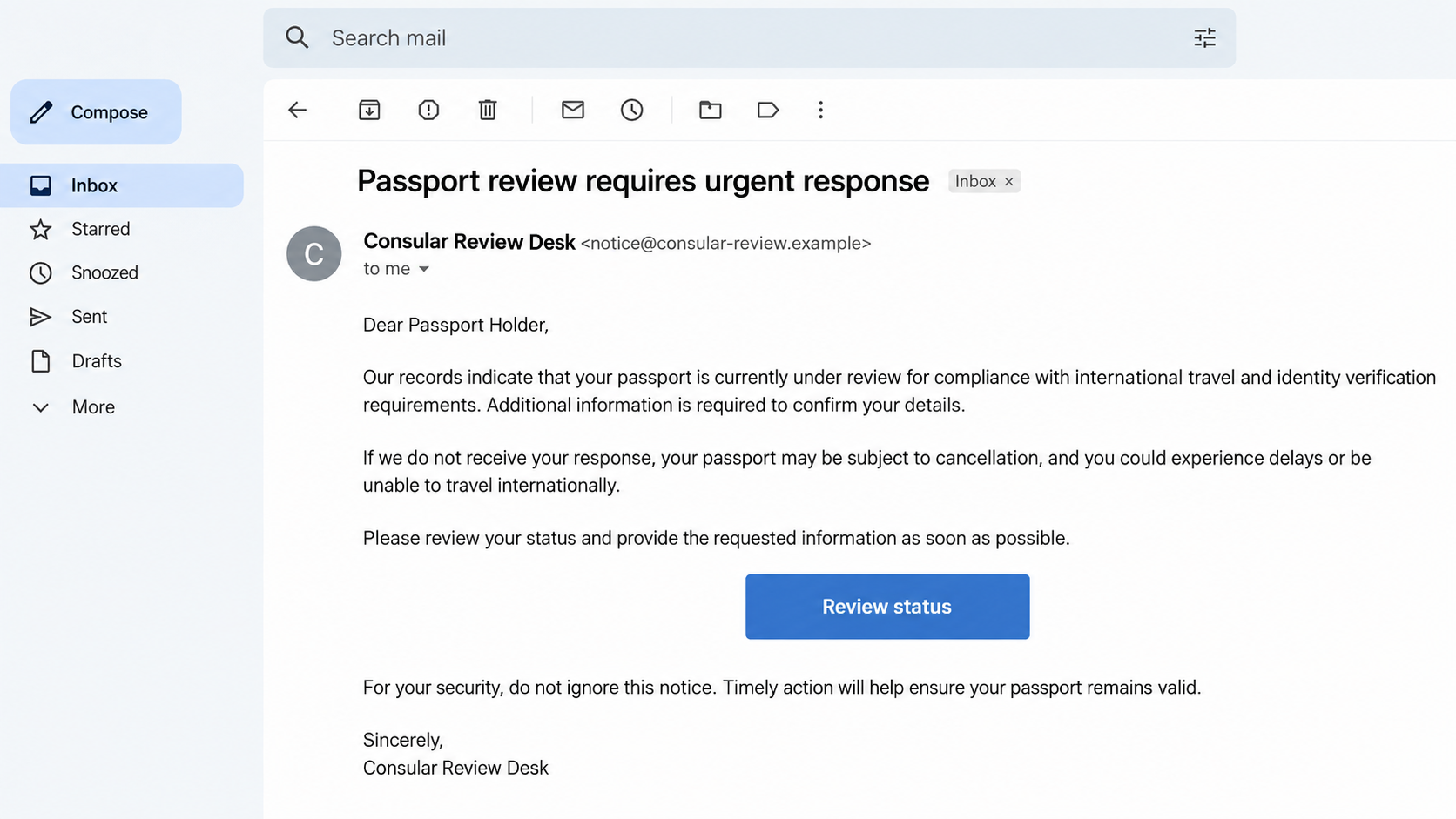
The inbox above is an illustrative reconstruction using a fictional sender. It is not a captured message from a reported victim or any real consulate.
How the Fake Diplomatic Official Scam Works
Step 1: Reach a person with a cross-border connection
The reported targets include foreign nationals, international students, and people from different ethnic communities in the United States.
A scammer may learn a person’s background from public profiles, community groups, or previous data exposure. The FBI does not say every case uses the same targeting method.
What matters is the fit between the story and the recipient. A threat about a home-country passport has more emotional force when travel is complicated.
Parents may also worry if the recipient is a student overseas. The impostor can turn that concern into pressure to keep the call private.
A student might fear losing a visa or missing a semester. The scammer does not need to control either process to exploit that fear.
Community-specific language can make the pitch sound knowledgeable. Someone speaking your language may still be an impostor rather than a consular employee.
Step 2: Claim a police or consular identity
The contact may begin by phone, text, or email. The speaker names a foreign police department, a diplomatic office, or an official-sounding case unit.
A familiar area code or government-looking address is not verification. Spoofing can make displayed details different from the system actually placing the call.
The caller may quote a case number or read out personal facts. Neither proves employment with an agency; reference numbers and leaked details can be invented or reused.
If asked for a written notice, the person may send a PDF. A formal layout can look persuasive while still being made outside any government system.
Check whether the claimed office has a published procedure for notices. Do not assume a stamped attachment is equivalent to a record in that procedure.
Step 3: Introduce the extradition or cancellation claim
The caller says a passport is about to be cancelled, or that the person faces extradition over an investigation in another country.
That threat is designed to interrupt normal judgment. It combines uncertainty about foreign procedures with a severe consequence the recipient may feel unable to challenge.
Some people worry that ending the call could be treated as noncooperation. A legitimate process does not become invalid because you independently confirm an unknown caller.
The threat can also be phrased as “help us clear your name.” That softer version still asks you to accept the stranger’s authority first.
Ask what specific allegation is being made, but do not supply missing personal details. An evasive answer is another reason to end the call.
Do not argue about laws with the impostor. Preserve the allegations and verify them with the real institution or an independent lawyer.
Step 4: Add a convincing visual or secrecy demand
The FBI describes scammers appearing on video in fake uniforms or mock official facilities. It also notes AI tools can support realistic impersonation.
That does not mean every case uses AI or a video call. A plain phone call and copied letterhead can be enough for this fraud.
The supposed officer may refuse to speak with a family member, lawyer, or bank. Isolation makes it harder for anyone else to test the story.
Another tactic is keeping the recipient on the call continuously. If you cannot pause to verify, the caller controls the only information you hear.
An instruction not to tell your university, family, or bank protects the impostor from contradiction. It does not protect your passport.
Step 5: Convert fear into a transfer or data disclosure
The broader FBI alert documents demands for prepaid cards, bank wires, cryptocurrency, cash couriers, and payments at cryptocurrency kiosks.
For the diplomatic variant, a demand may be framed as a clearance payment or confidential cooperation. The exact wording varies, so focus on the behavior.
No government officer should use an unexpected call to demand payment as the price of avoiding arrest or keeping a passport valid.
Be especially wary if the recipient account belongs to a person or company unrelated to the alleged agency. A cross-border transfer can be hard to recover.
Do not send a passport photo merely to “open” the case. Document images can create a separate identity risk even without a cash payment.
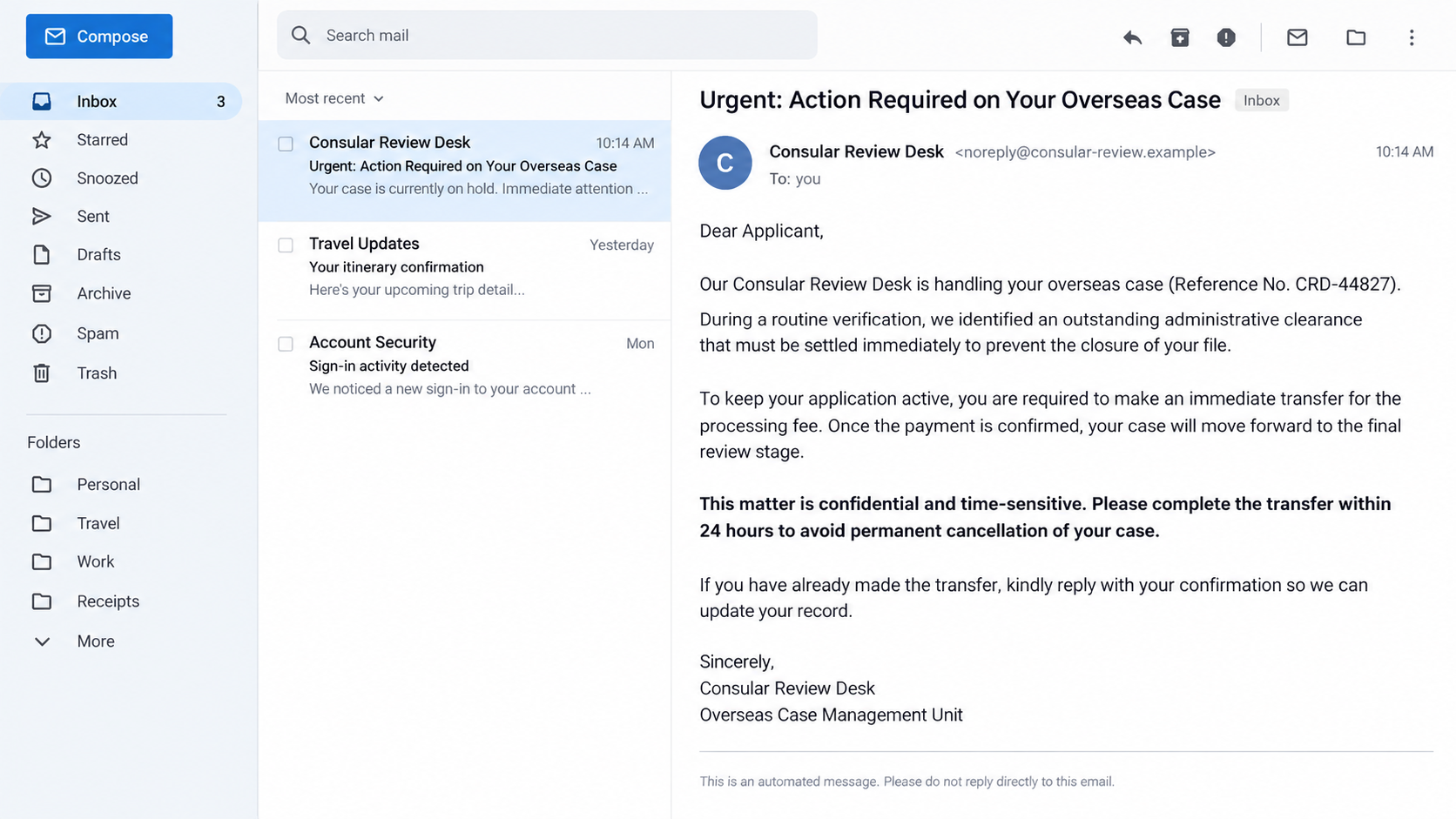
The second image shows a fictional follow-up. Its invented desk, case number, and transfer request are examples, not verified text from the FBI’s cases.
Step 6: Discourage outside contact after payment
If a victim pays, the scammer may keep the purported file open and ask for another action. The person may be told the first transfer is still under review.
The FBI’s warning does not establish one universal follow-up script. The stable element is the impersonation of authority to extract money or sensitive details.
Secrecy after a transfer helps the thief too. Reporting promptly gives financial institutions and investigators a better chance to trace the route.
When the story changes, note each version. Contradictory reasons for urgency can help an investigator understand how the contact evolved.
How to Verify a Real Diplomatic or Police Matter
Find the institution without the caller
Type the embassy or consulate’s official address yourself, or find it through your home country’s government directory. Ignore a link sent by the alleged officer.
Ask whether the office employs the named person and whether it can confirm the case reference. Explain that you are checking an unsolicited threat.
Do not assume the first person who answers a number printed on the letter is independent. That number may route directly to the same operation.
If the official website has several regional offices, select the one that actually serves your location. Ask for the correct department rather than guessing.
A local police nonemergency number may also help if you are being threatened with immediate arrest. Do not use an emergency line for routine verification.
Get help from a trusted local adviser
International students can contact a university’s international-student office. A reputable immigration lawyer can advise on a genuine status issue.
If you believe a real warrant or document problem exists, professional advice matters. A scam report cannot decide your legal status from one message.
Verification and legal advice are compatible. You can refuse an unverified payment demand while still taking a legitimate notice seriously.
Check the requested method, not only the story
Ask why an official would require cryptocurrency, prepaid cards, or a transfer to a private account. Those routes are central warning signs in the FBI alert.
Being told to hide the call from your bank or family is another reason to stop. Genuine authorities should withstand independent scrutiny.
Recorded audio, screenshots, email headers, and payment instructions may help investigators. Preserve them without opening suspicious attachments again.
Names and badge numbers supplied by the caller are search leads, not proof. Confirm them with the agency switchboard you found independently.
Why Video Calls and Credentials Can Mislead
A uniform communicates authority instantly, even when the wearer has no authority. The same is true of a flag, seal, or formal room in a video background.
The FBI specifically notes mock official facilities and AI-supported video impersonation. Neither turns a caller into an officer simply because the image looks coherent.
Ask yourself who initiated the contact and how you would verify them if the video were switched off. That is the safer test.
A photo ID sent in chat is another self-issued proof. It is easy to produce and impossible to validate by looking at the pixels alone.
Official websites and published phone numbers are useful because you choose the channel. Still confirm that you reached the agency’s actual domain and not a search ad.
If language barriers make a call difficult, request translation help from a trusted adviser. Do not let the impersonator become your only interpreter.
Video quality is not a test either. A crisp background and convincing voice can be staged, while a real office may have a poor connection.
The safest question is practical: can the supposed official be reached through a channel the caller does not control?
What to Do If You Fell for the Diplomatic Official Scam
- Stop contact and get to a safe pause. End the call or chat. A demand to stay connected is part of the pressure, not a legal obligation created by the stranger.
- Call your financial institution now. Explain any wire, card, cryptocurrency purchase, or account disclosure. Ask what can be stopped, recalled, or monitored under the payment method used.
- Secure exposed identity information. If you sent a passport image or other documents, contact the issuing authority and ask about fraud precautions. Monitor accounts for misuse.
- Verify the alleged case separately. Find the real diplomatic or police office through official channels. If it confirms a genuine issue, get qualified legal advice before responding.
- Preserve and report evidence. Save call logs, messages, wallet addresses, transfer records, and the names used. Report to local police and IC3 in the United States.
- Tell a trusted person. The scammer’s secrecy demand isolates you. A friend, family member, university adviser, or lawyer can help assess the next steps.
- Reject paid recovery promises. An unsolicited “agent” asking another fee to undo the transfer may be a second fraud. Do not send more money to regain control.
If you opened a file or installed a remote-access tool, disconnect the session and run a Malwarebytes scan. Change passwords from a trusted device.
AdGuard may help reduce future malicious advertising, but it cannot verify an official or reverse a transfer. Prioritize the bank and genuine agency.
If you made a cryptocurrency payment, keep the transaction hash and destination address. They may help your report even when reversal is unlikely.
If a courier collected cash, write down the pickup place, time, description, and any messages. Give those details to law enforcement promptly.
Frequently Asked Questions
Can a foreign consulate really contact citizens abroad?
Yes, legitimate contact is possible. The warning is about an unverified caller using threats and immediate payment demands. Confirm any actual case independently.
Does caller ID prove the official number is calling?
No. The FBI warns that displayed numbers can be spoofed. Hang up and dial a number found on the real agency’s site.
What if the caller knows my passport details?
Personal details can leak or be obtained elsewhere. Do not treat knowledge of a document number as proof of authority.
Is a uniform on video enough to verify an officer?
No. The FBI describes fake uniforms and staged facilities in these schemes. Verify the person’s identity using an independently sourced agency contact.
Should I pay to stop a threatened extradition?
Do not pay an unsolicited caller. Seek immediate advice from a qualified lawyer if an independently confirmed legal matter exists.
Where can a U.S. target report this?
Report to local law enforcement and the FBI’s Internet Crime Complaint Center at ic3.gov. Keep message and payment records for the report.
The Bottom Line
The diplomatic official scam turns uncertainty about foreign procedures into a demand for money or personal data. Convincing names, video, and documents do not replace verification.
Break the caller’s information loop. Contact the real institution yourself, protect accounts if you shared details, and seek legal advice for any genuine matter.








