

The application looks complete, the approval email arrives, and the money seems close enough to plan around. Then a new condition appears between you and the funds.
When a lender introduces a surprise requirement at the last moment, the paperwork deserves a second look before any payment leaves your account.
Overview
The reported personal loan pitch
Australia’s Scamwatch warns about fraudulent personal loan websites and social media advertisements. The operators pose as lenders or brokers.
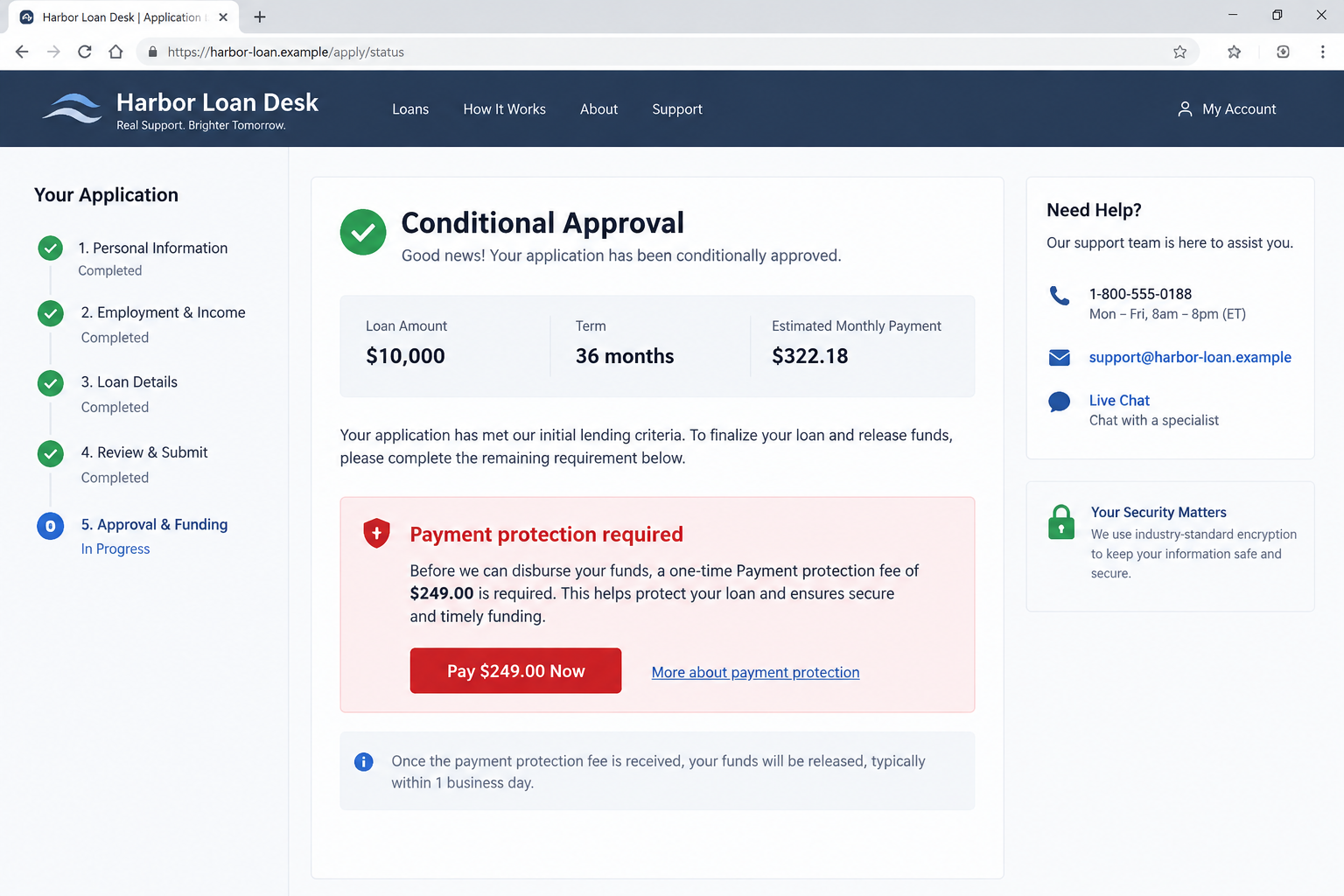
A person applies, receives an apparent approval, and is asked for documents. Before any loan money arrives, the supposed lender demands an upfront “payment protection” charge.
The fraud is not ordinary loan insurance. It is a demand to send money to the operator of a fake offer before the promised loan exists.
Why the approval feels convincing
Applicants may receive a contract, an approval email, and a portal showing loan terms. Those elements can be copied or invented without a real underwriting decision.
Scamwatch says some operators misuse details from genuine Australian Business Number and credit licence records. A real number in a document does not prove the sender owns it.
People looking for a loan may be under time pressure. The fake approval turns financial stress into anticipation, then makes the fee appear to be the final hurdle.
The lender’s confidence can be persuasive. Someone who feared rejection may feel relieved that the application appears to have moved forward.
That emotional shift matters because it changes the question from “Is this company real?” to “How do I complete the last step?”
What to check before paying
Leave the offer page and independently identify the licensed organization. Contact that organization through details from its verified website or ASIC’s records.
- Ask whether the exact website and staff member belong to the licensed business.
- Compare the payment recipient with the legal entity named in the contract.
- Decline a separate transfer demanded before any loan funds are released.
- Do not send bank or myGov passwords to a person claiming to approve a loan.
The example approval screen above uses a fictional lender and amount. It illustrates the reported mechanism, not an actual case file or identified company.
How the Personal Loan Payment Protection Scam Works
Step 1: Place a loan offer where borrowers search
The operator creates a loan-looking website and promotes it through social media advertisements. A polished page can make the offer seem like another mainstream lender.
The site may emphasize fast approval, flexible credit, or help during hardship. Scamwatch specifically warns that people experiencing financial difficulty can be vulnerable.
An ad is distribution, not vetting. The platform may remove a fraudulent advertisement later, but a visitor can reach the fake application first.
A social ad can also be shared by a friend who has not checked it. A familiar referrer does not authenticate the lender behind the page.
Some sites use generic company language and stock-style testimonials. Others copy details of a real license holder to make independent searches appear reassuring.
Step 2: Collect an application and create an apparent approval
The form asks for a name, address, employment details, requested amount, and contact information. In a legitimate process these details are sensitive; here they reach criminals.
The response may come by email or direct message. It can include a loan contract with repayment figures, giving the applicant something tangible to review.
At this stage, approval language is the bait. A PDF with a signature line is not proof that money has been set aside for disbursement.
Read the contract carefully, but do not stop at reading. A fabricated document can be internally consistent while naming an entity unrelated to the sender.
Ask the purported lender to confirm the application through the contact listed on its verified public site, not the address printed inside the emailed PDF.
If the borrower questions the company, the operator may quote a valid ABN or Australian credit licence number. The important question is whether it belongs to that operator.
Step 3: Ask for identity and account access
Scamwatch reports requests for photo identification, payslips, bank statements, and even banking and myGov login details. The last two are especially dangerous.
A genuine lender may need to verify identity and income, but passwords should not be sent by email or handed to a stranger in chat.
Uploaded ID can support later impersonation attempts. Bank statements reveal balances, employers, transactions, and enough context to tailor the next approach.
MyGov credentials would expose access to Australian government services. A loan broker asking for the password should trigger an immediate halt and account check.
If the application form prompted a one-time banking code, do not share it. That code may authorize an account login rather than verify a loan.
Someone who never pays the fee may still face an identity problem if they submitted documents. Treat that exposure as separate from the payment loss.
Step 4: Make “payment protection” a precondition
The operator says an insurance premium or establishment charge must be paid before funds can be released. It may be described as a standard safety step.
Scamwatch notes a telling detail: the operator refuses to deduct the amount from the loan proceeds and insists on payment in full first.
The supposed reason can change. A caller may cite underwriting, fraud prevention, a transfer hold, or mandatory coverage. The demand still runs ahead of the loan.
The amount in our image is fictional. Scamwatch’s alert describes the fee type, not a universal price that every target sees.
Focus on the sequence, not a particular amount. Even a small fee is suspicious when it must be transferred separately to unlock already promised funds.
An honest explanation of costs should appear in formal loan terms. A last-minute demand routed through chat is not an ordinary substitute for disclosure.
Step 5: Promise the fee will return later
Some victims are told the payment will be refunded after three months. That promise makes an immediate outlay seem temporary rather than risky.
A refund date is easy to invent and hard to verify. By the time it arrives, the operator may have changed names, phone numbers, or websites.
The three-month story also discourages complaints. Someone waiting for a refund may not contact the bank until transfer-recall opportunities have narrowed.
If a first transfer succeeds, another issue may appear. Additional fees are a possible continuation, but Scamwatch’s alert does not establish a fixed sequence for every site.
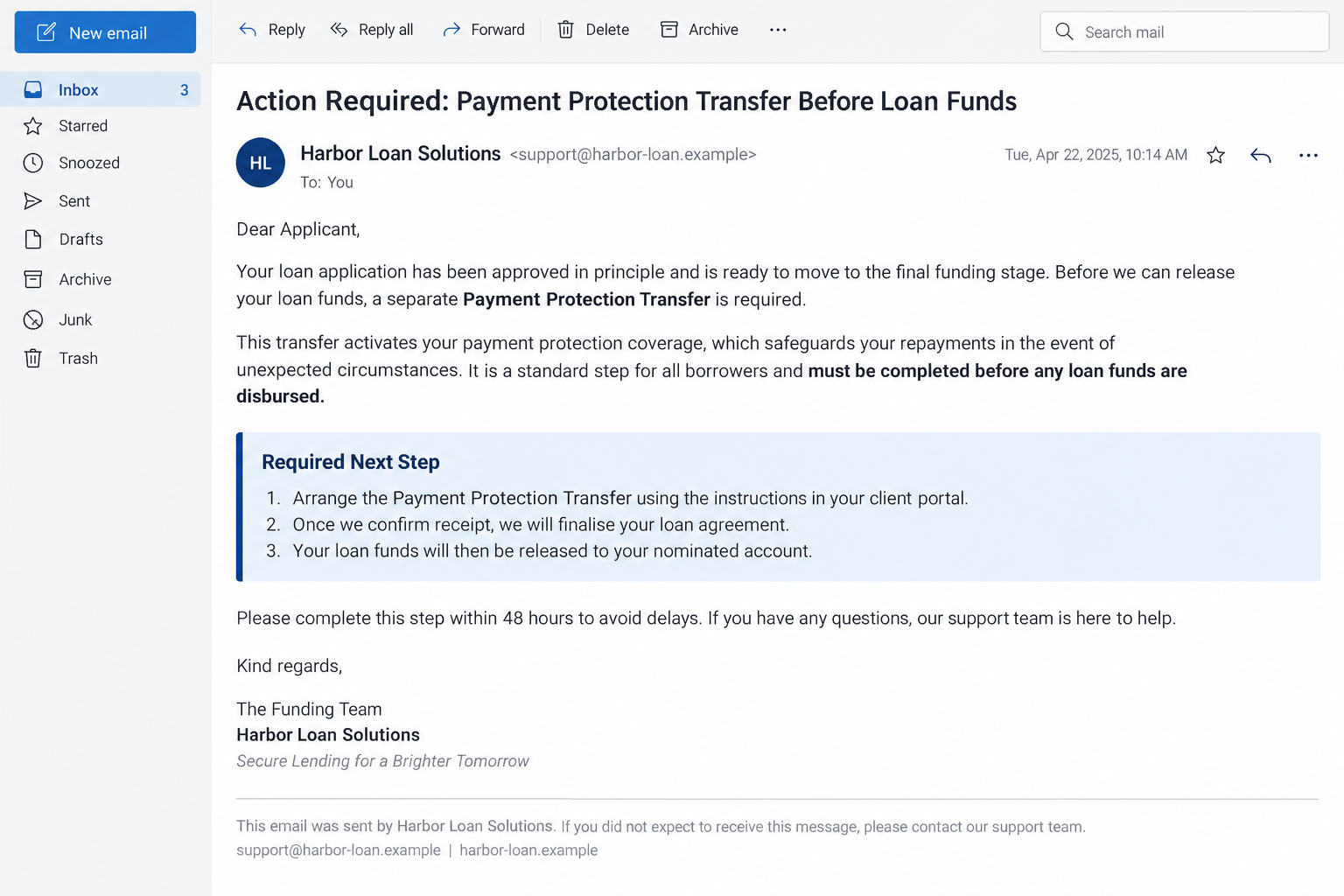
The email below is an illustrative reconstruction. Its invented sender and wording show how a separate transfer can be presented as a funding requirement.
Step 6: Keep the borrower waiting for funds that never arrive
After payment, the supposed lender may claim an administrative delay or stop replying. The original approval becomes a reason to wait instead of calling the bank.
The borrower has lost money and may have exposed identity documents. Those are two different problems with different recovery steps.
Act as soon as the fee demand seems wrong. Waiting for the promised refund can reduce the bank’s chance to intercept a transfer.
Company, Address, and Payment Recipient Checks
Match the legal name, not just the logo
Read the lender name on the offer, contract, privacy policy, email signature, and requested bank transfer. They should resolve to one identifiable business.
A copied logo or business number can make unrelated documents seem connected. Search the company yourself instead of following the page’s verification link.
Check whether a real company’s site links to the loan portal. If it does not, ask the company directly before concluding the portal is official.
Verify the credit licence through ASIC
Use ASIC’s professional registers to confirm the claimed licence holder. Then contact that holder using a separately sourced number and ask about the exact offer.
A record showing that a licence exists does not validate every website displaying its number. Scamwatch warns specifically about fraudulent use of genuine details.
Write down the licence holder’s exact legal name. Compare it with the name in your contract and the recipient on any payment request.
If the names differ, ask for a documented explanation from the verified organization. Do not accept a chat agent’s claim that the accounts are “partners.”
Investigate the address and contact route
A listed address may be a mailing service, unrelated office, or copied business location. An address alone does not establish who receives your application.
Call the verified entity, not only the number on the loan page. Ask whether its staff use the same domain and whether the applicant portal is theirs.
If the sender will only communicate through social media or a private chat, that makes the claimed corporate process harder to verify.
Try the stated support number before submitting documents. If it never answers or cannot identify the exact product, do not treat the address as proof.
Examine where the money would go
Compare the bank account name against the contracting company. A request to pay a personal account is a serious warning sign in Scamwatch’s guidance.
Do not assume a matching account name ends the investigation. Confirm the fee and recipient directly with the verified lender before moving funds.
If the payment route changes after you ask questions, stop. A supposed processing account that keeps moving is not a reassuring sign.
Why a Loan Contract Is Not Enough
A contract can describe terms that no real lender intends to honor. The question is whether an independently verified, licensed business actually issued it.
Look for inconsistencies between the website address, customer-service email, legal name, and the bank recipient. Small mismatches are more informative than polished formatting.
Be wary when the lender gives you a very short payment deadline. A real financial decision deserves enough time to read terms and seek advice.
Different countries have different lending rules. This case comes from an Australian alert, so ASIC and myGov references belong to that context.
For a loan offer elsewhere, use the regulator and identity-protection resources in your own jurisdiction. Do not assume Australian registration proves a foreign offer legitimate.
Even if the company name checks out, ask the company whether it operates the specific site and sent the specific approval. Impersonation often borrows real names.
Keep a copy of what you checked. If you later report the site, the original domain, claimed licence, and payment details help explain the impersonation.
Search for the exact web address, not merely the brand. A fake site can appear in results alongside a legitimate company’s unrelated pages.
Be cautious with testimonials on the offer page. They are controlled by the same operator making the promise and are not independent evidence of funded loans.
What to Do If You Fell for the Personal Loan Scam
- Contact your bank immediately. Explain the payment was induced by a fraudulent loan offer. Ask whether the transfer can be recalled, the recipient flagged, or further debits blocked.
- Protect online banking and myGov access. If you disclosed passwords, change them using the official apps or websites. Review sessions, recovery options, and multifactor authentication with each provider.
- Preserve the evidence. Keep the ad, site address, emails, contract, payment instructions, receipts, and names used by the operator. Do not keep interacting to gather more proof.
- Respond to identity-document exposure. If you supplied ID or payslips, contact IDCARE in Australia for tailored identity advice. Monitor accounts and ask the issuing authority about protective steps.
- Report the site and payment details. File a report with Scamwatch and, where relevant, the police and your financial institution. Mention any misused ABN or credit licence number.
- Check your credit and accounts. Watch for applications or transactions you did not authorize. Follow local credit-reporting procedures if identity misuse becomes apparent.
- Reject recovery-fee offers. A stranger claiming to retrieve the loan fee for another advance payment may be exploiting the same loss.
If you entered a password on the site, security software cannot undo disclosure. Change the credential first, then check the device if you also downloaded a file.
Malwarebytes is useful if you installed suspicious software. AdGuard can reduce exposure to deceptive ads, but neither replaces banking and identity recovery steps.
Contacting the lender named in the documents also helps the real business learn its licence or name may have been misused.
Frequently Asked Questions
Is every loan insurance product a scam?
No. The warning concerns a fake lender demanding a separate upfront transfer before releasing promised funds. Verify any real product with its actual provider.
Does a valid Australian credit licence number prove the site is genuine?
No. Scamwatch says fraudsters may quote real licence information. Contact the listed licensee through independently found details to confirm the site and representative.
Why will the operator not deduct the fee from my loan?
In the reported pattern, forcing a separate payment is how the criminal obtains money before any loan arrives. The refusal is an important warning sign.
What if I sent documents but no money?
You may still face identity misuse. Preserve the messages, secure affected accounts, seek IDCARE guidance if in Australia, and watch for unauthorized activity.
Can the bank always reverse an upfront transfer?
No. Speed and payment method affect the options. Contact the bank immediately, provide transaction details, and ask for its fraud process.
Should I wait three months for the promised refund?
No. Scamwatch identifies that promise as part of the pitch. Report the issue now while payment and account protections may still be available.
The Bottom Line
A fake loan approval can hide a direct request for money and identity data. In this pattern, “payment protection” is the fee demanded before any funding exists.
Verify the actual lender, domain, licence, and payment recipient through independent channels. If you already paid or shared credentials, involve your bank promptly.

Join the discussion
0 commentsShare your experience or ask a question about this article.
Discussion
Start the conversation
Have a question or something useful to share? Add the first comment.