

A page promising work around a global football event can be tempting to open. The name in the address bar looks close to one you recognize.
Before you upload a résumé or identity document, take a moment to confirm which organization actually owns the page in front of you.
Overview
What the FBI actually identified
In a May 2026 public warning, the FBI listed websites spoofing FIFA. Several domain names contained words such as jobs, hiring, HR, careers, or career hub.
The FBI said spoofed sites can collect personal information, sell fake tickets or hospitality products, and potentially facilitate other malicious activity.
Its warning did not establish that every jobs-themed domain advertised a specific position, charged an application fee, or stole a particular applicant’s data.
That distinction matters. The confirmed fact is website impersonation; a job seeker’s document exposure is a serious, plausible risk on such a site.
The alarm is therefore about where an applicant might be led, not a claim that the FBI verified every screen in our illustrations.
Separate the address from the content. A careers word in the domain is observable; the intentions of an unseen form require additional evidence.
Why a careers-looking address is effective
An applicant may focus on role descriptions, pay, or event access. A domain containing “fifa” and “careers” can appear official at a glance.
The page can borrow colors, event language, and professional application steps. None of those design choices proves ownership by the real organization.
FIFA itself is the impersonated brand, not the operator of the spoofed domains in the FBI warning.
A person may also confuse a tournament contractor with the governing body. A legitimate contractor relationship should be independently traceable from official announcements.
Recruitment excitement can make this seem like a minor detail. In reality, the employer’s identity determines who receives your documents.
The safest route to a genuine opportunity
Go directly to FIFA’s official website by typing fifa.com yourself. Navigate to careers from there rather than trusting a search result or forwarded link.
- Compare the complete domain, including its ending, with the official site.
- Do not upload ID to a page whose ownership you cannot verify.
- Be skeptical of sponsored results that resemble an official recruitment page.
- Keep a copy of a suspicious listing for a report, without submitting the form.
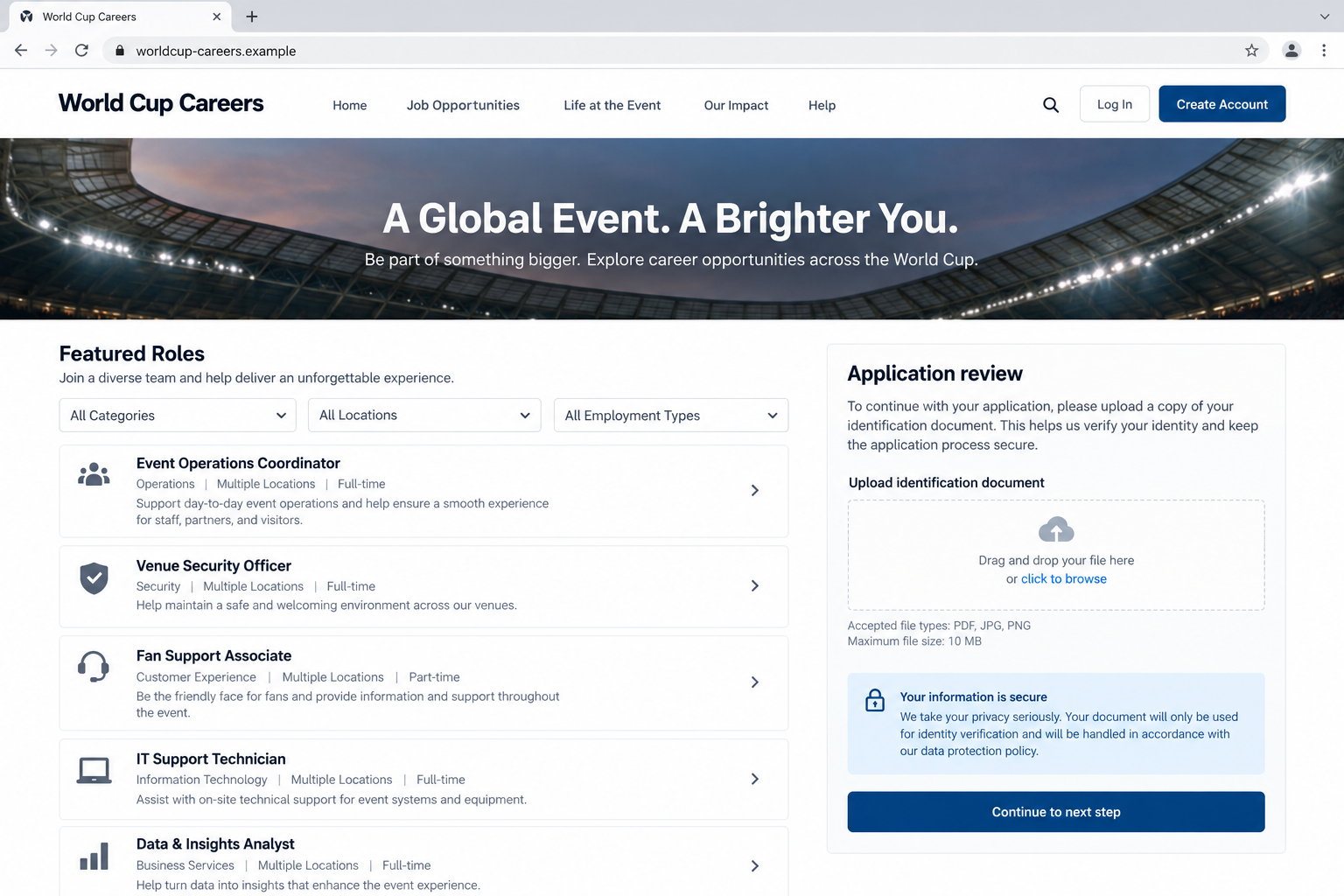
The careers screen above is a fictional illustration at a reserved example domain. It is not one of the websites the FBI listed.
How the FIFA Website Impersonation Scam Works
Step 1: Register a name that passes a quick glance
The FBI identified misspellings, alternative domain endings, and names adding a word to FIFA. Its list included several employment-themed addresses.
Examples in the alert included defanged forms such as jobs-fifa[.]com and fifa-careerhub[.]com. They are examples of names, not links to visit.
A domain with the correct brand letters is not automatically controlled by the brand. Anyone able to register a similar address can create that visual impression.
Small differences are easy to miss on a narrow screen, especially when the title says “official” and the search snippet sounds polished.
The part after the final dot matters. A domain ending in an unexpected extension is not made official by a recognizable word before it.
Hyphens can also rearrange an organization name into something that reads naturally. Read the whole address rather than recognizing only one fragment.
Step 2: Make the page look like a natural extension of the event
The FBI describes spoofing as creating a deceptive version of a legitimate site, complete with branding and product-style content.
A careers-themed version could present departments, locations, and application stages. Our illustrations show that possibility, not a recovered copy of a named domain.
Design is a weak identity test. A modern page can be assembled quickly, and a copied logo or photograph does not verify the operator.
Even links to a genuine FIFA page are not enough. A fraudulent form can sit beside outbound links to the real organization.
Photographs of a stadium or event badge add atmosphere, not authorization. Those visuals are easy to reuse across unrelated pages.
A privacy-policy link is worth reading, but its existence alone proves nothing. Check who the stated data controller is and whether the organization confirms it.
Step 3: Reach people through search and shared links
The FBI warned that users might visit spoofed sites while trying to access FIFA’s website. It specifically advised caution with sponsored search results.
A friend forwarding a listing may have checked only the title. The link still needs direct inspection before you open an application form.
Search results can show a shortened or visually confusing address. Tap or inspect the destination carefully before entering personal information.
If you are already on the page, open a new tab and navigate independently to fifa.com. Do not trust an “official site” button on the suspicious page.
A search ad can disappear after a campaign ends. Save a screenshot and the displayed destination if you need to report it later.
Do not use a recruiter-supplied QR code as a shortcut. It is another route to a destination chosen by the sender.
Step 4: Turn interest into personal-data entry
The FBI says spoofed FIFA sites aim to gather personal information, including names, home addresses, phone numbers, email addresses, and banking information.
A job application naturally asks for some personal details, which makes this theme useful for a thief. A later request for ID could seem like verification.
The warning does not say a particular careers domain collected passports. Treat our illustrated upload field as a plausible exposure, not documented evidence.
Do not provide banking details early in recruitment. An employer should not need your account number to decide whether to interview you.
Even basic contact details can support targeted follow-up. A later email using your chosen role and location may appear more authentic because you supplied them.
Before uploading anything, check whether the official site lists the same vacancy and the same application platform. A pasted job description can be copied.
Step 5: Use the data or make a separate money pitch
The FBI says information collected on spoofed sites can be used to create accounts in a victim’s name and commit fraud.
It also documented fake World Cup tickets and hospitality sales across the wider group of spoofed domains. That does not prove a job-fee scheme.
If a supposed recruiter later asks for an application, equipment, or training payment, verify it through FIFA’s real careers channel before paying.
The point is not that every unusual application charge is already proven in this case. It is that an unverified site controls both the form and any later messages.
A follow-up could also request a video interview or document scan. Verify the sender again before treating that invitation as evidence of a real hiring process.
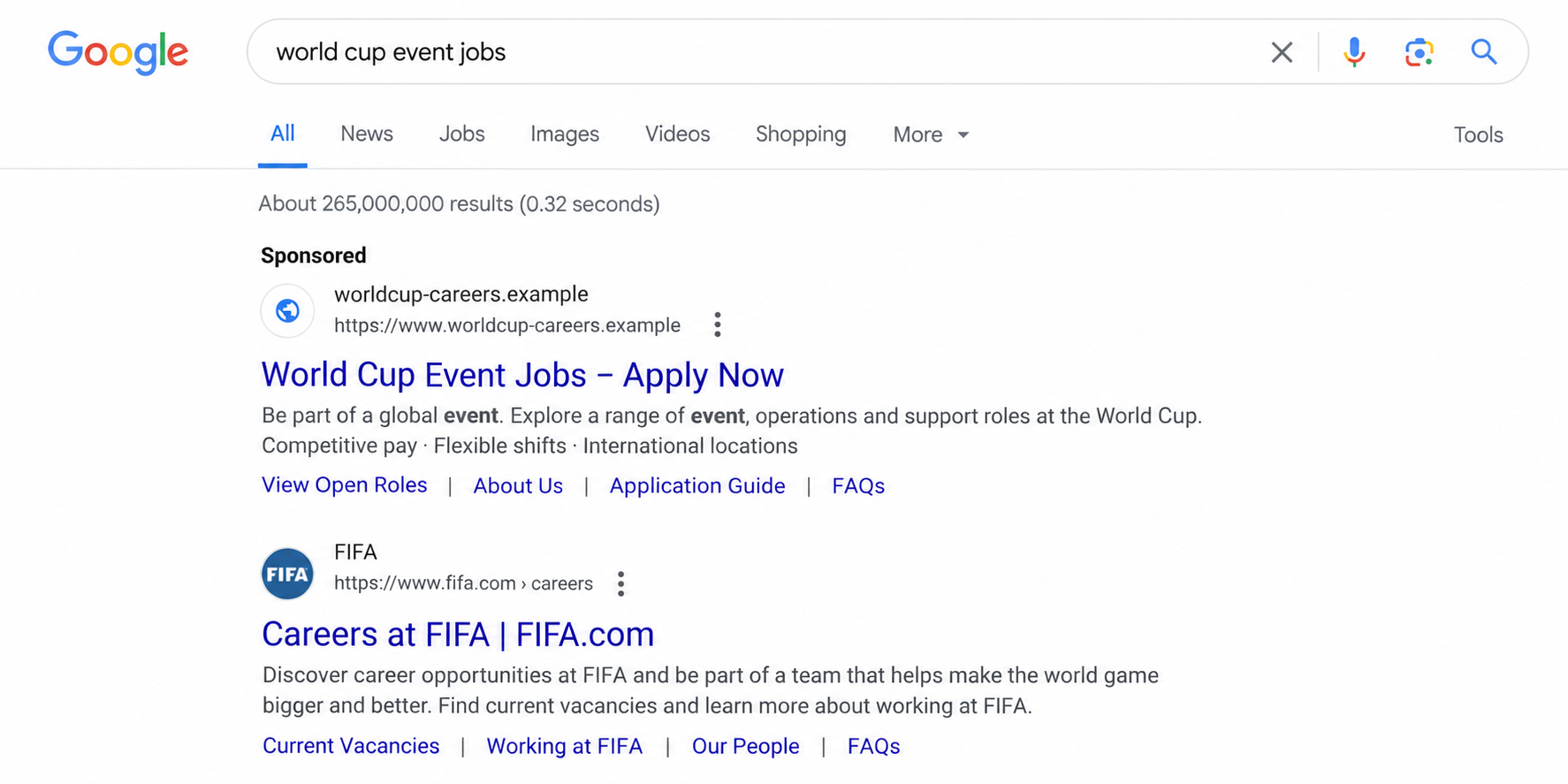
The second image compares a fictional sponsored result with the legitimate fifa.com domain. It is an illustrative comparison, not a captured search page.
Step 6: Change domains as old ones are flagged
The FBI anticipated additional spoofed addresses beyond those in its May 2026 list. A new domain may use different wording while repeating the same impersonation.
That is why memorizing a blacklist is not enough. Follow links from the verified organization and compare the complete destination every time.
A lookalike page may disappear quickly or remain online. Neither lifespan proves that the people behind it were authorized recruiters.
Search engines and security tools may eventually flag a domain. That helps, but a new registration can exist before it appears on warning lists.
The reliable habit is to begin from the real organization every time, especially when a forwarded link asks for identity data.
What Is Confirmed and What Remains Unproven
Confirmed: the FBI identified FIFA-impersonating domains, including several with hiring-related names. It warned that spoofed sites can harvest personal information.
Also confirmed in the broader campaign: fake ticket and hospitality sales were among the purposes identified. A visitor could encounter different lures at different domains.
Not confirmed by that alert: a documented job posting, applicant count, hiring fee, or victim loss tied to each careers-themed address.
A careful article should not invent those details. The warning is already valuable because an applicant may submit a great deal of sensitive information.
One site may present tickets while another uses hiring language. The FBI grouped spoofed domains in one alert, but did not assign every behavior to every address.
If a website changes content over time, an old screenshot may not show its present state. The domain and date of observation should travel together.
The two images are deliberately fictional. They help readers recognize the visual problem without reproducing an active malicious page or implying a verified screenshot.
When reporting a suspicious site, give authorities the exact domain. A broad phrase like “fake FIFA jobs” is less useful than the address you actually saw.
How to Check a Sports-Event Job Listing
Begin at the organization’s own site
Type fifa.com directly into the browser. Find careers or recruitment through the site’s navigation rather than starting from a paid result.
If a role appears only on another site, check whether the official organization links to that partner. A convincing logo on the partner page is insufficient.
Ask an official recruitment contact whether the partner is authorized to collect applications. Do not rely on the partner’s own assurance about its status.
Check the job title and location against current official vacancies. A dated listing may be recycled long after the original position closed.
Examine the full destination
Look past the page title and browser tab. Read the domain ending and surrounding words, not only the occurrence of “fifa.”
A lock symbol means the connection is encrypted. It does not tell you whether the person who registered the domain has any relationship with FIFA.
Look at any redirects too. A genuine-looking search result can send you to a different address before the form appears.
Protect the application data
A résumé can reveal home address, employers, phone number, and education history. Decide whether the site is genuine before submitting it.
Do not upload passport or driver licence images just because a form says the next stage requires identity verification. Confirm the process independently.
Use a unique password for any applicant account. Reusing a password on a spoofed site could expose unrelated email or shopping accounts.
Consider how much information the stage truly requires. A résumé submission and a final employment check are different points in a legitimate process.
If the form asks for more than expected, pause and verify. An attractive role is not a reason to rush past an unexplained passport upload.
What to Do If You Used a Fake FIFA Careers Site
- Stop using the site. Do not submit additional documents or pay a requested fee while verifying the address. Save the domain and any messages you received.
- Change reused passwords. Start with email and other important accounts. Enable multifactor authentication and review active sessions where available.
- Respond to document exposure. If you uploaded ID, contact the issuing authority or an identity-theft assistance service in your country about protective steps.
- Check financial accounts. If you supplied card or banking details, contact the provider, monitor activity, and ask whether the instrument needs replacement.
- Scan after a suspicious download. Use Malwarebytes if the site made you install a file, browser extension, or remote-access tool. Remove unknown software safely.
- Report the exact domain. In the United States, the FBI asks victims to report to IC3 and include the site, data supplied, and transaction details.
- Warn others without spreading the link. Share the official FBI alert or the site’s domain in a non-clickable form. AdGuard may help filter deceptive advertising later.
If you only viewed the page, that is different from submitting a form. Close it, avoid any download, and check browser security if something unexpected occurred.
If you shared documents, act on that exposure even without a charge. Identity misuse can develop separately from an immediate payment attempt.
Save confirmation emails, but do not interpret them as proof of an authorized application. A spoofed site can generate automatic receipts.
Frequently Asked Questions
Did the FBI confirm fake FIFA careers domains?
Yes. Its May 2026 list included several employment-themed lookalike domain names. It did not document a distinct job fee or applicant loss for each.
Is the real FIFA careers website a scam?
No. The warning concerns outsiders spoofing FIFA. Reach the organization’s genuine recruitment information from fifa.com.
Can a sponsored search result be fake?
Yes. The FBI specifically advises caution with sponsored results because paid placement does not verify a site’s identity.
Does HTTPS prove the page is official?
No. Encryption protects data in transit to that domain, which may still be operated by an impostor.
What if I sent only my résumé?
Monitor for tailored messages and report the site. A résumé may contain useful personal details even without a passport or bank number.
Should I pay an application or training fee?
Do not pay an unverified site. Confirm the specific role and process through FIFA’s official channels before any financial step.
The Bottom Line
The FBI documented FIFA lookalike sites, including names that suggest hiring. It did not establish every supposed recruitment detail a fake page might display.
Treat the complete domain as the first checkpoint. Apply through verified channels, and protect any account or identity data you already shared.








