

The name Parker & Hayes New York sounds like a small fashion address you might stumble upon during a city weekend.
Its sale page tells a warm family story. Before you buy into that picture, check which business takes the order and what the evidence actually shows.
Overview
A New York identity with a Dutch operator
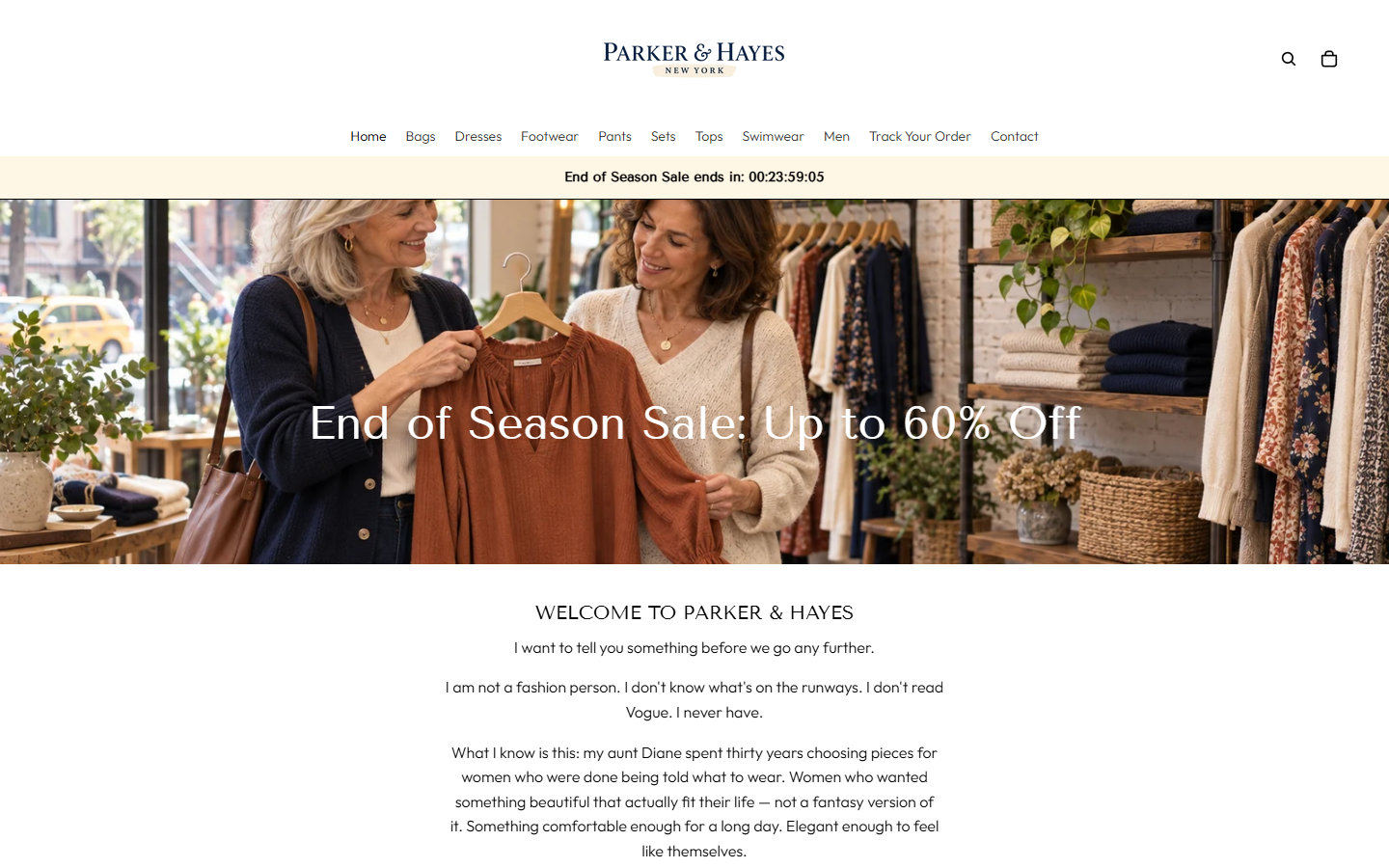
Parker & Hayes New York presents clothing and accessories through a boutique-style storefront and an end-of-season sale.
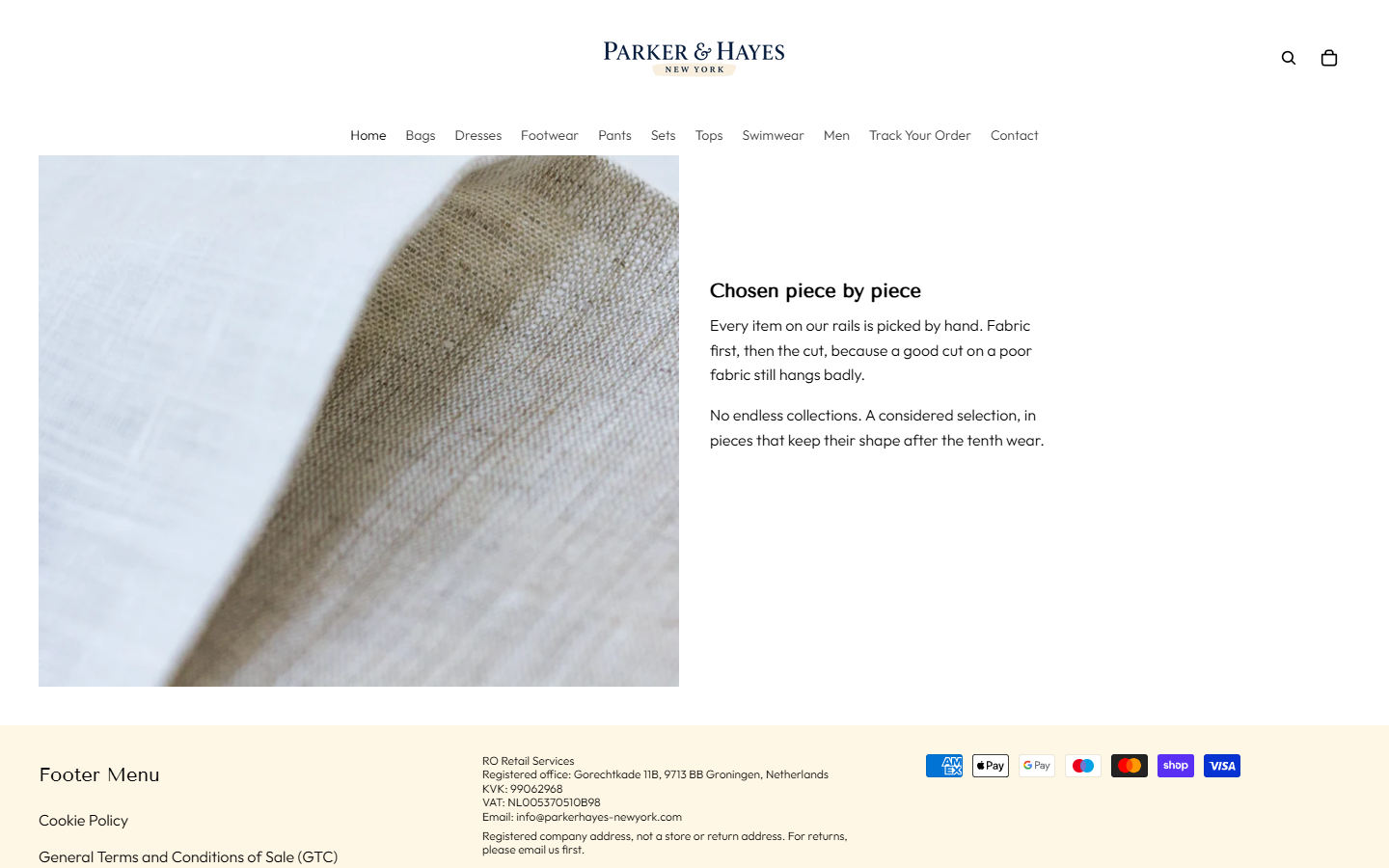
Its footer identifies RO Retail Services, with a registered office in Groningen, Netherlands, and a Dutch company registration number.
A company in the Netherlands may legally serve American customers. The issue is whether the New York branding leads buyers to assume a local shop or return location.
The footer itself says its registered address is not a store or return address. Customers must request return details by email.
Claims that deserve a closer look
The home and product pages show large discounts, limited-stock language, customer counts, review totals, and a 30-day money-back guarantee.
Those cues create confidence and urgency together. We could verify that they appeared on the live website, not that the underlying counts were independently audited.
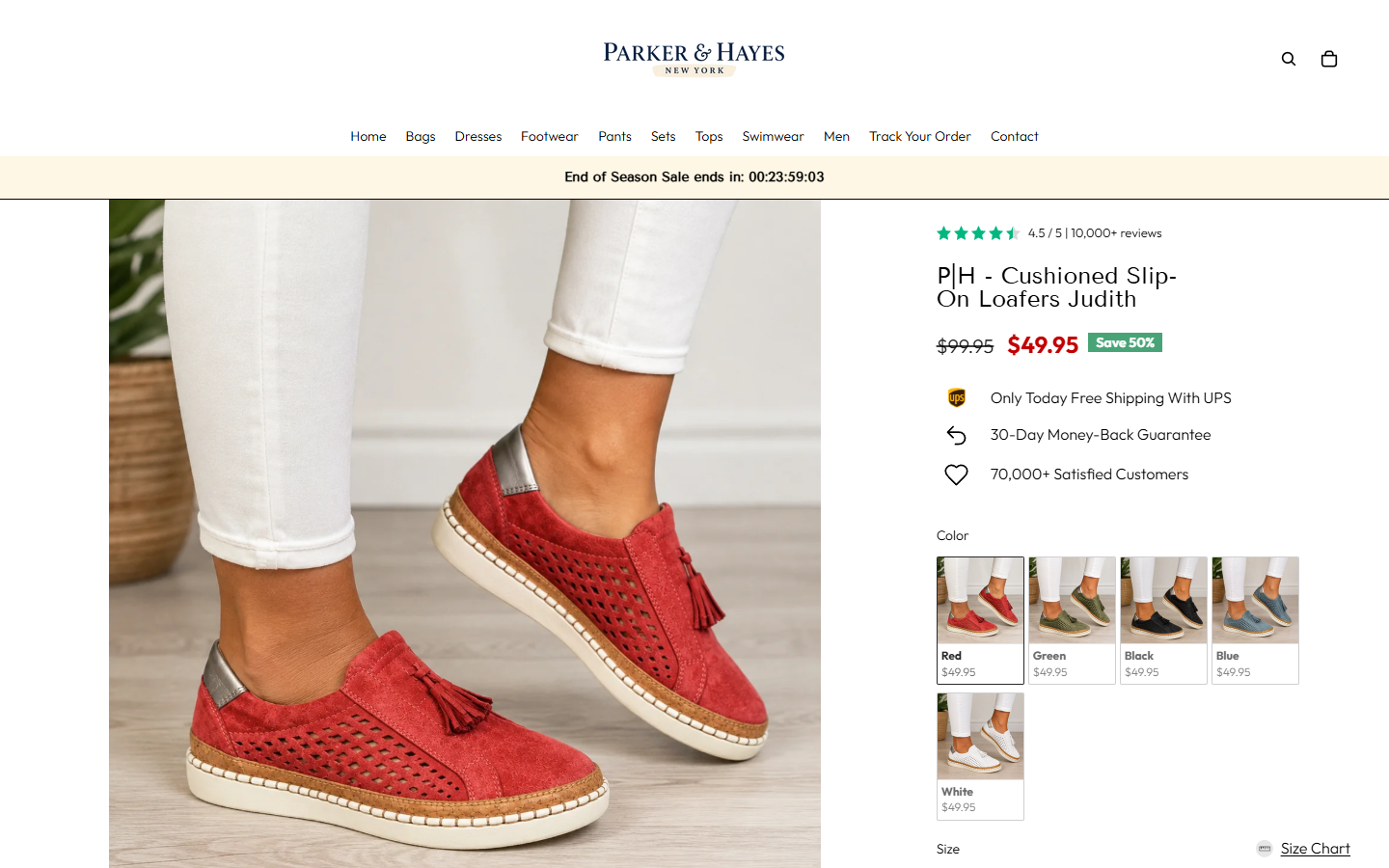
Several product pages display the same “4.5 / 5 | 10,000+ reviews” style of rating. We also saw repeated testimonial wording on product pages.
Repetition can come from a shared store-wide widget. It does not by itself prove that reviews were invented, but buyers should not mistake it for product-specific verification.
What this investigation concludes
We found commercial transparency questions, not conclusive proof that every order is fraudulent. We did not buy and inspect a garment.
The key is to separate brand atmosphere from facts: legal seller, actual product materials, dispatch route, return destination, and verifiable customer feedback.
- The storefront uses a New York identity and a personal boutique story.
- The stated legal operator is RO Retail Services in the Netherlands.
- The registered office is expressly not a store or return address.
- Product pages promote steep discounts and large review or customer numbers.
- Some visible testimonials repeat, which limits their value as independent evidence.
- The similarly named Parker Hayes site has a different operator; no affiliation was established.
Where the Boutique Story and Buyer Facts Part Ways
A family story makes the store feel local
The homepage describes learning from an aunt who spent years choosing clothes for women who wanted elegant, wearable pieces.
It is the kind of detail that makes a catalog feel curated by someone with taste and experience rather than generated by a warehouse feed.
A story can be honest. The storefront does not, however, give a shopper independent proof of the aunt, the alleged shop history, or a physical New York location.
We are not declaring those details false. We are saying they should not substitute for product specifications and a clear legal seller.
If visiting the shop is important to you, request its public street address and hours before assuming the “New York” name describes one.
The countdown changes the pace
The page promotes an end-of-season sale and displays a countdown. Product pages also use limited-stock prompts such as “almost sold out.”
Neither tactic proves deception. Retailers do run real promotions and can run out of stock in specific sizes.
Still, an urgent timer can keep a shopper from comparing materials, sizing, and return costs. Pause and capture the offer before deciding.
Revisit the page later. If the same “only today” message or timer restarts, ask what deadline actually applies.
We did not monitor every sale period, so we cannot establish a perpetual discount from a single visit.
Large numbers need a source
The Judith loafer page showed a 4.5/5 rating with more than 10,000 reviews and a claim of 70,000 satisfied customers.
Those are seller-presented figures. A shopper should be able to inspect dated, product-specific reviews and understand how the totals were calculated.
If the same rating appears across unrelated dresses, shoes, and sweaters, check whether it is a store-wide number reused in each template.
That is different from thousands of people reviewing the exact pair of loafers on the current page.
Look for purchase verification, review dates, size information, and photographs of the delivered item. Generic praise contributes little to judging fit or fabric.
Repeated testimonials are a weak quality signal
On the pages we reviewed, identical positive testimonial text appeared multiple times. One review also describes stopping by a store in New York.
That could reflect a site-template or import problem. It also means the page does not offer reliable, distinct customer experiences in those slots.
We did not verify the named reviewers or a physical shop. A testimonial claiming a store visit is not proof that a store exists.
Ask for a public location if in-person shopping matters. Do not travel based on an embedded testimonial or a place name in a logo.
Balanced independent reviews can still help, but confirm they refer to this exact domain rather than another Parker Hayes business.
If a testimonial includes a city, check whether the merchant identifies an actual store in that city. A reviewer’s location may simply describe where they live.
Repeated wording across multiple products can also result from a global review widget. Ask the seller whether the score is for one item or the whole catalog.
Those questions are fair even if the reviews are genuine. A shopper needs to know what the number measures.
How the Parker & Hayes New York Shopping Journey Works
Step 1: The boutique identity invites trust
The logo, polished clothes, and New York name suggest an established fashion retailer. A personal family story supplies the human touch.
Before treating that as a location claim, scroll to the footer. There the operator and registered office are stated plainly.
The distinction matters if you expect easy domestic returns or an in-person store visit.
Step 2: A sale and stock cue create urgency
The shopper sees discounts reaching 60% and messages that some sizes are almost gone. The combination encourages a quick decision.
Check whether the reference price has a meaningful history. We did not verify past prices or inventories for individual products.
Do not buy a wrong size simply because a timer suggests a deadline. A return can cost more time than the temporary discount saves.
Step 3: Social proof reduces hesitation
High review counts and customer totals make the product look widely tested. Repeated testimonial text makes those cues less informative.
Read the actual review detail where available. Determine whether feedback concerns the specific garment, the whole store, or a syndicated rating.
A rating cannot tell you whether a fabric is natural or synthetic, or whether a shoe fits a particular foot shape.
Step 4: Checkout identifies the real seller
The footer names RO Retail Services in Groningen. Compare that entity with the merchant of record shown during payment and on your receipt.
If the names differ, ask which company processes the order and which one is responsible for refunds.
Save the domain and checkout total. Similar brand names can lead a customer to the wrong support address later.
Step 5: Delivery tests the promise
The site advertises free tracked shipping in the United States. Tracking availability is useful, but it does not establish dispatch origin or delivery speed.
Keep the first carrier scan and parcel label. If the item differs from the listing, photographs taken before wearing it are important.
Ask for an updated estimate if tracking stalls. Do not assume a generated label means the parcel has entered a carrier network.
Free initial shipping does not answer who pays return postage. Those are separate costs, especially if the return destination is outside your country.
For a date-sensitive event, ask whether delivery is guaranteed rather than simply estimated. Keep the written response.
Step 6: A return needs an address from support
The site promotes a 30-day guarantee and directs customers to contact support for return instructions. The Dutch registered office is not the return destination.
Before ordering, ask which country receives returns, who pays postage, and whether a discount changes eligibility.
If support supplies a destination after purchase, keep that message and use tracked shipping. Never mail a return to an address guessed from the footer.
How to Check the Company, Address, and Returns
Read the footer as carefully as the story
RO Retail Services is named with a Dutch registered office and registration details. That identity should appear consistently in formal sale documents.
A registered office may be an administrative address. The site explicitly states this one is not a store or return address.
That disclosure is better than hiding the distinction, but buyers still need the actual return process before paying.
Search the legal name and registration number independently. A matching registration verifies a legal entity, not product quality or a physical New York boutique.
Ask a practical return question
Write to the site’s published support address with the exact product link. Ask where an unwanted but unused item must be returned.
Request the return country, shipping responsibility, required condition, deadline calculation, and expected refund timing.
A response saying “contact us later” leaves the largest unknown in place. Decide whether you are comfortable with that uncertainty.
For a size-sensitive garment, the return destination and postage may matter more than a claim of free initial shipping.
Ask whether the 30-day period begins on purchase or delivery, and whether the item must be returned within that period or merely requested.
Also ask whether an exchange changes the original deadline. A replacement arriving late could otherwise leave little time to resolve a second issue.
Put those answers beside the receipt. A clear paper trail is useful if a support agent later applies a different rule.
Examine the product itself
Look for fiber content, measurements, care instructions, photographs of details, and size charts. A flattering model image cannot verify these basics.
If a listing says leather, linen, or wool, ask whether that means the whole item or only a trim or blend.
Save the product copy and photographs. If the delivered label tells a different story, you will have a useful point of comparison.
We have not inspected an actual garment, so we cannot say that the materials advertised on every listing are wrong.
For footwear, note sole material, lining, heel height, and width. A broad comfort claim does not tell you whether the shoe fits.
For sweaters, compare the actual fiber percentages rather than interpreting “soft” or “premium” as a specific composition.
Where the listing omits composition entirely, ask support to identify it before buying. The answer can determine care, comfort, and durability.
Keep the two Parker names separate
Parker Hayes on a hyphenated domain lists S.OASIS LLC. This site lists RO Retail Services and uses a different domain.
We found no evidence that they share ownership. Similar names alone do not prove impersonation, a coordinated network, or a legal violation.
Search engines may mix their reviews. Before using a complaint or policy, check that its URL matches the store where you paid.
Likewise, do not send a screenshot of your card or order number to a support account from the other domain.
What to Do if You Have Already Ordered
- Identify the exact site. Check your confirmation email and bank descriptor. Save the full `parkerhayes-newyork.com` URL rather than relying on the brand name alone.
- Preserve the offer. Capture the size, material claims, sale price, 30-day guarantee, checkout total, and any return wording shown before payment.
- Inspect delivery promptly. Photograph the parcel, labels, garment, and defects. Compare measurements with the saved chart before removing tags.
- Request authorized return details. Contact the support address on your order. Ask for a complete destination, postage responsibility, and written deadline.
- Use traceable shipping. Keep the carrier receipt and proof of delivery. Never send a return to the registered office without explicit instructions.
- Escalate a material mismatch. If an item was misdescribed or a valid refund is refused, present a factual timeline to your payment provider before its dispute limit.
If your concern is only a change of mind, explain that honestly. Faulty goods and sizing preferences may have different remedies.
Do not mistake a late tracking update for proof of non-delivery. Check the carrier record and give support the order number.
If the parcel arrives with a different product name on its tag, photograph both tag and package before removing anything.
Give the seller a chance to explain a rebrand or replacement, but do not accept an unwanted substitute without reviewing your options.
Frequently Asked Questions
Is Parker & Hayes New York a confirmed scam?
We cannot establish that. The site raises buyer questions about branding, review presentation, urgency, and the return process.
Is there a physical New York store?
We did not verify one. The site lists a Dutch registered office and says that address is not a store or return location.
Does the Dutch operator mean the clothes are made in the Netherlands?
No. A registered business location does not establish manufacturing or dispatch origin. Ask for those facts separately.
Are the 10,000+ reviews for each product?
The display alone does not establish that. Similar counts across pages and repeated testimonial text call for product-specific review evidence.
Where do returns go?
The site says to contact support. Its registered office is expressly not a return address, so obtain written instructions before mailing anything.
Is this the same as Parker Hayes on the hyphenated domain?
We found different named operators and no verified connection. Check the exact URL and order receipt before reading reviews or contacting support.
The Bottom Line
Parker & Hayes New York sells a persuasive boutique mood. A careful buyer should verify the seller, product details, review claims, and real return route.
A Netherlands-based operator is not itself a problem. The risk lies in making a New York-flavored purchase without understanding who handles it afterward.








