

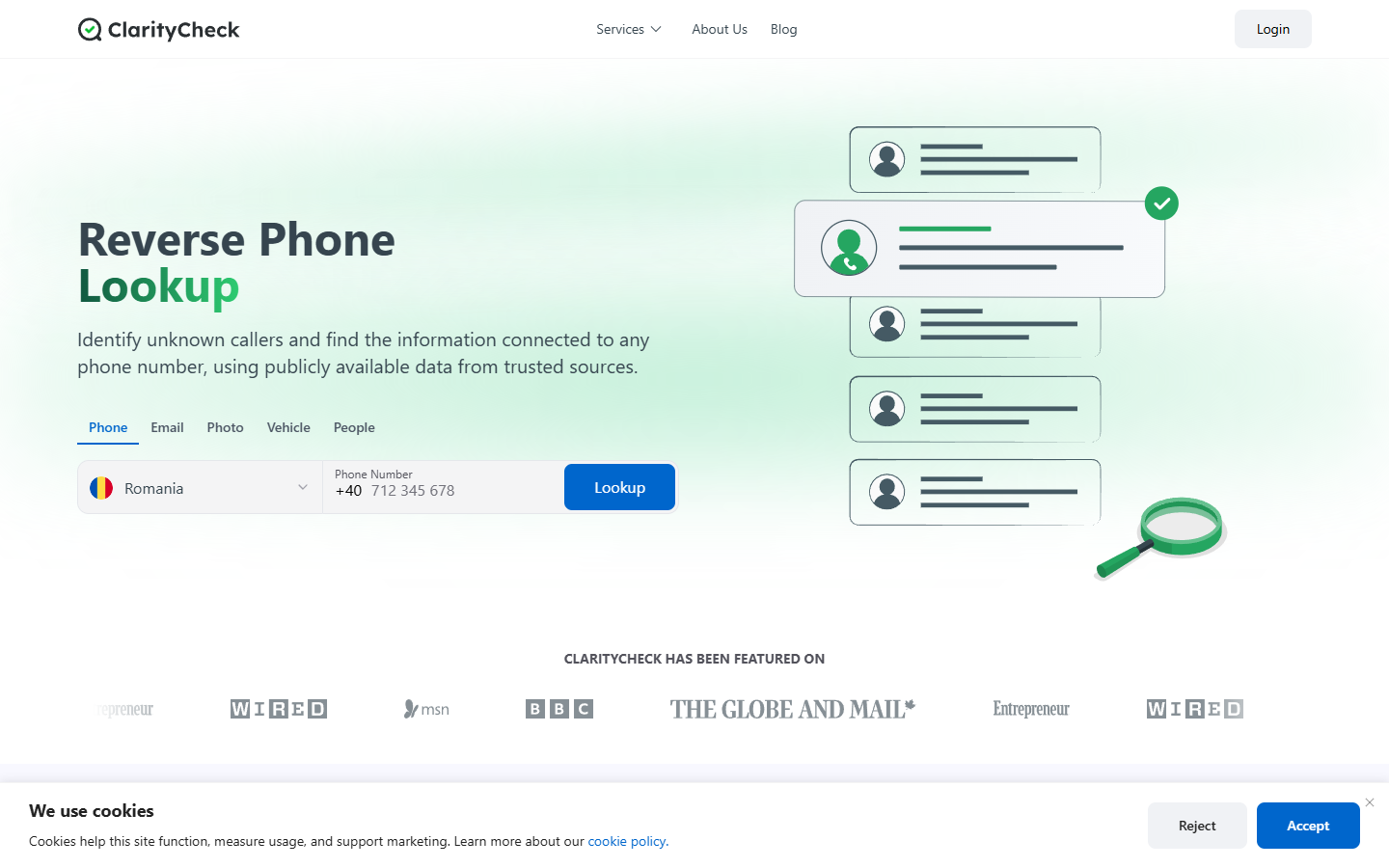
A missed call from an unknown number can be surprisingly hard to ignore. ClarityCheck offers to turn that uncertainty into a quick search.
Before entering a card, take a closer look at what the search includes and how the billing continues after the first visit.
Overview
A real search service with a subscription model
ClarityCheck presents reverse phone lookup and related searches. The service may return public-record or aggregated information, depending on the query and available data.
It is not necessarily a one-time purchase. The terms describe a seven-day trial that can convert into a recurring subscription.
The standard billing cycle described there runs every 28 days. A customer who expects one inexpensive report could therefore face later charges.
That arrangement is disclosed in the terms. Our concern is whether shoppers notice it before they enter payment information and whether a report meets expectations.
Reports have important limits
A reverse lookup cannot guarantee a useful identity for every number. Prepaid lines, recently reassigned numbers, business systems, and spoofed caller ID complicate results.
Even a name in a report may belong to a previous subscriber or an unrelated person. Treat it as a lead, not definitive proof.
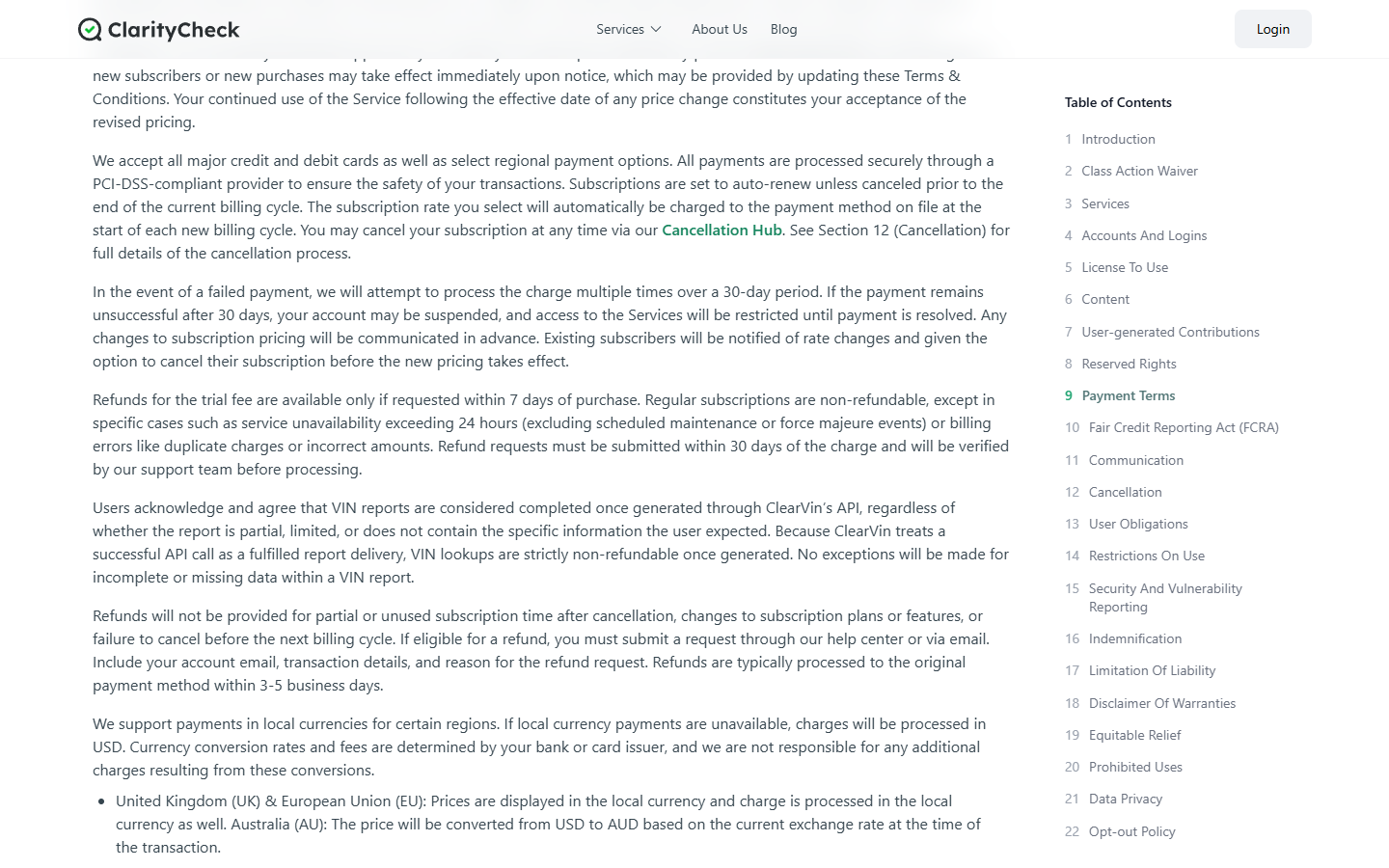
ClarityCheck’s terms also discuss vehicle identification number reports. They say a generated VIN report is treated as delivered even if it lacks desired information.
That distinction matters when a customer pays hoping for a particular answer. A completed report may still be incomplete for the customer’s purpose.
Our assessment is about billing and expectations
We reviewed the homepage, help material, and subscription terms. We did not purchase access or test the accuracy of a particular search result.
We therefore cannot say every report is inaccurate or that a particular charge was unauthorized. The documented risk is automatic renewal and limited refund eligibility.
- The site offers phone and other lookup services, not guaranteed identification of every caller.
- A trial can become a recurring subscription if it is not canceled.
- The standard recurring cycle is described as every 28 days.
- Trial refunds and ordinary subscription refunds follow different rules.
- Some generated reports may remain nonrefundable even when the output disappoints.
- This is a buyer-risk investigation, not a finding that ClarityCheck is a confirmed scam.
The Cost of Searching for One Answer
Trial pricing changes the frame
A small initial payment can make a lookup feel like a low-stakes experiment. The recurring price after the trial is the larger financial decision.
The terms discuss plan prices that vary by offer and region. They give a typical weekly range, but the checkout amount is what matters for your account.
The US pricing page currently advertises a $3.99 seven-day trial followed by $29.99 every 28 days. Confirm your own checkout before paying.
Do not rely on a price quoted in another person’s review. Promotions, currency, taxes, and plan selection can change what a new customer sees.
Write down the trial end date, the next billing date, the recurring amount, and how to cancel. Take a screenshot of the actual checkout.
Seven days can pass quickly, especially when the search is performed on a weekend or while traveling. Put a reminder well before the deadline.
A 28-day cycle is not the same as monthly
Four weeks sounds close to a month, but it produces more billing events across a year than a calendar-month schedule.
Check the exact renewal language rather than assuming charges arrive on the same day each month. Your bank statement may show dates drifting earlier.
Someone who uses the service only once might miss the second charge until a statement arrives. At that point, the refund rules become critical.
Track every subscription in one place. Include the merchant name shown on your card, which can differ from the site’s headline brand.
A card alert for online recurring payments can catch a renewal while there is still time to ask about it.
Refund rights are narrower than a simple guarantee
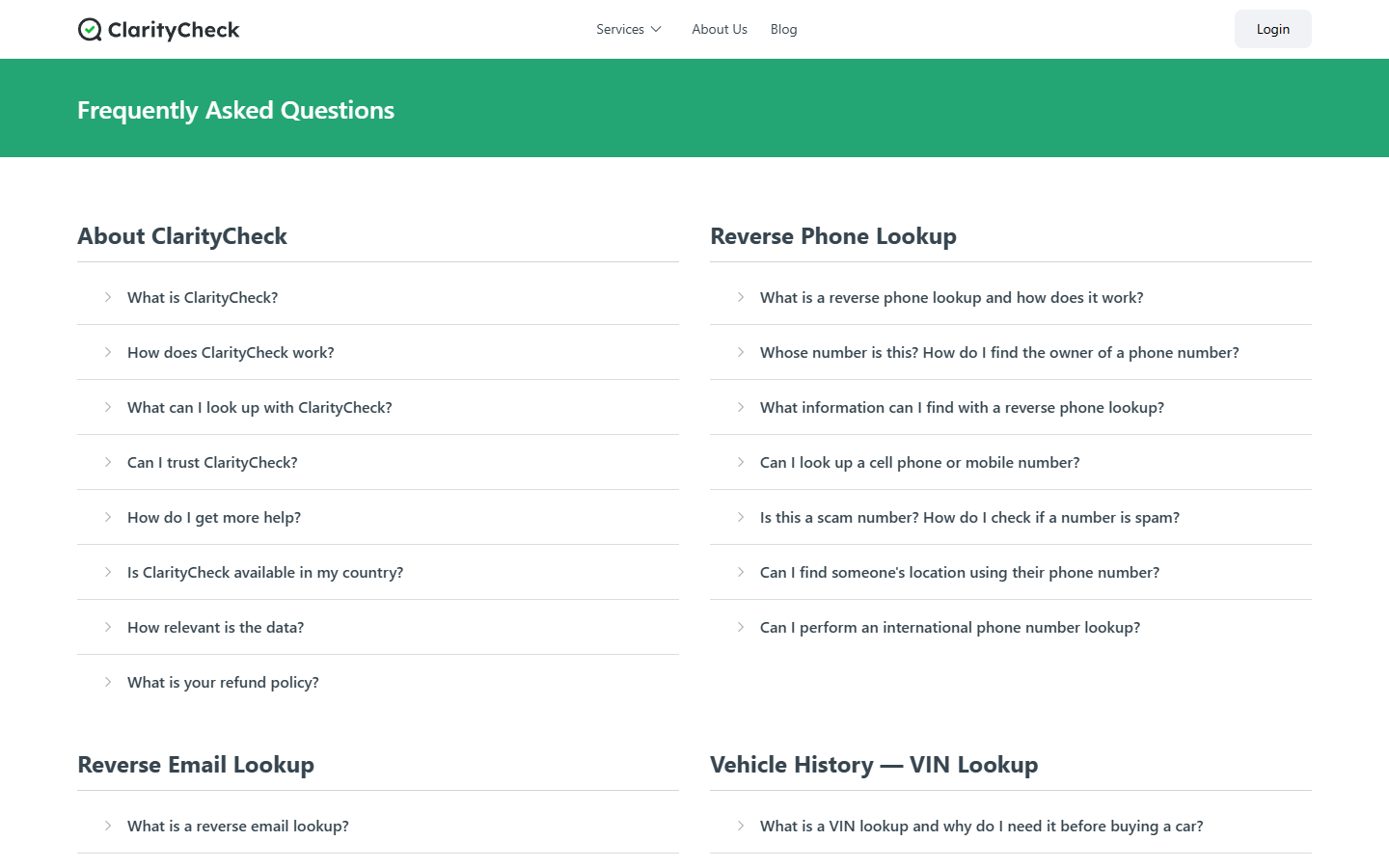
The terms say a trial-fee refund must be requested within seven days of purchase. Ordinary subscription charges are generally nonrefundable, with stated exceptions.
Examples include certain prolonged service outages or duplicate and incorrect charges. The policy also sets a request window for eligible refunds.
Partial or unused subscription time after cancellation is not refunded under the stated terms. Canceling stops future billing, not necessarily the current charge.
Read the current rules before paying. Terms can change, and local consumer protections may affect which provisions are enforceable in your location.
Do not assume deleting an account or closing a browser tab cancels the plan. Use the specified cancellation route and keep confirmation.
The “successful report” definition matters
The terms state that a VIN report is completed when generated through an API, regardless of whether it includes the information the user expected.
That is a service-delivery definition, not a promise that the report answers your question. Check a sample report before purchasing.
For phone lookups, ask what data sources are covered, how recently records are refreshed, and whether partial matches are labeled clearly.
Never confront someone based solely on a lookup result. Spoofed numbers and outdated ownership records can point to the wrong person.
If you need a safety answer about a threatening caller, preserve the calls and contact your carrier or local authorities as appropriate.
How the ClarityCheck Purchase Journey Works
Step 1: A question creates urgency
You receive a strange call, find a number in a partner’s phone, or consider a used car. A lookup appears to offer a fast answer.
That motivation is understandable. Uncertainty can make a small trial charge seem easier than hours of independent research.
Before paying, decide what result would genuinely help. “Any record” may not be the same as a verified current owner or complete history.
Step 2: A preview encourages you to proceed
Search tools commonly show a progress screen or limited result before requesting payment. Treat that as a preview of availability, not proof of completeness.
ClarityCheck markets several lookup categories. Read which specific search you are buying and whether that plan includes other features.
Do not enter a card simply to learn that a result exists. Confirm the final price and the recurring terms first.
Step 3: The trial begins when payment is accepted
Save the timestamp and receipt. The seven-day window may be measured from purchase, not from when you first view a finished report.
Inspect the checkbox and adjacent text that describes renewal. If the checkout is unclear, leave and ask support in writing.
Different regions may show different currencies or offers. Capture your own screen rather than trusting a general article’s example price.
Step 4: A result may be less conclusive than hoped
The output can contain partial records, an old association, or no confident match. That may reflect data limits rather than a broken website.
Compare a critical result with independent evidence. For a vehicle, use official title and recall resources alongside any commercial history report.
If you believe the service malfunctioned, document the exact error and time. “I did not like the result” may not qualify for a refund.
Step 5: The renewal arrives unless canceled
The terms say the selected subscription renews automatically until cancellation. The standard plan bills on a 28-day cycle.
A cancellation request made after a charge might stop the next one without reversing the current one. Do not wait for a billing alert.
Use the site’s help center or cancellation hub described in the terms. Save the confirmation email or screen.
Step 6: A dispute depends on precise records
If a charge is wrong, identify the plan, receipt, cancellation date, and billing descriptor. Ask support for an itemized explanation.
For duplicate charges or a documented outage, cite the specific exception in the current policy. Keep the reply and case number.
If the merchant cannot resolve an unauthorized charge, ask your card issuer about its dispute process and deadlines.
How to Check the Company, Billing, and Cancellation Terms
Identify the legal merchant on the charge
A brand logo is not always the full legal name used by a payment processor. Your receipt and bank statement can show the merchant of record.
Compare that name with the current terms and support responses. If it does not match, ask for clarification instead of assuming fraud.
Keep the customer-service email, subscription ID, and last four card digits together. Those details usually help support find the account.
Never send the full card number, security code, or a one-time bank verification code through email to speed up cancellation.
If the descriptor is unfamiliar, verify it through your bank’s transaction details. Some merchants use a processing name rather than the website name.
That mismatch deserves an explanation, but it is not by itself evidence of an unauthorized payment.
Check the plan you actually selected
Look for the trial duration, post-trial rate, billing interval, and any add-on purchase. Different offerings may have different rules.
Terms can describe a typical range while your checkout displays a specific price. The specific authorization is the key record for a billing complaint.
Check your email immediately after purchase. A confirmation may include the renewal amount and a direct account-management link.
If you cannot find it, search spam folders and the payment descriptor before making another account or paying again.
A second checkout can create a second subscription. Ask support to search by your original receipt before trying again.
If the site offers multiple lookup products, identify whether each is covered by one plan or charged separately.
Test the cancellation route early
Locate the cancellation hub in the terms and confirm whether you can access it with the same email used at checkout.
Do not wait until the trial’s last hour. Time zones, account-recovery delays, or a support queue can erase the cushion you expected.
After canceling, take a screenshot showing the date and status. Verify that future billing is disabled, not merely that marketing emails stopped.
Watch the next bank statement. If a charge posts after confirmed cancellation, contact the merchant with the timestamp first.
Some banks display a pending authorization before a final posted charge. Note which one you see when describing the problem.
Closing a card may not automatically terminate a contractual subscription. Tell the merchant directly that you are canceling.
Know the difference between a refund and a dispute
A merchant refund request asks the seller to apply its policy or correct an error. A card dispute asks the issuer to investigate a transaction.
Do not describe a knowingly authorized trial as stolen-card fraud. Explain accurately if the renewal terms were unclear or cancellation failed.
A well-documented timeline gives both sides something concrete to examine. Anger alone cannot establish what the checkout displayed.
Consumer rights vary by jurisdiction. If the amount is significant, consult the relevant consumer agency or legal adviser.
Keep copies of polite, specific messages. State the amount, date, and remedy requested so the company can investigate without guessing.
If support asks for more information, use its official portal. An unsolicited message promising a guaranteed refund may be a separate phishing attempt.
What to Do if You Paid or Were Charged Again
- Find the original authorization. Save the checkout screen, receipt, trial start, recurring amount, and terms that applied when you purchased.
- Cancel through the stated route. Use the account hub or support channel in the current terms. Record the date, confirmation, and account email.
- Request the appropriate refund. If you are inside the trial window or meet a listed exception, cite it precisely and attach supporting evidence.
- Check every charge. Compare dates and amounts with the disclosed cycle. Flag duplicates, incorrect amounts, or charges after confirmed cancellation.
- Escalate unresolved billing. Contact the card issuer within its deadline if the merchant cannot resolve an unauthorized or erroneous charge.
- Protect your account. Change a reused password and enable bank alerts. Never share verification codes with anyone claiming to process a refund.
If you received only a limited report, separate that disappointment from a billing error. The merchant may treat them differently under its terms.
Explain the precise issue you experienced. A clear, calm record is more useful than a broad accusation that every lookup is fraudulent.
Frequently Asked Questions
Is ClarityCheck a confirmed scam?
Our review does not establish that. It is a search service with documented recurring billing and refund restrictions that buyers should understand.
Does the trial automatically renew?
Under the terms reviewed, a trial can convert into a subscription unless canceled. Confirm the exact offer displayed at your checkout.
Is a 28-day plan billed monthly?
Not exactly. Twenty-eight days is four weeks and does not stay aligned with calendar months. Check each scheduled billing date.
Can I get a refund if a lookup finds nothing useful?
Do not assume so. The policy limits ordinary refunds and treats some generated reports as delivered even when they lack expected details.
How do I cancel?
Use the cancellation hub or help channel described in the current terms. Keep dated proof that the subscription, not just emails, was canceled.
Can I trust a phone number match as proof of identity?
No. Numbers are reassigned and caller ID can be spoofed. Corroborate important conclusions with an independent source.
The Bottom Line
ClarityCheck may help with a lookup, but the service should be judged by its full subscription terms, not only the first search screen.
Know the renewal price, cancellation route, and report limitations before paying. If you already subscribed, document the timeline and cancel promptly.

Join the discussion
0 commentsShare your experience or ask a question about this article.
Discussion
Start the conversation
Have a question or something useful to share? Add the first comment.