


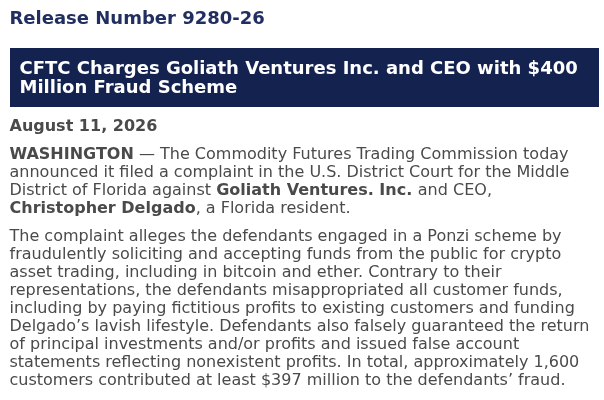
On August 11, 2026, two US regulators sued Goliath Ventures on the same day, alleging that at least $397 million meant for crypto liquidity pools never reached a single pool.
We read both complaints in full and tested their numbers against each other and the archived website. The .com carrying the company’s name was not its site.
Overview
What Goliath Ventures Offered
Goliath Ventures Inc. described itself as a crypto liquidity pool and Bitcoin mining firm. It signed investors to Joint Venture Agreements promising monthly returns and their principal back.
We read the CFTC’s complaint (case 6:26-cv-01737) and the SEC’s complaint (case 6:26-cv-01741), both filed in Florida’s Middle District.
We also read the Justice Department’s victim page for the criminal case, which carries the guilty plea and the forfeiture orders.
Both agencies allege that no customer money ever entered a liquidity pool and that earlier investors were paid with later investors’ money.
The company’s CEO has already pleaded guilty to wire fraud conspiracy, wire fraud and money laundering, so this case has a court record and not only allegations.
What Our Checks Found
Four official documents give five different totals for the same scheme, from $250 million to $425 million, and we could not make the customer counts agree either.
The company’s real website lived at a different domain from the one most people would type. It was still online five days after the CEO ordered new investments to stop.
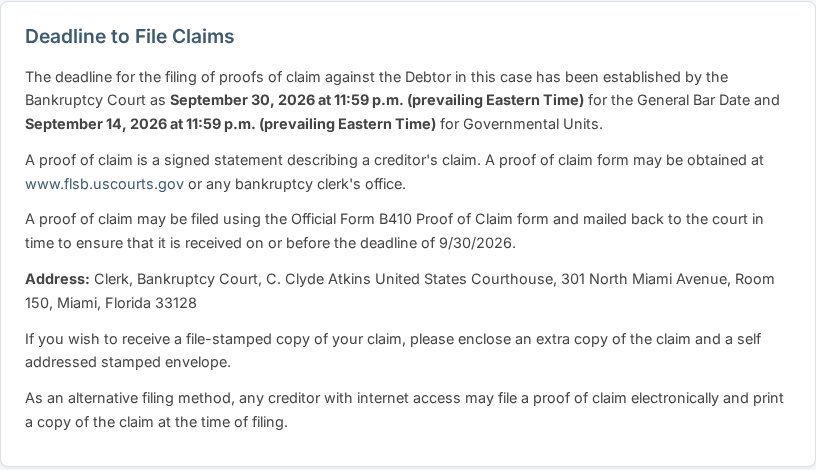
The office address on that old contact page appears among the properties the Justice Department lists for sale. The bankruptcy claims deadline passed on September 30, 2026.
What We Could and Could Not Verify
Here is where the evidence stands after our checks:
- Verified by us: both complaints, the Justice Department and bankruptcy case pages, the domain records, and the archived website text that the complaints quote.
- Not found: any returns, guarantee or minimum investment on the website pages we could read, and any working Goliath site today.
- Not verified: who holds the lookalike domains, where the money went, and how much creditors will receive, because no court has decided those questions.
Our advice is not to invest, reinvest or pay anything to a person or site using the Goliath name, and to use only the official channels listed below.
Five Totals for One Scheme
We started with the money. Every document describes the same company and each counts it differently, and your share of any recovery depends on which count a court accepts.
The criminal complaint, announced on February 24, 2026, put the amount at no less than $328 million.
The plea announcement of June 30 cites at least $250 million in investor losses admitted by the CEO, and also at least $400 million paid in by investors.
The CFTC’s press release and complaint say about 1,611 customers contributed at least $397 million (paragraphs 2 and 23). Its headline rounds that up to $400 million.
The SEC’s litigation release and complaint say at least $425 million came from over 1,300 investors (paragraphs 1 and 17).
We divided each figure by its own headcount. The CFTC’s numbers mean an average of $246,000 per customer, and the SEC’s mean no more than $327,000 per investor.
That is 2.5 to 3.3 times the $100,000 minimum in the agreements (SEC paragraph 18). This was a high-ticket scheme, not a crowd of small savers.
Over the CFTC’s 1,202-day window, from November 3, 2022 to February 17, 2026, $397 million works out to about $10 million a month, or $330,000 every day.
That arithmetic means a new customer arrived about every 18 hours for more than three years, each bringing on average a quarter of a million.
The SEC’s paragraph 21 adds up exactly: $415.5 million arrived in bank accounts and $9.5 million in crypto, which equals the $425 million total.
Paragraph 21 also traces at least $189 million of the bank money into Goliath’s crypto wallets (45% of it), yet paragraph 37 puts none in a liquidity pool.
Neither complaint says where that $189 million went next. It is a question a receiver’s accounting has to answer, and we mark it as unresolved.
Where the Money Went, Added Up
Next we added each complaint’s own spending figures, because a Ponzi allegation is only as strong as the ledger behind it, and the two ledgers do not line up.
The CFTC alleges $87 million in payments to other customers (paragraph 29), $174 million to Directors and staff (paragraph 30) and $48 million taken by the CEO (paragraph 26).
Those items total $309 million, or 78% of the $397 million. The striking part is commissions: for every $100 customers sent, about $44 went to Directors and staff.
The SEC’s version differs. It counts $281 million in distributions paid from other investors’ money (paragraph 45), $51 million misappropriated (paragraph 44) and $53 million spent on appearances (paragraph 47).
Those add up to $385 million, or 91% of its $425 million, and the SEC gives no commission total at all.
The gap that stands out is the payouts: $87 million in one complaint and $281 million in the other, a difference of $194 million that neither document explains.
The SEC’s itemized spending for the CEO deserves a calculator. Real estate, vehicles, retail, entertainment and a yacht total $35.9 million.
Add the $13 million moved to his own accounts and the total is $48.9 million, which is within $2.1 million of the CFTC’s $48 million.
It falls short of the SEC’s own “at least $51 million”, so that headline figure is not fully itemized in the text.
Corporate cards are another mismatch. The CFTC lists at least $21 million of card spending (paragraph 28), while the SEC counts about $12 million of card bills (paragraph 47).
Early complaints often count differently, and these are filing-stage figures, not audited totals. For a victim it matters because the receiver will decide who gets paid.
The Returns Do Not Survive a Calculator
We tested the promises next, because the complaints quote them precisely and arithmetic is the quickest way to see what a promise implies.
A 2023 slide deck, quoted in CFTC paragraph 14, offered “3% Monthly (36% Annual)” with an option to compound.
Compounded monthly, 3% is actually 42.6% a year, so the “36%” was the simple version.
A July 18, 2024 agreement guaranteed monthly profits of up to 5% (paragraph 15), which is 60% a year simple and 79.6% compounded.
SEC paragraph 20 puts the promised range in the agreements at 3% to 10% a month.
At 10% monthly with compounding, $100,000 becomes about $313,800 in a year and roughly 31 times that in three.
For scale, if the whole $397 million had earned 3%, the monthly payout bill would be $11.9 million. At 10% it would be $39.7 million, every month.
Real liquidity pool fees move with trading volume. The SEC’s footnote defines them as a share of trader fees, so a fixed monthly rate cannot come from them.
Neither can a guaranteed return of principal. That is our reading of the mechanism, not an allegation, and it explains why this combination should have ended the conversation.
The SEC adds that agreements promised withdrawals in 5 to 7 business days, with delays of up to 90 or 180 days in limited cases (paragraph 41).
Apply that clause to the timeline. A withdrawal requested on November 17, 2025 would have hit its 90-day limit on February 15, 2026, two days before operations ceased.
What the Company’s Own Website Showed
We then went to the website, and the first result was a surprise. The domain goliathventures.com is a GoDaddy parking page, with search tiles about lawsuits and scam news.
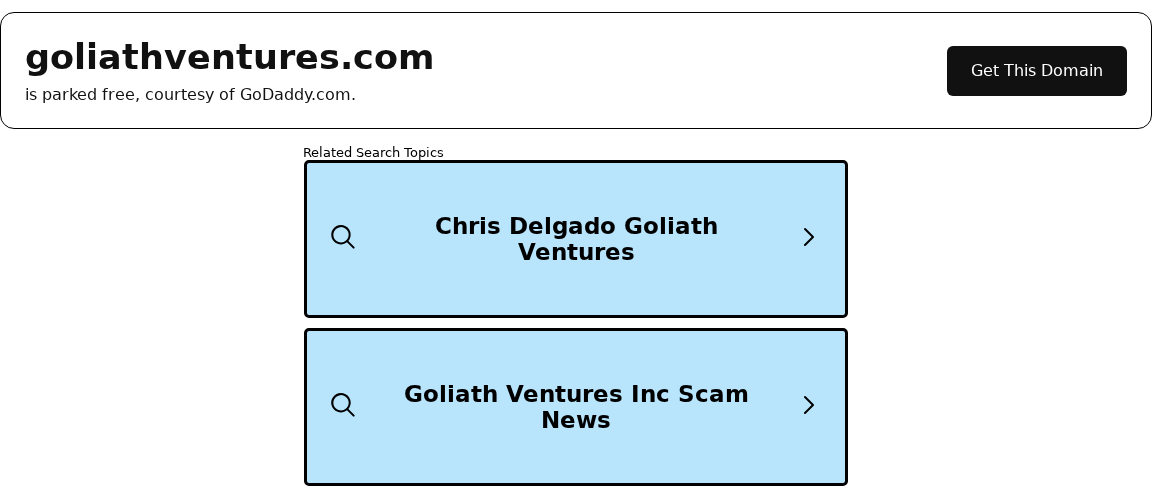
The Internet Archive shows the same name parked in the four captures we opened, from 2019, 2021 and 2024, so it never carried the company’s pages.
The registry lists goliathventures.com with a creation date of November 17, 2016 and an expiry of November 17, 2026, so the name could be dropped within days.
If it lapses, anyone can register a name that investors still search for. That is a standard setup for a recovery scam, so treat any message pointing there with suspicion.
The real website sat at goliathventuresinc.com, which the archive captured 84 times between December 2021 and October 2026.
The last working copy we opened is dated February 2, 2026, and it matches what the CFTC quotes. It names Chris Delgado as the firm’s leader.
It touts over $1 million in donations in a year and $4 million since 2019, and lists exactly nine charities, as paragraph 17 of the complaint does.
The timing is the finding. That copy dates from five days after the CEO told Directors to stop taking new investments and 15 days before operations ended.
It still described Goliath’s partnerships as by invitation only and carried a 2026 copyright line, with no notice that anything had changed.
Today the same domain answers with a Cloudflare error 1001, and the archive recorded error responses in May and October 2026. The site went dark sometime after that last copy.
We then read the pages meant to sell the business.
The five we could retrieve, including the liquidity pool page, the FAQ and a case study, show no monthly rate, guarantee or minimum.
The case study praises a liquidity pool investment that “yielded impressive results” but offers no figure. The numbers that moved money lived in private agreements, which a visitor never saw.
The archive also dates the pivot. Five captures from May 9, 2022 to March 14, 2023 show one page, which called Goliath a private equity firm and a referral-only business.
The first capture mentioning liquidity pools and Bitcoin mining is dated May 25, 2023. That is 144 days into the SEC’s period and 203 days after the CFTC’s start date.
So the public site changed after the offers allegedly began. Capture dates are not publication dates, but the order fits a business that was sold privately first.
One more mismatch: the 2022 page already placed Goliath’s consumer investments partly in crypto, while SEC paragraph 11 puts that period in consulting and marketing with no crypto activity.
The Collapse, Day by Day
We built a day-by-day timeline from the dates the complaints quote, and the weeks before the collapse are the most revealing part of both documents.
On September 3, 2025 the company filed dissolution papers in Florida and reincorporated in Wyoming the same day. Six days later its lawyers sent a cease-and-desist letter to a journalist.
On September 22 the company sued that journalist for defamation (CFTC paragraphs 32 and 33). Both documents insisted Goliath had never paid old investors with new money.
The CFTC alleges the defendants knew both statements were false when made (paragraph 34).
On November 17, 2025 an email told investors that distributions were delayed while a forensic audit was completed. The CFTC alleges there was no audit (paragraph 36).
A December 3 email promised everything owed would arrive in the December 15 to 18 cycle, and a December 18 email denied that the delay reflected liquidity constraints.
Meanwhile, paragraph 16 of the CFTC complaint places a Casino Royale Christmas party at an Orlando resort in December 2025, while payouts were being delayed.
On January 28, 2026 the CEO told the Directors to suspend all new investments, 41 days after the December 18 assurance that nothing was wrong.
On February 17, 2026, 61 days after that assurance, he told them operations were ceasing. Three days later the criminal complaint was filed.
On March 3, 2026 a Florida court appointed a receiver on a single investor’s motion. On March 16 the receiver put both Goliath entities into Chapter 11 bankruptcy.
On September 29 the bankruptcy court merged the two estates, one day before the general deadline to file claims.
Where the Documents Disagree
A scheme with this many documents will not match perfectly. We recorded every conflict we found, because the conflicts show which facts are firm.
The CFTC’s period runs from November 3, 2022 to February 17, 2026. The SEC’s and the Justice Department’s run from January 2023 to January 2026.
The CFTC puts the company’s headquarters in Sunrise, Florida until September 2025, while the SEC puts it in Orlando throughout. The archived website listed Orlando and Fort Lauderdale.
The SEC’s paragraph 11 calls Goliath a Wyoming corporation formed in February 2019, then has it staying a Florida corporation until September 3, 2025.
That only reads sensibly if the Wyoming company is the successor.
CFTC paragraph 46 dates a customer’s lawsuit to “February 2025”. Its own case number, CACE-26-003310, points to 2026, so we read that as a typing slip.
The customer counts differ too: 1,611 against “over 1,300”, a gap of 311 people that no document reconciles, even though the SEC’s total is the larger one.
None of this changes the core allegation that no customer money was deployed. It matters because every disputed number is a number someone will have to prove in court.
Who Ran Goliath Ventures?
The company named in the court papers
The defendants are Goliath Ventures Inc., formerly Gen-Z Venture Firm Inc., and its founder and CEO, Christopher Delgado, listed as the sole owner in SEC paragraph 13.
The company was formed in 2019 and took the Goliath name in September 2021. SEC paragraph 11 puts it in consulting and marketing until September 2022.
The CEO pleaded guilty on June 30, 2026 to the three counts in a federal Information. The Justice Department’s page, updated November 2, lists his sentencing for January 28, 2027.
That date moved, because the IRS investigators’ plea announcement gave October 8, 2026. As far as we can tell, no sentence has been imposed.
Both complaints feature sales Directors who began as investors and earned commissions on the capital they raised (SEC paragraphs 25 to 27).
The SEC adds that the offering was never registered with it.
The addresses on the site and in the papers
The archived contact page listed an Orlando office on South Orange Avenue and a Fort Lauderdale suite.
The Justice Department’s forfeiture table lists office condo units at the same Orange Avenue address among its sale items, so that contact address is now part of the case.
SEC paragraph 47 puts about $3 million of the CEO’s spending into buying and renovating luxury office space, which fits a head office built to impress visitors.
The domains and the case website
We checked every Goliath-named domain we found. goliathventuresinc.com was registered on October 9, 2021 at GoDaddy, shortly after the September 2021 rename, and its record now runs to October 2034.
goliath-ventures.com, with a hyphen, was registered on October 6, 2025 at Squarespace, 27 days after the cease-and-desist letter, and shows only an under-construction page.
We found no document linking that hyphenated name to the company, and its record was last changed in September 2026. Treat it as unrelated until a court filing names it.
The bankruptcy case has its own site at goliathventuresbk.com, registered May 1, 2026, 46 days after the petition.
It lists the receiver’s counsel as the contact and links to the court’s docket.
We could not confirm from the court’s own site that this address belongs to the receiver, so use the court’s links for anything binding.
What we could not confirm
We could not identify who holds the parked or hyphenated domains. We could not read the receivership orders, and we did not search the Florida or Wyoming business registers.
The CFTC and SEC allegations against the company are unproven, and the company itself is in bankruptcy, so no court has decided those claims against it.
How the Goliath Ventures Scheme Works
Step 1: A referral, not an advertisement
The 2022 homepage called Goliath a referral-only firm with a strict interview process. SEC paragraph 25 traces the investors to personal referrals, events and charity sponsorships.
A referral from a friend or a neighbor skips the questions a stranger’s ad would trigger, which is why this entry point worked so well.
Step 2: A joint venture that reads like a deposit
Investors signed an agreement calling them partners, but SEC paragraphs 19 and 24 give them no control over their funds and no say in which pools were chosen.
The same agreements promised monthly profit and guaranteed principal, so the paperwork described a savings product while calling it a partnership.
Step 3: A portal that only goes up
After signing, investors received a portal showing balances, distributions and a dashboard of pool positions with wallet addresses. The SEC alleges the ledger was fake (paragraph 50).
A screen showing growth is not evidence of an asset, and a ledger the operator controls proves nothing a bank statement would.
Step 4: Payments that came from other investors
Monthly returns were paid by wire or in USDC and ether. SEC paragraph 39 traces every distribution from January 2023 to October 2025 to investor money.
That is up to 34 monthly payment cycles that looked like profit and, on the allegation, were other people’s deposits coming back.
Step 5: Parties, charity and private flights as proof
The SEC puts $12.5 million on private flights and $21.5 million on promotional events and parties (paragraph 47), all spent to support the picture of a thriving business.
It also alleges $4 million went to charities so the company could promote the opportunity. Generosity on that scale made the business look established.
Step 6: Audits no one could check
A compliance firm owned by Goliath’s head of compliance wrote 2025 letters saying the company held 100% to 115% of partner balances, the CFTC alleges (paragraphs 18 to 21).
A review by a business the company controlled is not an audit. The CFTC’s word for them is sham audits, repeating statements Goliath knew were false.
Step 7: Delay, excuses and a pause for an audit
When money slowed, investors received emails blaming a forensic audit, then compliance steps, then banking infrastructure. Each one promised the money was coming.
The pattern is a familiar one: the excuse changes each month while the payment stays missing.
Step 8: A quiet end
The Directors were told to stop talking to partners and to stop updating the dashboard. Investors then faced a silent dashboard until a court appointed a receiver on March 3.
By then, losses to customers ran into the hundreds of millions (CFTC paragraph 31).
What to Do If You Invested in Goliath Ventures
If you put money into Goliath, the official routes are few, they are free, and each one has a date attached.
The bankruptcy deadline has passed, so the first job is to find out where you stand. The case website’s deadline box is shown below.
-
Stop sending anything. Do not send crypto, fees or “release” payments to anyone using the Goliath name, and do not log in to any old portal link.
-
Keep your records. Save your agreement, wire confirmations, wallet transaction hashes, monthly statements, portal screenshots and the emails from November 17, December 3 and December 18, 2025.
-
Tell federal investigators. The Justice Department’s case page links the IRS investigators’ online questionnaire and gives an email address for victims and for anyone with information about assets.
-
Plan for the sentencing. The same page lists January 28, 2027 for sentencing and asks victims who wish to speak to contact the Victim Witness Unit well in advance.
-
Check the bankruptcy case. The cases are 26-13174-RAM and 26-13176-RAM. Look up the docket on the court’s website and ask the receiver’s counsel whether you can still file.
-
File your claim the free way. The court’s own electronic claim page mentions no fee. Nobody needs a middleman to file, so ignore anyone who sells that service.
-
Report it. Use the CFTC tip page, the SEC tips page, the FBI’s IC3 and ReportFraud.ftc.gov.
-
Ask professionals. A tax adviser can explain theft-loss reporting, and a securities or bankruptcy lawyer can advise on claims. If you recruited others, speak to a lawyer first.
Frequently Asked Questions
Is Goliath Ventures a scam?
Both agencies allege a Ponzi scheme, and the CEO pleaded guilty to wire fraud conspiracy, wire fraud and money laundering. The civil claims are unproven, but nothing supports investing.
Is goliathventures.com the company’s website?
No. That domain is a GoDaddy parking page. The company’s site was goliathventuresinc.com, whose archived copy from February 2, 2026 still shows it live and which now returns an error.
How much money was involved?
The documents give at least $250 million (plea), $328 million (criminal complaint), $397 million (CFTC) and $425 million (SEC). They count different things, and no court has fixed the number.
Can I still get my money back?
Nothing we read promises a recovery. A receiver and a bankruptcy court control the assets, and forfeited property is being sold, but we found no payment plan for investors.
Has the CEO been sentenced?
Not as far as we can see. The Justice Department’s page, updated on November 2, 2026, lists sentencing for January 28, 2027, a date that moved from October 8.
Should I pay a recovery service that contacted me?
No. The official channels are free and run through the court and the investigators, so anyone selling recovery for an upfront fee is not part of that process.
The Bottom Line
Do not invest in or send money to anything using the Goliath Ventures name: the court papers allege a Ponzi scheme, and the CEO has pleaded guilty.
A fixed monthly return plus a guaranteed principal is the red flag to remember. Before trusting any crypto yield promise, ask how variable fees could pay a constant rate.
If you already invested, keep your records, report to the investigators, check your place in the bankruptcy case now, and pay nobody for recovery.

Join the discussion
0 commentsShare your experience or ask a question about this article.
Discussion
Start the conversation
Have a question or something useful to share? Add the first comment.