

A flight deal arriving at the right moment can save more than weeks of ordinary bargain hunting. That promise gives travel-alert clubs an immediate appeal.
Triips packages that search into a free trial and annual membership. Before joining, travelers need to understand the calendar, not only the destinations.
Overview
Triips sells alerts, not airline tickets
Triips monitors airfares and emails selected deals. Members click through to Skyscanner, then complete any booking with an airline or another travel provider.
This makes Triips a subscription information service. It is not the airline, ticket seller, travel agency, or party responsible for changing a booked itinerary.
The distinction becomes important when a fare disappears. Triips can identify a price, but it cannot reserve seats while a customer considers the trip.
The free trial converts to a $59 annual membership
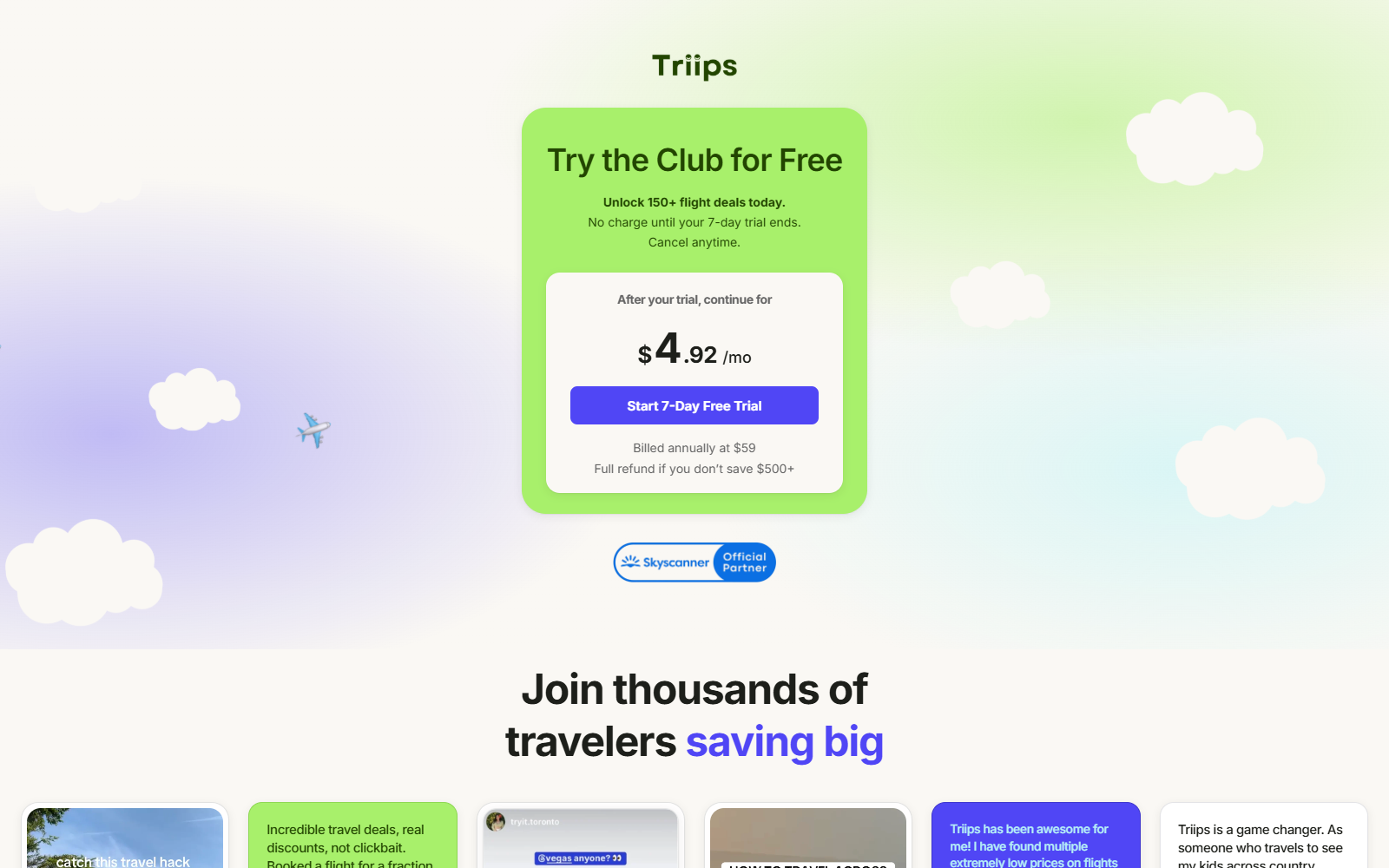
The pricing page displays $4.92 per month, but the smaller text explains that billing occurs annually at $59 after the seven-day trial.
The trial lasts exactly 168 hours from signup. Triips says it converts automatically unless the member completes cancellation before that precise deadline.
Customers receive only one free trial during their lifetime. A returning user may be charged immediately, even when the signup screen feels familiar.
Value depends on flexibility, timing, and careful expectations
Triips advertises two or three alerts weekly and savings of 50% to 90%. Its terms also say promotional examples may not reflect current availability.
Members cannot demand a specific destination or date. The service works best for travelers able to move quickly when an appropriate route appears.
A person needing one fixed school-break flight may receive many attractive alerts without finding a usable fare. That is a value mismatch, not proof of fraud.
- The seven-day trial becomes a recurring annual plan.
- The $4.92 figure is a monthly equivalent, not monthly billing.
- Processed payments are generally final and non-refundable.
- Email unsubscribing does not cancel paid membership.
- The savings guarantee has several demanding conditions.
Is Triips Fair Fares Club a Scam?
Triips operates a functioning flight-alert service with published prices, terms, a Florida mailing address, Stripe billing, account cancellation, and customer support.
Those facts do not support calling every Triips membership fraudulent. The sharper criticism concerns marketing expectations, automatic conversion, final-payment rules, and limited recourse after a missed deadline.
The service’s own terms state that advertisement screenshots, testimonials, prices, destinations, and discount percentages are illustrative. They may not match current booking availability.
That disclosure matters because the emotional sale happens through spectacular examples. A traveler may join for one dramatic fare, then discover the service only supplies future alerts.
Complaints online should be read carefully. Some users allege unavailable prices or refund frustration, while other reviewers describe useful savings and timely notifications.
Neither a glowing testimonial nor an angry comment proves the experience everyone will have. The written contract offers a more reliable picture of predictable risks.
What Members Actually Receive
Triips says its software analyzes millions of fare combinations and sends two or three curated deals each week from a selected departure city.
The email includes example dates and a link. Clicking it sends the member to Skyscanner, where live inventory and current prices determine what remains bookable.
Travelers still choose the airline, schedule, fare class, baggage terms, and booking provider. Triips does not handle the resulting reservation.
This service model can be useful. Dedicated fare watchers often find temporary price drops that casual shoppers miss, especially across flexible international routes.
However, the alert does not guarantee a complete trip at the headline price. Baggage, seat selection, airport transfers, overnight connections, and separate tickets can change value.
An unusually cheap itinerary may use inconvenient dates or distant airports. Compare the total journey, not merely the first number in the email.
Triips also says fares can vanish within hours. That creates real urgency, but urgency should not replace checking the airline, connection rules, and cancellation terms.
How the Triips Membership Works
Step 1: Marketing highlights exceptional fare examples
Travelers encounter social posts, testimonials, price comparisons, or destination images showing dramatic discounts. The examples make membership feel capable of paying for itself immediately.
Triips says its deals can be 50% to 90% below regular prices. The terms clarify that marketing examples are illustrative and may not remain available.
Before signing up for one displayed route, search that exact itinerary independently. Confirm dates, airports, baggage, cabin, and whether the price still exists.
Step 2: The visitor begins a seven-day trial
The customer supplies account and payment information. The trial has no initial membership charge, but the card authorizes later annual billing.
The clock runs for precisely 168 hours. If signup happens Tuesday at 3:17 p.m., the conversion is scheduled around the same time next Tuesday.
Set reminders at least 48 hours and 12 hours before expiry. A calendar date without the signup time can create an expensive misunderstanding.
Step 3: Deal emails begin arriving
Alerts are tailored to the selected departure city rather than a guaranteed destination. Members may receive opportunities unrelated to their immediate plans.
A deal can still be useful months later. Yet the trial is too short to measure a full year of unpredictable destination coverage.
Evaluate the service process during the trial, not only whether a dream fare appears. Check email frequency, route relevance, click quality, and live price accuracy.
Step 4: The trial converts into annual billing
Unless canceled, Triips charges $59 for a year. The advertised $4.92 monthly amount is the annual price divided into twelve parts.
This presentation is common in subscription marketing. It can still confuse shoppers who equate a monthly equivalent with a cancellable monthly installment.
Read the receipt after enrollment. It should show the plan, next billing date, card descriptor, and a path to account management.
Step 5: Cancellation requires the account dashboard
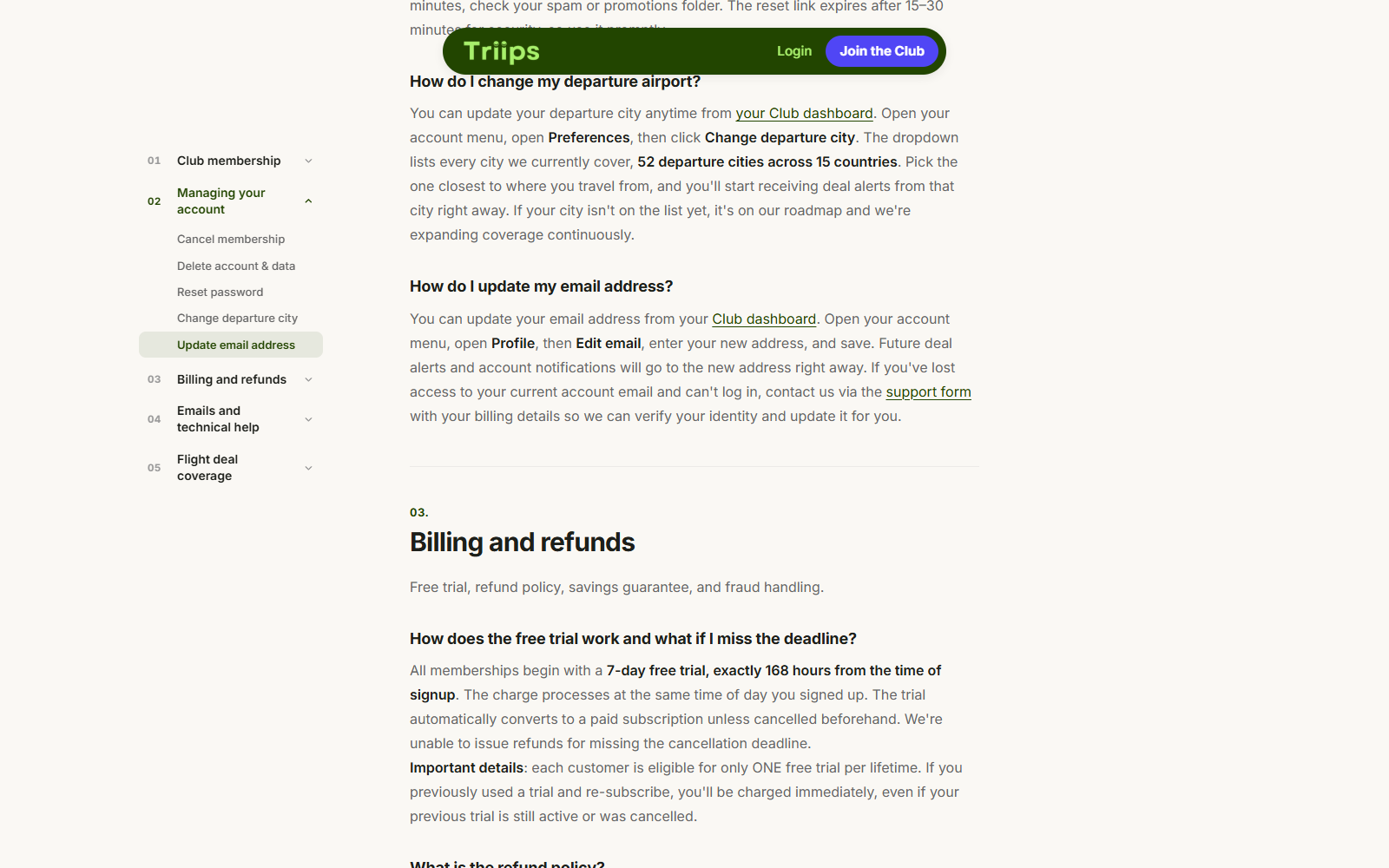
Members must log in, open the Club dashboard, enter Settings, and choose Cancel subscription. A retention window may offer extensions or promotions.
Triips states that staff cannot cancel by email, phone, or chat. The user must finish the self-service flow and receive confirmation.
Unsubscribing from deal emails is separate. It removes messages but does not end the paid plan or prevent its next renewal.
Step 6: Refund options narrow after the charge
Triips says processed subscription payments are final. Missing the trial deadline does not qualify for a routine refund under its FAQ and terms.
The savings guarantee is an exception with conditions. A member must stay for twelve months, book two qualifying flights, and document less than $500 saved.
The request must also arrive within 30 days after the first-year billing anniversary. This is not an immediate satisfaction guarantee.
The $500 Savings Guarantee Is Not a Simple Refund Promise
The pricing page gives the guarantee prominent space. A quick reader may interpret it as protection against an unhelpful membership.
The terms make it narrower. Eligibility begins only after a complete twelve-month membership, not during the trial or shortly after the annual payment.
The member must book at least two flights using deals received through Triips. Someone who finds nothing suitable cannot satisfy that booking condition.
Booking confirmations and related alert emails must be supplied. Deleting deal messages can therefore weaken a later claim.
The request window lasts 30 days after the year-end billing date. Missing it can end eligibility even when other conditions were completed.
Savings calculations can also become disputed. A comparison depends on route, dates, fare class, baggage, booking time, and the baseline used.
Treat the guarantee as a conditional contract benefit, not a reason to ignore the trial deadline. Decide whether $59 is worthwhile without relying on reimbursement.
Why a Fare May Be Gone When You Click
Airline inventory changes continuously. The cheapest fare bucket may contain only a few seats, and another traveler can purchase them before you arrive.
Search platforms also cache information. A headline number may update only after the user selects exact dates, travelers, baggage, and the final booking provider.
Some examples use broad date combinations. Your preferred weekend may cost more even when a nearby Tuesday remains available at the advertised level.
Foreign currency and location can affect display prices. Bank conversion fees may increase the final cost when a transaction processes in another currency.
None of these issues automatically means Triips invented the fare. They explain why a detected price and a completed purchase are different events.
Still, repeated dead links reduce the service’s practical value. Keep a small log during the trial showing alert time, click time, route, and live result.
That record supports an informed decision before conversion. It is more useful than relying on the excitement of one screenshot.
How to Decide Whether Triips Fits Your Travel Style
A strong candidate lives near a covered airport, travels several times yearly, has flexible dates, considers unexpected destinations, and can book quickly.
A weak candidate needs one precise route, travels during rigid school holidays, requires complicated accessibility support, or rarely checks email.
Compare the service with free airline newsletters, Google Flights tracking, Skyscanner alerts, credit-card travel portals, and manual flexible-date searches.
The paid club must save either money or meaningful research time beyond those alternatives. A large discount on a trip you cannot take has no practical value.
Before enrolling, confirm that your departure city is supported. Triips says coverage focuses on selected cities even though worldwide visitors can access the service.
Also consider the full travel party. A fare available for one seat may not remain available for four people on the same itinerary.
Keep expectations realistic. The service discovers opportunities; it does not manufacture low fares for dates and destinations chosen in advance.
Company, Address, and Fulfillment Checks
Triips identifies a legal business
The current terms name Triips, LLC. They explain the alert model, Stripe payment processing, third-party booking, automatic renewal, cancellation, and customer responsibilities.
That level of disclosure supports treating it as a traceable subscription service. The remaining question is whether its value matches a particular traveler.
The listed Orlando address appears mailbox-formatted
Triips publishes 7345 West Sand Lake Road, number 210-4752, Orlando, Florida 32819. The numbered format may represent a commercial mailbox.
A mailbox is not automatically deceptive. It should not be mistaken for a staffed travel office where customers can obtain in-person assistance.
Support is deliberately limited to digital channels
The terms list contact@triips.com and an online form. They state that phone and social-media requests are not accepted support routes.
The same terms say responses may take up to 30 days. A traveler should not depend on Triips for urgent airline problems or same-day itinerary changes.
Fulfillment means emailed information
Triips fulfills membership through alerts and dashboard access. Skyscanner, airlines, and booking sites handle the actual ticket transaction independently.
Save both records. The Triips alert proves what was promoted, while the booking confirmation controls the flight, payment, baggage, and cancellation rights.
Billing Details to Check Before Starting the Trial
- The plan renews automatically after exactly 168 hours.
- The $4.92 display represents a $59 annual charge.
- A second lifetime trial is not available.
- Returning members may be charged immediately.
- Completed payments are generally non-refundable.
- Email unsubscribe does not cancel membership.
- Cancellation must finish inside account settings.
Take a screenshot of these details before submitting the form. Promotional pages and terms can change after a customer joins.
Use an email address you monitor. Billing notices and cancellation proof are easy to lose inside a promotions folder.
Create a unique password and store it securely. Losing access near the deadline can make the self-service cancellation requirement harder to satisfy.
Test login immediately after signup. If account access fails, contact support while substantial trial time remains.
What to Do if You Were Charged by Triips
- Confirm the signup time. Locate the welcome email and calculate the exact 168-hour deadline rather than relying only on the calendar date.
- Cancel in the dashboard. Complete every retention screen until a cancellation confirmation appears, then save the email and account screenshot.
- Separate email preferences from billing. Unsubscribing from alerts does not cancel the membership, so verify the subscription status itself.
- Write to support promptly. If a technical error ignored timely cancellation, attach the confirmation and a clear chronology of the attempted steps.
- Review the transaction with your issuer. Explain accurately whether the charge was unauthorized, duplicated, or continued after confirmed cancellation.
- Secure the account. Change reused passwords and inspect the connected email account if someone enrolled using your identity or card.
- Check the device that displayed the offer. Malwarebytes can detect unwanted software, while AdGuard can block many deceptive ads and tracking redirects.
- Preserve travel evidence. Keep alerts, live-price screenshots, booking confirmations, receipts, terms, and all refund communications until the matter closes.
Frequently Asked Questions
Is Triips the same company as Trip.com?
No. Triips says it is unrelated to Trip.com. Triips sells flight-alert membership, while Trip.com operates as an online travel booking platform.
How much does Triips cost after the trial?
The current offer displays $4.92 per month but bills $59 annually after the seven-day trial unless the customer cancels beforehand.
Does unsubscribing from Triips emails stop billing?
No. The terms distinguish marketing-email preferences from subscription cancellation. Members must end billing through the Club dashboard and retain confirmation.
Can Triips guarantee that an advertised flight remains available?
No. Airline inventory and prices change continuously. Triips identifies deals, while the live booking platform determines availability when the traveler clicks.
Will Triips refund a missed free-trial deadline?
Its published policy says processed payments are final and missing the cancellation deadline does not receive a routine refund. Documented technical errors may be investigated.
Is the $500 savings guarantee automatic?
No. Members must complete twelve months, book two flights through received deals, submit evidence, and apply within 30 days after the year ends.
The Bottom Line
Triips is a real airfare-alert subscription, not a ticket seller. Its main risks are annual auto-billing, a strict deadline, final payments, and illustrative marketing.
Flexible travelers may find value, but every customer should judge the live alerts during trial, cancel correctly, and never confuse a monthly equivalent with monthly billing.

Join the discussion
0 commentsShare your experience or ask a question about this article.
Discussion
Start the conversation
Have a question or something useful to share? Add the first comment.