

Joint pain can quietly shrink a person’s day. Stairs, sleep, gardening, and even getting out of a chair may begin to require planning.
SynoCell enters that moment with confident promises about inflammation, cartilage, healing, and movement. The offer deserves a careful reading beyond its testimonials.
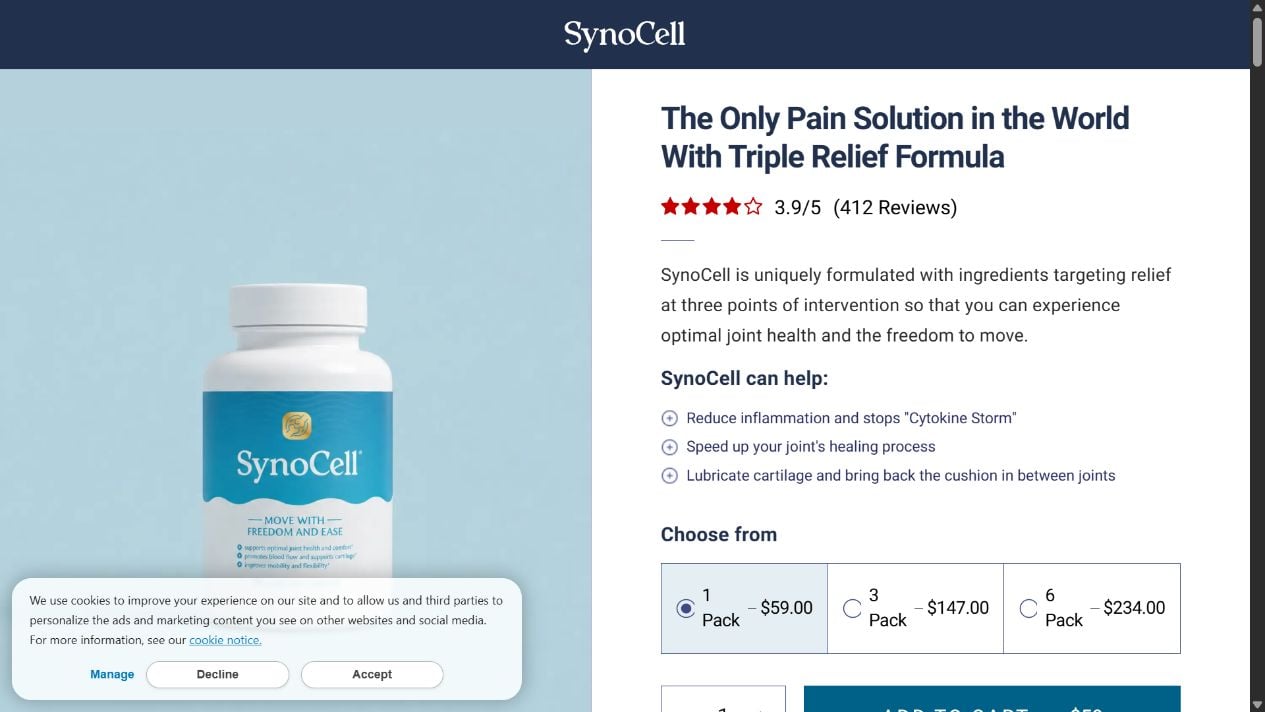
Overview
SynoCell is a real dietary supplement sold by an identifiable business group
The current SynoCell site lists capsules, ingredients, prices, customer support, policies, and a named group of related companies.
Its terms identify Konscious LLC, Enclave LLC, and Vital Health LLC, using several business names collectively described as Konscious Brands.
This is stronger disclosure than anonymous supplement funnels provide. It still does not prove that every advertised health outcome is clinically established.
The sales language reaches beyond ordinary joint support
SynoCell says it can reduce inflammation, accelerate healing, lubricate cartilage, restore movement, and address root causes of joint and back discomfort.
Some pages use even stronger language involving damaged nerves, scar tissue, cytokine storms, cartilage regeneration, and old injuries.
Those claims sound therapeutic. The footer simultaneously says the product is not intended to diagnose, treat, cure, or prevent disease.
The refund policy contains important conditions
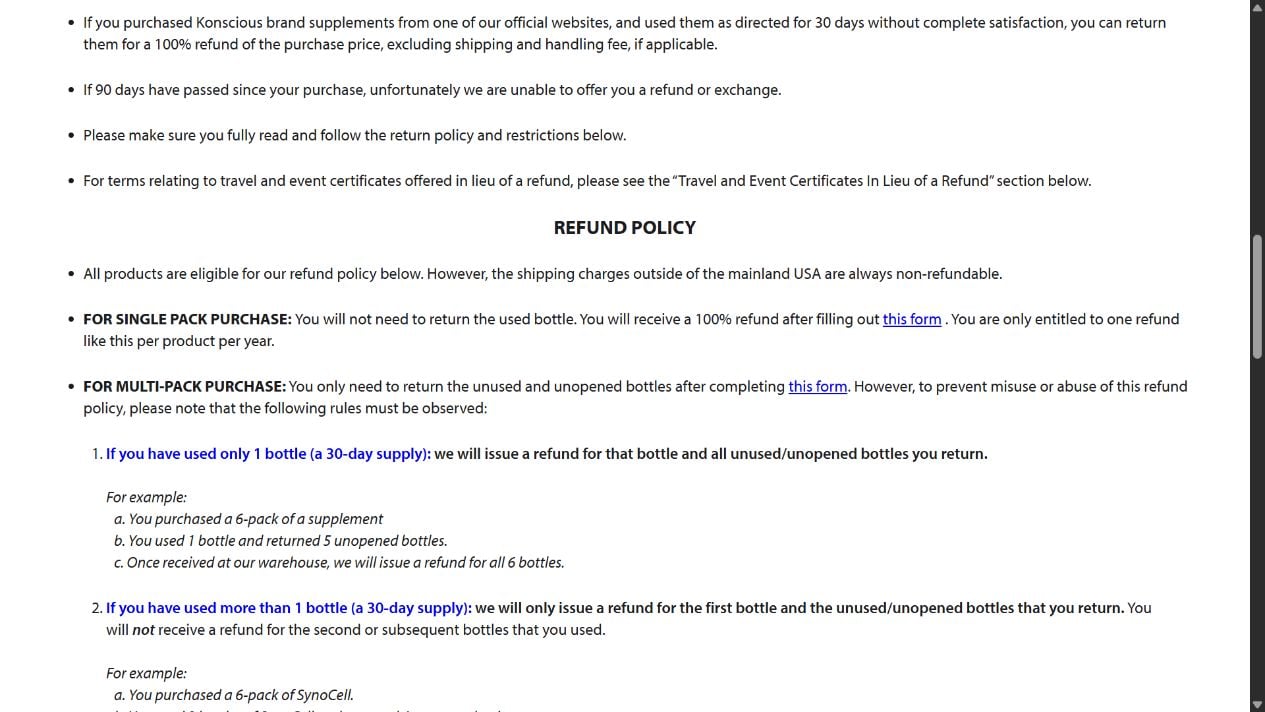
SynoCell advertises a 90-day money-back guarantee. Single-pack customers may request a refund without returning the used bottle, subject to the written process.
Multi-pack buyers must return unused, unopened bottles. If more than one bottle was used, later opened bottles are excluded from the refund.
The policy also deducts shipping and handling where applicable, restricts order changes, and may offer travel certificates instead of refunds.
- SynoCell is a tangible supplement with published Supplement Facts.
- The seller identifies related legal entities and support channels.
- Product pages make broad healing and structural claims.
- Independent evidence does not establish every advertised outcome.
- Multi-pack refunds require unopened bottles to be returned.
- The wider terms describe optional subscription pricing for some offers.
Is SynoCell a Scam?
The available evidence does not support calling SynoCell a nonexistent product or an anonymous fake store. A real seller, formula, policies, and support process are visible.
That answer should not be mistaken for an endorsement. The marketing repeatedly moves from plausible ingredient support to claims that imply healing damaged body structures.
Dietary supplements can contain familiar ingredients without proving that the finished product performs every promised function.
SynoCell’s current formula lists avocado and soybean unsaponifiables, quercetin, Boswellia extract, hyaluronic acid, and black pepper extract.
Research on joint supplements is mixed and often depends on the exact ingredient, dose, preparation, condition, study quality, and outcome measured.
The current product page displayed one-time package choices during our review. We did not see an automatic subscription selected beside those options.
However, the umbrella terms say some Konscious Brands offers use auto-renewing subscriptions. Buyers must rely on their exact checkout, not assumptions from another page.
The fair conclusion is that SynoCell is a real supplement sold through aggressive health marketing, with meaningful refund and billing details that require attention.
What the Ingredients Can and Cannot Establish
Avocado and soybean unsaponifiables, often shortened to ASU, have been studied for osteoarthritis symptoms. Study results cannot automatically validate a branded mixture.
Boswellia extracts have also been researched for discomfort and inflammation. Preparations vary in concentration, standardization, quality, and actual absorbed dose.
Hyaluronic acid is naturally present in joints. Evidence involving injections, topical products, and oral supplements should not be treated as interchangeable.
Quercetin is a plant compound studied for many biological effects. Laboratory activity does not prove that a capsule regrows human cartilage or bone.
The National Center for Complementary and Integrative Health describes joint-supplement evidence as inconsistent. It advises considering side effects and medication interactions.
Ingredient research can justify cautious words such as “may support.” It does not justify promising repaired nerves, renewed cartilage, or reversed chronic injuries.
A finished-product trial would need to study SynoCell itself, at its marketed dose, against a comparison group, using meaningful outcomes and adequate follow-up.
Quality also matters. A label can state target amounts without showing whether an independent laboratory confirmed identity, potency, microbes, or heavy metals.
Lot-specific testing would answer that question more directly than seals, badges, or broad manufacturing claims displayed on a sales page.
How the SynoCell Sales Funnel Works
Step 1: The page begins with pain and lost independence
SynoCell advertising focuses on knees, backs, necks, sleep, mobility, exercise, and hobbies. These problems are personal and emotionally powerful.
The message suggests that ordinary approaches only mask symptoms, while the supplement supposedly reaches an underlying cellular cause.
This framing can make a complex diagnosis feel settled before a clinician has identified arthritis, nerve compression, injury, inflammation, or another cause.
Step 2: Ingredients are turned into a repair narrative
The page assigns each ingredient a vivid role. One stops inflammation, another rejuvenates cartilage, and another coats joints like a low-friction surface.
That storytelling is easier to remember than a cautious research summary. It also creates an impression that the combined mechanism is proven.
Biological plausibility is not the same as clinical effectiveness. Human bodies do not deliver supplement ingredients directly to one painful joint on command.
Step 3: Testimonials make improvement feel predictable
The sales page features customers describing rapid relief, restored mobility, better sleep, and bodies that feel younger.
Testimonials do not show unsuccessful buyers, concurrent treatments, diagnosis, adherence, natural symptom fluctuation, or placebo effects.
The page displayed hundreds of reviews, but review volume is not a substitute for a controlled, independently published trial.
Step 4: Package pricing encourages a longer commitment
Buyers can choose one, three, or six bottles. The larger packages lower the displayed cost per bottle and imply that sustained use is preferable.
A multi-month supply increases the upfront charge. It also creates more conditions if the customer later requests a refund.
Before ordering six bottles, calculate the entire transaction and decide whether unopened units can be returned affordably from your location.
Step 5: The guarantee reduces the fear of buying several bottles
The 90-day promise makes a large order seem reversible. On the main page, the guarantee is described in reassuring, low-friction language.
The detailed policy is more specific. It protects one used bottle, but later opened bottles in a multi-pack may not qualify.
International customers pay return postage. Shipping charges are nonrefundable, and a 10% shipping and handling deduction may apply.
Step 6: The written terms govern billing and disputes
The terms cover one-time purchases and subscriptions across several associated brands. Subscriptions may renew every 28, 30, 56, or 364 days.
That does not prove every SynoCell checkout is recurring. It means buyers must inspect whether their selected option says subscription, autoship, delivery frequency, or one-time purchase.
The terms also contain binding arbitration and a class-action waiver. These provisions affect disputes even though they are far from the main product promise.
The Medical-Style Claims Deserve More Scrutiny
The phrase “triple relief formula” is marketing, not a recognized medical category. It organizes the sales narrative but does not establish a clinical standard.
The site says SynoCell targets a cytokine storm. That term commonly describes severe systemic immune dysregulation, not an ordinary synonym for daily joint soreness.
Using it in routine supplement marketing can blur the difference between serious medical conditions and general inflammation language.
Claims about healing scar tissue, cartilage, tendons, or nerve endings are especially consequential. Structural repair requires evidence beyond customer stories and ingredient descriptions.
The product disclaimer acknowledges that statements were not evaluated by the FDA. Dietary supplements are not preapproved for effectiveness like prescription medicines.
People with persistent joint swelling, weakness, numbness, fever, trauma, or unexplained weight loss should seek evaluation instead of relying on an online formula.
Anyone taking warfarin, diabetes medication, or multiple prescriptions should discuss ingredients with a clinician or pharmacist before use.
Pricing, Subscription Language, and Order Control
During our review, the visible product selector showed package quantities rather than a preselected subscription. That is the evidence for the page we examined.
The terms nevertheless authorize subscription pricing for certain offerings. They say recurring charges continue at the selected interval until cancellation.
Consumers should inspect the final button, order summary, confirmation email, and bank descriptor. The checkout controls the transaction, not a review article.
The refund policy says fulfillment begins quickly and orders generally cannot be canceled or modified after placement.
This means a quantity mistake may become a return problem. Check whether the cart contains one bottle, a bundle, or a recurring delivery before paying.
Save screenshots showing the selected package and billing frequency. They can resolve confusion if the confirmation differs from what was displayed.
Company, Address, and Fulfillment Checks
Several legal entities share the Konscious Brands terms
The terms identify Konscious LLC, Enclave LLC, and Vital Health LLC, alongside several trading names.
That disclosure connects the storefront to an operating group. Customers should still confirm which entity appears on their receipt and card statement.
The published mailing address is in Puerto Rico
The dispute section lists Konscious Brands at 151 Calle de San Francisco, PMB 5585, San Juan, Puerto Rico 00901.
A private mailbox or corporate address is not automatically suspicious. It should not be assumed to be the product factory or return warehouse.
Support routes through email and an online request system
The current site publishes hello@synocell.com and a support form. The terms also use hello@konsciousketo.com for some subscription cancellations.
Because two addresses appear, buyers should send time-sensitive requests to the address listed on their specific order and retain delivery records.
Returns go through authorization, not the public mailing address
U.S. customers can receive a prepaid label after approval. International customers must arrange and pay for return shipping themselves.
The warehouse destination may differ from the company mailing address. Never mail bottles without written instructions tied to the order number.
What to Check Before Ordering SynoCell
Read the Supplement Facts rather than the ingredient story. Confirm the amount per serving, capsule count, allergens, warnings, and complete other-ingredients list.
Ask support for a certificate of analysis tied to the current lot. Verify whether testing covers identity, potency, heavy metals, microbes, and contaminants.
Search for a published clinical trial of the finished SynoCell formula. General ingredient studies cannot prove the exact product’s advertised outcomes.
Review every package option. Make sure the cart reflects the intended bottle count, one-time price, shipping, taxes, and any subscription frequency.
Read the multi-pack refund rules before opening a second bottle. Opening several bottles can reduce the refundable amount.
Ask where an international return would go and estimate tracked postage. A guarantee can lose practical value when return shipping is expensive.
Discuss the formula with a clinician if you have a diagnosis, surgery planned, allergies, pregnancy, or medicines that affect bleeding or blood sugar.
What to Do if You Have Fallen Victim to This Scam
- Preserve the checkout evidence. Save the product page, selected package, billing frequency, receipt, confirmation, guarantee, policies, and all support messages.
- Check whether the order is recurring. Review the confirmation and card statement for subscription wording. Do not infer billing frequency from the bottle count.
- Contact the correct support channel. Use hello@synocell.com or the official request form. Include the order number and exact remedy requested.
- Keep unopened bottles sealed. Multi-pack refunds depend on returning unused, unopened units. Photograph the seals, labels, lot numbers, and full package.
- Request a return label and calculation. Ask which bottles qualify, what deductions apply, where the parcel goes, and the mailing deadline.
- Use tracked shipping. Preserve the acceptance receipt, tracking history, delivery confirmation, parcel weight, and photographs taken before mailing.
- Escalate accurately if necessary. Contact the payment provider for unauthorized recurring charges, non-delivery, or a documented policy violation. Avoid exaggerating the dispute.
- Report adverse effects. Stop taking the supplement and seek medical advice for concerning symptoms. Report serious events through appropriate health authorities.
- Check online safety. Scan the device with Malwarebytes after suspicious redirects or downloads. AdGuard can reduce malicious ads, pop-ups, and tracking.
Frequently Asked Questions
Is SynoCell a real supplement?
Yes. SynoCell is a physical dietary supplement with a published formula, operating website, support channels, terms, and refund policy.
Does SynoCell regrow cartilage or heal nerves?
The sales language suggests repair, but we found no product-specific clinical evidence proving that the finished supplement regrows cartilage or heals damaged nerves.
Is SynoCell FDA approved?
No. Its own disclaimer says the statements were not evaluated by the FDA and the product is not intended to diagnose, treat, cure, or prevent disease.
Does SynoCell enroll every buyer in a subscription?
No evidence shows that every purchase is recurring. The broader terms allow subscriptions, so each buyer must check the exact checkout and confirmation.
Can I return an opened multi-bottle order?
The policy covers the first used bottle and unopened returns. Additional opened bottles may be excluded, and shipping-related deductions can apply.
Who operates SynoCell?
The terms name Konscious LLC, Enclave LLC, and Vital Health LLC among related entities collectively described as Konscious Brands.
The Bottom Line
SynoCell appears to be a real supplement from an identifiable seller, not an empty storefront or proven universal subscription trap.
Its medical-style healing claims go far beyond what ingredient descriptions and testimonials can establish. The refund policy also matters more than the reassuring headline.
Consider it only as a supplement, not a treatment. Verify billing, preserve unopened bottles, and discuss persistent pain with a qualified professional.

Reviews & discussion
0 commentsShare a firsthand experience, or ask a question.
Community reviews
SynoCell
Moderated reader experiences, not an editorial verdict.
Start the conversation
Have a question or something useful to share? Add the first comment.