

AMP Joint-10 is promoted with familiar joint-support ingredients and the promise of easier movement. Its sales pages make the formula sound straightforward.
But when you are choosing something to take daily, the details need to agree. Reading beyond the first page reveals questions worth answering before ordering.
Overview
The promotional formula does not match the support page
AMP Joint-10’s clearest problem is a verified information mismatch. An official-looking affiliate page advertises ingredient amounts that differ substantially from the offer’s published Supplement Facts.
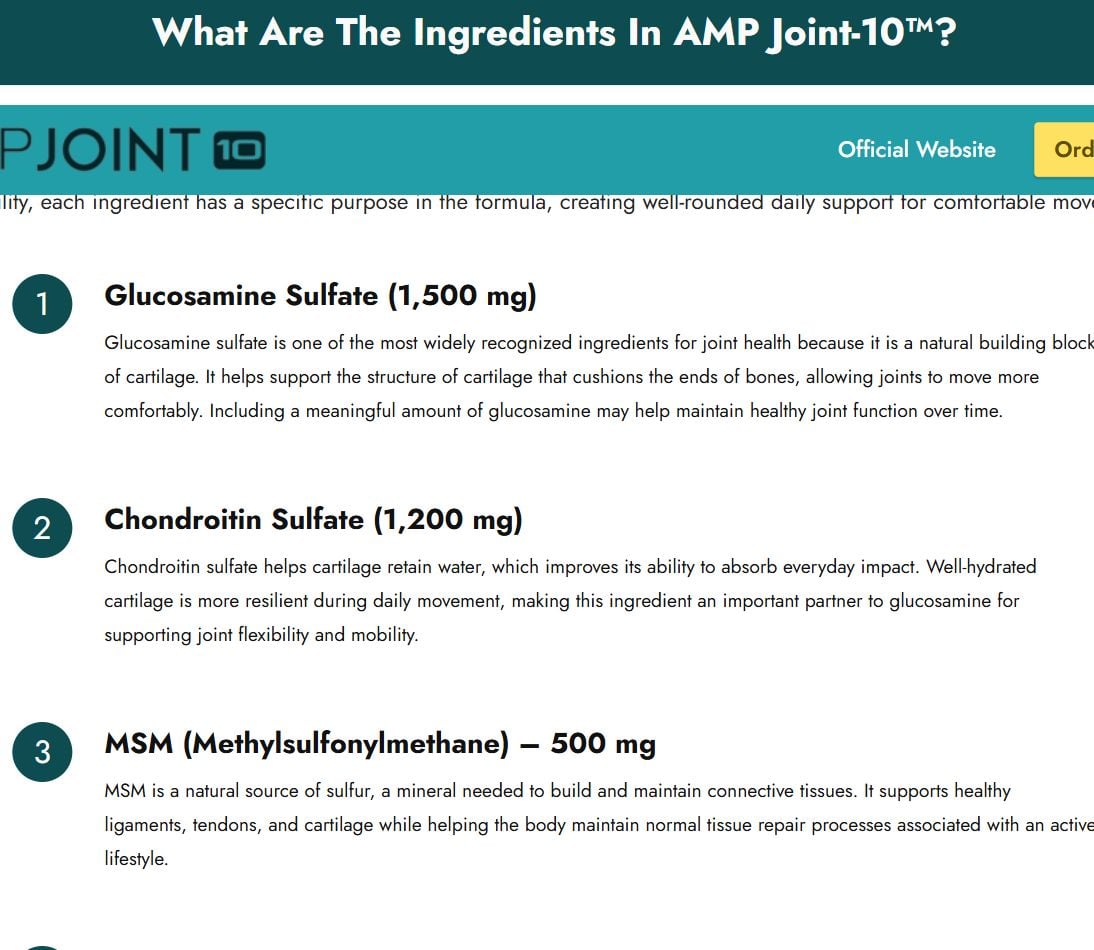
For example, the promotion lists 1,200 mg of chondroitin. The linked offer’s customer-support page lists 100 mg per two-capsule serving.
That is not a small punctuation error. It changes the formula a buyer believes they are evaluating.
We inspected the route from ampjoints10.com through a ClickBank affiliate link to getampjoint.com on October 8, 2026.
The findings go beyond one incorrect number
- The affiliate and support pages also disagree about glucosamine and MSM amounts.
- The promotion includes unrelated Sumatra Slim Belly Tonic copy and a discount link pointing to that other product’s domain.
- A claimed 73% reduction from $79 to $49 does not match the arithmetic, which is about 38%.
- The actual offer displays multi-bottle packages with different per-bottle prices and total commitments.
- The support information identifies a shellfish ingredient that matters to buyers with relevant allergies.
These observations concern the sales information. We did not analyze capsules, verify clinical effectiveness, or prove that the brand owns every promotional domain.
Our verdict: do not buy from an inconsistent formula pitch
Do not make a health purchase based on ampjoints10.com’s description. Require a current physical-label copy and an explanation of the discrepancies first.
The examined offer is a real purchasing route with published support and return information. That does not make the affiliate’s claims accurate.
We did not establish forced six-bottle orders or automatic refills. The confirmed problem is misleading and inconsistent promotional information, not a universal subscription finding.
The Ingredient Comparison Buyers Need to See
Three advertised amounts change on the destination site
The promotional page uses a detailed ingredient section. Its precise numbers can make the description feel more authoritative than ordinary wellness advertising.
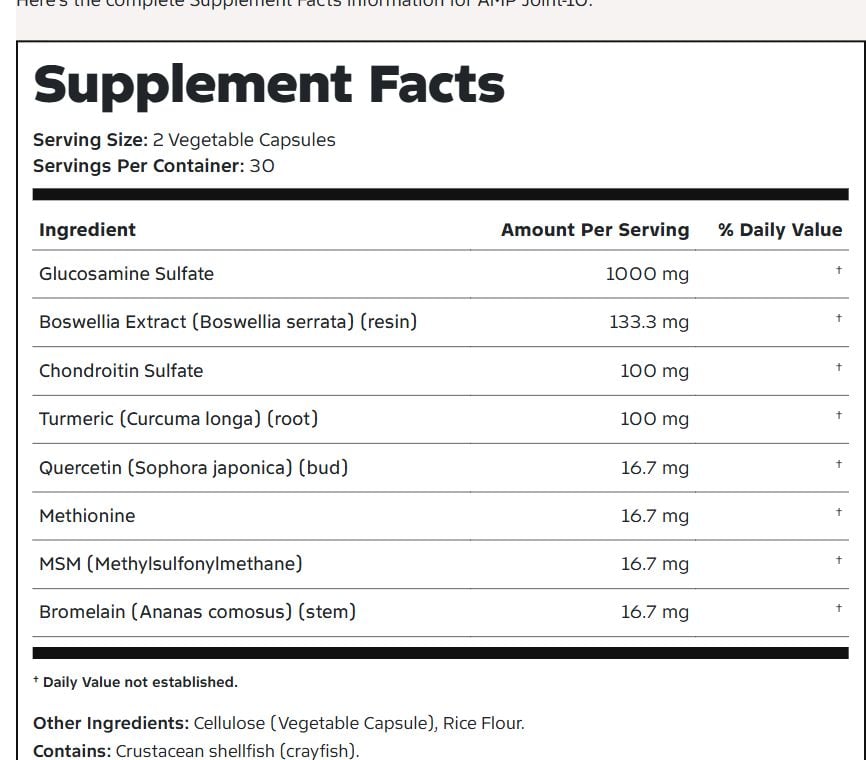
Following its main order route leads to a different domain. The offer’s support page publishes a Supplement Facts table with different amounts.
| Ingredient | Affiliate claim | Published support facts, per serving |
|---|---|---|
| Glucosamine sulfate | 1,500 mg | 1,000 mg |
| Chondroitin sulfate | 1,200 mg | 100 mg |
| MSM | 500 mg | 16.7 mg |
The support table specifies two vegetable capsules per serving and 30 servings per container. Neither page constitutes a laboratory measurement of a bottle we opened.
Nevertheless, buyers should not be expected to resolve a major formula contradiction themselves. The party selling the product needs to provide consistent, current information.
A familiar ingredient name does not make the difference irrelevant
When evaluating supplement research, preparation and amount matter. You cannot assume two products are equivalent merely because both mention glucosamine or chondroitin.
Nor should you solve this discrepancy by taking extra capsules. That could increase other ingredients and introduce risks not reflected in the directions.
A seller might explain that a page is outdated or refers to another formulation. We did not receive such an explanation during this read-only investigation.
Until the discrepancy is resolved, the promotion is not a dependable basis for comparing products, checking interactions, or deciding what to swallow.
How the AMP Joint-10 Affiliate Sales Funnel Works
Step 1: An official-looking page presents itself as authoritative
The affiliate site repeatedly describes its destination as official and surrounds the offer with benefits, testimonials, ingredient explanations, and urgency messages.
A reader can easily interpret that presentation as the manufacturer’s own information. The site’s commission disclosure makes a different relationship relevant.
An affiliate can earn money when a reader purchases through its link. That commercial incentive does not automatically make an affiliate dishonest.
It does mean the reader should check the seller’s current label and policies rather than treat a promotional review as independent medical guidance.
Step 2: Precise formulation claims strengthen the sales argument
The ingredient list gives specific amounts and explains their supposed contribution to joint function. This lends the page an appearance of product-level expertise.
Yet the amounts do not align with the support table reached through the same main sales route.
There is also unrelated weight-loss-product copy in a section describing joint mobility. That mismatch is visible without buying anything.
It suggests unreliable page maintenance or reused promotional material. It does not establish that the capsules themselves contain the other product.
Step 3: Discount claims push attention toward the lowest bottle price
The promotion pairs $79 and $49 with a 73% discount claim. The difference is $30, approximately 38% of $79.
Its large savings language therefore cannot be accepted simply because it appears beside a purchase button.
More importantly, $49 is presented in connection with a larger package. A per-bottle figure is not necessarily the amount charged for the order.
Do the arithmetic using the whole basket. Discounts should explain a purchase, not distract from how much money you are committing.
Step 4: The main order button redirects to another domain
We observed the main button pass through a ClickBank affiliate hop and reach getampjoint.com. This confirms the sales route examined in our review.
A domain change is not inherently malicious. Affiliate systems commonly track referrals across separate sites.
But it gives buyers another point to check: are the label, company information, guarantee, and price the same as the page that persuaded you?
Another discount link on the promotional page points to a Sumatra-related domain. That inconsistent destination is a further reason not to trust every button blindly.
Step 5: Package selection determines the actual commitment
The offer displayed two bottles for $158, three for $207, or six for $294. Shipping benefits varied by package and destination.
Those options are not evidence that buyers requesting one bottle inevitably receive six. We did not complete checkout or inspect an individual customer’s authorization.
The genuine purchasing risk is overlooking the total because the largest package has the lowest unit price.
Six bottles create a larger initial exposure, more product to return, and a longer personal-use commitment. That matters when the formula information already conflicts.
Step 6: A guarantee becomes a return procedure
The destination site’s return page requires contacting support before mailing all bottles, including used, unused, and unopened ones.
The customer pays return postage. That is a practical condition, even when the offer prominently advertises a money-back guarantee.
The support page counts 60 days from purchase, while the return page describes shipment. Buyers should ask for their actual deadline.
Do not wait for the later interpretation when you are already dissatisfied. Preserve the promise and request a remedy while both windows remain open.
Company, Support, Address, and Manufacturing Checks
The affiliate, brand, and retailer are separate roles
The promotional page names Montra Health, while the destination footer identifies ClickBank as retailer. Neither establishes that the affiliate is the manufacturer.
ClickBank’s disclosed role is a sales relationship, not scientific endorsement. Its footer explicitly distinguishes retailing from approval of product claims.
Check the business identified on your payment receipt. For a transaction problem, that record helps determine which support route can locate the order.
We did not independently authenticate brand ownership or corporate relationships beyond the observed pages. An official-style domain should not be treated as proof of ownership.
The Colorado returns department is not a verified factory
The return instructions identify a department at 19655 E 35th Dr, #100, Aurora, CO 80011.
That is a published returns address. We did not verify that it is the product’s manufacturing site, corporate headquarters, or a customer-facing office.
The Boise address in the ClickBank disclosure concerns the retailer. It should not be used as evidence of where the supplement is manufactured.
Get return registration and current recipient details before sending bottles. A correct-looking postal address alone does not confirm that a refund request has been opened.
Two email domains require clarification, not guesswork
The support page gives support@getampjoint.com, telephone (833) 667-9482, and text number (737) 738-8063.
The return page instead uses support@AMPJoint.com. We did not call, text, or test delivery to either email address.
Those differing contacts do not prove an inbox is fake. They do make it important to obtain acknowledgment connected to your order.
Use the receipt’s verified assistance route if a website address fails. Avoid sharing medical records or complete payment credentials simply to identify a supplement purchase.
The current bottle label must settle the formula question
The support page provides a more concrete ingredient and allergen disclosure than the affiliate pitch. Buyers still need the label for the batch actually supplied.
Ask for manufacturer or distributor information, lot identification, expiry details, and any claimed independent testing tied to that batch.
We did not establish Chinese manufacturing, contamination, or undeclared drugs. None should be asserted solely because the advertising resembles other supplement campaigns.
The missing proof concerns accuracy and traceability. A vague manufacturing-quality badge does not answer a specific question about conflicting ingredient amounts.
Health and Allergy Questions Come Before a Bulk Order
The shellfish warning deserves attention
The published support facts list crustacean shellfish, specifically crayfish. That is relevant information for someone with a shellfish allergy or sensitivity.
Do not infer suitability from phrases such as natural, daily support, or vegetable capsules. A capsule’s shell material does not determine every ingredient inside it.
If the disclosed allergen concerns you, consult an appropriate healthcare professional before use. Ordering extra bottles does not make that uncertainty smaller.
Ingredient research is not a trial of this formula
NCCIH’s evidence review describes inconsistent research findings for glucosamine and chondroitin in osteoarthritis. Clinical recommendations are not uniform.
It also notes potential interactions with warfarin and possible blood-glucose effects from glucosamine. Discuss relevant conditions and medication with your clinician.
Those general findings are not an AMP Joint-10 clinical trial. They neither prove this product works nor establish that every person will experience harm.
What they show is why the exact preparation and dose matter. An inconsistent affiliate list is especially inadequate for a medically relevant decision.
Testimonials cannot replace a current label
Customer stories may describe sincere improvement, but they do not resolve which formulation was used, what other treatments changed, or whether the results were typical.
We did not independently verify the promotional review count or individual testimonials. Treat them as seller-selected marketing rather than a controlled effectiveness measure.
If the product interests you after those limitations are understood, begin with documentation. A six-bottle recommendation should not outrun basic information about the first bottle.
What to Do If You Ordered AMP Joint-10
- Save both versions of the formula information.
Capture the affiliate ingredient claims and the destination support table with their page addresses. Keep the ad or referral page that influenced your decision.
Your concern is stronger when it identifies the exact discrepancy, such as the chondroitin amount, rather than saying the marketing generally seemed suspicious.
- Check the receipt for quantity and billing terms.
Find the total, bottle count, shipping, taxes, and retailer contact. Compare those with what you actually selected.
If there is a recurring-payment term, document it separately. This review did not establish automatic refills for all AMP Joint-10 orders.
- Photograph the delivered Supplement Facts and lot details.
Keep seals and packaging intact while clarifying any mismatch. Ask support which published formula accurately describes your bottles.
Do not compensate for lower advertised amounts by changing the serving yourself. That would also change exposure to the other ingredients.
- Request cancellation or a registered refund promptly.
Use the verified order-support route and identify the purchase. Ask for the precise guarantee deadline, authorization, and current returns recipient.
Retain every bottle if pursuing the advertised guarantee, because the return instructions call for all bottles to be mailed back.
- Keep tracking and repayment evidence separate.
Send the authorized return using the agreed instructions and retain the postage receipt. Ask when the refund was issued after receipt and inspection.
If repayment does not arrive, contact the retailer or payment provider with the registration, tracking, and written promise. Check dispute deadlines before they expire.
- Address health concerns with qualified help.
Bring the actual label to a pharmacist or clinician when checking allergies, medication interactions, or suitability. Seek prompt care for concerning reactions.
A seller cannot resolve a medical issue merely by offering another bottle. Keep treatment decisions independent of discount offers and refund negotiations.
Frequently Asked Questions
Is AMP Joint-10 a confirmed scam?
We verified misleading affiliate information and important discrepancies, not fraud in every product order. The strongest finding concerns an unreliable promotional formula pitch.
Why are the ingredient amounts different?
The reviewed pages do not resolve that question. Ask the merchant for the current physical label and an explanation before relying on either description.
Does AMP Joint-10 contain shellfish?
The destination support page explicitly lists crayfish as a crustacean-shellfish ingredient. Review your actual bottle and seek appropriate advice if allergies are relevant.
Is $49 the total price of an AMP Joint-10 order?
Not for the reviewed six-bottle offer. Its unit price is $49 and its displayed package total is $294, before any other applicable charges.
Does ClickBank certify that the formula works?
No. The destination disclosure identifies ClickBank as retailer and distinguishes that role from endorsing or approving product claims.
Do AMP Joint-10 purchases automatically start refills?
We did not establish that from this review. Examine your checkout and receipt for future billing rather than assuming a subscription exists because other supplements use one.
The Bottom Line
AMP Joint-10’s affiliate pitch and destination Supplement Facts do not agree. The unrelated product copy and inaccurate discount arithmetic make that promotional page less trustworthy.
Do not order until the seller supplies a consistent current label and clear purchase terms. A joint-health decision deserves better evidence than conflicting sales descriptions.
Already purchased? Preserve the discrepancy, check the bottles, and register any refund promptly. You do not need to prove every capsule fraudulent to challenge inaccurate marketing.








