

A thoughtful gift doesn’t need to be expensive. A calendar, ornament, or small craft can feel special when the presentation makes it seem carefully chosen.
Primatrove leans heavily on that feeling. Before paying for its version of handmade charm, look at what the store actually tells you.
Overview
A gift shop built around the handmade feeling
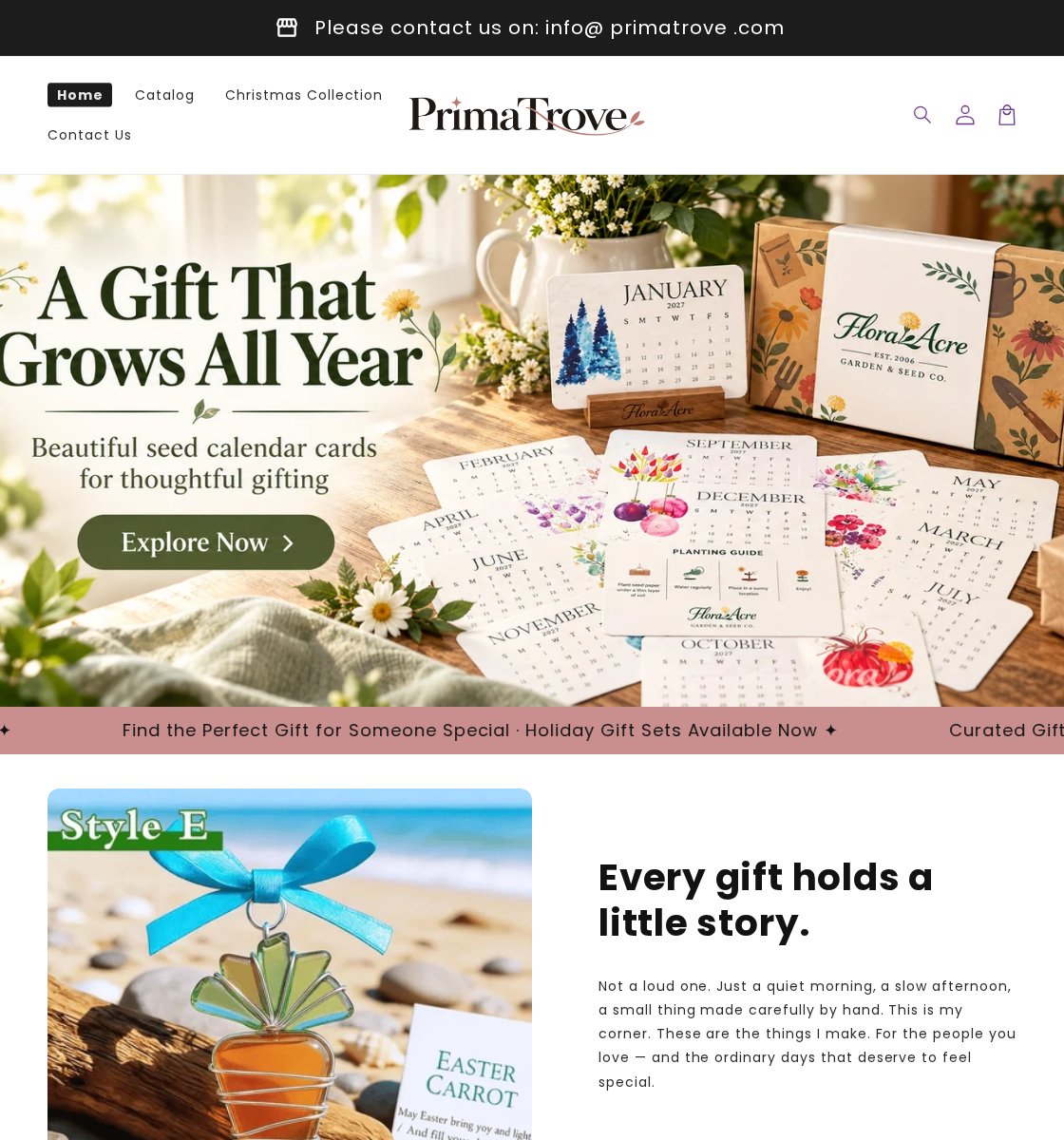
Primatrove.com promotes gifts, seasonal decorations, craft projects, and small household keepsakes. Its homepage speaks of items made by hand, limited quantities, and lasting quality.
The inspected catalog contains six products, including a plantable calendar, ornaments, a pearl-art DIY kit, and gift bags. Some listings clearly describe kits rather than finished artwork.
The issue isn’t whether a DIY kit can make a good present. It’s whether the seller’s handmade story and supporting claims justify your confidence in this particular offer.
The statistics don’t agree with their own explanation
A homepage panel labels repeat customers at 90%, while the accompanying sentence describes three in four customers returning. Three in four is 75%, not 90%.
Another claim about 98% of customers refers to Gift Luxur rather than Primatrove. The page doesn’t explain that name or provide the survey behind the figure.
- Handcrafted positioning appears alongside a broader description of selected gift merchandise.
- The repeat-customer percentage conflicts with the nearby numerical explanation.
- The delivery page charges different amounts for Standard, Express, and VIP services without separate arrival estimates.
- The contact page names a legal entity, but that seller statement isn’t independent registry verification.
Don’t pay a premium for claims the store hasn’t explained
Primatrove’s present offer doesn’t justify paying extra for an assumed artisan origin or a faster delivery service without a defined timing benefit.
These findings don’t establish that every gift is poor quality or that no orders arrive. They do give buyers concrete reasons to choose a clearer retailer.
What the Customer Numbers Actually Tell You
A percentage can look precise even when the evidence behind it is missing. Primatrove uses several figures to suggest satisfaction, quality, and repeat business.
The simplest problem is arithmetic. A 90% repeat-customer label cannot be explained by saying three in four customers come back.
The difference isn’t a minor rounding choice. It is 15 percentage points, and the page gives no explanation of different groups or measurements.
A separate 98% statement introduces Gift Luxur. A buyer reading Primatrove’s homepage shouldn’t have to work out whether that refers to another business or a template left behind.
That doesn’t independently prove a fabricated survey. It means the figures can’t be treated as reliable purchase evidence without the underlying method and correct brand attribution.
Useful context would include how many customers were asked, when they were asked, which product they bought, and what the question actually measured.
A satisfaction percentage is particularly weak when applied across very different products. Buying a gift bag isn’t the same experience as assembling a craft kit.
Instead of letting those numbers settle the decision, focus on the exact item, contents, delivery commitment, and remedy if it differs from the description.
How the Primatrove Gift Offer Leads to a Purchase
Step 1: The presentation suggests a personal maker’s shop
The homepage describes a quiet corner where things are made carefully by hand. Elsewhere, it says pieces are shaped individually and created in limited quantities.
That language suggests more than ordinary resale. It invites the buyer to associate the price with a maker’s time, attention, and original work.
The About Us page uses a different emphasis, explaining that collections are selected. Selection and manufacturing are not necessarily the same activity.
Before paying for an artisan story, ask which part of your specific product is handmade, by whom, and whether you receive a finished item or materials.
Step 2: Product options determine what the attractive image represents
The catalog includes DIY products and items with multiple options. The advertised starting price may not describe every configuration shown in a promotional image.
Read the selected variant and package contents closely. A kit can be entirely legitimate while still being the wrong purchase for someone expecting ready-made decor.
Save the parts list and any assembly description. For a gift, decide whether the recipient would enjoy making the item or needs something ready to display.
Step 3: Shipping upgrades add cost without a clear timing comparison
The shipping information lists Standard at $5.99, Express at $9.99, and VIP at $15.99. Standard is advertised as free over $39.
The page gives a general transit estimate, but doesn’t assign a separate arrival range to each paid service. VIP being described as fastest doesn’t quantify the benefit.
Ask what the upgrade changes: handling priority, carrier service, or transit time. Without that distinction, you can’t evaluate whether the extra charge serves your deadline.
VIP costs $10 more than paid Standard shipping. That price difference is specific; the promised arrival advantage isn’t.
For a gift with a fixed date, buy a defined delivery commitment rather than the suggestion of speed in a service name.
The storefront’s cart markup also includes $3.99 shipping insurance. Its presence doesn’t establish that it is preselected or that any buyer was charged without consent.
Check your actual final summary for extras and keep only what you intend to purchase. An unused option and an authorized payment are different things.
Step 4: Handmade production can add time before transit
Typical preparation is listed as 3–5 business days, with shipment the following day. Busy periods may require 1–2 weeks of production for handmade items.
The separate travel estimate is 10–15 days. The policy does not guarantee an exact delivery date, and customs may add time.
That isn’t a reliable last-minute gifting arrangement. Buying faster shipping shouldn’t be assumed to remove a production queue unless the merchant expressly confirms it.
Ask whether your selected item is already made and available to dispatch. A general statement about handcrafted quality doesn’t answer that operational question.
Step 5: The return journey depends on an address obtained later
The return policy gives a 14-day window from receipt to request a return, with unused condition and original packaging required.
Customers pay return or exchange shipping. The correct address is supplied through support, and the page warns against sending items directly to the manufacturer.
If the item is inexpensive, obtain that destination before buying. Returning a small gift across a long distance can remove much of the value of a refund.
Primatrove Company and Customer-Service Checks
The site names a company, but the claim needs matching
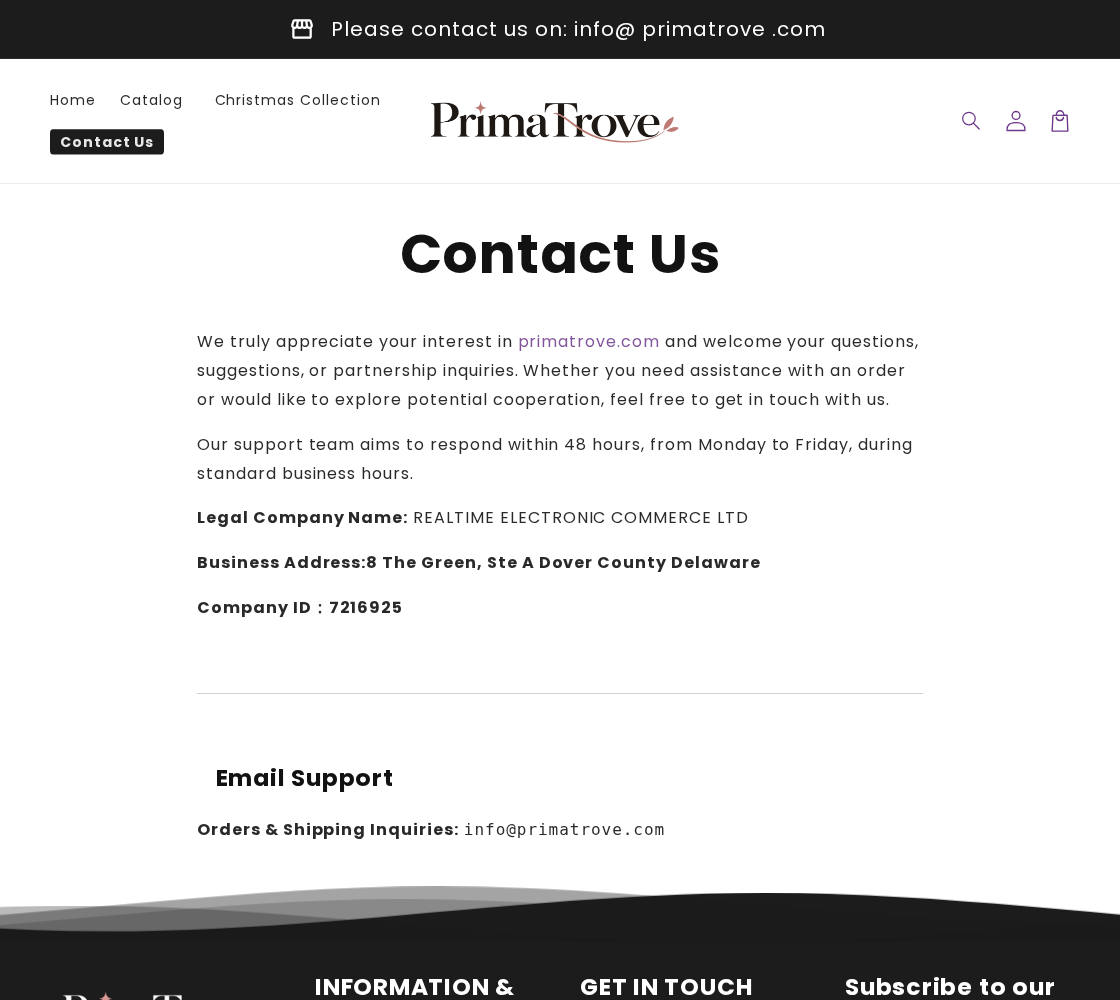
The Contact Us page identifies REALTIME ELECTRONIC COMMERCE LTD and gives company ID 7216925.
Those details are the merchant’s published claim, not an independently authenticated registration in this investigation. A company number needs to match the entity and jurisdiction it purports to identify.
Compare that name with the invoice and payment descriptor if you order. A materially different recipient should be explained rather than assumed to be another harmless brand.
The Delaware address doesn’t identify the workshop
The same page lists 8 The Green, Ste A, Dover County, Delaware. It doesn’t establish that the advertised gifts are made or stored there.
A business contact address, workshop, warehouse, and returns facility can serve different purposes. The page shouldn’t be read as proof that they are all one location.
Ask for the authorized return country and full instructions separately. Sending a parcel to a corporate address without permission may not get it processed.
Email hours aren’t a guarantee of resolution
Customer service uses info@primatrove.com. The contact page says the team aims to respond within 48 hours during Monday-to-Friday business hours.
The footer also gives support hours in Pacific Time. Use the published schedule when assessing a reply, but distinguish an acknowledgment from a decision on your request.
No customer-service exchange or test purchase was carried out. There is no basis here to say the email never answers or that a specific refund was refused.
The handmade supply chain is still unexplained
The homepage’s maker language and the About page’s selected-collection language leave an important question: who actually produces each item?
That uncertainty doesn’t establish factory origin, AI imagery, or mass production in any particular country. Those would require their own evidence.
It does mean you shouldn’t pay a handmade premium solely for the atmosphere of the page. Seek product-specific information that connects the story to the goods.
The Return Policy Has a Deadline, Not a Satisfaction Trial
Fourteen days to request a return doesn’t necessarily give you permission to assemble, use, or alter a craft and then send it back.
The unused-condition requirement is especially important for DIY products. Clarify how inspection differs from starting the project before opening consumable components or making irreversible changes.
For damaged materials, photograph the issue before trying to repair it. A clear record helps separate an arrival problem from something that happened during assembly.
Cancellation is offered before the order is produced or shipped. Because production is itself a cutoff, an unshipped order isn’t automatically still cancelable.
Approved refunds are described as taking 1–5 business days. That period follows the merchant’s return inspection and approval, not your initial request.
Get the approval date and expected refund amount in writing. If support discusses a partial remedy, ask exactly what you must keep, return, or pay.
Don’t let warm studio language turn a straightforward financial question into an awkward favor. You are buying a product and should receive clear transaction terms.
What to Do If You Purchased From Primatrove
-
Identify the precise version you ordered. Retain the product page, selected option, quantity, and any list of included components.
For a DIY item, save whether assembly materials or a completed decoration were promised. That distinction is central to an accurate complaint.
-
Audit the actual order total. Check delivery service, insurance, discounts, and other line items against the payment you authorized.
Ask about any unexplained extra rather than assuming a visible optional feature was necessarily charged. Keep the final receipt for a clear comparison.
-
Request the timing benefit of any upgrade. If you selected Express or VIP, ask which handling or carrier commitment applies to your order.
Record a date-specific promise if one is made. A delivery-service label alone doesn’t establish that the seller guaranteed arrival before a celebration.
-
Act before production if you want cancellation. Send info@primatrove.com your order details and request a written cancellation outcome.
If the seller says production has started, ask which item entered production and when. Preserve that answer with your original request.
-
Inspect before using the gift or kit. Photograph damage, missing parts, incorrect variants, and packaging. Notify support within the stated delivery-based request window.
For an agreed return, obtain the full destination and shipping conditions. Keep evidence that the parcel reached the address the merchant supplied.
-
Follow the refund through to the payment account. Record approval and check the stated processing period, rather than relying on a vague promise that it is coming.
Where a missing or misdescribed order remains unresolved, consult your payment provider promptly. Ask which deadline applies while preserving the correspondence and transaction evidence.
Frequently Asked Questions
Are Primatrove’s gifts definitely handmade?
The homepage makes handmade claims, but no workshop or production process was independently verified. The About page instead describes selected gift collections.
Ask what handmade means for the exact item. A pleasing studio-style presentation doesn’t establish who manufactured the product you will receive.
What is wrong with the 90% repeat-customer claim?
The nearby text says three in four customers return, which equals 75%. The page doesn’t explain why its headline uses 90%.
That inconsistency makes the statistic unreliable as presented. It isn’t a substitute for a defined survey, sample, or independently supported customer record.
Why does the homepage mention Gift Luxur?
Gift Luxur appears in the 98% customer statement. Primatrove’s inspected material doesn’t explain whether that is another brand or a leftover reference.
The mismatch should be corrected or explained by the seller. It doesn’t, by itself, establish shared ownership or a particular fraudulent network.
Does VIP shipping guarantee a faster arrival date?
The policy charges more for VIP and calls it fastest, but doesn’t provide its own delivery range. A specific guaranteed date wasn’t established.
Request the actual service difference before paying the upgrade. Production time and customs can still affect when the gift reaches you.
Is the $3.99 insurance automatically charged?
The public cart markup contains a $3.99 insurance option. This inspection didn’t verify its selection state or complete a payment.
Review your live order summary and receipt. An option appearing in the storefront isn’t proof of an unauthorized charge.
What if I receive a kit instead of finished artwork?
Compare the delivery with the exact listing and selected option. The catalog openly describes some products as DIY kits, so a kit alone doesn’t establish misrepresentation.
If the actual offer promised something different, save that wording and send photographs to support. Escalate an unresolved mismatch through your payment provider’s process.
The Bottom Line
Don’t pay a handmade premium or an undefined fast-shipping surcharge on the strength of Primatrove’s current presentation. Its inconsistent statistics and unexplained brand reference weaken that sales story.
If you’ve bought, confirm the exact product and extras, protect the return deadline, and seek a payment-provider remedy when the merchant doesn’t resolve a documented order problem.

Join the discussion
0 commentsShare your experience or ask a question about this article.
Discussion
Start the conversation
Have a question or something useful to share? Add the first comment.