

Breathing problems make simple promises unusually persuasive. A small adjustable device can feel like an affordable answer when stairs, workouts, or congestion have become frustrating.
OxyFlow wraps that familiar idea in dramatic health language, large review counts, and a money-back promise. A closer reading reveals details every buyer should understand first.
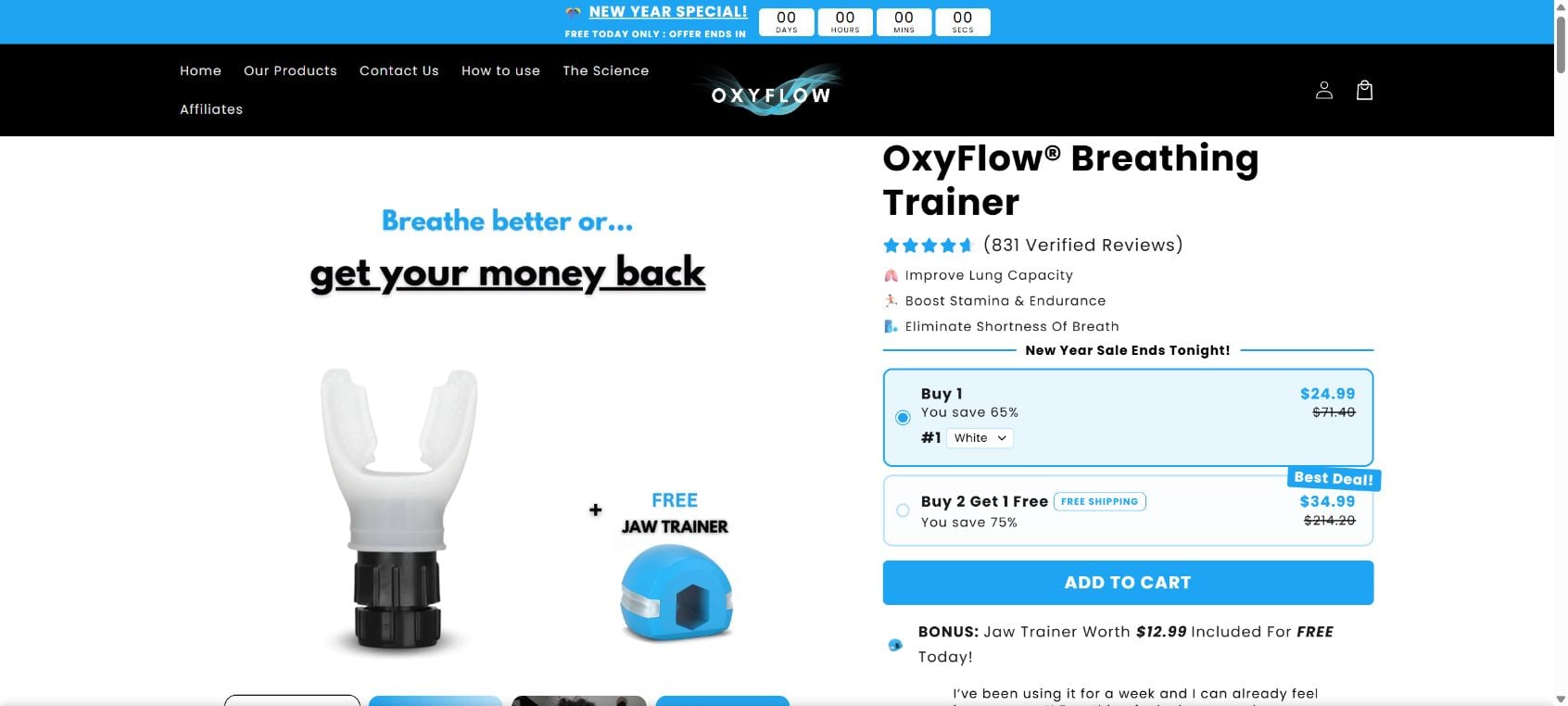
Overview
OxyFlow is a real resistance breathing device
OxyFlow is an adjustable mouthpiece that makes inhaling and exhaling more difficult. The resistance is intended to exercise muscles involved in breathing.
That basic concept is not invented. Respiratory muscle training appears in clinical rehabilitation and athletic research, usually with defined protocols and properly evaluated devices.
The existence of legitimate respiratory training does not prove every benefit advertised for one consumer product. Device design, resistance accuracy, supervision, and user health all matter.
The sales page makes unusually broad benefit claims
The page says OxyFlow improves lung capacity, boosts stamina, eliminates shortness of breath, reduces chest heaviness, clears blocked airways, and increases oxygen intake.
It also presents the device as addressing a “root cause” and promises profound or life-changing results. Those statements go beyond modest fitness positioning.
Shortness of breath can have serious causes. A marketing page cannot determine whether symptoms come from deconditioning, asthma, infection, heart disease, anxiety, or another condition.
The refund promise is less simple than the headline
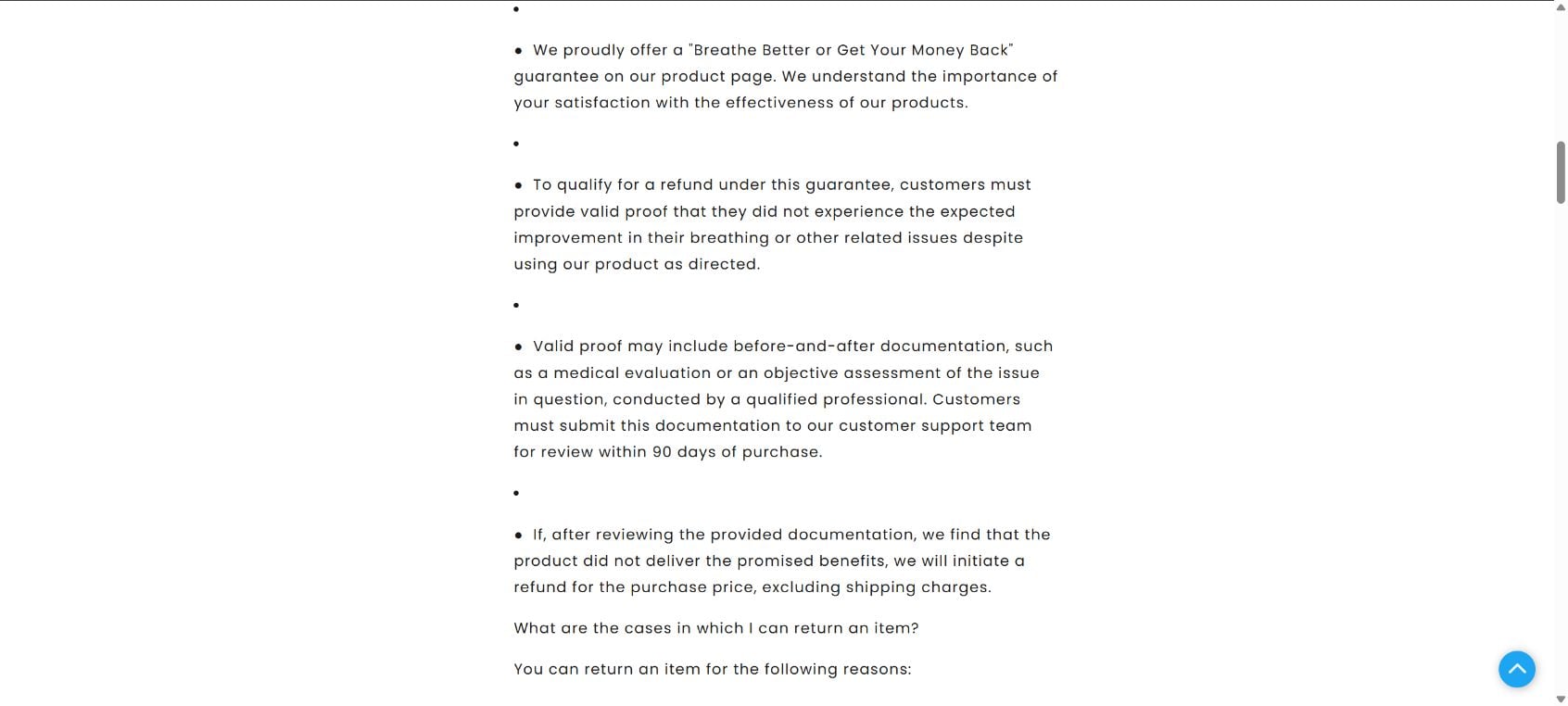
The product page describes a 90-day, no-questions-asked, risk-free guarantee. The detailed refund policy adds documentation, packaging, approval, and inspection requirements.
Customers may need medical or objective before-and-after evidence showing that expected improvement did not occur. Shipping charges are excluded from an approved effectiveness refund.
The policy also rejects change-of-mind returns and says the company’s inspection decision is final. Those conditions materially change how an ordinary buyer may understand “risk free.”
- A physical product and named Wyoming company exist.
- Respiratory muscle training is a genuine practice.
- The page extends general research to OxyFlow without product-specific proof.
- Displayed review totals conflict across the same page.
- The return policy imposes conditions absent from the headline promise.
- No recurring subscription was visible during our review.
Is OxyFlow a Scam?
Available evidence does not justify calling OxyFlow a nonexistent product or automatic subscription scam. The site shows a tangible device, checkout, policies, and an identified business.
That does not make the offer problem-free. The most significant concerns involve medical-style claims, inconsistent social proof, urgency marketing, and conflicting refund language.
The device may provide resistance when someone breathes through it. That mechanical function is different from proving that it eliminates breathlessness or clears obstructed airways.
General studies about inspiratory muscle training do not establish that this exact device reproduces the tested pressure, protocol, supervision, or outcomes.
OxyFlow’s own disclaimer says product claims have not been evaluated by the FDA and that the products are not FDA-approved.
FDA approval is not required for every simple wellness accessory. However, buyers should notice the gap between strong promotional wording and cautious legal disclaimers.
The balanced conclusion is that OxyFlow appears to be a real product sold through a functioning store, but its marketing overstates certainty and understates refund friction.
What Respiratory Muscle Training Can Actually Do
Breathing uses muscles, principally the diaphragm and muscles between the ribs. Training against controlled resistance can strengthen parts of that system in selected people.
Clinical programs may include respiratory muscle training alongside exercise, education, breathing retraining, nutrition, airway clearance, and medical supervision.
That wider context matters. Pulmonary rehabilitation is not simply a mouthpiece ordered from an advertisement and used without assessment.
Evidence also varies by population. Results involving trained athletes, people with weakened inspiratory muscles, COPD patients, or healthy volunteers are not interchangeable.
A Cochrane review found uncertain and mixed conclusions for inspiratory muscle training in COPD. Some measures improved, while meaningful patient benefits remained unclear.
Another Cochrane review found insufficient evidence to support or reject inspiratory muscle training for asthma. That is far from proving rapid relief for everyone.
Resistance training may improve respiratory muscle strength without increasing the physical size of healthy lungs. “Lung capacity” is often used loosely in advertising.
A person might feel breathing becomes easier during exercise, yet spirometry, oxygen saturation, airway obstruction, and subjective comfort measure different things.
No credible trainer should replace diagnosis. New, severe, or worsening breathlessness deserves medical attention, particularly with chest pain, fainting, blue lips, or confusion.
Why the Advertising Deserves Careful Scrutiny
The product page displayed “831 Verified Reviews” near the title during our review. Farther down, it displayed “22,007 Verified Reviews” beside a bonus offer.
Another section claimed “47,500+ Lungs Saved.” The embedded review widget then showed 840 verified customer reviews but visibly summarized only 60 ratings.
Those figures may reflect different counters, campaigns, or stale page elements. The page does not explain their relationship.
Unexplained social-proof numbers make popularity difficult to evaluate. A buyer cannot tell whether counts represent purchasers, ratings, site visitors, or marketing estimates.
The sale banner says the offer ends tonight, while the countdown displayed zeros. Persistent urgency can pressure visitors before they inspect the policies.
The pricing showed one unit for $24.99 against $71.40, described as 65% savings. Three units were offered for $34.99 against $214.20.
A crossed-out price does not establish ordinary market value. Compare similar adjustable breathing trainers before treating the discount percentage as meaningful savings.
The page also bundled a free jaw trainer, adding another perceived benefit unrelated to validating the respiratory claims.
How the OxyFlow Offer Works
Step 1: A simple device is presented as a broad health solution
The funnel begins with familiar problems such as breathlessness, weak stamina, chest heaviness, stress, mucus, or difficulty exercising.
OxyFlow then connects one resistance mouthpiece with nearly all those concerns. That compression makes a complicated symptom appear to have one simple answer.
The promise is emotionally effective because buyers can picture using the device for minutes at home rather than navigating appointments and testing.
Step 2: General studies are used to support product-specific expectations
The page links studies involving breathing patterns, respiratory training, COPD, stress, sleep apnea, exercise, mucus clearance, and other topics.
Its explanations repeatedly suggest OxyFlow could deliver similar benefits. That is an inference, not a clinical trial of the retail product.
To validate the device, research should identify its resistance range, measurement accuracy, training schedule, comparison group, safety monitoring, and real participant outcomes.
Step 3: Review counts and percentages strengthen the sales story
Testimonials describe lighter chests, easier workouts, asthma improvement, and rapid results. Marketing percentages claim decreases in chest heaviness and shortness of breath.
The page does not show a published survey method, sample definition, questionnaire, raw responses, or independent analysis supporting those percentages.
Customer stories can describe individual experiences. They cannot establish effectiveness, diagnose disease, or predict what another person will experience.
Step 4: The purchase page emphasizes simplicity and urgency
The visible options encourage either one unit or a three-unit bundle. Both display large discount percentages and time-limited language.
The bundle may look dramatically better because its crossed-out total is much higher. Buyers should calculate the actual unit price and intended household need.
During our review, the product selection did not disclose an automatic refill or recurring membership. The evidence supports a one-time product purchase, not a subscription allegation.
Step 5: The guarantee headline reduces hesitation
The sales page says the trial is no questions asked and promises support if the customer changes their mind for any reason.
That language reasonably suggests a buyer can test the device and request a refund if dissatisfied.
The separate policy says change of mind is not accepted and effectiveness claims may require medical or objective evidence. This contradiction deserves written clarification.
Step 6: The detailed policy controls the return process
Returns require prior approval, original packaging, labels, and resellable condition. Customers pay return shipping unless the company recognizes a product problem.
An effectiveness refund excludes shipping. The company may reject a return after inspection and can require the customer to pay for rejected goods to be shipped back.
Cancellations are limited to ten hours unless the order has already shipped. A buyer should preserve screenshots and contact support immediately.
The Product Claims and the Disclaimers Do Not Match Comfortably
The page says the trainer eliminates shortness of breath. Elsewhere, the site warns that its information is not medical advice and results vary.
It describes airway clearance similar to positive expiratory pressure devices, yet similarity in a marketing explanation does not make two devices clinically equivalent.
The site says OxyFlow targets a root cause. Breathlessness has many possible causes, so no single consumer tool can truthfully target every underlying problem.
It also states that customers could feel improvement within days. Timing depends on health, technique, resistance, adherence, diagnosis, and the outcome being measured.
The disclaimer lists important exclusions, including unhealed pneumothorax, unhealed eardrum injury, and asthma with frequent severe exacerbations.
Users with respiratory, heart, or blood-pressure conditions are told to consult a doctor. That warning is more cautious than the front-page promise.
Marketing and safety information should communicate with the same clarity. Important exclusions should not require scrolling beneath testimonials, bundles, and promotional claims.
Company, Address, and Fulfillment Checks
BHT Brands LLC is named as the operator
The terms identify BHT Brands LLC, doing business as OxyFlow, and say the company is registered in Wyoming.
The same terms connect the company with tryoxyflow.com, getoxyflow.co, and theoxyflow.com. That disclosure is more useful than a storefront showing only a product name.
A trademark filing provides an address, not a factory
A public OxyFlow trademark application names BHT Brands LLC and lists 5830 East 2nd Street, Suite 7000, number 7191, Casper, Wyoming.
That record connects a legal applicant to the mark. It does not identify the factory, warehouse, manufacturer, or country where the device is produced.
Customer support is primarily email-based
The contact and policy pages publish team@tryoxyflow.com. We did not find a customer-service telephone number on the reviewed pages.
Email support is not inherently suspicious, but health-adjacent claims and conditional returns make a complete, durable contact trail especially important.
The return location is provided only after approval
The refund policy instructs customers to request authorization before mailing anything. It says support will then provide a dedicated return address.
A return warehouse may differ from corporate registration or manufacturing. Buyers should not assume any single address answers every supply-chain question.
What to Check Before Ordering OxyFlow
Ask support to identify the device manufacturer, production country, resistance range, materials, cleaning limits, expected lifespan, and any independent product testing.
Request the exact refund conditions in writing. Specifically ask whether testing the mouthpiece makes it used, non-resellable, or otherwise ineligible.
Ask whether ordinary dissatisfaction qualifies without medical documentation. The answer should reconcile the no-questions-asked page with the proof requirement.
Confirm the complete order total, quantity, shipping charge, taxes, optional protection, and whether any future charge is authorized.
Screenshot the offer, chosen quantity, guarantee, checkout summary, refund policy, and cancellation period before submitting payment.
Use a credit card with dispute protections when possible. Avoid bank transfers, cryptocurrency, gift cards, or payment methods that remove practical recourse.
Do not use the product to self-treat unexplained breathlessness. Discuss symptoms and resistance training with a qualified clinician.
What to Do if You Bought OxyFlow and Want a Refund
- Preserve the entire order record. Save the confirmation, receipt, checkout total, product page, guarantee, policies, emails, tracking, and photographs of the delivered package.
- Stop using it if symptoms occur. Dizziness, pain, severe breathlessness, fainting, wheezing, or pressure requires caution and potentially urgent medical advice.
- Contact support immediately. Write to team@tryoxyflow.com, state the order number, requested remedy, reason, and the date your 90-day period ends.
- Request written return authorization. Ask for the address, authorization number, eligible amount, shipping deductions, documentation requirement, and deadline before mailing anything.
- Document the condition carefully. Photograph the device, packaging, labels, accessories, and parcel. Use tracked shipping and retain the acceptance receipt.
- Challenge contradictory promises accurately. If refused, show the no-questions-asked wording beside the condition the company later applied.
- Contact your card issuer when justified. Explain whether the dispute concerns non-delivery, wrong quantity, misrepresentation, or a return refused contrary to written terms.
- Check devices used for the purchase. Scan with Malwarebytes for unwanted software. AdGuard can filter dangerous advertising, intrusive pop-ups, and tracking links.
- Monitor statements. We found no displayed subscription, but watch for unfamiliar charges and report any unauthorized transaction promptly.
Frequently Asked Questions
Is OxyFlow a real product?
Yes. The reviewed site presents a physical adjustable breathing trainer. The main concerns involve advertising claims, social-proof inconsistencies, and refund conditions.
Is OxyFlow an automatic subscription?
We found no recurring subscription disclosed in the reviewed product offer. Buyers should still read their checkout summary and monitor statements after purchase.
Can OxyFlow cure shortness of breath?
No consumer breathing trainer can diagnose or cure every cause of breathlessness. Persistent, severe, or unexplained symptoms require professional medical evaluation.
Does science prove that OxyFlow works?
Research supports respiratory muscle training in some settings, with mixed results across conditions. It does not automatically validate this device or every advertised outcome.
Is the 90-day guarantee really no questions asked?
The headline says that, but the policy may require objective or medical documentation, prior approval, original packaging, inspection, and customer-paid return shipping.
Who operates the OxyFlow website?
The terms name BHT Brands LLC, a Wyoming company, as the operator. The public pages provide an email but no visible customer-service telephone number.
The Bottom Line
OxyFlow appears to be a real resistance breathing trainer, not a proven fake product or documented subscription trap.
Its marketing still deserves skepticism. Broad medical-style promises, unexplained review totals, urgency tactics, and a conditional refund policy create substantial buyer risk.
If the device interests you, treat it as an exercise accessory, not treatment. Clarify returns in writing and seek medical advice for breathing symptoms.

Join the discussion
0 commentsShare your experience or ask a question about this article.
Discussion
Start the conversation
Have a question or something useful to share? Add the first comment.