

A bath product promising more than fragrance can sound pleasantly effortless. Drop in a sachet, watch it fizz, and let an invisible molecule handle the rest.
One hydrogen bath-bomb listing turns that idea into a $144.49 purchase. The product page raises questions that the silver box does not answer.
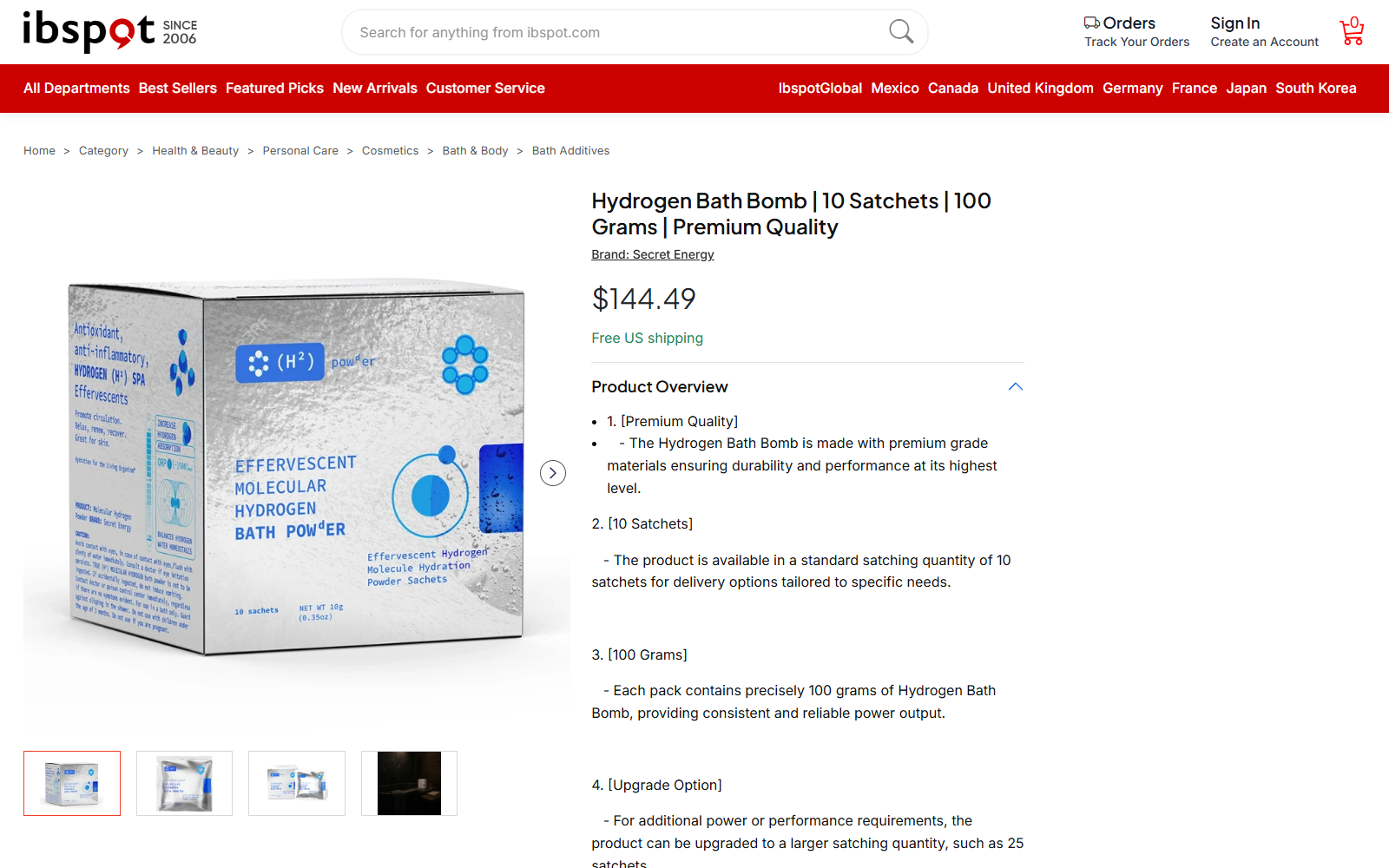
Overview
The listing sells ten small sachets for $144.49
IBSPOT lists a Secret Energy product described as “Hydrogen Bath Bomb,” containing ten sachets and showing a total weight of 100 grams.
The displayed price was $144.49 with free United States shipping during our review. That works out to roughly $14.45 for each bath.
High pricing is not evidence of fraud. It does make ingredient transparency, dose, testing, manufacturing, and realistic benefit more important.
The product description is vague and internally awkward
The page spells sachets as “satchets” and uses language about durability, power output, and upgrade options that sounds borrowed from an unrelated product template.
Its ingredients field reportedly reduces the contents to “hydrogen, molecular hydrogen.” That does not explain the chemical material generating dissolved hydrogen in bathwater.
Molecular hydrogen is a gas. A credible effervescent formula should identify all ingredients, quantities, warnings, storage conditions, and expected dissolved concentration.
Hydrogen research does not validate this specific retail box
Scientific literature explores molecular hydrogen through inhalation, hydrogen-rich water, injections, and baths. Researchers describe promising signals alongside major limitations and unresolved questions.
Small hydrogen-bath studies use measured concentrations, defined equipment, controlled procedures, and documented participants. Those experiments cannot be transferred automatically to an unknown sachet.
No product-specific clinical trial, concentration test, independent laboratory report, or regulatory approval was located for this Secret Energy listing.
- The exact active chemistry is not clearly disclosed.
- The delivered hydrogen concentration is not stated.
- The listing contains contradictory or generic specifications.
- Health and personal-care returns may be excluded after opening.
- The seller and marketplace fulfill different parts of the order.
Is the Hydrogen Bath Bomb a Scam?
The available evidence does not prove that every sachet is nonexistent or that IBSPOT never delivers orders. The page depicts a tangible packaged product.
However, the listing does not provide enough technical information to justify strong wellness expectations or the premium price. That is the central consumer problem.
The phrase “molecular hydrogen” sounds scientific, but a label is not a measurement. Buyers need to know how much dissolved gas appears and how long it remains.
Research reviews call the wider field promising but still developing. Many studies are small, heterogeneous, preclinical, or focused on delivery methods unlike retail bath powder.
Consequently, it would be irresponsible to say the product treats inflammation, disease, fatigue, skin conditions, or recovery based only on general hydrogen research.
The safest verdict is a high-priced, poorly documented wellness product whose marketing information is insufficient for confident health or value claims.
What Molecular Hydrogen Research Actually Shows
Molecular hydrogen is the simple gas H2. Researchers study whether it can influence oxidative stress, inflammation, signaling pathways, or recovery under specific conditions.
Some early trials report interesting changes. Other findings remain uncertain, and mechanisms, dosing, delivery, safety, and clinically meaningful outcomes require stronger evidence.
A recent scientific review described hydrogen therapy as promising while noting that the field remains in its infancy and lacks universal acceptance.
Hydrogen-bath research is narrower still. Studies may involve specialized generators that maintain measured dissolved concentrations rather than a consumer sachet dissolving in an ordinary tub.
One small bathing study cited in the literature included only four people. A result from four participants cannot establish broad effectiveness for a retail product.
Water temperature, tub volume, dissolved concentration, exposure time, skin condition, and measurement method all affect whether two bathing procedures are comparable.
Marketing often removes those details and keeps the scientific nouns. That makes preliminary research sound like finished product proof.
A legitimate product claim should connect its exact formula, tested concentration, protocol, and outcome to published evidence. This listing does not complete that chain.
Why the Ingredients Description Is Not Enough
A sealed dry sachet cannot simply contain a useful amount of free hydrogen gas without some method for storing or generating it.
Effervescent hydrogen products commonly rely on reactive ingredients that release gas after contact with water. Those starting materials matter for safety and dose.
The marketplace page should identify every substance, including binders, acids, salts, fragrance, color, preservatives, allergens, and the hydrogen-generating component.
It should also state the quantity per sachet, recommended tub volume, water temperature, dissolution time, expected concentration, and how that concentration was verified.
Warnings are equally important. Users may have sensitive skin, respiratory conditions, allergies, open wounds, pregnancy, medication concerns, or children sharing the bathroom.
A vague “premium quality” statement cannot replace a complete label. Nor can a country-of-origin field prove manufacturing controls or batch testing.
Without a lot number and responsible manufacturer, a buyer may struggle to report irritation, contamination, missing instructions, or an adverse reaction.
How the Hydrogen Bath Bomb Offer Works
Step 1: Scientific language turns a bath into a therapy-like purchase
The name combines a familiar bath bomb with molecular hydrogen, antioxidants, anti-inflammatory language, and recovery imagery printed on the package.
That vocabulary suggests measurable wellness performance even when the retail page provides no concentration, test report, or product-specific human study.
Consumers should separate the molecule from the merchandise. Research about H2 does not certify every product using H2 on its box.
Step 2: The marketplace listing establishes a premium price
The offer showed $144.49 for ten sachets. It also advertised free shipping, 30-day returns, buyer protection, and guaranteed delivery.
Those protections concern transaction fulfillment. They do not independently verify ingredients, effectiveness, safety, or value.
Compare the cost per bath with ordinary bath products and with hydrogen products that publish complete composition and independent concentration tests.
Step 3: A third-party seller and IBSPOT share the transaction
The listing identified “Wishes Valley” as the seller and IBSPOT as the fulfiller. That means branding, sale, storage, shipping, and support may involve different parties.
Before ordering, ask who imports the product, who manufactured it, and who holds the laboratory documentation for the exact lot.
If support cannot name that responsible party, a buyer has little practical recourse for a formulation concern beyond requesting a marketplace return.
Step 4: The buyer protection message meets category exclusions
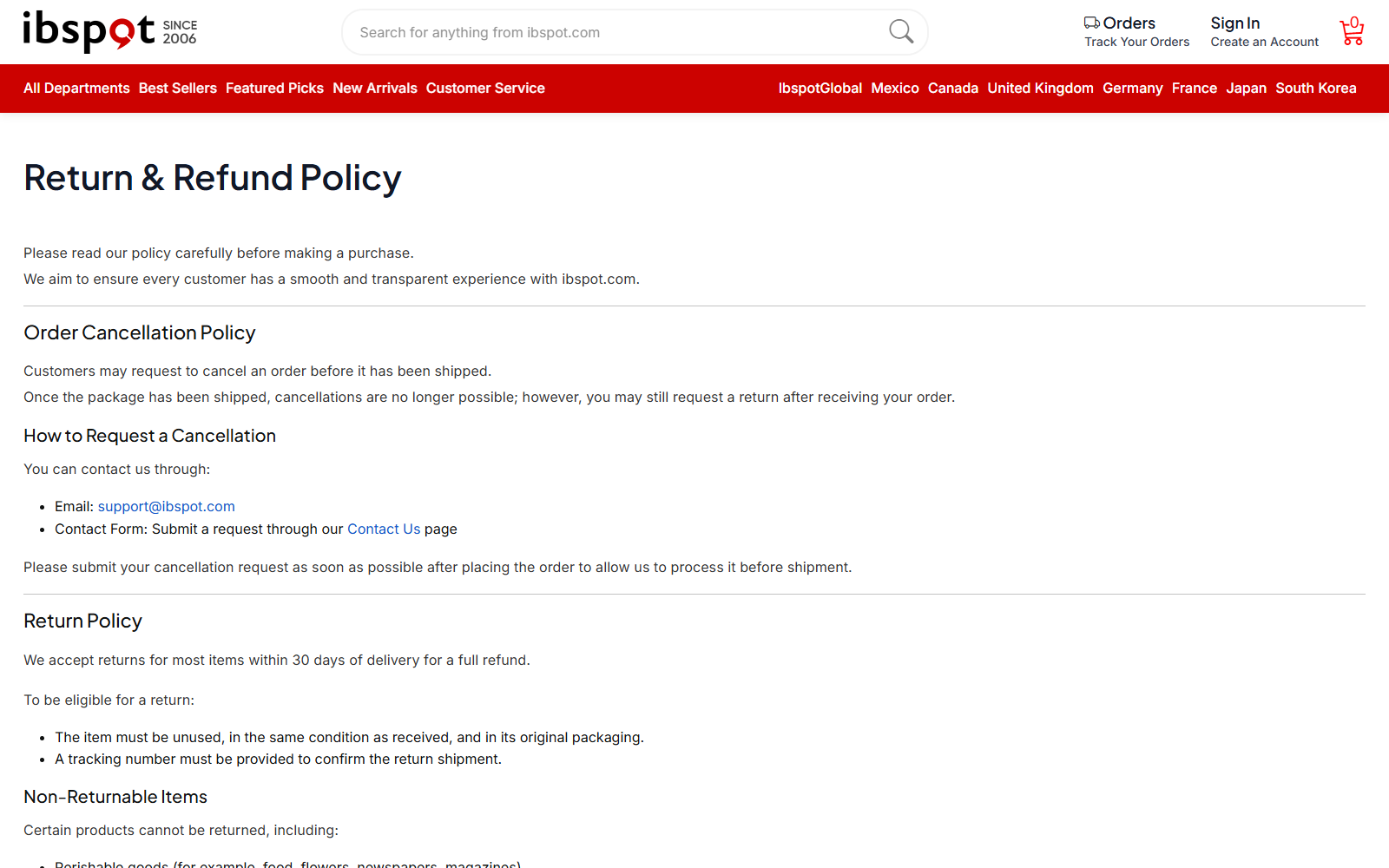
The product page says “Free 30-Day returns.” IBSPOT’s detailed policy requires unused goods in original packaging and excludes some health and personal-care items.
A bath additive may fall inside that ambiguous category, particularly after one sachet has been opened or dissolved.
Ask support in writing whether this exact SKU remains returnable after testing one sachet. A general banner is not a product-specific approval.
Step 5: Customer-reason returns can lose fees
IBSPOT says it may deduct original shipping and the return-label fee when the customer changed their mind or ordered the wrong item.
Free shipping on the purchase page does not necessarily mean the merchant incurred no outbound shipping cost that could later be deducted.
Request a written refund estimate before mailing. It should identify the label fee, original shipping deduction, restocking deduction, and expected net amount.
Step 6: Health expectations may be difficult to dispute
A buyer may receive the exact box pictured yet feel no benefit. Transaction protection usually focuses on delivery and description, not subjective wellness outcomes.
That makes pre-purchase evidence crucial. A product without defined measurable claims leaves little objective standard for showing that it failed.
Do not buy on the assumption that a card dispute will resolve disappointment. Evaluate documentation before opening the payment form.
The Listing Contains Red Flags That Deserve Explanation
The title says ten sachets and 100 grams, while the visible package image appears to show a net weight of 10 grams.
That could mean each sachet weighs 10 grams, making 100 grams total. The page should state this plainly rather than forcing shoppers to infer it.
Other fields reportedly list four ounces and 12.8 ounces. Conflicting weights affect expectations, shipping records, and confidence in the product database.
The wording promises “durability and performance at its highest level,” language that fits hardware better than a dissolving personal-care sachet.
An “upgrade option” refers to more power or performance and a larger “satching quantity.” These phrases resemble automated catalog text rather than manufacturer instructions.
Spelling errors alone do not prove a dangerous product. Combined with missing composition and measurement, they show weak listing quality control.
A premium health-adjacent item should have better documentation than an ordinary gadget. Here, the price and scientific presentation move upward while transparency remains low.
Safety Questions to Ask Before Using It
Request a photograph of the complete package, including ingredients, warnings, directions, manufacturer, distributor, country of origin, lot code, and expiration date.
Ask whether independent testing confirms microbial limits, heavy metals, contaminants, skin irritation, and dissolved hydrogen concentration for the finished product.
Confirm whether fragrance or color is present. People with eczema, allergies, asthma, or sensitive skin may react to ingredients unrelated to hydrogen.
Do not combine the sachet with bleach, peroxide, cleaning chemicals, essential oils, or another reactive bath product.
Avoid use on broken skin unless a qualified clinician confirms it is appropriate. Stop immediately if burning, breathing difficulty, dizziness, swelling, or rash develops.
Keep powder away from eyes, mouth, children, and pets. Store it dry and follow the package instructions rather than improvising a stronger concentration.
This product should not replace medical treatment. Persistent pain, inflammation, fatigue, skin changes, or recovery problems require professional evaluation.
Company, Address, and Fulfillment Checks
The marketplace identifies IBSPOT.COM Inc.
IBSPOT publishes IBSPOT.COM Inc. as its business name. The product page separately names Wishes Valley as seller and IBSPOT as fulfiller.
Those roles should be preserved in any complaint. A fulfillment marketplace may not be the manufacturer or creator of the listing content.
The corporate and return addresses differ
IBSPOT lists 1414 Willow Avenue, Elkins Park, Pennsylvania 19027 as its contact address. Returns go to 15 Sawmill Lane, Dover Plains, New York 12522.
A return center proves where packages are processed, not where the sachets were formulated, manufactured, tested, or imported.
Support details are available
The marketplace lists support@ibspot.com and (888) 666-8165. Telephone support is published for weekdays, while email support is described as continuously available.
Ask product-specific questions by email so the answer becomes part of the order record. Avoid relying on a generic chat promise.
The manufacturer remains the missing link
The box shows Secret Energy branding, but the listing does not clearly identify a responsible manufacturer with address, testing contact, and batch documentation.
Without that chain, “made in the United States” or another origin field cannot establish the source of ingredients, factory standards, or finished-product verification.
How the IBSPOT Return Process Affects This Product
Most items can be returned within 30 days when unused, unchanged, and inside original packaging. A tracking number is required.
The policy excludes some health and personal-care products without naming every affected SKU. That uncertainty should be resolved before purchase.
Customers must contact support first. IBSPOT supplies instructions and may issue a prepaid label, but fees depend on why the item is returning.
When the seller made an error, the policy says it covers return shipping. Customer-choice returns can lose original shipping and label costs.
Mail-in refunds are processed after inspection. Delivery to the return center and subsequent bank posting can take additional business days.
Photograph the sealed shipment, each sachet, lot code, expiration date, and package weight before sending anything back.
Never mail a used chemical or personal-care product without authorization. Carrier rules and warehouse safety policies may prohibit it.
What Evidence Would Make the Product More Credible?
- A complete ingredient list with exact quantities.
- A named manufacturer and physical contact address.
- Lot-specific independent laboratory certificates.
- Measured dissolved hydrogen under stated bath conditions.
- Clear warnings, storage, and expiration information.
- Product-specific human evidence rather than molecule-level research.
- An unambiguous opened-product return policy.
None of those items guarantees a health benefit. Together, they would allow buyers and specialists to evaluate what is actually being sold.
A barcode, shiny box, and marketplace badge cannot substitute for formulation traceability. Premium packaging can be produced without premium evidence.
When support supplies documents, check the product name, lot, date, laboratory, test method, and measured result. Generic certificates may describe something else.
What to Do if You Bought a Hydrogen Bath Bomb
- Do not open every sachet. Preserve the sealed product, box, label, receipt, listing screenshots, and delivery packaging while assessing return rights.
- Ask for product documentation. Request ingredients, quantities, manufacturer, lot testing, concentration data, warnings, and the country where final production occurred.
- Confirm return eligibility in writing. Ask whether this exact personal-care item can return after one sachet is opened and what deductions would apply.
- Stop after any reaction. Rinse with clean water, seek medical advice when symptoms are significant, and retain packaging for ingredient investigation.
- Report serious health events. Contact the relevant health authority and provide the lot number, photographs, purchase source, and medical information requested.
- Dispute only with accurate grounds. Distinguish non-delivery, wrong item, undisclosed ingredients, refused eligible return, and simple dissatisfaction.
- Check your device after suspicious advertising. Malwarebytes can detect unwanted software, while AdGuard can reduce malicious ads, pop-ups, and tracking links.
- Monitor the payment method. This listing did not show recurring billing, but every buyer should still watch for unfamiliar follow-up charges.
Frequently Asked Questions
What is a molecular hydrogen bath bomb?
It is a dissolving product marketed to release molecular hydrogen into bathwater. The useful concentration depends on formula, water conditions, and verified measurement.
Does hydrogen-bath research prove this product works?
No. General and small-scale studies do not validate this Secret Energy formula, dose, concentration, safety, or any specific outcome promised by a retailer.
How much does the listed product cost per bath?
At $144.49 for ten sachets, the displayed cost is approximately $14.45 per bath before any tax or other charge.
Who sells and fulfills the hydrogen bath bomb?
The page identifies Wishes Valley as seller and IBSPOT as fulfiller. It does not clearly establish the responsible manufacturer of the sachets.
Can the product be returned after opening?
The policy requires unused original-condition goods and excludes some health and personal-care items. Obtain written SKU-specific approval before opening or returning it.
Should this bath product replace medical care?
No. It is not a proven treatment for inflammation, skin disease, pain, fatigue, or another medical condition. Persistent symptoms need qualified evaluation.
The Bottom Line
The Hydrogen Bath Bomb listing combines a premium price and scientific language with weak ingredient, concentration, manufacturing, and product-specific evidence.
Do not confuse early molecular-hydrogen research with proof for this box. Request documentation, clarify opened-item returns, and avoid using it as medical treatment.

Join the discussion
0 commentsShare your experience or ask a question about this article.
Discussion
Start the conversation
Have a question or something useful to share? Add the first comment.