

Elari New York looks like the sort of boutique someone might discover while searching for one striking piece. The skyline imagery completes the mood.
A shopper may reasonably wonder what sits behind that elegant presentation. We followed the site’s own shipping and return language to find out.

Overview
The key warning is in Elari’s own pages
Elari New York promotes a fashion-boutique identity, a 50% summer sale, free US shipping, and a 30-day money-back guarantee.
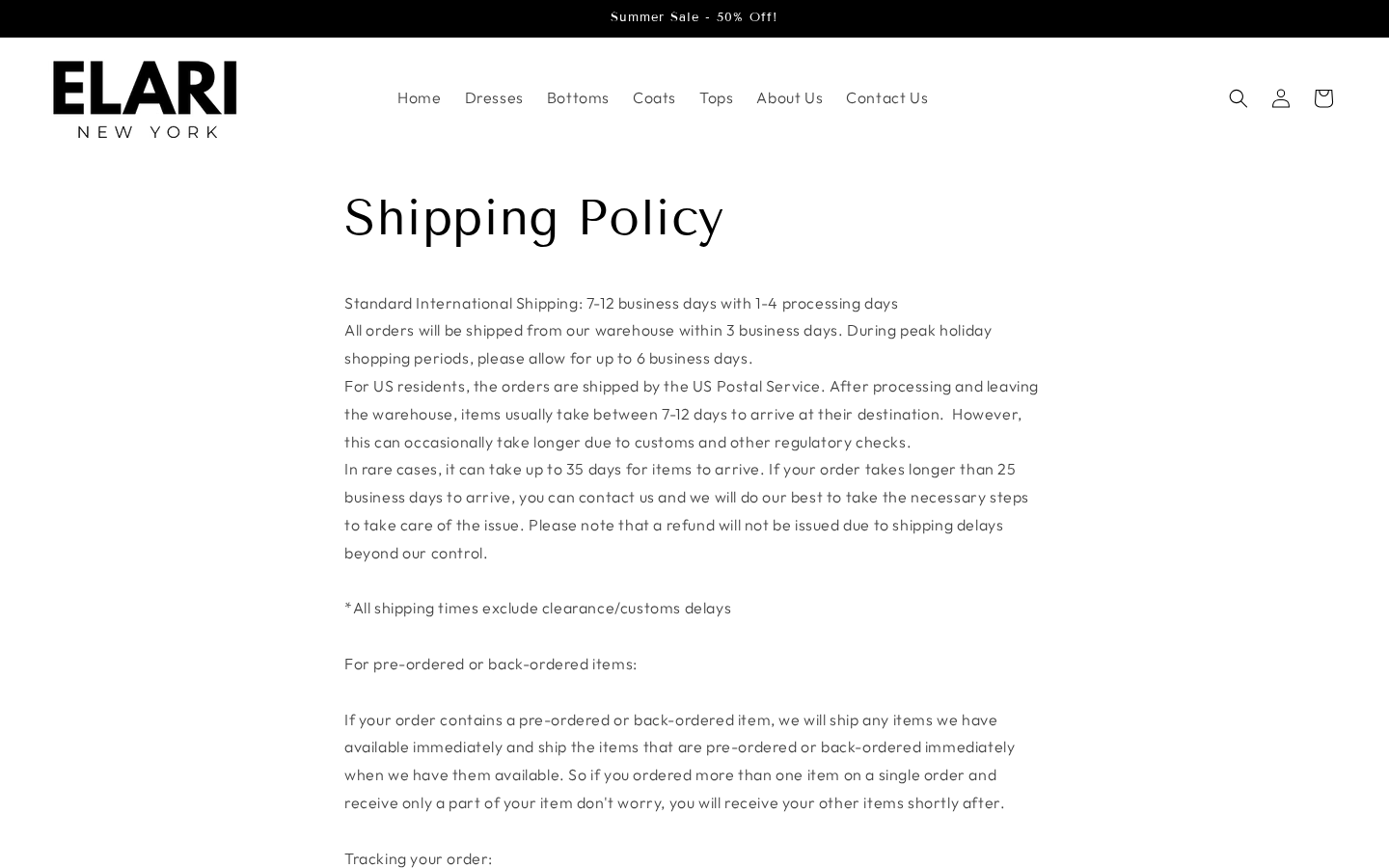
Its shipping policy, however, calls the service “Standard International Shipping” and allows customs delays and occasional arrivals as late as 35 days.
A product page simultaneously promises a hassle-free cash refund and says customers can return for an exchange or gift card.
Those differences are material. A buyer should know whether the order involves international transit and whether a return produces money or store credit.
Our verdict is not that every order is fake
We found an accessible storefront and product pages. We did not make a purchase, prove non-delivery, or verify where each garment was manufactured.
What we can say is stronger than a vague caution: Elari’s buyer-facing promises are not internally consistent enough for an unexamined purchase.
If the seller cannot state the controlling return remedy and shipment route in writing, we would shop elsewhere.
The New York styling should not answer logistics questions
A brand name, city photograph, and US-shipping banner can create a local-boutique impression. They do not prove US stock or domestic origin.
The site’s detailed shipping page explicitly describes international delivery and customs-related delays. Those written facts deserve more weight than the imagery.
Before ordering from Elari, check these points:
- Does the exact item ship domestically or through international transit?
- When does processing end and the delivery estimate begin?
- Can an unhappy buyer receive cash back, or only an exchange or gift card?
- Who pays to send the garment back, and to which country?
- Does a sale item qualify for the stated return promise?
- What company appears on the invoice and payment statement?
The New York Impression Versus the Written Shipping Route
Elari’s front page uses Manhattan-flavored imagery and the phrase “Elari New York.” That is branding, not a literal shipping map.
There is nothing inherently improper about an international boutique serving US customers. The problem is when shoppers infer domestic speed from surface cues.
The FAQ says domestic orders usually arrive three to seven business days after dispatch. That sounds familiar to a US shopper.
The detailed shipping policy describes a different route: one to four processing days plus seven to twelve business days for “Standard International Shipping.”
It also mentions customs checks, a possible 35-day arrival in rare cases, and no refund solely for delays outside the store’s control.
Both pages could describe different service categories, but the site does not clearly tell a buyer which category a US order actually uses.
That uncertainty matters for birthdays, travel, and seasonal clothing. “Free US shipping this week” says nothing about when the parcel arrives.
A customer might wait through processing, overseas transit, customs, and local handoff before the promised outfit is wearable.
The policy says US packages are delivered by USPS. A domestic final carrier does not prove the parcel began in the United States.
Many cross-border shipments enter a national postal network for their last mile. Customers see the local carrier but not necessarily the earlier route.
We cannot establish the origin warehouse from the page. We can establish that Elari itself warns about international transit.
Ask support for the dispatch country, expected first carrier scan, and realistic arrival range for the exact item and address.
Save the reply. If the order runs late, a documented commitment is more useful than a broad homepage banner.
Elari’s policy asks buyers to contact it if an order takes longer than 25 business days. That is a long wait for a fashion purchase.
Payment-dispute timelines may start from the transaction date, not from the date a seller decides a parcel is lost.
If tracking stalls, do not allow the site’s longest possible estimate to consume every other remedy. Monitor the payment provider’s deadlines independently.
None of this proves the store never delivers. It makes the cheerful “New York” presentation a poor substitute for actual fulfillment terms.
How an Elari New York Order Can Become Hard to Undo
Step 1: A limited sale invites a quick choice
The homepage features 50% off. Product pages use “last day of sale” messaging and encourage readers to act before the deal disappears.
A bargain can be genuine, but urgency reduces time spent examining material, sizing, seller identity, and return rules.
Do not evaluate the discount against only the crossed-out price. Compare similar fabrics and designs at other stores.
For a garment, the most useful facts are fabric content, measurements, construction, and a return route that remains affordable.
A stylish photograph cannot reveal those details, and a short sale clock does not make them less important.
Step 2: The product page offers two different remedies
On the Jules long-sleeve shirt listing, a “Fast and easy return” panel says a return within 30 days can lead to an exchange or gift card.
Further down, a “30-Day Money Back Guarantee” says an unhappy buyer can send the item back for a hassle-free refund.
An exchange, store credit, and refund to the original card are not interchangeable outcomes. Each changes what the customer retains.
We did not test how Elari resolves a real dispute. The page itself should not make buyers guess.
Ask support to cite the exact clause governing the item you want, especially if it is discounted.
Step 3: Checkout may feel domestic while shipping is not
The site promotes free US shipping, while its policy labels standard service international and anticipates customs checks.
That combination can be legitimate, but the dispatch country should be explicit at checkout, not something a customer discovers through tracking later.
Record the shipping estimate and total before paying. Fees or taxes may depend on destination and how the seller routes the parcel.
Do not infer that USPS appearing in a policy means dispatch from a New York warehouse.
The written transit range starts only after processing and may be stretched by customs and peak periods.
Step 4: A late parcel turns marketing into a contract question
The shipping policy says delays beyond Elari’s control do not automatically create a refund right under its terms.
That makes a late order more complicated than the store’s “free shipping this week” banner suggests.
A buyer should follow carrier scans, save communications, and ask for a concrete remedy when the published estimate has passed.
Whether separate consumer-protection laws provide additional rights depends on location and circumstances. Do not assume a website policy overrides them.
Use your card issuer’s dispute guidance if the item never arrives and the merchant cannot resolve the problem.
Step 5: Returning the item requires a clear cash-versus-credit answer
When the parcel arrives, a buyer may discover that fit or quality does not match expectations.
That is exactly when the difference between a cash refund and a gift card becomes expensive.
Before shipping anything back, ask for written authorization, the destination, postage responsibility, eligibility conditions, and refund method.
Keep the original packaging, tags, order number, and photos. These help establish condition without relying on memory weeks later.
If Elari offers only store credit despite a visible money-back promise, send both pages to support and request the precise controlling term.
What the Return Language Actually Says
“Return” describes sending an item back. It does not automatically mean that the payment returns to the same card.
Elari’s page uses three separate ideas: exchange, gift card, and money-back guarantee. A buyer needs to know which applies before purchase.
A store may offer exchanges for one reason and refunds for another. If that is Elari’s intention, the page should explain the distinction.
It does not clearly do so in the product section we reviewed. The contradictory copy appears on the same listing.
That is why the issue cannot be dismissed as a generic warning about “reading the fine print.” The fine print itself is competing with the headline.
Some shoppers are happy with store credit because they want another size. Others specifically need their money back.
For an international return, shipping costs can further reduce the practical value of any remedy.
A store credit also locks the buyer into another purchase from the same catalog, which may not solve the original disappointment.
We did not find a clear public quote of postage for this exact item. The destination must be confirmed by the merchant.
Ask whether the return must go overseas, whether a local processing center is available, and whether the shipping charge is deducted.
Also ask when the 30-day clock starts. A dispatch-based clock is substantially shorter than a delivery-based one during a slow international shipment.
Elari’s FAQ says 30 days from delivery, but the exact product remedy still needs clarification.
A useful support reply would say: “For this product, received on this date, you may return it for a refund to your original payment method.”
Anything less precise may leave the buyer negotiating after the deadline has passed.
Company, Address, and Fulfillment Checks
The brand name does not establish a New York office
Elari’s name and visuals evoke New York, but those elements are not evidence of where the company is registered or where inventory sits.
We did not verify a street-level headquarters from the public pages reviewed. Do not assert that the brand name itself is false.
Ask for the legal business name and compare it with the receipt and card statement.
The last-mile carrier does not reveal the first-mile origin
The shipping policy discusses international transit, customs, and eventual USPS delivery for US residents.
That sequence can involve multiple logistics partners. A US tracking update alone cannot identify the factory or initial warehouse.
Ask for a complete tracking history if the parcel is late or the dispatch origin matters to your purchase.
Customer contact should be usable before checkout
The site’s contact page presents a form. Its privacy policy lists Info@Elarinewyork.com for inquiries.
We did not test whether either channel answers promptly. Send a pre-sale question about refunds and shipping to measure the support you might receive later.
A generic “24/7 support” badge is less valuable than a clear written response to a specific question.
A return warehouse may not be the seller
If a return address is supplied, check whether it belongs to a logistics processor, mailbox, or office before treating it as the brand’s headquarters.
The important accountability trail is the legal seller, the payment recipient, and the company agreeing to refund the transaction.
If those names differ, ask why. Do not assume the warehouse can answer a billing dispute.
What to Do if You Already Ordered From Elari New York
- Keep the pages that shaped your decision. Save the sale offer, product’s money-back text, exchange-or-gift-card clause, FAQ, shipping policy, and checkout total.
- Identify the seller on your receipt. Note the card descriptor, order number, support email, and the exact product and size purchased.
- Track the shipment against the written ranges. Separate processing days from transit days. Request a trace when scans stop, without waiting until every payment deadline passes.
- Report problems at delivery. Photograph the parcel label, garment tags, fabric, fit issue, or damage immediately. Keep packaging and carrier proof.
- Demand a definite return remedy. Ask whether this item qualifies for a refund to the original payment method, an exchange, or only a gift card. Request the return address and postage rules.
- Escalate a contradiction with evidence. If support cites store credit while the product promised money back, provide both screenshots and ask for a written explanation.
- Use payment protections before they expire. For non-delivery or an unresolved material mismatch, contact the card issuer or payment platform with the documented timeline and merchant replies.
Frequently Asked Questions
Is Elari New York a proven fake store?
No. We found inconsistent shipping and return claims, not proof that all orders are fictitious or undelivered.
Do Elari orders ship from New York?
The brand name does not prove that. Elari’s shipping policy describes international transit and possible customs delays.
Does the 30-day promise mean cash back?
Not clearly. The same product listing mentions both a money-back guarantee and a return for an exchange or gift card.
How long does delivery take?
Elari lists international delivery of seven to twelve business days plus processing, while acknowledging customs delays and rare arrivals up to 35 days.
Can a sale item be returned?
Do not assume so from the banner. Ask Elari to confirm the exact item’s eligibility and refund method in writing before ordering.
Does USPS tracking prove domestic stock?
No. USPS can handle the final US leg after an item crosses a border or passes through another carrier.
The Bottom Line
Elari New York sells a polished boutique feeling, but its own policy describes international shipping and a product page offers conflicting return remedies.
That combination creates a real buyer risk. We would not pay until Elari states the dispatch route and cash-refund terms for the exact item in writing.








