

A stranger says somebody is trying to take money supposedly reserved for you. The amount is enormous, and the explanation includes a disturbing claim about your health.
The Change of Beneficiary email scam makes ignoring the message feel risky. Before defending a claim you never made, examine the story behind it.
Overview
The authorization question introduces an invented entitlement
This is an advance-fee lure presented as an urgent banking concern. It asks you to respond about a supposed fund without establishing any genuine right to it.
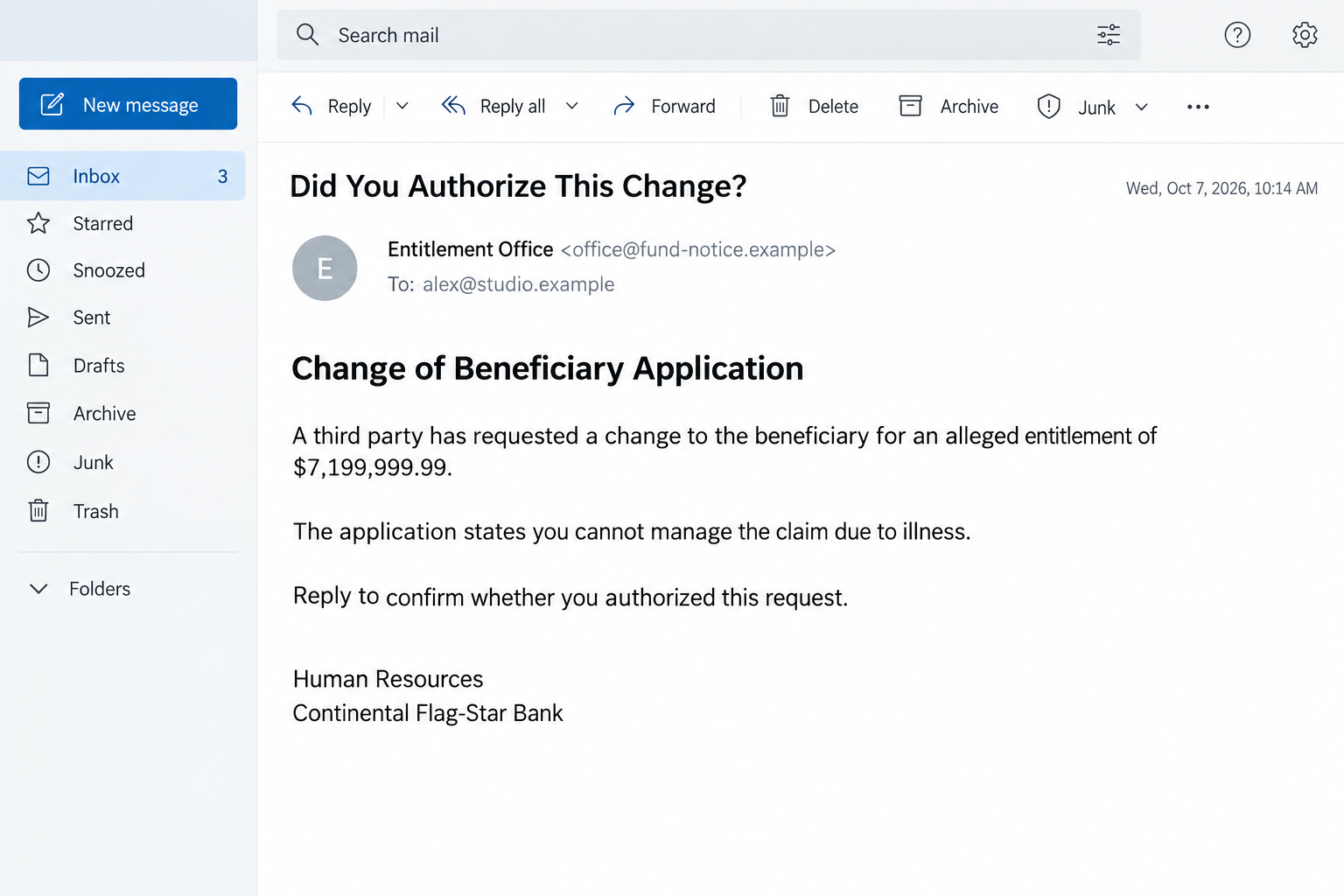
The documented message describes an entitlement of $7,199,999.99 and alleges that another person requested a beneficiary change. It also invents an illness-related explanation.
That combination encourages a defensive reply. You may want to correct the health claim or stop the supposed transfer before asking why the money exists.
The message provides no authenticated account record, estate documentation, or independently verified institution handling a real claim. Its apparent administrative detail does not fill those gaps.
A stranger’s allegation cannot make you the owner of a fortune. Check any genuine account concern through your actual bank rather than replying to this notice.
Banking details give the letter an appearance of substance
The sender supplies third-party banking information and signs under the claimed name Continental Flag-Star Bank. The institution and its authority were not established through trustworthy evidence.
A bank name, street address, routing reference, or account number in a letter does not demonstrate ownership, authorization, or a balance.
Real financial institutions can be named inside fabricated stories. Their names should not be treated as accusations that those institutions participated in the fraud.
Likewise, a name resembling another bank’s name does not establish affiliation. Verify the exact legal institution through appropriate official records and its independently obtained contact route.
- The recipient never initiated the supposed claim.
- A huge entitlement appears without a clear legal basis.
- A third party allegedly threatens the recipient’s interest.
- An illness claim adds pressure and provokes correction.
- The requested reply opens contact with the operator.
The reply creates an opportunity for payment or identity demands
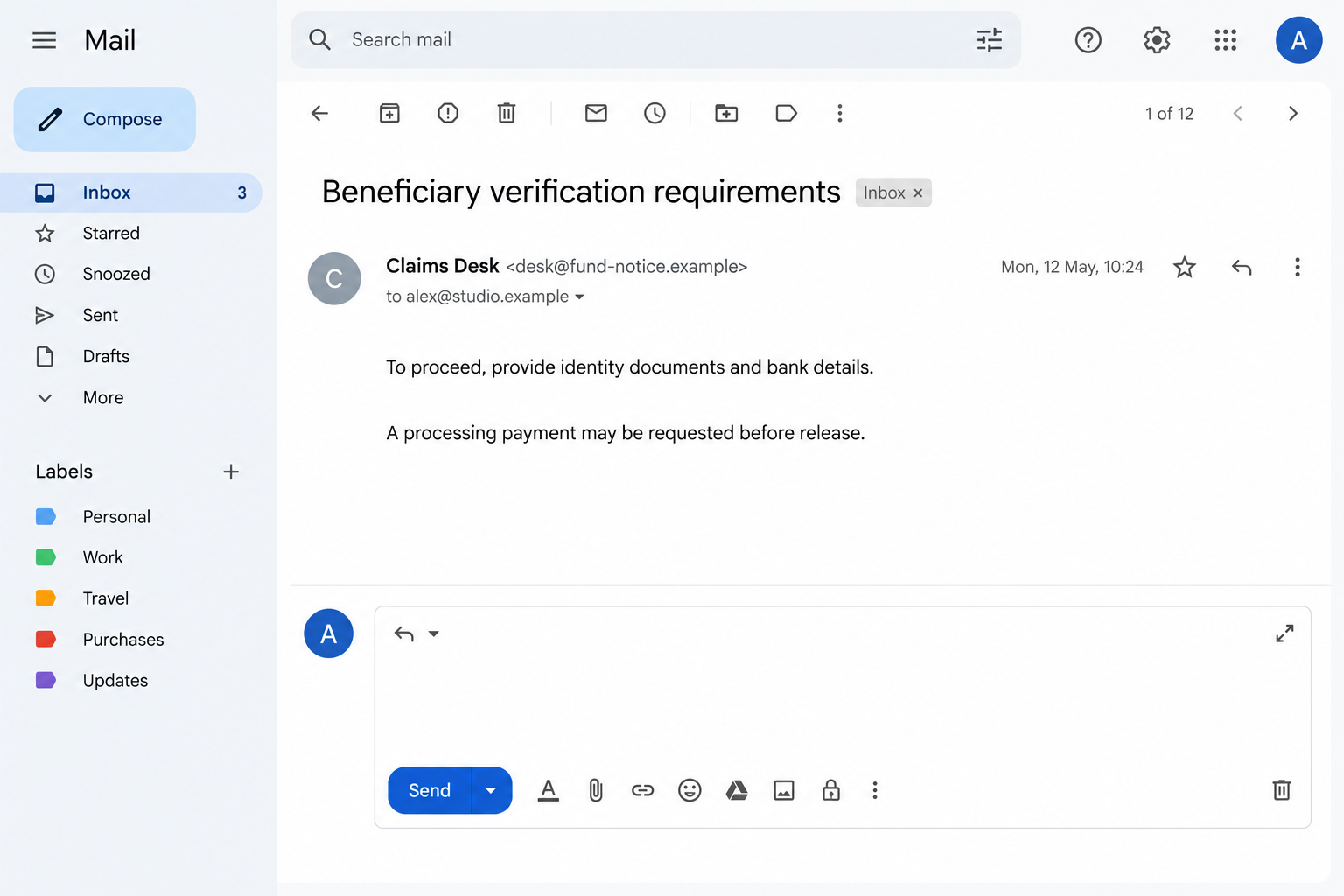
Advance-fee fraud typically turns promised money into requests for payments, documents, or financial information. Labels such as processing or release can make the demands sound procedural.
The initial letter does not prove a particular fee was paid or identify every later request. Treat those developments as possible escalation, not observed transactions.
The clear problem is already present: an unsolicited, unauthenticated financial story invites you into a process controlled by its sender.
You do not need to pay, submit identification, or negotiate to determine whether the notice deserves trust. Independently verified records should come first.
Why the Scam Starts With a Threat Rather Than a Gift
A familiar fortune scam announces good news. This variation introduces a dispute, making the reader feel there is something valuable to protect.
It can seem more believable because the sender appears cautious. The letter says it paused the application and is checking your authorization before proceeding.
That posture gives the sender the role of helpful gatekeeper. The reader may feel grateful for an intervention in a situation that exists only in the letter.
The health allegation supplies another reason to respond. Even somebody uninterested in the money might want to correct a false statement about being incapacitated.
But correction is not necessary when the sender has shown no legitimate recordkeeping role. Replying can simply confirm that your address reaches a concerned person.
An apparent rival also redirects attention. Instead of evaluating the sender, you begin thinking about the stranger who supposedly tried to take the fund.
That is an effective emotional distraction. The fundamental questions remain unanswered: who owes the money, why, and through which verified legal or account process?
The first illustration summarizes the claim. The next shows a fictional follow-up request common to this type of fraud, rather than actual correspondence from a victim.
How the Change of Beneficiary Email Scam Works
Step 1: An unexpected letter assigns you an interest in a fortune
The sender introduces a fund as though you already know about it. Administrative wording avoids the obvious question of how you became entitled to the money.
An exact amount may make the story seem based on a ledger. Precision is easy to type and has no evidentiary value without authentic records.
Ask whether you have an existing account, court proceeding, estate relationship, or documented claim that explains the notice. A surname or email address match is insufficient.
If nothing connects the story to your circumstances, do not let the sum persuade you to supply the missing evidence yourself.
Step 2: A supposed unauthorized change makes silence feel dangerous
The letter claims somebody else is acting on your behalf. That makes a reply feel protective rather than speculative.
The invented illness explanation further suggests that your ability to act has been questioned. You may feel compelled to demonstrate that you can manage your affairs.
You are not required to provide medical records or identity documents to disprove an anonymous email. First establish whether any genuine institution requested them.
A legitimate concern about your actual bank account can be checked through that bank. The stranger’s correspondence need not become part of the process.
Step 3: Your response lets the sender personalize the next demand
A reply can reveal your full name, telephone number, location, financial concerns, or willingness to pursue the supposed fund. Even ordinary corrections can be useful to the operator.
The next message may refer to those details, creating the impression of an active file. Familiarity developed through conversation is not independent verification.
Requests can arrive gradually. A simple confirmation may be followed by a form, document request, or payment instruction once you have invested time.
Do not measure legitimacy by how polite or responsive the sender seems. A convincing conversation can still be built around an invented financial premise.
Step 4: Verification becomes a reason to collect documents or money
Fraudsters may request identification and banking details under the pretext of correcting the beneficiary record. They may then introduce costs supposedly necessary to release the money.
Those requests require evidence of a real institution and a real process. A scanned certificate supplied by the same correspondent does not provide that independence.
Be especially wary when payment goes to a person, unfamiliar account, gift card, or cryptocurrency address rather than an authenticated institution’s established channel.
Legitimate legal or estate work can have fees. The warning here concerns an unsolicited fortune story using unverified charges to make the promised payout accessible.
Step 5: New obstacles can keep the payment cycle going
A completed payment may produce another explanation: a missing approval, clearance, tax, or discrepancy. The supposed fortune remains just out of reach.
That creates pressure to protect what you already spent. A further charge can feel smaller than abandoning the entire promised payout.
Past payment does not establish that the claim became genuine. Evaluate each request against independent evidence rather than the amount already lost.
Stop contact and consult your payment provider promptly if you paid. Do not let an additional release fee become the price of admitting something went wrong.
How to Check the Claimed Bank and Fund
Verify the exact institution, not a similar name
Use the relevant financial regulator’s official records for the country involved. For a claimed United States insured bank, the FDIC provides banking information and lookup resources.
A different institution with a similar name does not validate the letter. Compare the legal name, official website, and independently listed contact information.
The check is jurisdiction-specific. Absence from one country’s list is not proof that a similarly named entity cannot exist anywhere.
What matters is whether the particular institution claiming authority can be independently authenticated. The email has not established that relationship.
Demand a real connection to your own records
An actual entitlement should have an explainable origin. Your existing paperwork, professional adviser, bank, or official proceeding should provide a basis beyond the unsolicited message.
Do not accept a generic certificate as a substitute. Ask your own adviser to assess any plausible claim through independently obtained information.
If you genuinely manage a beneficiary designation, review it directly with the responsible provider. Do not share that account’s details with the stranger to compare stories.
Keep third-party identities out of public accusations
Names and addresses inside scam letters may be invented, stolen, or copied from unrelated records. The letter alone cannot identify the person operating the campaign.
Preserve the material privately for your bank or investigators. Posting a named individual as the perpetrator could wrongly accuse somebody whose details were misused.
This uncertainty does not weaken the warning about the notice itself. It prevents a fabricated document from deciding whom you blame.
If the Health Claim Has Made You Uneasy
The accusation of illness can feel personal even when it is generic. It does not establish that the sender has seen a medical file.
Do not provide a doctor’s letter, treatment history, or proof of health to correct the claim. Those records could expose sensitive information without resolving anything.
If you have a genuine concern about authorized access to medical or financial records, contact the institution that actually maintains them through its usual channel.
Ask whether an unexpected change or disclosure is recorded there. Keep that inquiry separate from the stranger’s purported entitlement process.
A fabricated assertion should not become an invitation to disclose facts the sender never possessed. You can reject the story without answering every detail.
The same principle applies to a relative’s name or address appearing in a later message. Public or previously shared information can be reused to create familiarity.
Verification belongs with the real institution involved in your life. It should not require proving your circumstances to an unidentified correspondent.
What to Do if You Have Fallen Victim to This Scam
-
End the conversation before providing anything else. Stop replying, sending documents, or paying charges associated with the alleged entitlement.
You do not need to persuade the sender to admit the fraud. Save the original letter and follow-up messages before blocking the contact.
Tell a trusted person what happened if pressure or embarrassment makes stopping difficult. A second pair of eyes can help you keep the decision steady.
-
Contact the company that handled any payment. Use your bank’s normal app, statement, or known telephone number and describe the deception accurately.
Ask whether a recall, reversal, dispute, or account safeguard is available. Provide transaction dates, amounts, recipients, and the correspondence supporting your report.
The FTC’s payment-response guidance explains options by payment method. Recovery depends on the circumstances and cannot be promised.
-
Identify exactly which personal details were disclosed. List identity documents, account numbers, contact details, signatures, and any information about genuine financial relationships.
Share that inventory with the relevant bank or identity-theft service. They can help assess measures appropriate to the actual exposure.
For United States identity concerns, IdentityTheft.gov offers tailored steps. Use the corresponding official service where you live.
-
Protect accounts if login information was included. Replace exposed passwords through real providers and check security settings for unauthorized changes.
Bank details alone and an online-banking password are different exposures. Explain which one occurred rather than assuming every account has already been accessed.
Watch for unusual activity and ask the bank whether an affected account or payment instrument needs replacement.
-
Investigate software exposure when relevant. If a follow-up asked you to run a file or install support software, report that separately to a trusted technician.
Malwarebytes may help check for malicious software. AdGuard can reduce some malicious advertising exposure during browsing, but neither tool cancels payments or validates an inheritance.
Reading an unsolicited letter does not, by itself, establish that your computer needs a paid repair.
-
Report the incident with usable evidence. Keep the full email, sender details, payment records, forms, and any telephone or messaging exchanges.
Submit them through your local fraud-reporting authority and the mail provider’s reporting controls. Retain a reference number if one is issued.
A concise timeline helps: initial contact, documents sent, payment demands, payments made, and the point at which you recognized the problem.
-
Expect possible recovery approaches. Someone may later claim to be an investigator, lawyer, or specialist able to recover the entitlement or your lost payments.
Verify that person through independently obtained professional or official details. Knowledge of your case can come from the same compromised conversation.
Do not send a new fee merely because another stranger promises to fix the first stranger’s fraud.
Frequently Asked Questions
Does the letter mean I have a real entitlement?
No authenticated claim is established by the message. Check a plausible legal or account connection through your own verified records and advisers.
Must I reply to deny authorizing the change?
No. A stranger has not demonstrated authority to administer your affairs. Check any actual beneficiary designation directly with its real provider.
Do the account numbers and addresses prove the story?
No. Details can be invented or copied. They do not prove a balance, account ownership, valid instructions, or the sender’s authority.
Is a bank with a similar name connected?
A similar name establishes no relationship. Authenticate the precise institution and contact it through official details before drawing a connection.
What if I sent money already?
Stop further payments and contact the payment provider quickly. Ask about available recovery options while preserving receipts and messages.
Can someone guarantee recovery for an upfront fee?
Treat that promise skeptically. Verify the provider and proposed method independently; neither a secret fund nor a stranger’s guarantee proves recoverable money exists.
The Bottom Line
The Change of Beneficiary email scam turns an invented financial dispute into pressure to reply, disclose information, or pay. The supposed entitlement requires independent proof.
Verify real account concerns with your own institution. If you already engaged, stop the demands and contact the relevant bank or recovery authority promptly.








