

A new client likes your photography, has a date in mind and is happy with your fee. The conversation feels like the booking you were hoping for.
The photography job scam often gives you plenty of time to picture the finished shoot. The awkward request arrives only after the arrangement starts feeling real.
Overview
The photo booking becomes a way to send money elsewhere
This is a confirmed fake-check mechanism targeting photographers and other service providers. A supposed client sends too much, then asks you to pay a third party.
The claimed recipient might be a videographer, event planner, stylist or another professional involved in the shoot. That explanation makes the extra payment sound practical.
The incoming check can later be rejected while the money you forwarded has already left. The client gets your real funds without buying a photography session.
A recent account describes the same payment switch
In a September report, a photographer describes lengthy discussions about a shoot, a digital check and a request to forward the excess to a supposed videographer.
The photographer reports sending money and later discovering a negative balance. The incident is a firsthand account, not an independently audited bank record.
The FTC’s fake-check guidance independently confirms the underlying trap: visible deposited funds do not establish a valid check, and requests to forward money are dangerous.
This article does not identify a real photographer, videographer or business as the criminal. It explains the fraudulent booking and payment arrangement.
Your invoice should not turn you into the client’s payment service
A client can arrange and pay their own additional vendors. You do not need to send part of an unfamiliar check elsewhere to receive your fee.
- The payment exceeds your agreed photography price.
- The client explains that another vendor cannot accept their payment method.
- You are asked to deposit a check and quickly send the difference.
- The outgoing recipient is selected by the client.
- A positive account balance is presented as permission to transfer.
The central warning is the money movement. Polite emails, a believable schedule and a sensible creative brief do not make that arrangement safe.
Why a Good Creative Brief Can Still Be Part of a Bad Booking
Photographers expect questions about lighting, location, timing and image delivery. A stranger who asks those questions seems more serious than someone offering unexplained money.
The conversation can last days. By the time payment is mentioned, you may already have reserved the date or begun planning the session.
That investment makes the booking harder to abandon. Rejecting an odd payment request starts to feel like losing work you have already earned.
A scammer can also borrow a real person’s name or a plausible event location. Those details should be checked, but they are not ownership credentials.
A real venue has no reason to know every person who claims to be organizing a private shoot there. Its existence alone does not confirm the booking.
The same is true of a portfolio compliment. Someone who can describe your style has learned about your work, not demonstrated that their payment is genuine.
You can acknowledge the interest while keeping your booking policy. Set the price, payment route and scope in your own invoice before holding the date.
Then judge the payment proposal independently of the creative conversation. The hours already spent discussing the job should not decide what you do with the check.
How the Photography Job Scam Works
Step 1: A prospective client makes the shoot feel achievable
The approach may arrive through your website, social media or an email inquiry. The sender asks whether you can cover a session or event.
They can offer dates, subjects and a budget. Some versions are vague; others discuss enough ordinary details to create a convincing working relationship.
The recent photographer report describes conversations about style and scheduling over roughly a week. A short or badly written message was not the deciding clue.
A genuine client might also contact you this way. Continue through a consistent booking process, rather than treating every unsolicited inquiry as proof of fraud.
Step 2: The client proposes a payment outside your usual process
The stranger wants to use a check, sometimes described as digital, certified or supplied by their employer. The terminology can make the method sound established.
Electronic payment systems do exist. A label such as e-check does not prove that an emailed image is valid or acceptable for your bank’s deposit process.
Ask your bank about its rules before depositing an unfamiliar instrument. Do not rely on the client’s explanation of what your mobile app will accept.
The client may request your bank’s name or other details. You can decline to disclose unnecessary financial information without having to prove the inquiry is criminal first.
Step 3: The incoming amount includes someone else’s fee
The proposed payment now covers more than your invoice. The explanation might be an accounting convenience, a mistake or an arrangement with another member of the team.
In the reported version, the extra amount was intended for a videographer. The photographer was asked to pass it along because that person supposedly could not accept the check.
That request changes your role. You are no longer simply being paid to photograph; you are financing another transaction for a person you have not verified.
Keep your invoice limited to your own agreed work. The client’s other vendor should receive payment directly from the person who hired them.
Step 4: The visible balance is used to push the transfer
After a deposit, the account may show funds before the check’s validity is settled. The stranger treats that visible balance as confirmation that everything is finished.
The client can now sound impatient rather than suspicious. They have supposedly paid you, and the videographer needs their share so the shoot can go ahead.
The pressure may be friendly: please help us finalize the arrangements. It may become accusatory if you ask the client to pay the other person themselves.
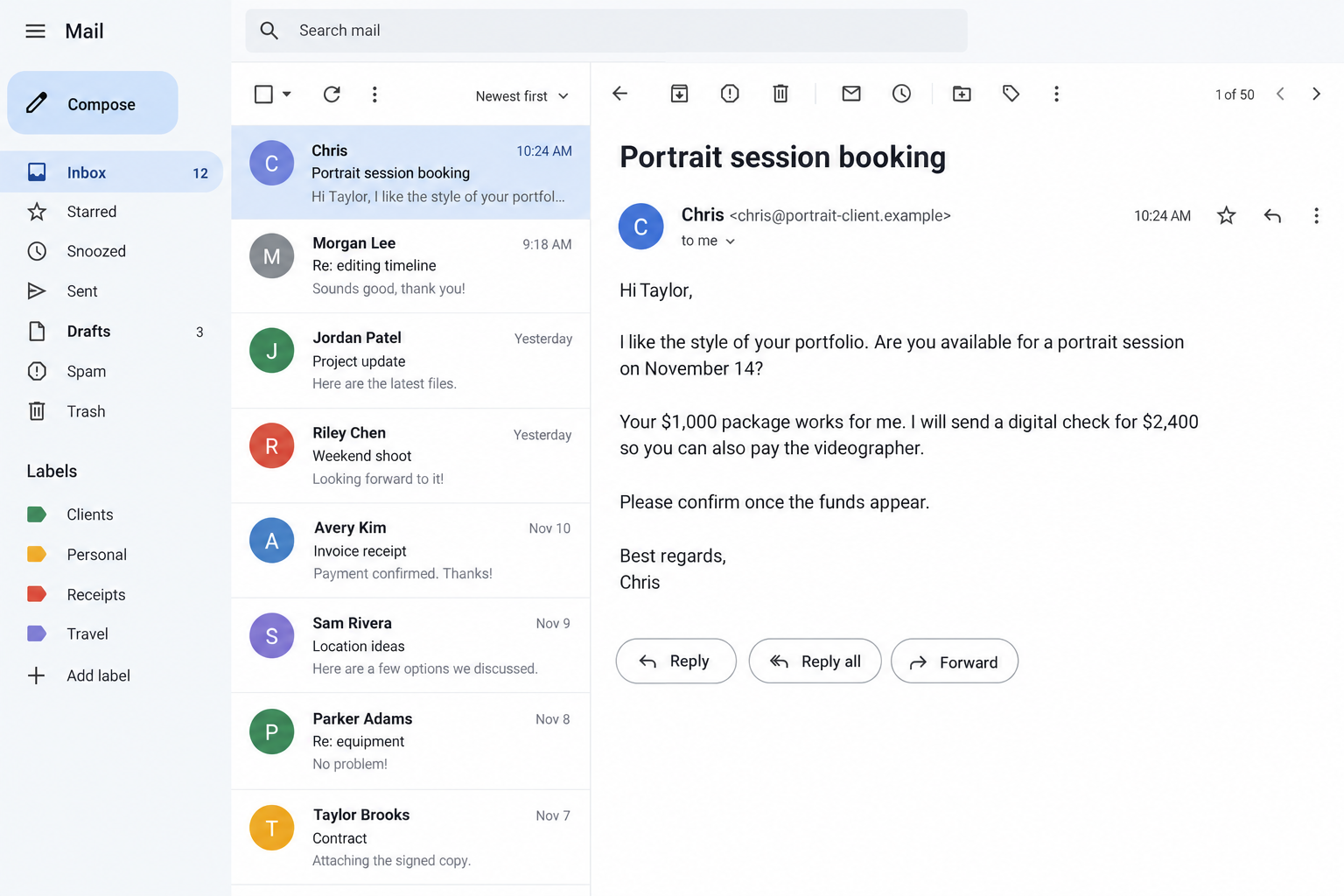
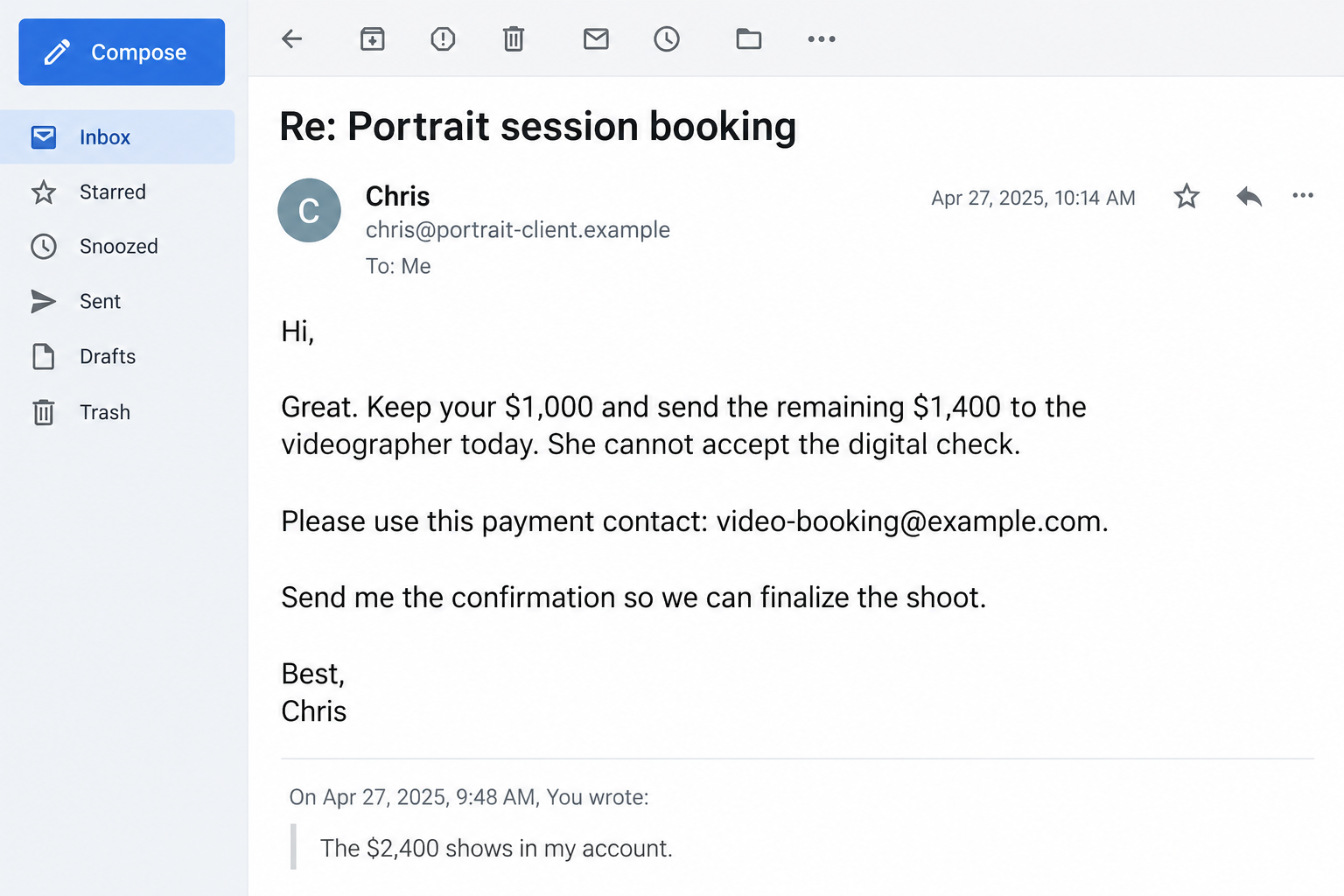
The pictured emails are fictional reconstructions with example amounts and identities. They illustrate the switch from a booking inquiry to an outgoing payment request.
Step 5: The check is reversed after your real money is sent
When the check is discovered to be counterfeit, altered or otherwise invalid, the apparent incoming payment can disappear. Your outgoing transfer is a separate transaction.
The BBB’s fake-check study documents convincing instruments that borrow legitimate business or financial-institution details. Professional presentation does not settle who actually authorized them.
The result can be a depleted balance, fees or an account restriction. The particular consequences depend on the bank, account agreement and incident.
Do not assume a fixed number of waiting days makes a stranger’s overpayment safe. The better decision is to reject the forwarding arrangement entirely.
A Bigger Deposit Does Not Mean a Better Booking
Imagine your invoice is for one amount and the client sends enough to cover several people. The visible excess is not a bonus or a new profit margin.
It is a proposed obligation. The sender expects you to make another payment before you have verified the source of the funds.
Even if the recipient sounds like a genuine videographer, you have not necessarily contracted with them. Why should their compensation pass through your account?
Perhaps the client says the other vendor lacks the right banking app. That explains their inconvenience, but does not make you responsible for solving it.
If they claim the funds must move today, ask why the client cannot pay directly. Do not let an artificial deadline substitute for an answer.
Your own savings can disappear even when the deposit seems to cover the transfer. An account balance combines money from different sources; it does not certify a check.
A negative balance is also different from the total sent. Record the outgoing amount separately so your bank understands the actual transaction you want investigated.
You do not need the scammer’s permission to stop. The apparent payment is not a debt you must settle through a route they dictate.
Check the Booking Before It Reaches Your Bank
Use the same intake process for a flattering inquiry as for any other new client. Obtain a clear brief, contact details and agreement about your own deliverables.
If the sender claims to represent a company, reach that company through independently located contact information. Ask whether it authorized this specific job and sender.
A matching name on a website does not prove the person in your inbox owns that identity. Anyone can copy an employee’s title into a signature.
When a venue matters, verify practical arrangements with the venue. That can uncover an invented booking, although an unconfirmed venue detail alone does not prove fraud.
Keep the invoice and payment recipient consistent with the agreement. Unexpected changes should be resolved before you accept a payment or reserve significant resources.
There is no need to upload your bank statement to prove your honesty. The client can correct their own payment without inspecting your account balance.
Do not send images of a deposited check to random online testers. They can contain information that should remain within your bank’s support process.
And do not accept a second check to fix the first one. Replacing one uncertain payment with another does not settle the original risk.
What to Do if You Have Fallen Victim to This Scam
-
Stop payments to the supposed client and videographer. Do not send a refund, cancellation fee or additional vendor payment while trying to understand the check.
Decline further instructions to move money. You can pause the booking without debating every detail of the person’s creative brief.
-
Contact your bank’s fraud department promptly. Explain that a photography client supplied a possible fake check and requested a separate payment to another person.
Ask the bank to assess the deposit itself, not just tell you whether funds currently appear available. Provide the check and deposit date through its approved process.
If you deposited the check but sent nothing, say so clearly. Your bank needs that distinction to understand the exposure and explain the next steps.
-
Report any outgoing payment to the service that processed it. Identify the recipient, transaction reference, amount, date and the fraudulent booking explanation.
Ask whether a pending transfer can be stopped or a completed transaction reviewed. Also notify your bank if a linked card or account funded it.
Do not promise yourself reimbursement before the provider reviews the facts. The payment route and authorization matter, and recovery options differ.
-
Preserve the original email thread, messages, invoice, check image and transfer records. Keep copies of the profile or booking form used to approach you.
Build a short timeline from the initial inquiry to the last payment request. A clear sequence is more useful than a collection of disconnected screenshots.
-
Review the information you shared. A business email address, mailing address, bank name, password and complete account credentials represent different levels of exposure.
If a password was disclosed, change it through the real service and replace reused versions. If identity documents were supplied, ask about identity-protection steps.
-
Ask your bank about any balance shortfall, restriction or fee. Explain the scam and request the available review or support options.
Do not use a new deposit to hide the incident from the bank. Clear reporting gives its team a better chance to address the actual problem.
-
Report the fraudulent profile or listing to the platform where the inquiry began. For a U.S. incident, submit details through the FTC’s reporting portal.
Report losses to local law enforcement where appropriate. Keep reference numbers so later bank or platform conversations can be connected to the same incident.
-
Tell a trusted person if the incident is making it hard to act. Shame can delay reporting, especially when the booking involved days of apparently normal conversation.
Be alert to people offering guaranteed recovery for an advance fee. A second stranger’s reassurance does not make their payment request safer.
A Booking Policy That Removes the Awkward Decision
Write a simple rule into your payment process: your invoice covers your work, and you do not forward customer money to independently hired vendors.
That rule helps when the client seems pleasant. You can refer to an established policy instead of making a personal accusation during an uncertain conversation.
If a check arrives for too much, contact your bank before taking further action. Ask the client to resolve their own payment through the appropriate provider.
Use payment methods your business understands. Learn their dispute rules before a rushed booking, not while a stranger waits for you to transfer the excess.
Leave room in your schedule for verification. A client who insists there is no time for an ordinary invoice is asking you to absorb their urgency.
A lost booking can be frustrating. It is still easier to recover from than sending your savings to finance an event that never existed.
Your photography can be excellent and the offer can still be fraudulent. Those two facts are compatible; being targeted does not judge the quality of your work.
When a suspect inquiry ends, return to your normal process. You do not need to distrust every future client to keep control of how your business gets paid.
Frequently Asked Questions
What is the decisive sign in this photography job scam?
An unfamiliar client sends an oversized check and asks you to forward part of it elsewhere. That money-moving request is the central trap.
Does money showing in my account prove the check is valid?
No. Funds can become available before a fake check is discovered. Ask your bank about the deposit and do not forward the supposed excess.
Are all electronic checks fraudulent?
No. Legitimate electronic payment systems exist. An emailed check image and a stranger’s deposit instructions still require scrutiny and must meet your bank’s rules.
Does a certified or cashier’s check eliminate the risk?
No. Those formats can be counterfeited too. A reassuring label does not establish who issued the instrument or whether its payment is genuine.
What if I deposited it but never paid the videographer?
Contact your bank, explain the suspected fraud and leave the uncertain funds alone. Follow its instructions rather than refunding the stranger directly.
Should I finish the shoot to earn back the money?
Do not continue a booking controlled by a suspected scammer. Address the payment incident first and avoid additional spending based on the same promises.
The Bottom Line
The photography job scam makes an attractive commission depend on paying someone else’s vendor. The check’s apparent arrival disguises the risk of your separate transfer.
Accept payment for your own invoice. If an unfamiliar client needs you to forward the excess, stop the arrangement and involve your bank.








