

A remote marketing job pays on time, the dashboard looks polished, and the group chat is full of people celebrating. It feels like a promising start.
The Metric Flow task scam becomes harder to question once you have seen money arrive. Look closely at what the next level asks you to do.
Overview
The deposit-funded job is the scam, not ordinary marketing work
The offer described under the Metric Flow name is a task scam: apparent online work turns into a requirement to fund tasks with your own money.
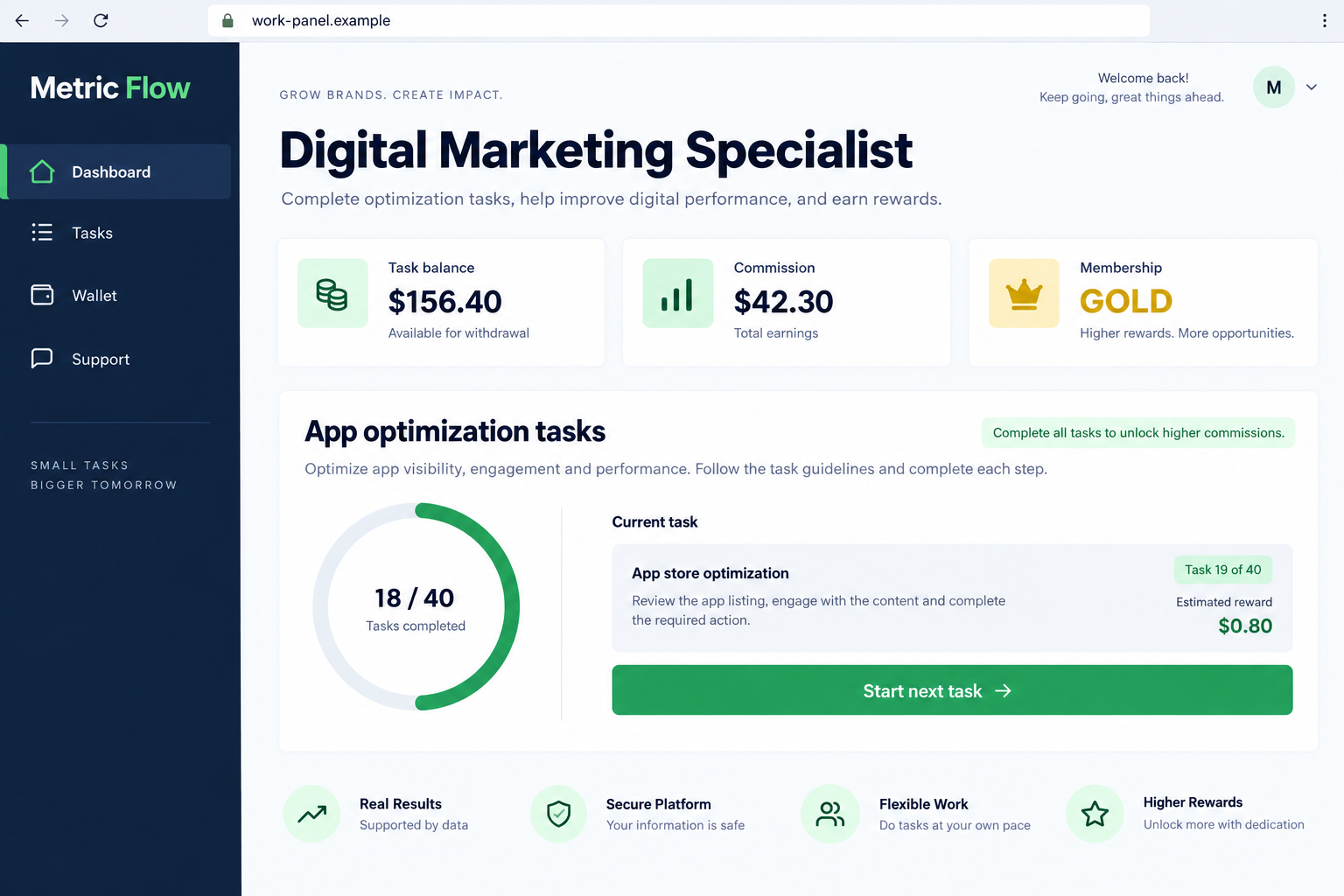
A recent report describes simple button-clicking, several days of withdrawals, a Gold membership upgrade, and higher amounts needed to cover the supposed data work.
Those details match the independently documented pay-to-unlock mechanism warned about by the FBI and FTC. A successful early withdrawal does not validate that mechanism.
This finding concerns the described job offer and payment demands. It is not an accusation against every unrelated business, software tool, or professional using a similar name.
Gold status changes how much of your money is at risk
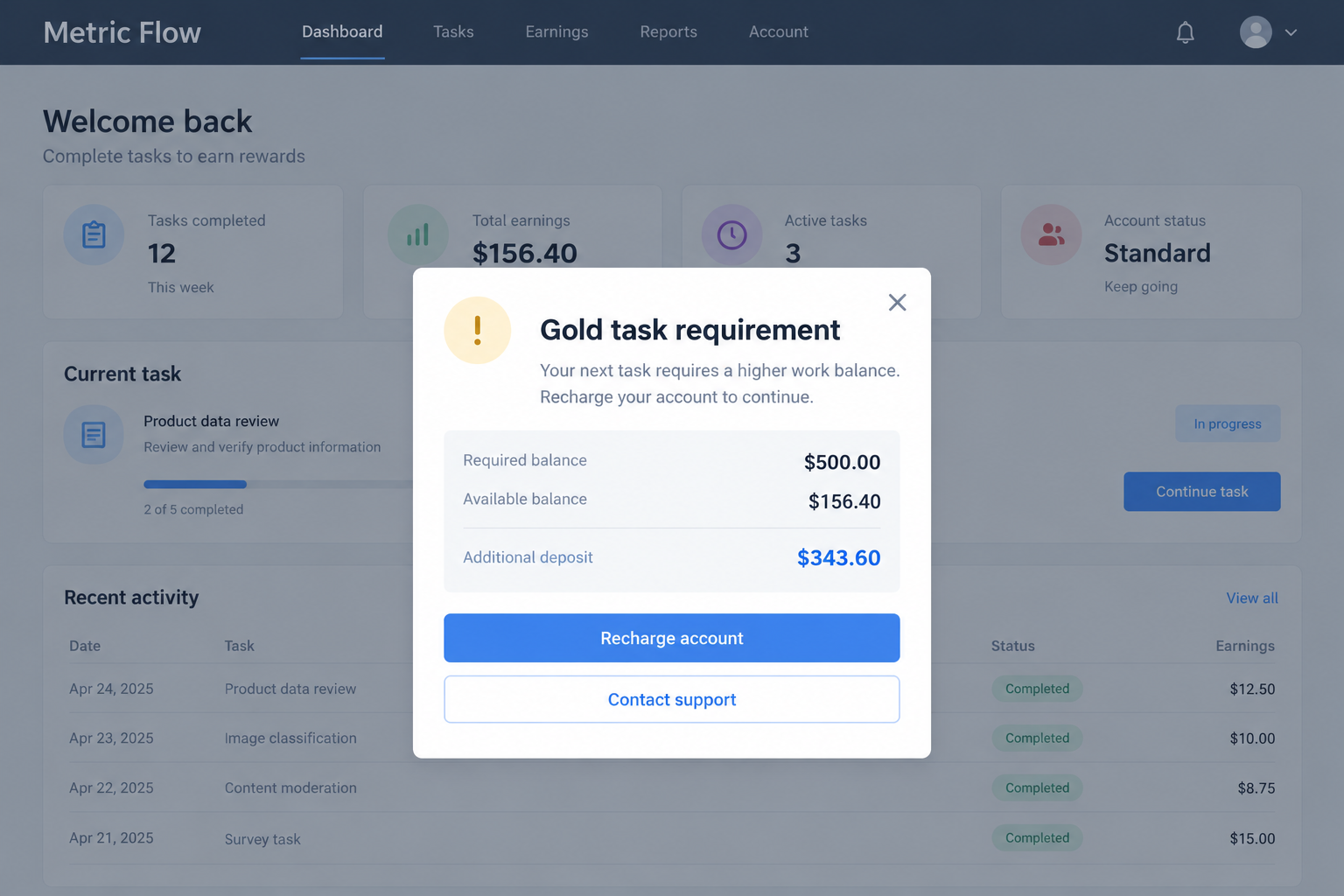
The upgrade promises better commissions. In the reported experience, it also increases the funds required to continue working, moving the risk onto the person seeking a paycheck.
That is the decisive reversal. You thought the company was paying for your work; now you are expected to finance the activity that supposedly produces your earnings.
A dashboard can display profits without holding those funds for you. The operator controls the numbers, task requirements, and withdrawal conditions shown on the page.
- A digital marketing specialist title attached to repetitive clicks.
- Initial payments that make the platform feel tested.
- A paid tier or Gold upgrade presented as career progress.
- Your own deposit required to cover or unlock another task.
- A WhatsApp group emphasizing success, earnings, and friendly reassurance.
- A changing balance that encourages you to keep completing the sequence.
The name and website should not distract from the payment demand
The report identifies floweralice.com as the website used for the offer. The connection is reported, not proof that every past use of that domain was fraudulent.
The FBI’s work-from-home scam warning describes fake task interfaces requiring payments to unlock work. That independently confirms the wider deceptive mechanism.
No exact Gold price or final loss is established here. The examples in our reconstructed screens use fictional addresses and illustrative figures, not a victim’s financial records.
Do not send another deposit to test the platform. Its ability to release a small payment does not establish an obligation or ability to return a larger amount.
Why Five Good Days Can Be More Persuasive Than a Company Profile
When the first payment arrives, it answers a question you actually care about: can I get money out? That experience can outweigh warning signs elsewhere.
A stranger’s testimonial is easy to doubt. A payment you saw in your own account feels like evidence from your own experiment.
But you have tested only that transaction. You have not tested whether the employment is genuine, whether displayed earnings exist, or whether later deposits can be recovered.
The next request is framed as an extension of what worked. If a basic account paid, a Gold account sounds like the same thing with better rewards.
That framing hides a change in the deal. A payment received and a deposit demanded are not equivalent evidence, even when they appear inside the same interface.
The more time you spend on tasks, the easier it becomes to treat the dashboard balance as wages already earned.
A blocked withdrawal then feels like a temporary obstacle between you and your money, rather than a warning about whether the balance is real.
The scam exploits that feeling. You are asked to protect apparent earnings by putting more real funds at risk.
How the Metric Flow Task Scam Works
Step 1: A specialist title makes repetitive clicks sound like a job
The offer uses a marketing role to explain why you are interacting with apps, products, or a task dashboard. The work looks easy to learn.
A trainer or contact may guide you through the buttons. A smooth introduction can make the process seem established, even when the job itself has not been verified.
Real digital marketing can involve analytics, research, campaigns, and content. A genuine industry name does not validate a particular person offering paid clicks.
Ask what useful service is being delivered, who the employer is, and how compensation works. Do not confuse a job title with an employment relationship.
Step 2: The dashboard turns actions into apparent commissions
Each completed action is accompanied by a balance or reward. The interface provides immediate feedback, making the activity feel productive.
Displayed app names or familiar categories can reinforce that impression. Their presence does not prove those businesses purchased your work or authorized the platform.
You may see progress toward a set of tasks. Finishing the sequence becomes the obvious next goal, particularly if the page associates completion with withdrawal.
The figures remain claims controlled by the operator. A growing number is not a bank statement, escrow account, or proof that an employer owes recoverable wages.
Step 3: Early withdrawals make the offer feel proven
The reported participant says payments arrived over several days. The FTC independently warns that small initial payouts can be used to build trust in task scams.
This is why the argument that it paid me is incomplete. The money can be genuine while the larger opportunity is false.
There is no reliable number of safe days, withdrawals, or successful tasks after which a deposit-funded scheme becomes legitimate employment.
A second or fifth payout can extend confidence without changing who controls the next requirement. The operator can raise the amount you must risk afterward.
Step 4: Gold membership introduces larger funding requirements
The upgrade is presented as a way to increase profits. In the reported case, the amount needed to cover data work also increased.
That funding requirement is not ordinary salary payment. The person seeking work becomes the source of money that keeps the supposed job moving.
The platform may call it a recharge, task balance, deposit, or account level. Changing the label does not change whose money leaves the bank.
Do not evaluate the deposit only against the promised return. Evaluate whether an independently verified employer has any legitimate reason to require this arrangement.
A statement that the money is temporary or refundable is not protection. You would still be trusting the same operator to enforce the promise.
Step 5: Social reassurance makes stopping feel unreasonable
The participant describes a friendly WhatsApp group with people displaying success and satisfaction. That environment can make your concerns feel like a misunderstanding.
The FTC has documented fabricated success stories in task-scam groups. That does not establish who controlled every account in this particular chat.
Still, messages inside the recruitment group’s own circle are not independent references. Screenshots of withdrawals can be invented or show transactions that prove very little.
A helpful tone does not answer the financial question. Someone can patiently explain a fraudulent process while encouraging you to keep funding it.
Step outside the group before making decisions. Ask a trusted person to review the actual payment instructions, not only the glowing messages around them.
Step 6: Another condition can stand between you and withdrawal
In the wider task-scam pattern, operators introduce additional work requirements, fees, or balances when people try to withdraw larger apparent earnings.
Those later demands are a documented risk, not a claim that every one has already occurred in this reported Metric Flow case.
The trap is the same whenever new payment is required to release the supposed earnings. The screen offers a reason to send more; it does not guarantee release.
Stop at the first demand to fund the job. Waiting for a larger frozen balance can make the decision emotionally harder and the loss more expensive.
What Gold Membership Does Not Prove
Gold is a label chosen by the platform. It is not an employment credential, payment guarantee, or independent certification of the company’s finances.
A polished dashboard can look like software used by a real business. Its appearance says little about the legal identity or obligations of the person requesting money.
Likewise, a domain name that has existed for some time does not establish the current offer’s legitimacy. Websites can change purpose, ownership, or content.
Do not borrow confidence from a business found in search results merely because the names match. Verify the specific contact and offer through an independently identified organization.
A normal employer should be able to explain the work, contractual relationship, compensation, and contact route. A chat room and an upgrade button do not answer those questions.
You do not need to prove who owns every account before declining a funding demand. Protecting your money is a decision you can make now.
A Practical Way to Check the Money Story
Keep two separate totals: money actually received outside the platform, and money you actually sent. Do not count the dashboard balance as cash.
Then write down the next condition. Is it a task, deposit, membership upgrade, negative-balance repair, or fee before withdrawal?
This makes the change visible. A platform that appeared to pay for work may now be collecting larger amounts than it has paid you.
Do not conduct another test deposit to settle the question. A successful small withdrawal can be part of the process that encourages the next, larger transfer.
If the contact claims a pending deposit is legally required, ask an independent adviser rather than the group’s supposed supervisor.
A screenshot of a policy does not create a debt by itself. Avoid accepting the platform’s description of a work balance as an obligation you must repay.
Real freelance tools or optional professional subscriptions are not automatically scams. The problem here is the fabricated job and demand to bankroll tasks to access supposed earnings.
What to Do if You Have Fallen Victim to This Scam
-
Decline the next recharge or upgrade. Do not send a final deposit, even if the contact says you are one task away from withdrawal.
Pause before taking a loan, using savings, or asking someone else to cover the balance. Another payment increases exposure without independently validating the promised payout.
-
Preserve the evidence outside the platform. Save recruitment messages, the Gold requirement, withdrawal screens, usernames, dates, receipts, and destination details.
Keep screenshots privately, excluding passwords and wallet secrets. If access disappears, you will still have a record of the instructions and transactions.
-
Notify whoever processed your payments. Contact your bank, card issuer, payment app, or exchange through its official support route.
Describe the deposit-funded fake job, the transactions you authorized, and any unauthorized activity separately. Ask what reversal, recall, or fraud-reporting options remain available.
-
Report crypto transfers with transaction details. Provide the exchange and authorities with transaction identifiers, sending and receiving addresses, amounts, and dates where available.
A public transaction record does not itself recover funds. Do not pay a stranger who claims that seeing the transfer proves they can reverse it.
-
Secure login information you reused or disclosed. Change a reused password on genuine accounts, starting with email and financial services.
Use official apps and sites to review recovery settings and active sessions. If you shared identity documents, ask relevant institutions about appropriate identity-protection steps.
-
Inspect devices after downloads or unusual permissions. Run Malwarebytes on a supported system if the recruiter had you install an app or file from an untrusted source.
AdGuard can add protection against known malicious websites and ads. Neither tool can release a task balance or undo money already sent.
-
Make a factual report to the authorities. In the United States, use the FBI Internet Crime Complaint Center and the FTC’s official reporting service.
People elsewhere should use their country’s cybercrime or fraud channel. Include the offer’s actual names and domains rather than accusing an unrelated similarly named company.
-
Leave the reassurance loop. After saving evidence, block the recruiting contacts and report the chat or accounts through the platform’s tools.
Tell someone you trust what happened. You are responding to a deliberately convincing scheme, not failing a test of intelligence or work ethic.
Frequently Asked Questions
Is the Metric Flow Gold-membership offer a real marketing job?
The described pay-to-fund-tasks offer matches confirmed task-fraud mechanics. This finding applies to that offer, not unrelated organizations sharing the name.
Why would scammers pay me for several days?
Early payments can buy confidence and encourage larger deposits. A completed payout proves that transaction occurred, not that later earnings or withdrawals are guaranteed.
Does Gold membership make my balance more secure?
No. The tier label is controlled by the platform. It does not independently protect a deposit, verify an employer, or establish that displayed commissions are available.
Are all WhatsApp job messages scams?
No platform alone establishes fraud. The important combination here is apparent click-based earnings, an unverified job, and your money required to finance or unlock further work.
Should I finish the tasks before leaving?
Not if completion requires more payment. Do not increase your exposure to rescue a screen balance controlled by the same operator requesting the deposit.
Can a recovery expert unlock my account balance?
An unsolicited promise to recover earnings for another fee is a further warning. Use legitimate payment providers and reporting channels; do not fund a private rescue attempt.
The Bottom Line
The Metric Flow task scam uses early payouts and Gold status to make funding a supposed job feel like progress. The real risk is the next deposit.
Stop paying to continue work. Save the evidence, contact your payment provider, and assess actual transfers rather than the earnings displayed inside the dashboard.








