

An OpenxAI staking offer promises up to 20% APR on OPENX. The page looks like another opportunity in a crypto community already talking about decentralized AI.
You may only want to check the rate before deciding. Start by finding out which project the offer represents and what the next wallet request would authorize.
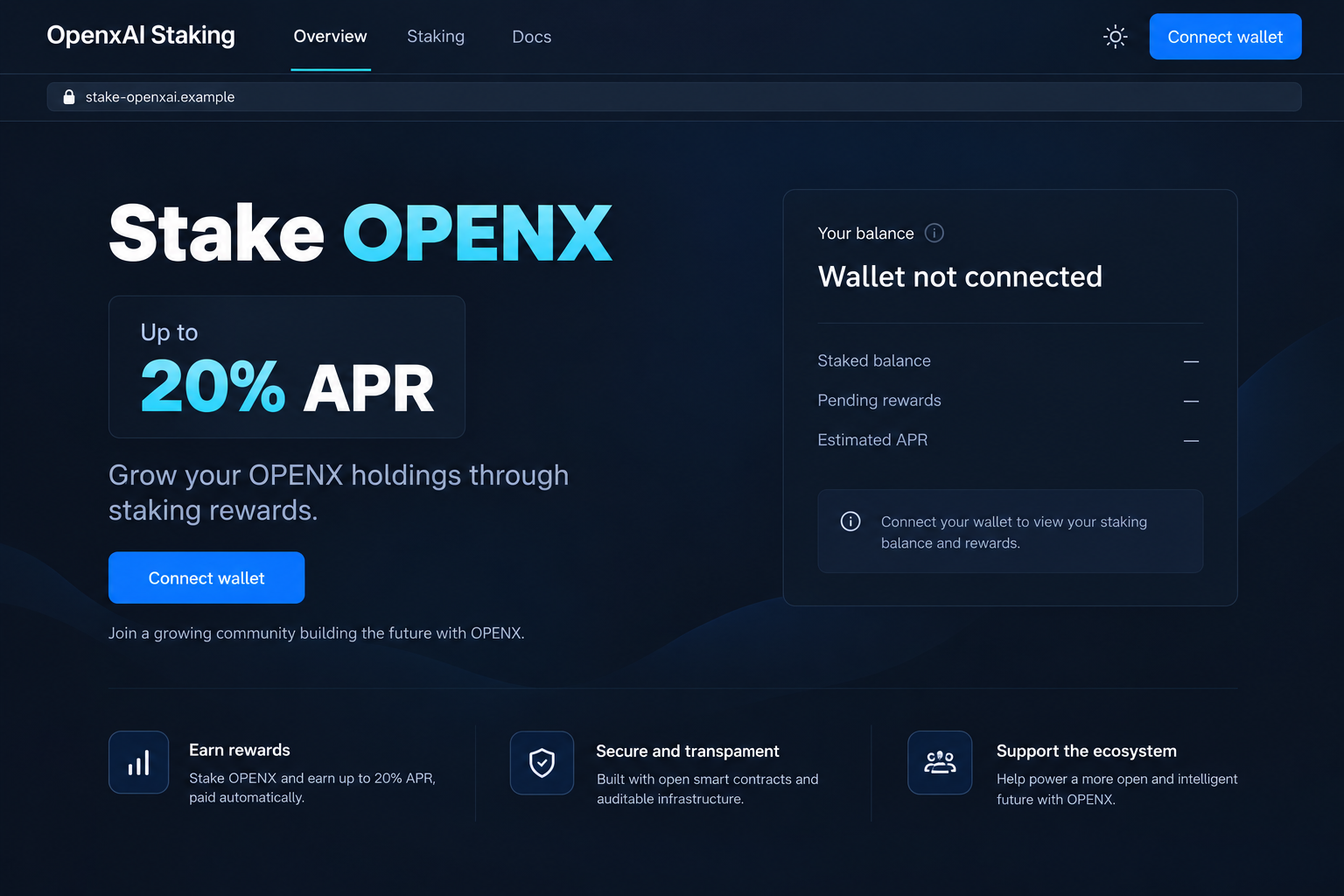
Overview
The staking offer borrows a real project’s identity
The OpenxAI staking scam is a counterfeit rewards page, not the genuine OpenX project. A documented imitation advertised OPENX staking while seeking access to visitors’ wallets.
The example recorded in September 2025 used stake-openxai[.]com. Its name resembles a purpose-built staking portal, but that separate domain did not authenticate the offer.
The distinctive pitch was an annual rate reaching 20%. A familiar token name and a plausible-looking dashboard made the wallet interaction seem like ordinary participation.
The recorded page was classified as a wallet-draining imitation. We did not execute its contracts or verify a particular victim’s transaction, so those technical details remain unconfirmed.
The official route has changed since the older campaign
During this review, openxai.org redirected to openxnetwork.org, which presents the current OpenX Network website and its documentation.
That verified redirect is not the same thing as an unsolicited dash-domain staking page. A genuine identity change does not authorize every site retaining an older name.
- Confirm the project and its present website before considering a reward offer.
- Check whether the exact staking destination is linked through that independently opened project route.
- Read the wallet’s requested action rather than relying on the website’s staking label.
- Decline requests that expose secrets or grant permissions you cannot explain.
This article concerns an impersonation campaign documented earlier. It does not establish that its original domain is still active or that a new October 2026 wave exists.
The rate is a lure, not the technical cause of theft
A displayed 20% rate cannot by itself prove fraud. Nor does it prove a sustainable return, a funded reward pool, or a relationship with the named project.
The serious risk appears when the copy persuades someone to authorize an unwanted action. Merely viewing a rate and signing a spending permission are different events.
The pictures use fictional hostnames to explain that distinction. The approval example is hypothetical, not a captured contract request from the historical page.
If you used a similar offer, review what you actually approved. Do not assume either complete safety or automatic theft from the connection label alone.
What the 20% APR Pitch Leaves Out
A yearly rate is not a promise about next week’s balance
APR expresses a yearly rate. A promotional number does not mean the same increase arrives immediately, and the value of token rewards can change with the market.
For a simplified example, 20% on a stable $1,000 principal would equal $200 over a year before costs. That is arithmetic, not an expected OPENX outcome.
A real arrangement may have variable rewards, fees, lockups, or token-price exposure. A copied dashboard can display an appealing percentage without addressing any of those conditions.
“Up to” also leaves the actual result unspecified. The reader needs a verifiable program, defined terms, and an understandable transaction, not just an attractive upper limit.
An AI theme does not validate financial permissions
Decentralized AI is the background story that makes this offer feel relevant. It gives a reward page a place in a wider conversation about builders and networks.
Those ideas do not tell you who controls the website’s wallet requests. A counterfeit can repeat project language while substituting its own destination.
For someone following the community, an unfamiliar staking link may look like a new feature rather than an unfamiliar operator. That is precisely the identity gap to investigate.
Check the claimed feature independently. Learning what a network builds is separate from authorizing a page to move assets in your account.
A token ticker is not a complete identity check
A site can write OPENX anywhere. That text does not establish which token contract, chain, or staking program an interaction actually uses.
Before a legitimate transaction, compare asset identifiers with the project’s current documentation. Do not accept an address supplied only by the page requesting permission.
A copied logo or matching color palette is equally weak evidence. Visual consistency can make a page familiar without proving control by the real project.
You are not required to connect first to investigate these claims. Basic identity and program information should be established before exposing a wallet to requests.
How the OpenxAI Staking Scam Works
Step 1: A staking invitation appears alongside a recognizable AI story
The offer presents itself as a way to put OPENX holdings to work. It borrows the recognizable name rather than introducing an obviously unrelated investment.
Such invitations can arrive through social posts, messages, ads, or shared links. The historical report does not establish one delivery channel for every person who encountered the copy.
A recommendation from another user may simply mean they saw the same page. It does not show they checked the domain or received the advertised returns.
Take the invitation as a claim requiring verification. Find the project independently before deciding whether its language describes an authorized program.
An unexpected private message offering help with staking is not a shortcut. It can introduce another operator into a process that already needs careful identity checks.
Step 2: A separate hostname looks like a dedicated staking destination
The documented copy’s hostname combines a staking word with the older project name. That can appear sensible to someone expecting a separate dashboard.
However, a dash creates a different domain, not an official subdomain. Names that resemble each other can be registered or controlled by entirely different parties.
Look beyond the reassuring words. Determine the complete hostname and whether the genuine project’s current navigation establishes that exact destination.
The current official redirect gives a useful starting point, but not a blanket approval of third-party services. Verify each consequential handoff before interacting.
Do not visit the reported scam hostname to see whether it still works. Its spelling is included here for recognition, not as a destination to test.
Step 3: The APR headline encourages a wallet connection
The reward figure turns verification into anticipation. A visitor starts considering possible earnings before confirming who would receive the permissions needed for participation.
A connection button is familiar from legitimate applications. That familiarity can make the next step feel like signing into a website rather than making a financial decision.
Connection commonly reveals a public address and allows a site to request interactions. It does not universally give the page authority to transfer every asset.
That distinction is worth keeping even when the website is fraudulent. Accurate recovery depends on separating an exposed address from an approved spending action.
If the next screen is unclear, reject it. A visible staking rate cannot explain away an unrelated transfer or broad allowance.
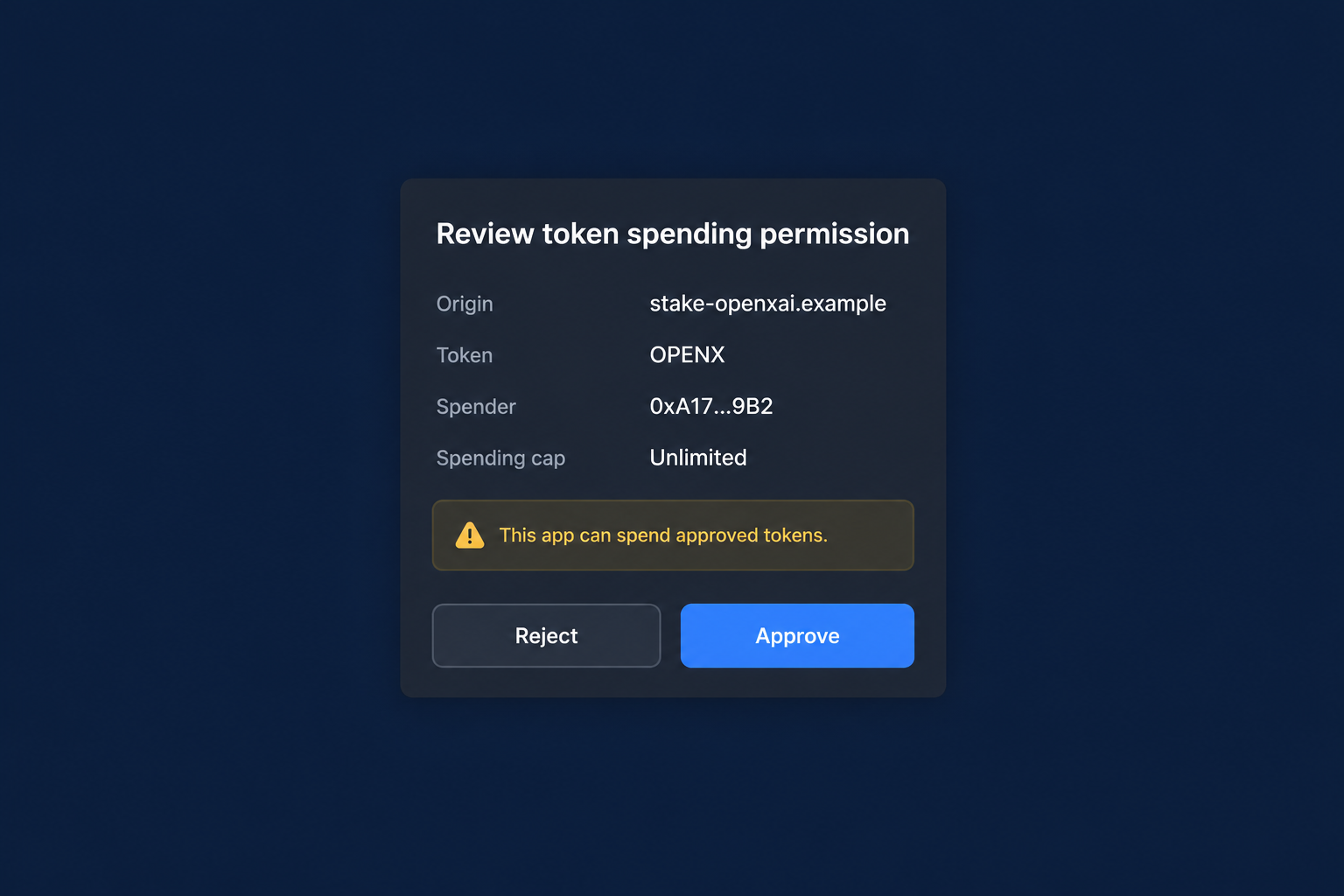
Step 4: The wallet can request more than the website’s wording suggests
A malicious page may request a token allowance, a transaction, or a signature with financial consequences. Those are possible routes, not verified identical stages for every copy.
The pictured example shows an unlimited allowance. It illustrates why a harmless-looking staking label and the wallet’s actual permission must be evaluated separately.
Check which asset is involved, who receives authority, and how much can be spent. A permission covering unrelated holdings does not become appropriate because the page says OPENX.
Do not treat every signature as a login acknowledgment. If you cannot understand what it permits, use the wallet’s official guidance before proceeding.
A seed phrase or private key request is a different emergency. A site does not need those secrets to establish an ordinary wallet connection.
Step 5: An unwanted authorization can outlast the promotional page
Once a valid spending permission exists, closing a tab may not remove it. The authority can remain relevant after the staking interface stops responding.
A deceptive dashboard may continue showing projected rewards while the wallet records a different result. Check the account’s real transactions, not the page’s earning counter.
Loss depends on the authorization, assets, and chain involved. Without those records, nobody can responsibly say this particular interaction emptied every token or affected none.
A website disappearing does not reverse an on-chain action. It may instead make preserving the original invitation and transaction identifiers more important.
Do not send another payment to activate the promised yield. An extra deposit cannot prove that an impersonator owes you an earlier advertised reward.
Verify the Project Without Letting the Offer Set the Rules
Follow official navigation, not a search-result badge
Begin with a project address you independently confirmed. Compare the current site, documentation, and community references before trusting a newly supplied staking destination.
Search placement is not authorization. A sponsored result can advertise an impostor, and a familiar-looking title can obscure a completely different address.
For this case, the change from openxai.org to openxnetwork.org is relevant current context. It is not evidence that all pages using the old name are genuine.
When an announcement cannot be verified, leave the wallet disconnected. There is no need to grant financial permissions merely to resolve uncertainty about a link.
Ask what the transaction does when the headline disappears
Ignore the return figure temporarily. Describe the proposed action in ordinary language: which account is sending what, or which spender is getting access to which asset?
If that description does not match your intention, the interface has failed an essential check. Reject the request before debating its advertised yield.
A legitimate staking interaction can still carry financial risk. Authentication of the project is necessary, but it is not an assurance about price or investment performance.
Never let a helper pressure you to disable wallet warnings. A claim that a warning is “normal for AI staking” is not a technical explanation.
Do not confuse revocation with disconnection
MetaMask’s allowance guidance distinguishes spending approvals from a site’s connection. The appropriate remedy depends on which of those permissions you granted.
Disconnecting ends a site’s ordinary connection to the wallet. It does not necessarily remove a spending allowance already recorded on-chain.
Use a trusted wallet or explorer process for the affected network. The impersonation page’s own “revoke” button is not a reliable recovery tool.
Do not install a new extension from a direct message to perform that check. A recovery attempt should not add another unverified application to the device.
What to Do if You Have Fallen Victim to This Scam
- Put the staking invitation aside.
Stop signing requests from the offer. Note the hostname, approximate interaction time, wallet address, and whether you connected, approved, transferred, or disclosed a secret.
Those details define the problem more accurately than saying you clicked “Stake.” Keep screenshots already available without reactivating the page.
- Review the wallet’s actual activity.
Check transaction records through your established wallet and an independently reached explorer. Compare outgoing activity with what you intended to authorize.
A website earning counter is not proof of a staking position. Preserve transaction hashes and relevant asset details for reporting or professional review.
- Remove the connection and inspect spending authority.
Disconnect the suspicious application, then review token allowances on the relevant network. Revoke unwanted approvals through tools referenced by your wallet’s official documentation.
Revocation can limit later misuse of that allowance. It does not undo an already completed transfer or secure a leaked private key.
- Handle secret exposure as a separate compromise.
If a recovery phrase or private key was entered, create a genuinely new wallet on a clean device. Do not reuse that secret.
Protect remaining legitimate assets with care. If automated withdrawals occur, obtain trusted technical advice before repeatedly funding the compromised account with transaction fees.
- Check for an installed verifier or persistent redirect.
A downloaded staking tool or new extension warrants a device review. Updated Malwarebytes can help identify unwanted software, alongside inspection of browser extensions and permissions.
AdGuard offers another layer against deceptive advertising and some known malicious destinations. Neither product reverses blockchain transfers or authenticates a promised 20% return.
- Report the specific impersonation and financial record.
Notify the platform carrying the link and the real project through independently confirmed contact routes. Report losses to the appropriate local authority.
US readers can use ReportFraud.ftc.gov. Include useful records without publishing a recovery phrase, private key, or unrelated personal information.
- Refuse a second payment disguised as recovery.
Ignore private messages promising guaranteed refunds, unlocked staking, or a special tracing certificate. A request for another crypto payment can extend the original loss.
Legitimate reporting may help an investigation, but it is not a promise of reimbursement. Keep evidence and realistic expectations while securing what remains.
Frequently Asked Questions
Is the genuine OpenX Network the scam?
No. This warning concerns a separate staking imitation using the OpenxAI name. It is not an accusation against the real network or an investment review.
Does 20% APR automatically mean an offer is fake?
No single rate proves fraud. Verify the operator, program, risks, and requested authorization. The documented offer used impersonation, not merely an unusual percentage.
Why does the older official OpenxAI address redirect?
During this review it led to the current OpenX Network website. That observed redirect does not validate a different staking hostname received through an unsolicited link.
Can simply connecting a wallet move all my tokens?
Ordinary connection alone is different from approving spending or a transfer. Review every additional action rather than assuming the connection label explains the whole interaction.
Will closing the staking page remove an approval?
Not necessarily. An on-chain allowance may remain after disconnection or tab closure. Inspect and revoke unwanted authority using a trusted process for the correct chain.
Can antivirus software recover cryptocurrency already transferred?
No. A malware scan can address device threats. It cannot reverse an on-chain transfer, cancel a token allowance by itself, or guarantee financial recovery.
The Bottom Line
The OpenxAI staking scam packages a counterfeit wallet interaction as a familiar AI-network opportunity. An APR headline and a recognizable token do not establish permission to spend.
Verify the current project route first. If you used the copy, investigate the exact authorization and secure remaining assets without paying another supposed staking or recovery fee.








