

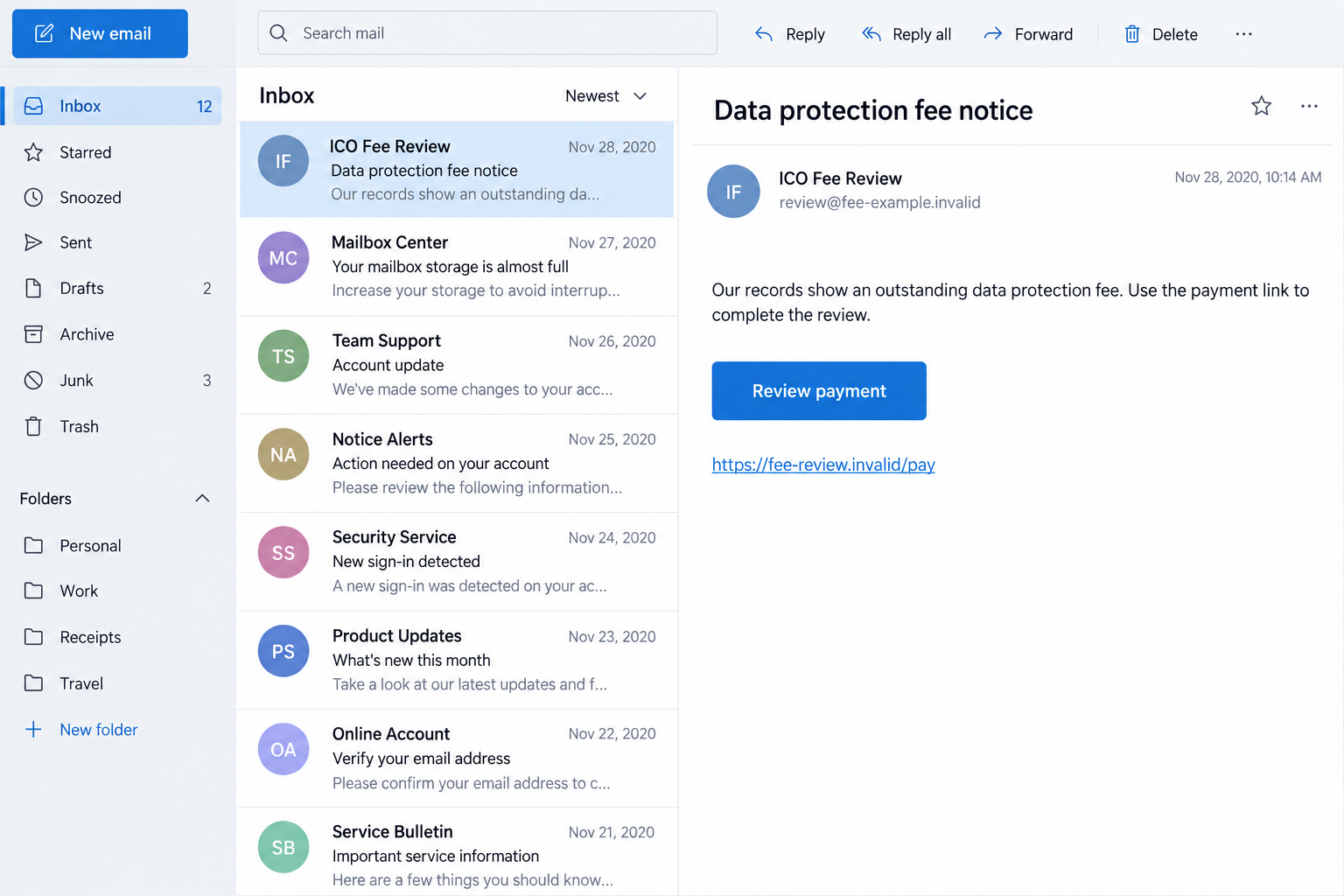
A notice arrives about your business’s data protection fee. It looks official, names an outstanding obligation, and offers a quick way to put the paperwork right.
The ICO data protection fee scam borrows that familiar responsibility. Before paying, check who sent the notice and whose payment route it wants you to use.
Overview
The real fee gives the false notice a believable subject
The ICO is the U.K.’s information-rights regulator, and a data protection fee can be a genuine obligation for an organization unless an exemption applies.
The scam occurs when an impersonator uses that subject to collect money or information through an unverified request. The existence of the fee does not authenticate the sender.
The ICO’s registration FAQs warn about fee-related scams and direct recipients toward payment through its official website, ico.org.uk.
A historical warning was documented in 2020. This report explains the impersonation pattern and current checks, not a newly intercepted notice or a fixed fraudulent charge.
Do not conclude that every ICO letter is fake. Real correspondence and real fee responsibilities must be distinguished from the fraudulent payment route.
The notice’s appearance cannot establish who has authority
A company name, registration reference, formal heading, and payment deadline can make a message feel administrative. Those details do not prove that the regulator issued it.
An unfamiliar sender may claim to act on the ICO’s behalf. That relationship needs independent confirmation, not a logo or the sender’s own explanation.
Some private businesses offer assistance with fee payment. A higher service charge alone does not establish fraud, but those providers do not acquire ICO enforcement powers.
The relevant question is whether the identity, service, and payment are represented honestly. Optional assistance should not be disguised as an unavoidable government demand.
Check the obligation and the payee separately
You can owe a genuine fee and still receive a fake payment request. Verifying one part of the story does not settle the other.
- Check your organization’s own registration and payment records.
- Use the ICO’s official assessment if the obligation is unclear.
- Start any genuine payment from ico.org.uk independently.
- Confirm who receives the money and what service is being purchased.
- Do not accept a stranger’s deadline as proof of regulatory authority.
The images are fictional on-screen examples with nonfunctional addresses. They are not authentic ICO correspondence, current fee quotations, or captures of a real checkout.
Why the Message Can Get Past a Busy Business
The fee sounds like a task someone else might handle
A business can have separate people managing compliance, invoices, banking, and correspondence. The recipient may assume the notice concerns a task another colleague already knows about.
That assumption can move a payment forward before anyone checks the original registration or previous receipt. The scam benefits from a gap between departments.
Ask who handles the genuine fee and where its records are kept. A short internal check is more useful than guessing from the notice’s tone.
Do not forward customer records to an outside sender to demonstrate compliance. A fee enquiry is not a reason to disclose the business’s underlying personal-data files.
The organization should choose the route for resolving uncertainty. The person demanding payment should not control every source used to verify the demand.
A legal-sounding deadline narrows attention
Words about an overdue obligation can make a business focus on avoiding trouble. The authenticity of the sender becomes secondary to completing the apparent task.
Genuine compliance matters should be addressed, but a stranger cannot establish official authority by threatening consequences in a message.
Check an actual case or fee record through the regulator. Do not make a payment first and plan to sort out the sender’s identity afterward.
Conversely, do not use the possibility of a scam to ignore legitimate correspondence. Verification should resolve the question, not replace one unsupported assumption with another.
How the ICO Data Protection Fee Scam Works
Step 1: An official-looking notice names the fee
The contact may arrive by letter, email, text, or telephone. It uses a real regulatory subject to make the approach feel less random.
The sender may present your organization’s details as if they came from a privileged record. Some business information is publicly available or easily obtained elsewhere.
Personalization therefore deserves checking, not automatic trust. The sender still needs an authentic relationship with the obligation it discusses.
Keep the notice’s exact wording and date. There is no need to follow its payment link just to preserve evidence of the claim.
If it refers to a real registration, compare that reference with your own record. Do not rely on the notice to supply both the problem and its proof.
Step 2: The sender presents its route as the necessary response
The notice may supply a payment button, a private account, or a contact offering to handle the matter. The suggested convenience redirects the business’s next step.
A company that honestly sells assistance is different from an impostor pretending to be the regulator. Read what the transaction actually describes.
Watch for a claim that a private provider can impose official penalties or that you cannot contact the ICO independently. Such a claim should not control your decision.
Do not let the contact authenticate itself through another number it supplies. Reach the regulator or established adviser using details you already trust.
You can pause an unverified payment while checking the genuine obligation. That is different from deciding that the organization is exempt without evidence.
Step 3: A page or conversation requests payment information
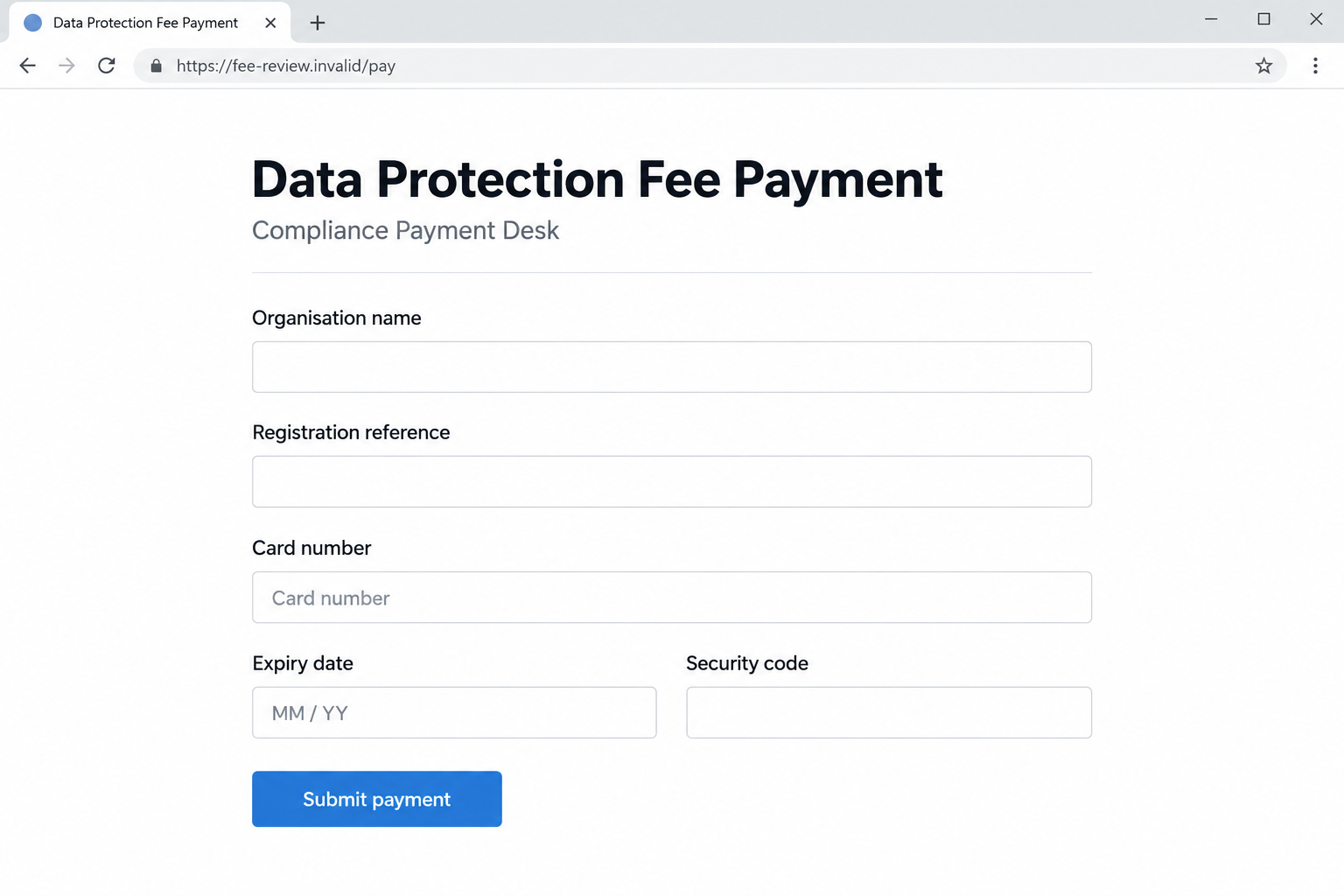
The proposed route may ask for card details, organization information, or a registration reference. An ordinary-looking form does not establish a legitimate beneficiary.
Some information would be normal during a genuine payment. The important distinction is whether you reached the process through the verified official route.
A copied government name inside a domain is not ownership proof. Neither is an address beginning with HTTPS, which describes the connection rather than the seller’s honesty.
Do not enter a real card to investigate the form. The payment provider or regulator can advise without requiring you to make an unverified transaction first.
The illustration below represents a fictional payment desk. Its fields are examples, not evidence of a particular current fraud operator or an official payment system.
Step 4: The payment may not satisfy the real obligation
Paying the wrong party can leave a genuine registration or renewal question unresolved. A receipt from an unverified desk is not the regulator’s confirmation.
That does not mean every delayed update indicates fraud. Check the actual payment record and official status rather than drawing a conclusion from timing alone.
If a private agent was knowingly engaged, compare its promised service with what it actually completed. A fee dispute and official impersonation are different complaints.
Keep the original payment purpose clear when contacting your bank. A transfer made under deception is not necessarily the same as a card charge you never approved.
Accurate reporting helps the provider assess the correct options. Do not alter the story to fit the remedy you hope will apply.
Step 5: A follow-up can invent another fee or verification task
An untrusted contact may say the first payment failed or a further administrative step is needed. Another request can increase the exposure.
This is a possible escalation, not a confirmed sequence in every fee scam. You can stop after identifying the first unverified demand.
Do not provide a banking password or security code to clarify a registration payment. A fee dispute does not authorize remote control of the business’s accounts.
Return to your own records and the regulator’s independently reached guidance. The sender of the questionable notice is not a reliable compliance adviser.
How to Check the Genuine Fee Without the Notice
Use the official assessment instead of guessing
The ICO’s fee self-assessment helps organizations determine whether a fee applies and which amount is relevant.
Your organization’s activities and circumstances matter. A general article cannot declare every sole trader, charity, company, or professional practice exempt or liable.
Answer the assessment based on what the organization actually does. Do not let a caller supply convenient answers just to support their payment request.
If the result is unclear, seek appropriate advice through a verified route. Uncertainty should not become a reason to pay an unidentified desk.
Compare registration details with your own records
Look for the prior official receipt, registration reference, renewal information, and the colleague responsible. Those records help you ask about a particular discrepancy.
If a business operates several entities or locations, do not assume the same fee arrangement applies to every one. Check the official guidance for the actual structure.
This is a verification step, not a legal conclusion about your organization. Keep the facts available for the person reviewing the real obligation.
A suspected fake letter and a legitimate overdue payment can coexist. Handling both separately prevents the impostor from monopolizing the process.
Understand the difference between the regulator and an assistant
The ICO’s FAQs distinguish private assistance businesses from the regulator. Those providers can charge for a service, but they have no official standing or enforcement powers.
Choose optional assistance only when its identity, fee, scope, and authority are transparent. Do not assume a paid certificate proves the ICO received the required payment.
For a direct payment, begin with ico.org.uk. If a legitimate process uses another payment component, verify that you arrived there through the official service.
The word official on an unrelated page is not the same evidence. Avoid search advertisements that present themselves as the compulsory route to a government task.
What to Keep Before Raising a Dispute
Preserve the notice and completed transaction separately
The notice records what the sender claimed. The bank statement or receipt records who received money and the transaction description.
Save both, along with relevant replies and internal approval records. A provider may need to understand why the business believed the demand was authentic.
If nothing was paid, say that. You can report suspicious impersonation without inventing a financial loss or accusing an unidentified provider of non-delivery.
Keep personal and business access details private
A registration reference is not a password, but it can still make later contact more convincing. Do not post a complete unredacted notice in a public forum.
Share necessary evidence through verified support and reporting channels. Redact customer names, account details, and unrelated material when discussing the warning publicly.
An outside caller should not need access to your customer database to authenticate a fee notice. Keep the verification task narrower than the organization-wide information they request.
What to Do if You Have Fallen Victim to This Scam
-
Stop the unverified payment conversation. Decline another charge, verification link, or request to share financial access while the sender promises to resolve the fee.
Keep the original notice and any replies. You can investigate the legitimate obligation without continuing through the questionable contact.
-
Review the real registration with the responsible colleague. Check the official records, prior payment, and renewal matter through ico.org.uk.
Do not automatically pay twice or assume the fee was satisfied. Establish what the original transaction did and whether a genuine obligation remains.
If eligibility or exemption is uncertain, use the official assessment or verified advice. The suspected scam does not determine the business’s legal position.
-
Contact the provider that handled the payment. Describe the false authority claim, the beneficiary, and whether the transaction was approved under deception.
Supply the notice, receipt, dates, and relevant replies. Ask what fraud protection or dispute route applies to that payment method.
A card dispute, transfer recall, and complaint about a knowingly purchased service differ. Give accurate facts rather than assuming every case qualifies for the same reversal.
-
Protect exposed card or account access. Ask the financial provider about safeguards if details were entered into an untrusted form.
Change any exposed password through the genuine service. Check the business’s recovery contacts and unexpected account activity where relevant.
If a security approval was granted, record what it authorized. Do not approve a second prompt from someone offering to reverse the first one.
-
Assess information exposure without widening it. Record which business and personal fields were submitted and who may need to know internally.
Inform your organization’s appropriate security or privacy lead if customer records or account credentials were involved. A fee scam is not automatically a reportable organization-wide breach.
Follow the relevant incident process based on the actual facts. Do not publish private documents or hand the database to an unsolicited recovery helper.
-
Check digital exposure when there was a risky interaction. A download, installed program, remote session, or continuing redirect needs technical attention separate from the fee.
Malwarebytes may help inspect suspicious software. AdGuard can limit malicious advertising, but it does not establish a payment recipient’s authority or satisfy the official fee.
A paper letter or unread email alone is not proof of infection. On a managed device, use your IT team’s established incident procedure.
-
Report impersonation through verified guidance. Consult the NCSC’s reporting and response information for suspicious digital contact.
Report financial fraud through Report Fraud in England, Wales, or Northern Ireland, or Police Scotland in Scotland. Keep case references alongside the payment review.
Describe the sender’s claims precisely. A copied regulator name or employee identity does not prove that the real person or organization committed the fraud.
-
Reject paid compliance rescue promises. Someone who contacts you afterward may offer to clear the matter or recover the payment after another fee.
Continue with the regulator, adviser, and financial provider you independently verified. Knowledge of your registration or loss is not sufficient authentication.
Frequently Asked Questions
Is the ICO data protection fee itself a scam?
No. It can be a genuine obligation unless an exemption applies. This warning concerns impersonation and unverified collection, not the existence of the official fee.
Does every ICO fee letter need to be ignored?
No. Genuine correspondence exists. Check the organization, obligation, and payment route independently rather than accepting or rejecting the letter solely from its appearance.
Are all private registration-assistance services fraudulent?
No. A paid service can exist separately from the ICO. It must not be mistaken for the regulator or treated as having official enforcement powers.
Can this article tell me whether my business is exempt?
No. Use the official self-assessment and relevant guidance for your actual activities and structure. A general fraud warning does not establish an individual exemption.
Does paying an unfamiliar desk prove the ICO received the fee?
No. Confirm the real payment and registration records. A receipt from another party should not substitute for evidence that the required administrative task was completed.
Should I send my customer database to verify a fee notice?
Not to an unverified sender. Keep verification limited to the appropriate official process, and protect customer information through your organization’s established privacy controls.
The Bottom Line
The ICO data protection fee scam exploits a real obligation through false authority or payment routing. A genuine fee does not make every notice or collection desk legitimate.
Check the requirement and payment separately through ico.org.uk. If money or information went to the wrong party, preserve the evidence and involve the appropriate provider promptly.








