

A friendly investment contact says your savings could become millions. The messages carry a recognizable financial firm’s name, and the opportunity sounds unusually personal.
The Siguler Guff impersonation scam can begin with that conversation. Before treating a familiar name as reassurance, look at who is actually making the offer.
Overview
The real firm has warned about people borrowing its identity
Siguler Guff is a legitimate investment firm. The scam discussed here is an unauthorized contact using its name to promote a supposed investment through messaging apps.
The firm’s official fraud warning excludes personalized investment advice and account-opening activity through social media and services such as WhatsApp, Telegram, Signal, and WeChat.
That provides an independent answer. A chat contact cannot establish a relationship with the firm simply by using its name or pointing to its genuine website.
Do not transfer funds or supply identification through the unsolicited conversation. Verify the contact with the actual firm using details you obtained outside that conversation.
The promise can put household savings into a stranger’s payment route
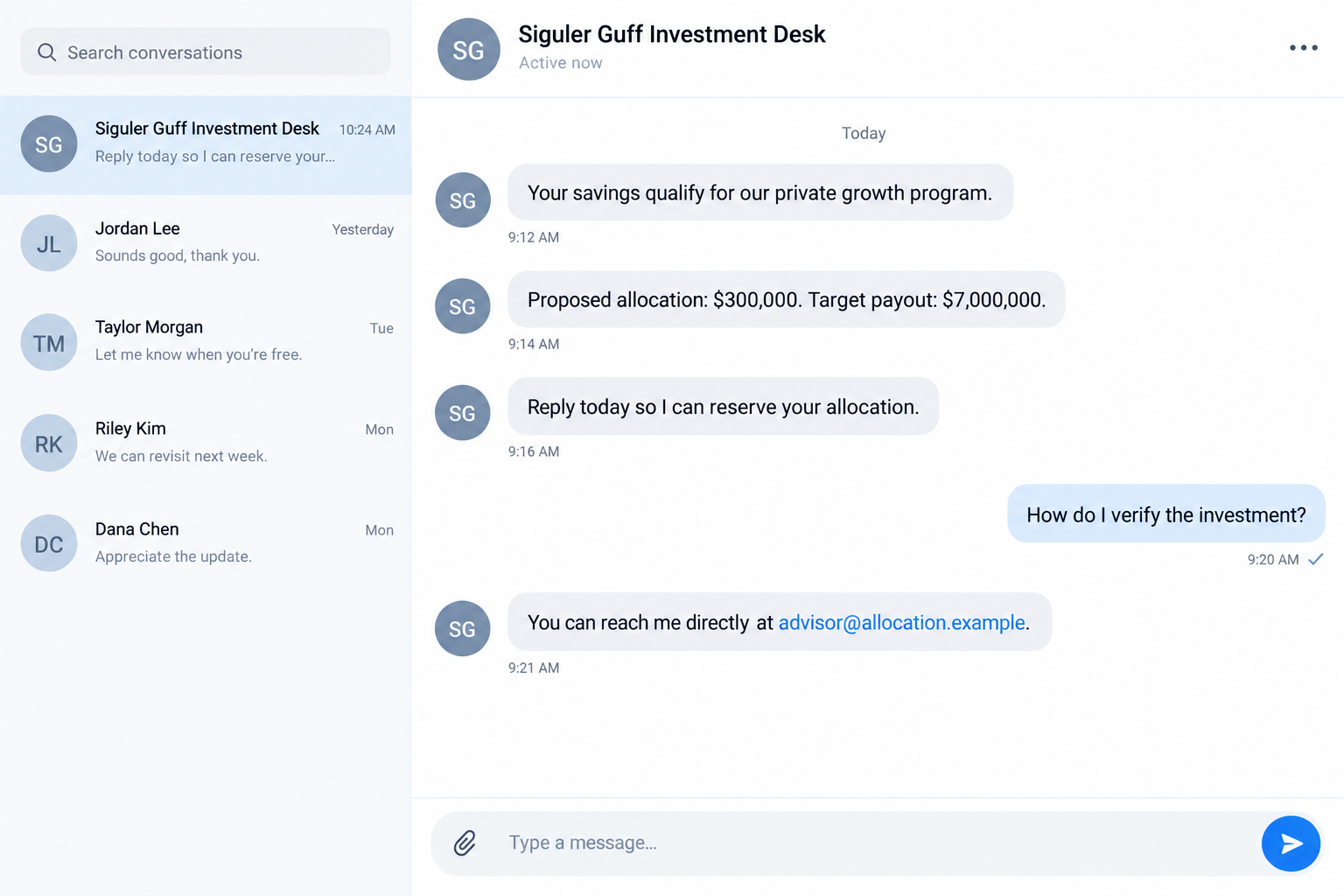
One family report described a WhatsApp offer promising $7 million from a proposed $300,000 investment. The family said $200,000 was wired before a later transfer was stopped.
Those amounts are reported, not independently audited. The official warning confirms the impersonation pattern, rather than every detail of that family’s experience.
The practical danger is clear: money saved for a real purpose is redirected toward an offer whose claimed authority has not been independently authenticated.
- A person introduces themselves through a private messaging conversation.
- A legitimate financial firm’s name supplies borrowed credibility.
- A large future payout makes an immediate transfer seem worthwhile.
- Application or funding instructions come from the same unverified contact.
- The beneficiary, investment, and contact cannot be confirmed independently.
- Pressure discourages discussion with the other people affected by the decision.
A genuine company record does not verify your adviser
Finding Siguler Guff online proves that the firm exists. It does not prove that the person in your chat works there or represents a genuine offering.
The same distinction applies to a copied biography, office address, investor-login page, or company document. Authentic background material can be used around a fraudulent payment request.
Do not confuse ordinary investment risk with this deception. A legitimate investment losing value is different from a stranger misrepresenting who they are.
Our illustrative screens use fictional contacts and reconstructed wording. They explain the message and funding stages without presenting invented documents as evidence from an actual investor.
Why the Company Name Can Distract You From the Contact
You may do what seems like careful research: search the name, read about the firm, and confirm that professionals work there.
That research can accidentally answer the wrong question. The issue is not whether a real financial business exists, but whether your conversation belongs to it.
An impostor can send a genuine company link because they want you to find reassuring information. The link does not bind them to that organization.
A contact may also describe the offer as private or exclusive. That explanation can make missing public information feel like a benefit instead of a verification gap.
Private offerings still require a real, verifiable process. Confidentiality is not permission to skip identity checks or accept banking details from an unconfirmed messenger.
The promise becomes especially persuasive when it solves a household worry. Retirement, housing, medical costs, or helping children can make a large future payout feel urgent.
That urgency should increase the quality of your checks. It should not make the person requesting your savings the only person you consult.
A convincing contact may be patient at first. Weeks of friendly conversation do not establish employment, authority, or a legally valid investment relationship.
The decisive moment is when the conversation asks you to commit real money or sensitive documents. Reassurance must become independent verification before that happens.
How the Siguler Guff Impersonation Scam Works
Step 1: An unverified contact adopts a trusted financial identity
The person presents themselves as an adviser, representative, or investment contact connected to the firm. Messaging makes them easy to reach and familiar over time.
A display name can include the business name without belonging to it. A profile image and professional signature can also be copied.
Do not infer authority from access to public information. Someone who knows a firm’s strategies, offices, or employee names may simply have read its website.
Ask the firm directly whether the person, communication channel, and offer are genuine. Use its independently located contact route, not the address provided by the messenger.
If the contact discourages that check, pause the exchange. A request to verify identity is reasonable when someone wants control over a large financial decision.
Step 2: The contact offers a future payout that changes your priorities
The proposal makes the expected return feel more important than the money being sent. A distant gain is described with confidence, while the immediate risk is minimized.
In the family report, the promised payout was many times the proposed investment. That was the contact’s claim, not a verified projection from the real firm.
Do not evaluate the offer only by whether you would like the outcome. Establish who owes you what, under which documents, and through which authenticated process.
A claim that money is guaranteed needs scrutiny. It cannot replace verification of the person, product, recipient account, or legal relationship.
Take the proposal to someone outside the conversation before committing household savings. A trusted adviser can review the documentation without relying on the messenger’s explanation.
Step 3: Ordinary-looking paperwork makes the interaction feel established
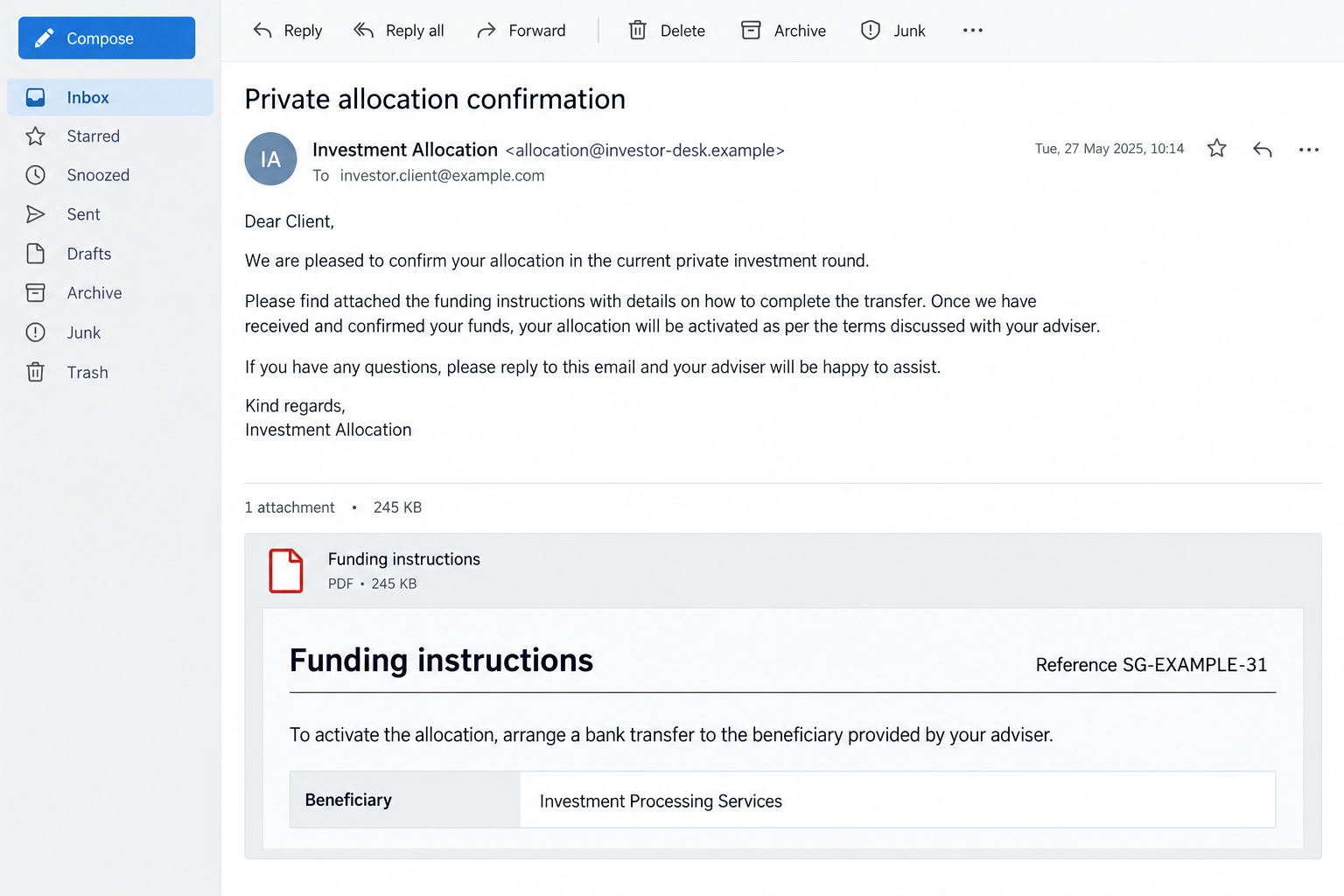
The contact may introduce an application, allocation notice, or funding document. Such paperwork can make an informal chat appear to have become a formal transaction.
A document’s appearance does not verify its issuer. A reference number, signature, logo, or statement of confidentiality can be placed into a file by an impostor.
Compare the instructions with a process confirmed by the real firm. Do not accept a new administrator solely because the original contact introduced them.
Requests for identity records deserve a separate check. The firm’s warning specifically rejects collecting personal identifying information through the messaging platforms it lists.
Our example funding notice illustrates this credibility problem. Its fictional beneficiary is not a finding about the recipient of any particular reported transfer.
Step 4: A payment instruction moves real savings out of your control
The proposed investment becomes a transfer. The amount, beneficiary, account details, and payment method should all be checked before money leaves your account.
Do not let a genuine company name explain away an unrelated payee. A claimed administrator or partner must be authenticated independently, not simply introduced in chat.
A banking receipt records a transfer; it does not verify the investment behind it. The receiving account can exist while the offer remains deceptive.
If the bank raises concerns, listen. A payment being paused is an opportunity to investigate, not an obstacle the messenger should help you bypass.
Do not split transfers, change the payment description, or use another account to get around a warning. Accurate information helps the bank assess what is happening.
Step 5: Further promises can keep the person paying
After a commitment, another request can feel like completing the investment rather than starting a new risk. The promised future balance makes stopping emotionally difficult.
The published material does not establish one identical follow-up script for every Siguler Guff impersonation. Do not assume every case involves a specific tax or withdrawal fee.
What matters is the verification gap. If authority and the investment were never established, another payment does not repair that gap.
Stop funding the conversation and preserve what you received. Do not send money to obtain a cancellation, prove cooperation, or unlock a promised refund.
A later rescue contact may reuse details of the first offer. Knowing the amount or company name does not make that new person a legitimate investigator.
Three Checks That Keep the Real Firm Separate From the Impostor
Confirm the person and the offer together
A real employee may have no connection to your message. Ask the genuine firm about the specific communication, not merely whether a person with that name exists.
Provide the claimed role, channel, proposal, and relevant document details through its established contact process. Do not submit bank passwords or wallet secrets to make the inquiry.
Also verify the offering itself. An authenticated professional identity would not automatically establish that every proposal sent under that identity was approved.
Read the actual sender and payment details
Look beyond the display name. A recognizable word in an email address or web address is not ownership of the genuine company’s domain.
Do not open an unfamiliar portal just because it resembles the firm’s legitimate investor site. Find the normal access route through the real organization.
Check new beneficiary instructions with an authenticated contact. Never authorize a major payment change by comparing a document only with the messenger’s explanation.
Give household decisions an independent pause
If the funds support a shared housing or retirement plan, involve the other people who rely on them. Secrecy removes a useful layer of checking.
Save a written summary of what is promised and what must be paid. Missing terms become easier to see when the story is separated from friendly messages.
You do not owe the contact a same-day decision. A serious financial commitment deserves time and qualified review through trusted channels.
If Someone Close to You Is About to Transfer Money
Start with the payment decision, not an argument about their judgment. Ask them to pause while you check the claimed relationship with the genuine firm.
Review the actual messages together. A person may have spent weeks speaking with the contact and feel that you are dismissing someone they trust.
Use the firm’s own warning as a concrete point of comparison. Ask how the private messaging offer fits that policy, rather than mocking the promised return.
If a payment is pending, help them contact their bank honestly. Do not take over accounts or submit instructions without their permission.
Keep the conversation open after a loss. Shame can drive someone back to the same contact, especially when another payment is presented as the way to recover.
What to Do if You Have Fallen Victim to This Scam
-
Cancel any transfer that has not completed. Contact your bank immediately through its official app or known number. Explain the suspected financial-brand impersonation.
Ask about a payment hold, cancellation, or recall where available. Do not follow a chat contact’s instructions to move the money through another route.
-
Report completed payments accurately. Give the bank the beneficiary, account information, amount, date, reference, and documents available to you.
Explain which transfers you authorized under the false story. Recovery options depend on the payment and circumstances; a report is not a guarantee of reimbursement.
-
Preserve the conversation before blocking. Save messages, profiles, URLs, funding notices, and receipts in a private location outside the messaging account.
Do not publicly upload identity documents or banking details. A clear timeline is more useful than an argument with the person requesting another payment.
-
Notify the real firm about the misuse. Start from Siguler Guff’s genuine website and independently confirmed office contacts.
Describe the impersonation rather than demanding that an unrelated employee authenticate the stranger. The firm’s warning is separate from your bank’s recovery process.
-
Secure any information you disclosed. If you shared credentials, replace them on the real services and review recovery settings and unfamiliar sessions.
If identification or financial records were sent, ask the relevant institutions what protections are appropriate. Exposure of documents is different from merely receiving a message.
-
Check a device used for an untrusted download. Malwarebytes can help inspect supported systems after a suspicious installation or file execution.
AdGuard may reduce exposure to known malicious investment pages or ads. Neither tool verifies an adviser or returns a transfer already made.
-
Make a report through legitimate fraud channels. In the United States, report internet-enabled investment fraud to the FBI Internet Crime Complaint Center.
Use appropriate police and financial-regulator channels in your jurisdiction as well. Keep case references and payment evidence for follow-up.
-
Bring another trusted person into the recovery. Large losses can make it tempting to hide the situation or chase the promised return.
Reject private recovery agents demanding fees. Work with authenticated institutions, and take care of the household plans affected by the missing money.
Frequently Asked Questions
Is Siguler Guff itself a scam?
No. The genuine firm has warned about unauthorized parties using its identity. This report concerns the impersonation, not its legitimate operations or ordinary investment performance.
Does a WhatsApp profile with the firm’s name prove employment?
No. Names, logos, and professional information can be copied. Verify the person and specific proposal through the firm’s independently established contact channels.
Was the reported $7 million payout verified?
No. It was a promise described in a family report. It should not be treated as a genuine offering, tested projection, or independently audited result.
Can authentic company documents appear in a scam?
Yes. Public material can surround a fraudulent contact or payment instruction. Genuine background information does not authenticate the person using it.
Should I pay another fee to get my investment back?
Do not fund an unverified refund or release request. Contact your bank and authenticated institutions instead of sending more to the person behind the offer.
What if my bank has already paused the transfer?
Use the pause to investigate independently. Explain the contact and promised return honestly, and do not seek a different payment route to bypass the warning.
The Bottom Line
The Siguler Guff impersonation scam borrows a real firm’s credibility to make a private chat feel like a financial relationship. The name is not the verification.
Keep your savings out of the messenger’s payment route. Confirm the person, proposal, and beneficiary independently before sharing documents or transferring funds.








