

A Fund Release email says a substantial payment is finally ready for you. Its official-looking memorandum turns an unexpected message into something that feels worth investigating.
The next instructions sound administrative rather than dramatic. Before sending anything, find out who is making the claim and what their proposed verification would actually expose.
Overview
The $4.7 million allocation is an impersonation story
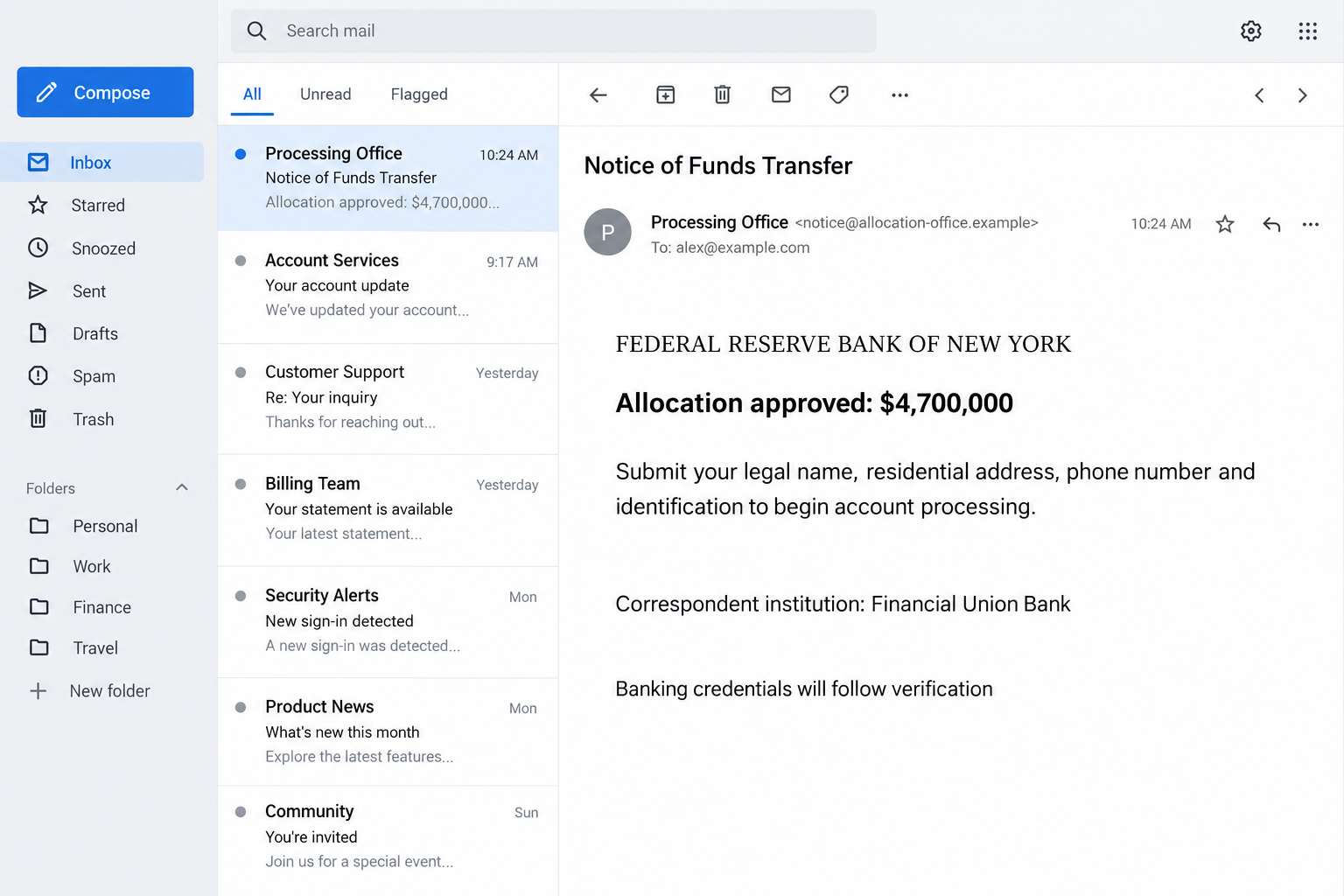
The Fund Release email scam uses supposed financial clearance to draw recipients into a false payment process. A documented version impersonates the Federal Reserve Bank of New York.
Its memorandum claims a $4,700,000 allocation has been approved. The reader is asked to provide identity details before a named processing institution issues banking credentials.
This is not evidence that the Federal Reserve owes you a payment. Its official guidance says individuals cannot hold personal accounts at Federal Reserve Banks.
The scam is the false correspondence and the process it invents. The real Federal Reserve, government agencies, and legitimate banks should not be blamed for an impersonator’s message.
The initial request is for identity information, not a confirmed fee
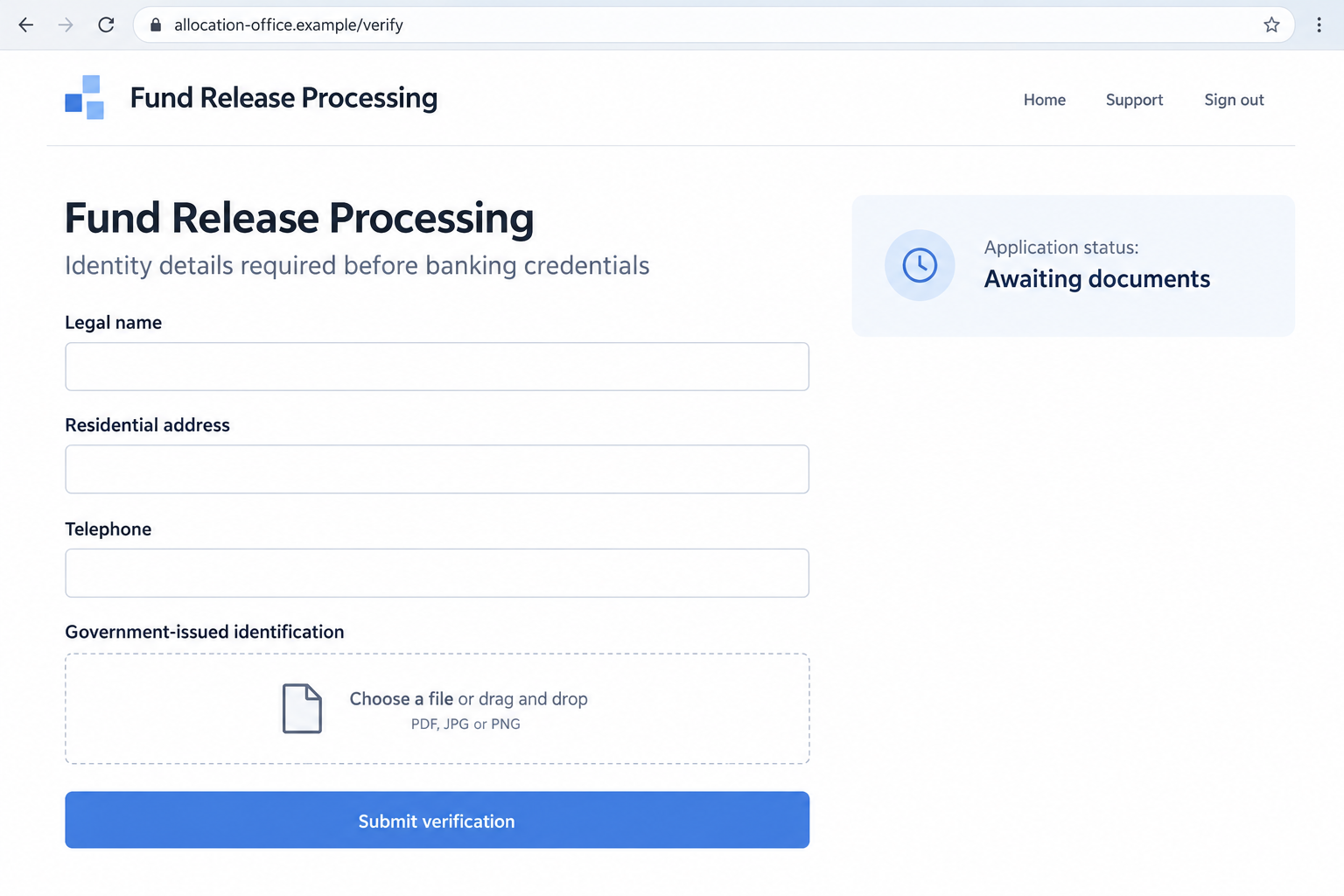
The sample added to a documented campaign in August 2026 asks for a legal name, residential address, telephone number, and government-issued identification.
It names Financial Union Bank as an intermediary and promises account credentials afterward. Those statements do not establish an authentic account, institution, or payment obligation.
- A windfall appears without an independently verified underlying transaction.
- An official-looking memo supplies references and a large allocation figure.
- The sender requests identifying information through its own processing route.
- Future banking access is promised as the reward for compliance.
The opening message does not itself demonstrate a fee demand. Later payment requests and fake balance dashboards are possible extensions, not observed facts about every recipient.
A familiar institution does not authenticate the sender
A government name, street address, or official’s signature can be copied. None proves the email came from the institution or that its promised allocation exists.
Our illustrations use invented addresses and a hypothetical verification form. They explain the request without reproducing a real person’s identification or an observed processing portal.
If you supplied documents, address that exposure directly. If you merely received the notice, there is no established identity theft, account compromise, or payment loss.
This review covers a previously documented message. It does not claim that every version is newly active or that all senders using similar financial language share an operator.
Why a Release Notice Can Feel More Credible Than a Prize Email
The money is presented as already allocated
A lottery pitch asks you to believe you won. A fund-release notice suggests the entitlement already exists and only routine administration remains unfinished.
That changes the reader’s question from “Why would I receive this?” to “What do I need to complete?” The second question accepts the sender’s premise too early.
Someone with an unresolved financial dispute may wonder whether the notice relates to it. The message does not establish that relationship merely by referring to pending funds.
Identify the underlying claim first. A real settlement, inheritance, or business payment should have a history that can be confirmed through people and records you already know.
Institutional language makes the request sound procedural
Clearance, allocation, correspondent institution, and account processing resemble the vocabulary of genuine finance. An impersonator can use those words without operating any legitimate banking process.
A reference code adds another impression of a file already being handled. It remains text chosen by the sender until an independent institution confirms it.
The size of the payment can make minor inconsistencies seem unimportant. In reality, a larger claim calls for stronger verification, not a lower standard.
You do not need to understand central-bank operations to decline an unsolicited document request. The sender must establish authority before collecting personal information.
A future bank login can make the story feel testable
The promise of online credentials suggests you will soon see the funds yourself. That apparent opportunity to check can persuade someone to send documents first.
Yet the proposed evidence would still come from the sender’s chosen process. A webpage showing a balance is not independent proof that a bank holds money for you.
This is a general risk of fabricated banking journeys, not a claim that the specific August message included a live balance portal.
Verify the institution and your underlying entitlement before enrollment. Do not surrender identification merely to obtain the next screen in an unverified story.
How the Fund Release Email Scam Works
Step 1: An unexpected notice supplies a supposedly completed financial decision
The email begins with the claim that authorities have approved an allocation. It asks the recipient to enter a process, rather than proving how that allocation arose.
The documented example uses a funds-transfer subject and a formal memorandum format. Those details encourage the reader to treat it as business correspondence.
An unexpected payment still needs an explanation. Which agreement, claim, estate, employer, or verified program created the entitlement, and why would this institution contact you?
If that explanation is absent, do not invent it from your own circumstances. A sender can benefit when a recipient connects an unrelated real problem to a false notice.
Receiving the email is not a debt or an obligation. You can leave it unanswered while checking any genuine financial matter through established contacts.
Step 2: Copied authority makes a stranger’s instructions feel official
The memorandum names a central-bank institution and presents itself as coming from an official office. Its formatting attempts to borrow the institution’s credibility.
Names of officials are not signatures that can be authenticated by appearance. Neither is a street address inside the message proof of the sender’s location.
Read the actual sender and reply destination. An administrative display name can hide an unrelated address, while a polished footer can distract from it.
Even a convincing address deserves independent verification. Email identities can be spoofed or compromised, and a copied reference number does not establish a file.
Do not ask the suspicious sender to prove itself with another document. An operator able to fabricate a memo can fabricate a supporting certificate too.
Step 3: The recipient is asked to supply identifying details
The request moves from a promise to a disclosure. The reader is asked to provide information useful for impersonation, targeting, or further social engineering.
A legal name and address may appear ordinary. Adding a telephone number and identification image makes the bundle substantially more sensitive.
A government-issued document can contain information beyond the fields named in the email. Think about the photograph, document number, birth details, and address visible in it.
Legitimate institutions can require identification for real services. That does not authorize an unverified sender to collect it for a payment you cannot independently establish.
The correct stopping point is before disclosure. Ask the genuine institution through an independently sourced contact route whether the purported process exists.
Step 4: A processing institution is offered as the next link in the chain
The recorded notice names Financial Union Bank and says verification will lead to banking credentials. That is a claim requiring examination, not a confirmed banking relationship.
This article does not declare every institution using that name fraudulent. We have not authenticated the particular processing office or intermediary described by this sender.
A chain of impressive names can spread responsibility across several supposed offices. The reader may keep complying because each new contact appears to handle one procedural step.
Check each claimed institution separately. Do not use a website, number, or account officer supplied solely by the original notice as independent confirmation.
If a real bank is named, contact it through its established channels. Explain the claim without sending your documents to the person who introduced it.
Step 5: Further conditions can turn promised money into further exposure
Advance-fee fraud often introduces charges before a promised payout. Supposed clearance, processing, insurance, or tax demands can keep the recipient paying toward a balance that never arrives.
That is a possible later pattern, not a fee established in the opening sample. The document request is already unsafe without inventing a payment stage.
A counterfeit account can also display a large sum and an obstacle to withdrawal. A displayed balance does not establish that assets exist outside the operator’s interface.
Do not pay simply because you have already invested time or disclosed information. Previous cooperation does not make the next instruction trustworthy.
Any new request should be independently checked. A claim that one final transfer will resolve everything is not evidence of a legitimate entitlement.
What the Real Federal Reserve Says
There are no personal Federal Reserve accounts to unlock
The Federal Reserve’s account FAQ explains that its banks provide services to banks and government entities, not personal accounts for individuals.
That is especially relevant when a message suggests a hidden personal balance, special access credentials, or a central-bank account waiting for your identifying information.
This does not mean ordinary banks cannot process legitimate payments or that genuine government benefits never exist. The false claim is the unsolicited process presented here.
Keep your verification tied to an actual entitlement. A familiar institutional name cannot create one by announcing a large allocation in an email.
Official fraud guidance gives a route outside the message
The Federal Reserve OIG fraud-prevention page warns about people misusing institutional identities to collect money and personal information.
Use official contact information when checking a suspected impersonation. A reply address printed in the suspicious memo is still part of the memo.
If the notice appears connected to a genuine legal or estate matter, ask your established adviser or representative. Do not substitute the sender’s supposed processing officer.
Preserve the original correspondence for reporting. Useful evidence includes headers, reply destinations, documents, and payment details if any money was actually sent.
What to Do if You Have Fallen Victim to This Scam
- End the verification conversation.
Stop replying and do not send another document or payment. Save the email, attachments already received, and records of messages or calls.
You do not need the operator’s permission to withdraw from the process. Ignore threats that stopping will forfeit the supposed allocation.
- Write down exactly what information was shared.
List the document type, identifying numbers visible, contact details, account information, passwords, and any codes you supplied. Avoid describing everything simply as “personal information.”
The response depends on that list. An address alone creates different exposure from an identification image, bank login, or recovery credential.
- Contact your financial institution about actual payments or banking disclosure.
Use the number on your card or your established banking app. Explain what happened and ask about account protection and options for the specific payment.
The FTC’s scam-response guidance describes routes for different payment methods. Do not assume a refund is guaranteed or wait for the sender to return funds.
- Address identification exposure through the appropriate authority.
US readers can use IdentityTheft.gov for a response plan when identity misuse occurs or relevant identifying information was exposed.
Contact the document issuer for guidance specific to the identification involved. Do not assume every document needs automatic replacement or that a bank alone can repair the exposure.
- Review accounts that the disclosure could affect.
Change compromised or reused passwords through real services. Check recovery details and unexpected sign-ins if account credentials were supplied.
Consider relevant credit protections with the credit bureaus and monitor unfamiliar applications. Do not create new accounts through links sent by a supposed recovery agent.
- Check software exposure only when it occurred.
If the process included an attachment you ran or a verification utility you installed, review the device and scan with updated Malwarebytes.
AdGuard may help limit deceptive ads and some malicious destinations. Neither tool deletes an identification image from a scammer’s possession or refunds a transfer.
- Report the impersonation with useful records.
Report internet fraud through the FBI’s IC3 where appropriate, and use your local reporting authority outside the US.
Include transaction references if money moved. Keep copies and case numbers, while avoiding public posts containing full identification documents or banking secrets.
- Expect follow-ups that borrow the same case details.
A new caller may know the promised amount or your earlier interaction and offer to release, refund, or recover it. Familiar details do not authenticate them.
Decline advance payments to strangers offering guaranteed recovery. Verify any genuine investigator or institution through contact information you obtain independently.
Frequently Asked Questions
Does the $4.7 million memo prove I have money waiting?
No. A memorandum and allocation figure do not establish an entitlement. The message’s claimed process must be checked outside the correspondence.
Can I have a personal account at a Federal Reserve Bank?
The Federal Reserve says individuals cannot have personal accounts there. Do not send identifying details to unlock a balance supposedly held in such an account.
Did this particular email already demand a processing fee?
The documented opening sample asks for identity details. Fee demands are a possible advance-fee continuation, not a payment request verified in that first message.
Is every bank named Financial Union fraudulent?
This article makes no such claim. The specific intermediary and processing office described by the suspicious sender were not independently authenticated.
What if I replied without sending documents?
Stop the conversation and watch for targeted follow-ups. A reply does not by itself establish identity theft, but it can confirm that your address is responsive.
Can a scan protect me after I sent an ID image?
A scan addresses device threats, not disclosed identity information. Follow document-issuer and identity-recovery guidance suited to what the image revealed.
The Bottom Line
The Fund Release email scam turns a supposed cleared allocation into a request for sensitive information. Official-looking paperwork does not make that process real.
Verify any genuine entitlement independently. If you already cooperated, protect the information or funds actually exposed instead of completing the sender’s next requirement.








