

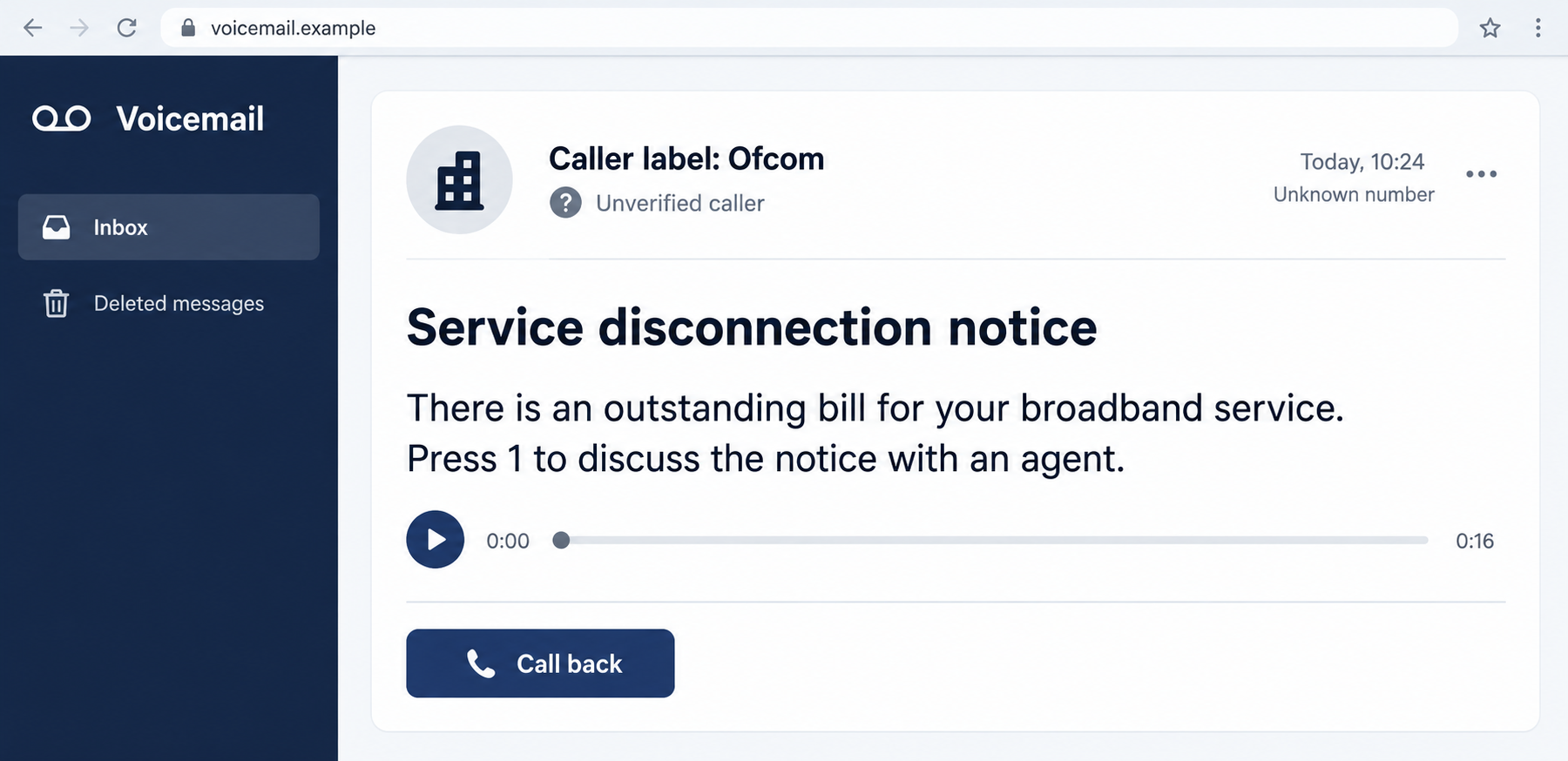
A voicemail says your broadband service is about to be disconnected. The caller claims to represent Ofcom, making an ordinary billing problem sound official.
Before returning the call, take a moment. Ofcom scam calls rely on that unfamiliar combination of a familiar service and a regulator’s name.
Overview
The regulator’s name gives a false bill extra weight
Ofcom regulates communications in the U.K. Fraudsters borrow that identity when claiming there is a problem with someone’s telephone or broadband service.
The caller may describe an unpaid bill, impending disconnection, or issue requiring immediate discussion. They want you to accept their authority before checking your provider’s records.
Ofcom’s current scam guidance explicitly describes impostors using service problems and unpaid bills to seek banking information or callbacks.
This is impersonation of a legitimate regulator, not evidence that Ofcom itself is making fraudulent demands.
Bank-information theft and costly callbacks are different risks
One branch connects you with someone requesting financial details or a payment. Another encourages a call to a chargeable number.
Do not assume every voicemail follows both branches. The risk depends on the destination called and the information or authorization subsequently requested.
The key warning signs are:
- A surprise Ofcom billing demand aimed at your personal broadband account.
- A threat that service will stop unless you cooperate immediately.
- A request for bank details, passwords, security codes, or payment.
- A callback number you have not independently verified.
- An instruction to press a button instead of checking with your own provider.
A telephone option alone does not prove that a premium charge occurred. Your provider can examine the actual call record and tariff.
Ofcom gives a clear way to reject the impersonation
The regulator states that it does not make unsolicited calls, request telephone payments, or ask for bank details.
That policy directly contradicts the unexpected service-billing approach. You do not need to complete the caller’s identity checks to challenge it.
Historical reports describe this pattern, and current official guidance continues to warn about it. That does not establish a new campaign behind one specific number.
The voicemail image is a fictional interface example. It illustrates the pressure tactic rather than reproducing an authenticated recording or identifying a caller.
Why a Regulator Would Not Collect Your Broadband Bill
Your service account belongs with your provider
A genuine question about your balance, payment method, or connection should be checked through the company supplying that service.
Knowing the regulator’s name is not the same as knowing your account. The impostor uses an institution you recognize without demonstrating access to legitimate records.
Ask yourself where the debt appears independently. An allegation spoken over the telephone is not a substitute for a bill or account entry.
The deadline is designed to interrupt ordinary checking
Most people do not want to lose broadband unexpectedly. A disconnection threat makes an unfamiliar request feel like a routine problem that cannot wait.
The caller may emphasize work, family contact, or inconvenience. Those consequences are persuasive even when the underlying account claim has no supporting evidence.
You can take the warning seriously without obeying it. Ending the incoming conversation and contacting your provider is a practical check, not neglecting a real bill.
Company labels and transfers do not authenticate a conversation
A caller can announce a department name, supply a reference, or transfer you to another supposed official. All those details may come from the same operation.
A familiar number on the display is also insufficient. Caller ID spoofing can make an incoming call appear associated with an unrelated organization.
The safe boundary is independent contact. A verification step chosen and controlled by the caller remains part of the unverified conversation.
How the Ofcom Scam Calls Work
Step 1: A live call or voicemail introduces an official-sounding problem
The approach begins with a statement about your telephone or broadband service. It may be delivered by a person or an automated recording.
Using Ofcom’s name makes the claim sound broader than an ordinary provider dispute. A recipient may assume a regulator has intervened in their account.
The message may leave few details beyond a deadline and an instruction to continue. That lack of detail should not be solved by supplying private information.
A real-looking caller label is merely a starting claim. Treat the conversation as unverified until you establish the issue through a channel you chose.
If the call arrives while you are busy, let it end. You can inspect your account afterward without accepting the message’s callback route.
Step 2: Disconnection pressure makes the response seem necessary
The alleged problem becomes urgent. The caller says an unpaid amount or technical issue could interrupt service unless you act immediately.
This changes the question from whether the demand is genuine to how quickly you can stop the consequence. That shift benefits the impostor.
You may be asked to press a telephone key, stay on the line, or call a number stated in the recording.
None of those actions proves Ofcom is involved. A menu can belong to a criminal call center just as easily as a genuine service.
Do not try to negotiate the deadline. Check your provider’s actual billing or support record after ending the contact.
Step 3: A supposed agent asks for details or payment
In the financial-information branch, the person claims they need account or banking details to identify the service, settle the bill, or prevent disconnection.
That request conflicts with Ofcom’s stated policy. A regulator impersonator does not become trustworthy because the amount sounds affordable or the questions appear routine.
Different disclosures create different risks. A name and address are not equivalent to a banking password, card security code, or approved transaction.
Tell your bank precisely what was shared if you responded. That allows it to assess the exposure without assuming either no harm or complete account takeover.
If the agent asks you to approve a code, read the code’s actual purpose. Never authorize a transfer under someone else’s verbal description.
Step 4: A callback may lead to an expensive destination
In the callback branch, the operator wants you to place a call rather than merely receive one. Costs depend on the number and your plan.
Ofcom warns that missed-call traps can connect people to premium-rate services. Unfamiliar international destinations can also carry charges outside an inclusive allowance.
A brief hold, repeated menu, or drawn-out conversation may increase time spent connected. Check the actual destination rather than assuming local-looking presentation means local pricing.
This is not proof that every number with a particular prefix is fraudulent. Legitimate chargeable services exist, and tariffs can change.
You do not need to call again to discover the price. Ask your telephone provider to identify the recorded destination and applicable charges.
Step 5: The conversation delays an independent check
The caller may insist that only their department can resolve the issue. They may dismiss your provider’s records or offer a supervisor to confirm the demand.
That keeps verification inside the same untrusted channel. A separate voice or case number adds detail without adding independent authority.
If payment has been made, a new fee may be presented as the last obstacle. If you questioned a charge, another callback may be suggested.
Neither request deserves automatic compliance. Stop additional payments and calls while your bank or provider investigates what actually occurred.
A later recovery offer must be checked separately too. The person who caused the concern cannot establish the legitimacy of a proposed remedy.
Check the Call Record and the Real Account Separately
Review your provider’s account without the voicemail link
Use your usual app, saved bookmark, or existing bill to access support. Avoid contact details supplied in the suspicious recording.
Check whether a balance, disconnection notice, or service issue exists. If there is a real problem, resolve it through the provider’s independently verified process.
A genuine overdue bill does not make the Ofcom caller authentic. Two unrelated events can overlap without validating each other.
Inspect the destination and duration, not just the display name
Note when the incoming call arrived and whether you made an outgoing call afterward. Those events can have different billing consequences.
Ask your provider to distinguish the displayed incoming number from the outgoing destination actually dialed. Spoofing can make the first record misleading.
Keep the itemized call entry and any disputed charge. A screenshot of the voicemail alone cannot establish how much the network billed.
If someone else manages the household contract, involve them before changing account restrictions. The relevant bill may belong to a different named account holder.
Ask whether the charge is pending or appears only on a later statement. Preserve the original entry and any correction so the complaint remains traceable.
Challenge unexpected charges through the provider
Explain that a regulator impersonation or missed-call trap prompted the call. Ask for the applicable tariff, complaint process, and available account restrictions.
Do not assume a refund is guaranteed or impossible. The provider needs the relevant record and circumstances to assess your complaint.
Ofcom’s response guidance recommends contacting the phone company after suspected scam-related call charges.
What to Do if You Have Fallen Victim to This Scam
-
Stop the conversation and avoid another callback.
End contact rather than pressing additional options or asking the same agent to authenticate themselves. Save any voicemail already received.
Tell others sharing your service account about the approach. This prevents a second household member from following the same urgent instruction.
-
Check financial exposure with your bank.
If you disclosed card information, banking credentials, or security codes, use a number from your card or trusted banking app.
Explain the exact disclosure and any payment authorization. Ask what needs blocking, replacement, review, or a password change.
-
Raise suspected callback charges with your telephone provider.
Supply the outgoing destination, call time, duration, and bill entry. Describe the voicemail that prompted the call and keep its wording.
Request a written complaint reference and clarification of the tariff. Ask about restrictions on premium or international calling appropriate to your account.
-
Secure any account whose login was shared.
Change the affected password through the real service, not through a caller-supplied recovery link. Replace reused passwords on other accounts.
Review recovery details and open sessions. If no login or code was disclosed, do not describe the incident as confirmed account takeover.
-
Build a concise timeline while the details are fresh.
Separate receiving the call, returning it, disclosing information, and paying. Record the claimed organization and threats in your own words.
Preserve bank and provider case references alongside the evidence. Do not publish full account numbers or private identity information when warning others.
-
Report the impersonation through official routes.
Follow GOV.UK fraud-reporting guidance for your location and circumstances. In Scotland, suspected fraud can be reported to Police Scotland.
Your telephone provider can also receive a scam-call report. Reporting assists investigation; it is not a promise that a payment will be recovered.
-
Address threats through police and provider support.
If callers become abusive or threaten your safety, contact the police and your provider’s malicious-call team. Immediate danger requires emergency help.
Keep records without prolonging the conversation. You do not need to confront the caller or prove you know who they are.
-
Refuse paid recovery or refund calls you did not request.
A new caller may claim the original charge can be refunded after a verification payment. That creates another unverified demand.
Continue through your existing bank or provider case instead. A trusted friend can help review new messages before you act.
Frequently Asked Questions
Would Ofcom telephone me to collect a broadband bill?
Ofcom says it does not make unsolicited calls, seek telephone payments, or request banking details. The unexpected collection approach contradicts that guidance.
Verify any genuine service balance with your provider, independently of the caller.
Does pressing 1 automatically create a premium charge?
Not necessarily. A keypress may route a conversation, while charges depend on the call actually connected and the applicable tariff.
Do not press options in a suspicious message. Ask your provider about any recorded charge.
Is every unfamiliar international or premium number a scam?
No. Chargeable numbers can support legitimate services. The warning concerns an unverified message pushing you to call without knowing the destination or cost.
A number’s prefix is a reason to check, not proof of criminal ownership.
What if the call showed Ofcom’s real number?
Caller ID can be manipulated. A displayed number or contact name cannot authenticate the conversation.
Leave the incoming call and use independently obtained information to check the underlying claim.
Should I install a security program after receiving the call?
A voicemail or telephone conversation alone does not establish malware infection. Response should match what you actually disclosed or authorized.
Unexpected callback fees belong with your provider; exposed financial information belongs with your bank.
Can my provider guarantee a refund?
No outcome should be assumed. Supply the evidence and request review under the provider’s complaint process.
Keep the written response and case reference if further escalation becomes necessary.
The Bottom Line
Ofcom scam calls misuse a regulator’s authority to make service threats, financial requests, and risky callbacks feel official.
Check your broadband account with your provider, not the voicemail’s agent. Separate billing evidence from caller claims, and stop unverified contact before more charges or disclosures occur.








