

GLP5 GLT sounds familiar before you have even read the ingredient list. For anyone following weight-loss treatments, those letters can make a capsule unusually intriguing.
The offer combines a simple daily routine with package savings and a money-back promise. Understanding what you are actually being offered takes a closer look.
Overview
What GLP5 GLT is advertised to be
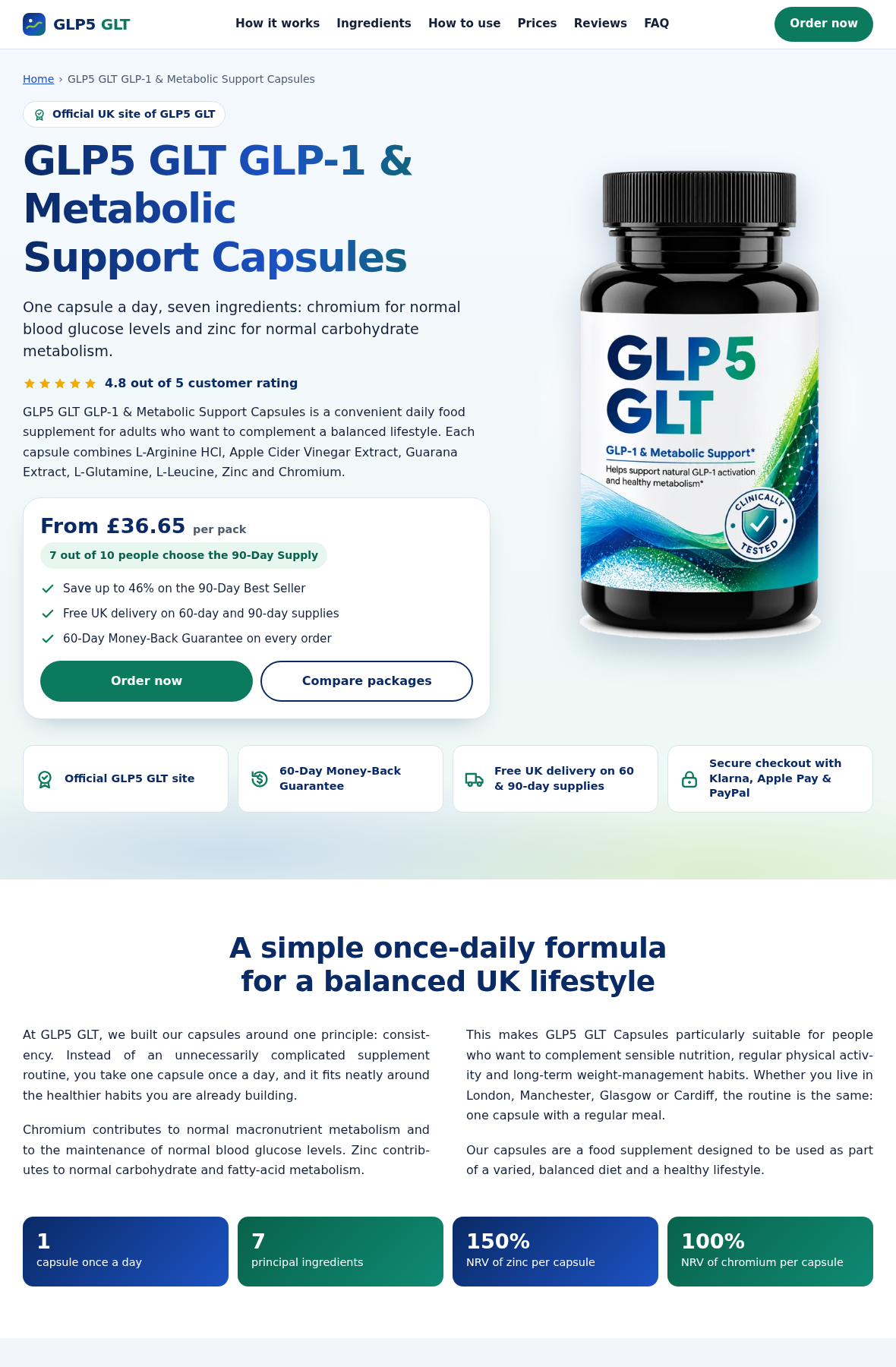
GLP5 GLT is promoted as a daily food supplement with seven ingredients. The UK information page places GLP-1 and metabolic-support wording prominently in the product name.
The listed formula combines amino acids, apple cider vinegar extract, guarana extract, zinc, and chromium. It is not presented as containing a named prescription GLP-1 medicine.
That distinction is also stated explicitly in the page’s disclaimer. The seller says the supplement does not produce the same pharmacological effects as GLP-1 receptor agonist medicines.
This review therefore concerns the supplement’s claims, evidence, pricing, and seller transparency. It is not an allegation that the capsules are counterfeit prescription medication.
Why the GLP-1 association needs scrutiny
The familiar medical terminology does considerable work in the presentation. A shopper looking for appetite or weight-loss treatment may expect more than the ingredient information supports.
The bottle artwork also carries a clinical-testing badge. The public information supplied does not identify an authenticated clinical trial of this exact finished product.
Basic nutritional roles for zinc and chromium are not equivalent to demonstrating meaningful weight loss from the seven-ingredient capsule.
The price and guarantee are not as simple as the headline
The offer starts with a from-£36.65-per-pack price. That rate belongs to the larger package, not the smallest order a new customer might choose.
The 60-day guarantee is measured from the order date. That makes it important to establish delivery timing, return instructions, and the business responsible for honoring it.
- GLP5 GLT is described as a food supplement, not a prescription GLP-1 medicine.
- The ingredient list does not establish finished-product clinical effectiveness.
- The lowest advertised pack price requires a larger upfront purchase.
- The guarantee clock starts at ordering, not delivery.
- The inspected information does not establish actual recurring-charge terms.
How the GLP5 GLT Offer Works
Step 1: The name connects an ordinary supplement with a medical trend
GLP-1 is associated with a genuine class of medicines used for specific medical indications. Placing that term beside a supplement can create expectations before ingredients are considered.
The GLP5 GLT page uses the association while describing nutritional support. Readers need to keep those two ideas separate rather than filling in an implied medical benefit.
The MHRA’s guidance on GLP-1 medicines explains their prescription status and the importance of appropriate clinical assessment.
A supplement bought through an online promotion does not become an equivalent treatment because the label contains similar letters or metabolic language.
Do not judge the distinction by whether something is swallowed or injected. Authorized oral GLP-1 medicines exist, but that does not authenticate this supplement.
Step 2: Familiar ingredients make the formula sound scientifically complete
The page names L-arginine HCl, L-glutamine, and L-leucine alongside plant extracts and minerals. A detailed list can make the formula appear well supported.
But a list answers what the seller says is present. It does not establish how the complete mixture affects appetite, body weight, or blood-glucose control.
Research on an individual ingredient must match its form, amount, duration, and intended outcome before it can inform a product claim.
The public page’s nutritional explanations do not replace those comparisons. Nor do they establish that combining seven ingredients creates the effects of a prescription medicine.
Look for an identifiable finished-product study with methods and results, not only a statement that the ingredients have metabolic roles.
Step 3: Nutrition reference values can look like performance scores
The page displays 150% of the nutrient reference value for zinc and 100% for chromium. Those figures describe declared nutrient amounts relative to reference values.
They do not mean 150% better metabolism or complete control of blood sugar. A nutrition percentage is not a measure of clinical improvement.
Recognized statements about normal physiological function are narrower than a promise to treat diabetes or cause substantial weight loss.
A buyer should not supply that broader meaning simply because a product appears in a weight-management promotion. Read the exact claim and the outcome it actually establishes.
The page itself says results vary and does not guarantee a particular amount of weight loss. That limitation should remain part of the buying decision.
Step 4: The best-value package raises the amount paid today
The 30-day package is advertised at £55, plus £4.95 delivery, for a £59.95 total. That is not the from-£36.65 headline price.
The 90-day offer lists three packs for £109.95, or £36.65 each, with free UK delivery. The smaller unit price requires the larger total purchase.
The 60-day package is displayed at £82.95 total with free delivery. Its rounded per-pack figure should not be confused with an exact separate transaction.
The page claims seven out of ten customers choose the 90-day supply. That is a seller assertion, not independently verified purchasing data.
A lower pack price is not a saving if you would not otherwise buy or use the extra supply. Consider the total commitment before comparing discounts.
Step 5: The guarantee becomes a procedure rather than a badge
The information page promises a 60-day money-back guarantee from the date of ordering. Delivery delays would therefore consume part of that period.
The described process requires contacting support, obtaining instructions, and returning containers. A refund is stated to follow receipt of the return.
Before relying on it, establish the recipient, return country, postage responsibility, and whether opened containers qualify. These details affect the real cost of claiming the guarantee.
The information page and completed checkout are different stages. The actual payment consent, merchant descriptor, and any recurring option were not verified here.
That prevents a claim that this particular offer secretly enrolls every customer in refills. It does not remove the need to inspect those terms before paying.
What the Ingredient Information Really Tells You
The declared amounts are specific, but remain seller-supplied
The public information gives amounts per capsule. These details are more useful than a proprietary-blend name, although they are not an independent assay of delivered stock.
- L-arginine HCl: 100 mg.
- Apple cider vinegar extract: 100 mg.
- Guarana extract: 100 mg.
- L-glutamine: 50 mg.
- L-leucine: 50 mg.
- Zinc: 15 mg.
- Chromium: 40 micrograms.
If you receive the product, compare its physical label with this information. A different formulation, serving size, or warning needs clarification before use.
The suggested routine is one capsule daily. Do not increase the amount in pursuit of faster results, especially when the ingredient-specific safety information is incomplete.
Guarana extract is not the same amount as caffeine
Guarana naturally contains caffeine. However, 100 mg of guarana extract does not automatically mean 100 mg of caffeine.
The relevant question is the extract’s caffeine content and how that fits with your coffee, energy drinks, or other stimulant-containing products.
The page acknowledges caffeine but does not turn the declared extract amount into a verified caffeine dose. Ask for that information if it matters to you.
People sensitive to caffeine should not assume a capsule is stimulant-free because it is marketed around minerals, amino acids, or metabolic support.
Ingredient research cannot authenticate the whole capsule
The NIH review of weight-loss supplement ingredients describes important limits in the evidence and the difficulty of applying individual-ingredient research to mixtures.
Its chromium summary reports minimal effects on weight and body fat. That is not evidence of substantial weight loss from GLP5 GLT.
A clinical-testing badge should identify what was tested. Was it the finished product, one ingredient, a laboratory mechanism, or an unrelated formula?
Without a traceable study, the badge should not influence your health decision. It supplies no meaningful comparison with approved GLP-1 treatments.
The Operator, Contact Details, and Product Trail
An official-site label does not identify the company
The UK page calls itself official and uses GLP5 GLT UK in its contact and terms wording. That is branding, not independently confirmed legal registration.
The reviewed public information does not clearly establish the registered entity responsible for the sale. Shoppers should request that name before sharing payment information.
Compare it with the business named on the receipt and statement. An unexplained difference makes a later refund claim harder to direct.
A UK audience is not a verified UK warehouse
The page addresses UK customers and quotes GBP prices. References to British cities do not prove the capsules are manufactured or dispatched in Britain.
The inspected information does not authenticate a factory, batch-testing laboratory, or physical return facility. It also does not establish Chinese manufacturing.
Ask where returns must go, because overseas tracked postage could materially change the value of the money-back promise. Do not infer the destination from the domain.
A guarantee requires reachable, accountable support
The page describes contacting support for return instructions. No authorized contact test or completed refund establishes whether that process works in practice.
A pre-purchase answer should specify who handles the claim, how the 60 days are calculated, and the documents or containers needed.
You should not need to disclose medical records merely to learn standard return conditions. Keep any product-suitability discussion separate from your personal health information.
The bottle needs more than attractive artwork
A convincing product image is not a batch record. Traceable stock should carry consistent ingredients, warnings, expiry information, and a responsible supplier’s details.
No independent laboratory test of these capsules was performed. Claims of contamination, undeclared medicines, or dangerous manufacturing would therefore exceed the evidence.
The stronger objection is simpler: a medical-sounding supplement lacks the product-specific clinical evidence and transparent seller information needed for a confident recommendation.
What to Do if You Ordered GLP5 GLT
- Check exactly what you purchased.
Retrieve the order confirmation and identify the number of packs, total GBP price, delivery charge, seller name, and payment descriptor.
Look for any renewal terms in your own receipt. Do not assume a subscription exists, but do not ignore recurring language if it is present.
- Preserve the guarantee and calculate its deadline.
Save the page describing 60 days from ordering. Record the purchase date, expected delivery, actual arrival, and dates of support requests.
If you want a refund, request instructions before the period runs out. Do not assume the guarantee starts when you first open the container.
- Inspect the actual label before use.
Compare ingredients, amounts, serving size, batch details, and expiry with the advertised information. Photograph anything missing, different, damaged, or difficult to read.
Ask a pharmacist or clinician about suitability if you take medicines, have a medical condition, or need to assess caffeine exposure.
- Do not replace prescribed treatment.
Keep following your clinician’s treatment plan. The page itself distinguishes this supplement from prescription GLP-1 medicines and does not establish equivalent effects.
If an advertisement led you to expect diabetes treatment or prescription-style weight loss, discuss that misunderstanding with a qualified professional rather than experimenting with dosage.
- Request a concrete cancellation or return decision.
Use the contact details supplied with your transaction. Specify whether you want cancellation before dispatch, a guarantee refund, or correction of an inaccurate order.
Ask for the full return address and postage terms. Preserve any authorization and shipping proof, and do not send containers to an unconfirmed destination.
- Challenge unresolved billing through the appropriate provider.
Provide your bank or payment service with the order, relevant promise, correspondence, and actual transaction problem. Ask about evidence requirements and time limits.
If your own order includes refills, cancel through the identified subscription channel and retain confirmation. A refund request should not be assumed to cancel future shipments.
- Act on adverse symptoms instead of waiting for a promised result.
Stop using a nonprescribed supplement if you suspect it is causing a reaction and seek appropriate medical advice. Urgent symptoms require prompt care.
Keep the packaging for identification and report the suspected reaction through the relevant national reporting channel. Do not claim a confirmed cause without medical assessment.
Frequently Asked Questions
Is GLP5 GLT the same as a GLP-1 medicine?
No. The seller describes a food supplement and explicitly states it does not contain a prescription GLP-1 medicine or produce equivalent pharmacological effects.
Its name, bottle design, and metabolic wording should not be treated as evidence of prescription-level efficacy or approval.
Is GLP5 GLT a confirmed subscription scam?
The inspected information does not establish recurring-payment consent or actual refill charges. A completed payment journey was not verified, so that allegation is not supported.
Check your own confirmation for subscription terms. The absence of verified billing evidence here is a limitation, not proof that every possible offer is one-time.
Does the ingredient list prove it causes weight loss?
No. Naming ingredients and their nutritional roles does not establish meaningful weight loss from the finished capsule. Product-specific clinical evidence would be needed.
The seller does not guarantee a particular weight-loss amount. Do not buy a larger package expecting a result that the evidence does not establish.
Why is the first package more than £36.65?
The from-£36.65 rate applies to each pack in the £109.95 three-pack offer. The one-pack option is £55 plus £4.95 delivery.
Compare total spending, not just the smallest per-pack figure. Larger packages also mean more unused stock if you decide the purchase was unsuitable.
Does the guarantee provide 60 days after delivery?
The public information describes 60 days from the order date. Delivery time therefore reduces the period remaining after the parcel arrives.
Save that wording and request full return instructions promptly. Refund eligibility and practical costs need to be clear before you depend on the promise.
What is the safest response to this offer?
Do not buy it as an alternative to prescription GLP-1 treatment. Seek appropriate medical assessment if weight management or blood-glucose concerns are your reason for shopping.
For an existing order, verify the label and payment terms, then pursue any requested refund with documented instructions and awareness of your provider’s deadlines.
The Bottom Line
Do not buy GLP5 GLT expecting the benefits of a prescription GLP-1 medicine. The supplement’s medical association is not supported by finished-product clinical evidence.
Do not pay through an offer that leaves the legal seller and return arrangements unclear. If you already ordered, inspect your receipt and pursue problems promptly.








