

A stranger offers you a rose while you’re enjoying Rome. The gesture feels friendly, and taking it seems easier than interrupting a pleasant afternoon.
Then the conversation changes. If you’ve encountered the rose scam in Rome, the uncomfortable part often begins after that seemingly harmless handoff.
Overview
A gift becomes a demand you never expected
The rose scam is a street-pressure trick: someone presents a flower as a gift, then demands money after the recipient accepts it.
You thought you were accepting a friendly gesture. Suddenly, you’re being asked to settle a purchase you never discussed.
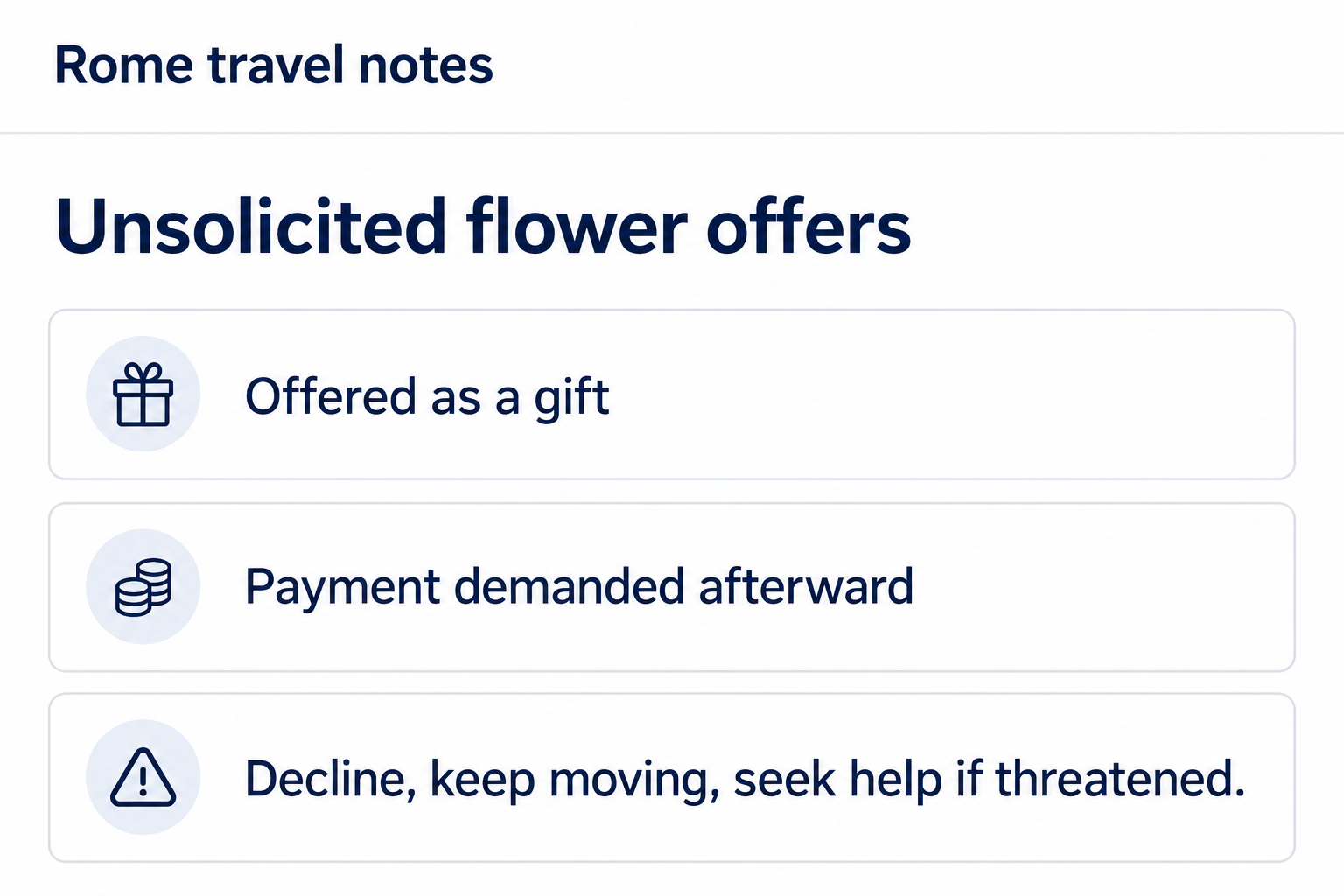
The travel-note image illustrates that switch. It isn’t a captured police bulletin or a record of one particular street encounter.
Some reported versions involve persistent following or an item being pushed toward the recipient. The encounter can become distressing even when the requested payment seems small.
You don’t need to identify the person’s intentions in advance. You can decline an unsolicited object without accepting a conversation about its price.
The tactic is documented, but not every seller is a scammer
Northeastern University’s Police Department describes the flower-giving scam among travel scams found in Italy and other European countries.
Its warning identifies the central sequence: a rose appears to be a gift, then the person offering it asks for money.
That supports a warning about the behavior. It doesn’t establish that every flower seller in Rome uses it, or that every encounter involves an accomplice.
An ordinary seller can offer an item at an agreed price. A demand introduced after a supposedly free handoff is a different situation.
The priority is a safe exit, not winning an argument
The immediate risk is pressured payment. Distraction can also leave belongings less secure, particularly when you’re focused on explaining why you won’t pay.
Keep these practical boundaries in mind:
- Decline the flower before taking it whenever possible.
- Keep your group together and your valuables secured.
- Don’t follow someone to a quieter location or cash machine.
- Seek a staffed place or police help if the person follows, blocks, or threatens you.
- Choose personal safety over recovering a small amount on the street.
No script guarantees that someone will back off. A short refusal and a clear route away are usually more useful than a debate about the gesture.
Why a Small Flower Can Create So Much Pressure
The surprise leaves little time to decide
You might be taking a photograph, checking directions, or talking with a companion. A sudden offer catches you before you’ve considered whether you want it.
Receiving something can feel different from choosing to buy it. Once it’s in your possession, returning it may seem awkward or impolite.
That awkwardness is the leverage. The person making the demand wants a quick resolution before you step back and recognize that the terms changed.
Embarrassment can make paying feel easier
A public disagreement attracts attention. You may worry about upsetting a partner, delaying your group, or looking unkind in front of other travelers.
The amount can seem less important than ending the scene. That doesn’t mean you were careless; it means the pressure worked in a stressful moment.
Recognizing this beforehand helps you prepare a boundary. You can be courteous without accepting an object, revealing your wallet, or staying in the conversation.
How the Rose Scam in Rome Works
Step 1: A friendly approach interrupts your visit
The encounter starts with an offered rose, a compliment, or a warm greeting. The approach can look more like a social gesture than a sale.
Travelers are often willing to acknowledge friendliness. You may smile, stop walking, or turn toward the person before noticing that an object is being handed over.
The key detail isn’t the person’s appearance, accent, or clothing. It’s whether the offer gives you a genuine choice and clear terms.
If you don’t want the flower, keep the response simple. You can decline and continue toward your destination without explaining your budget or travel plans.
A companion can help by keeping the group moving instead of starting a second conversation. Conflicting reactions can make the encounter harder to leave.
Step 2: Accepting the object creates an opening
The flower may be extended directly toward you or offered to someone traveling with you. Taking it provides the opportunity for a new demand.
Reported encounters sometimes involve an insistent handoff. That can leave the recipient holding something they didn’t request and trying to return it politely.
You might assume accepting a small gift ends the interaction. Instead, the giver keeps your attention and treats the handoff as an agreement.
If you’re already holding the rose, don’t turn returning it into a prolonged negotiation. Offer it back without accepting a price or continuing the exchange.
For example, you can say, “No, thank you,” while offering it back. You don’t need to add a promise to buy something later.
If returning it safely isn’t possible, prioritize leaving and getting help. Avoid wrestling over the object, throwing it at someone, or escalating the confrontation.
Keep children beside you. An adult should handle the refusal so a child isn’t left deciding whether a stranger’s demand must be obeyed.
Step 3: The supposed gift acquires a price
Once the recipient takes the rose, the person asks for money. The request may be framed as a small payment, contribution, or expected appreciation.
This is the central switch. The interaction began without a clearly agreed purchase, but the recipient is now being pushed to treat it as one.
The wording and requested amount can vary. Don’t rely on a particular price or phrase to decide whether the situation matches this pattern.
A lower demand doesn’t make the original presentation honest. It can simply make paying feel like the quickest way to continue your day.
You can refuse without negotiating an alternative amount. Bargaining can extend the conversation and draw more attention to your money or belongings.
Don’t accept the claim that touching the flower proves you chose to buy it. If a dispute becomes threatening, seek local assistance rather than debating legal conclusions.
Step 4: Social pressure keeps you engaged
If you hesitate, the person may repeat the request, appeal to sympathy, or follow as you walk away. Not every encounter escalates in the same way.
The pressure can shift your goal from deciding whether to pay to making the discomfort stop. That is why a prepared exit matters.
Avoid following suggestions to withdraw cash, change a large note, or step somewhere private. Those actions create further exposure without resolving the original deception.
Move toward a staffed shop, attraction entrance, or visible police presence. Explain plainly if you are being followed or prevented from leaving.
Tell a staff member what’s happening: someone is following you and demanding money. That gives them something concrete to respond to.
If there is an immediate threat, treat it as a safety situation rather than a minor souvenir dispute. Protect yourself and your companions first.
Step 5: Payment ends one encounter but may leave other concerns
Some travelers pay because they feel trapped or embarrassed. Once you’re away, the important question is what else happened during the exchange.
Check whether your bag remained closed, your belongings are present, and anyone handled your card or phone. Don’t assume that theft occurred merely because you were distracted.
A cash payment by itself doesn’t expose your bank login. A missing wallet, an unfamiliar card charge, or a shared PIN requires a different response.
Make that distinction before taking sweeping account measures. Your next actions should address what actually happened, not every possible travel scam.
Don’t return alone to demand a refund from someone who intimidated you. A small loss is not worth a renewed confrontation.
If you want to report the encounter, preserve the details once you’re safe. A clear account is more useful than an argument captured at close range.
A Simple Plan Before Visiting Busy Tourist Areas
Agree on a response with your companions
Discuss unsolicited gifts before heading out. A shared response prevents one person from accepting the rose while another is trying to decline it.
For example, decide that nobody accepts an unexpected item without checking with the group. This is a practical family rule, not a requirement to distrust everyone.
Give children an easy instruction: stay beside the adult and don’t take gifts from strangers. They don’t need a frightening explanation to follow that boundary.
If someone needs extra time to walk or communicate, choose a nearby staffed stopping point in advance. Leaving shouldn’t depend on moving quickly.
Separate courtesy from participation
A brief refusal is enough. You don’t owe a stranger a detailed reason for declining a flower, bracelet, photograph, or conversation.
Keep your hands away from an offered item if you don’t want it. Don’t reach for something merely to inspect it while saying no.
If you want to buy flowers, choose a normal purchase with an agreed item and price. That removes the ambiguity the gift trick relies on.
Stay alert to behavior rather than relying on whether someone seems charming. A cheerful opening and a later coercive demand can come from the same person.
Keep distraction from becoming a second problem
Official UK travel advice for Italy warns about distraction theft and pickpocketing around crowded attractions and transport.
Secure belongings before stopping for photographs or directions. Avoid opening a wallet simply to demonstrate that you don’t have cash.
Don’t spread valuables across a café table while handling an unexpected approach. One person can respond while another keeps track of the group’s possessions.
This doesn’t mean a rose seller necessarily has an accomplice. It means any distracting encounter is a poor moment to leave important belongings unattended.
What to Do if You Have Fallen Victim to This Scam
-
Get to a safe, staffed place. Leave the interaction before working out the loss. If you’re followed, ask a nearby business or attraction employee for help.
If someone threatens you, blocks your exit, or uses force, seek police assistance. Official Italy travel guidance lists 112 for police emergencies.
Don’t remain beside the person to photograph them or recover the flower. Evidence collection comes after immediate safety.
-
Check your belongings calmly. Confirm that your wallet, phone, cards, and travel documents are present. Ask companions to check their possessions too.
If something is missing, note when you last had it. Don’t accuse a specific person of theft without knowing what happened.
A rose payment and a missing item may be related, but your report should distinguish direct observations from suspicions.
-
Write down the encounter. Record the location, approximate time, payment method, amount, demand, and any threats or following.
Include descriptions you remember without guessing a person’s identity or nationality. Keep any receipt, payment notification, or relevant existing photograph.
Make notes while details are fresh, but don’t revisit the scene just to fill a gap.
-
Contact your card issuer if card information was exposed. Use your banking app or a trusted contact, not a number supplied during the encounter.
Explain whether you paid, surrendered the card, disclosed a PIN, or noticed an unfamiliar charge. Ask about blocking the card and the appropriate dispute process.
Describe an approved payment honestly. A dispute about pressure differs from an unauthorized transaction, and recovery isn’t guaranteed.
-
Report threats or theft to local police. Ask where to make a nonemergency report once you’re safe. Keep the report reference and a copy if available.
Use emergency assistance for immediate danger, not simply to ask whether a small cash payment can be refunded.
If language is a barrier, ask your accommodation or travel provider to help you locate an appropriate reporting route.
-
Handle missing travel documents through your own country’s consular service. Follow its replacement guidance and tell local police what was lost or stolen.
Don’t assume a police report alone replaces a passport for travel. Check the document requirements before changing flights or going to the airport.
Contact your insurer when the incident falls within your coverage. Ask what evidence and deadlines apply rather than assuming reimbursement.
-
Match account protection to the exposure. If your unlocked phone was taken, use trusted account-recovery and lost-device tools from a separate device.
If you only handed over cash, you generally don’t need to change every password because of that payment alone.
Keep monitoring relevant statements when a card was involved. Avoid unnecessary panic-driven changes that make it harder to manage your trip.
-
Be kind to yourself and your companions. Paying to end an intimidating encounter isn’t a character flaw. Discuss what will help you feel comfortable continuing.
Don’t send another payment to someone promising to recover street cash. Use your payment provider, insurer, and official reporting channels where appropriate.
A short break and a shared plan can help restore confidence without allowing one encounter to define the entire visit.
Frequently Asked Questions
Is every person selling roses in Rome running a scam?
No. The warning concerns presenting a flower as a gift, then applying payment pressure. An ordinary sale with an agreed price is different.
What should I do if the flower is already in my hand?
Offer it back if you can do so safely, refuse further negotiation, and leave. If the person blocks or follows you, seek nearby assistance.
Should I pay a small amount just to end the encounter?
Avoid pressured payments where you can safely leave. If you feel threatened, prioritize safety. You don’t need to risk confrontation to prove a point.
Does this scam always involve pickpocketing?
No. Distraction can create an opportunity for theft, but that isn’t proof an accomplice is present. Check belongings afterward without assuming a second crime occurred.
Can the bank return cash I handed over?
A direct cash handoff usually offers fewer recovery options than a traceable payment. Report serious coercion or theft locally, and don’t trust guaranteed-refund promises.
Do I need malware removal after a rose scam?
Not for an ordinary street encounter or cash handoff. Device cleanup becomes relevant only if a separate interaction involved suspicious downloads, software, or account access.
The Bottom Line
Decline unsolicited flowers and leave the rose scam in Rome without negotiating. The warning sign is a supposedly free gift turning into an unwanted payment demand.
If you already paid, get somewhere safe, check your belongings, and address any card exposure or threats through your bank and local police.








