

A private message claims to come from Brad Pitt. It starts warmly, remembers small details, and makes an ordinary day feel unexpectedly special.
The Brad Pitt romance scam rarely opens with its most troubling request. First, the conversation gives you reasons to keep answering.
Overview
The actor’s identity is borrowed to build a relationship
This is a celebrity impersonation scam, not a relationship with Brad Pitt. Someone adopts his identity and uses private attention to make financial requests seem personal.
The fraud concerns the impersonator’s conduct. The real actor is not responsible for a stranger using his name, photographs, or a supposed private account.
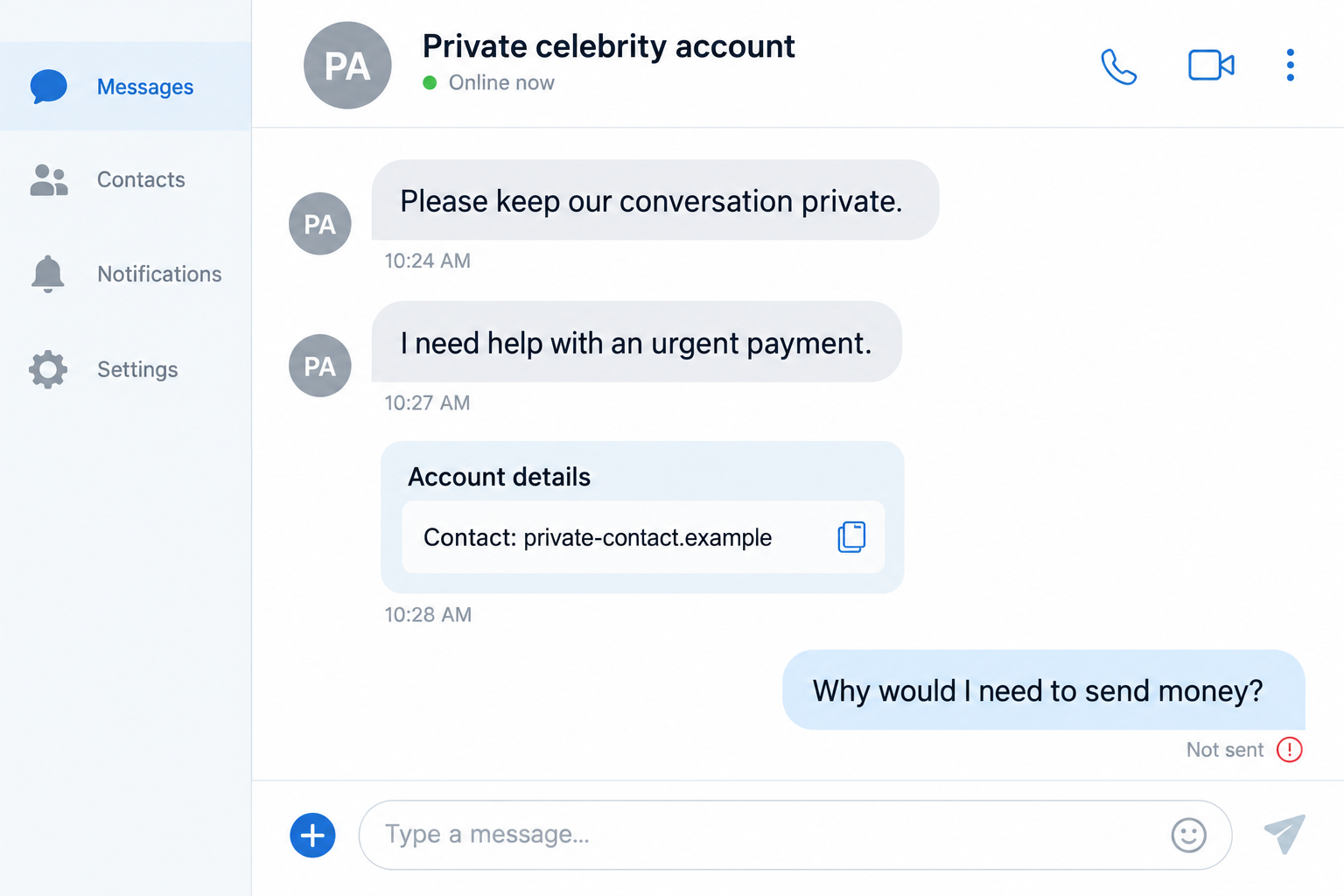
The illustrative chat shows two pressure tactics: secrecy and an urgent payment request. Its wording is fictional, not a transcript from an identified victim.
Money can be requested for an emergency, an investment, travel, or another personal-sounding reason. The excuse changes while the unverified identity remains central.
A police investigation confirms this is more than a hypothetical risk
Spain’s Guardia Civil reported a fake Brad Pitt operation in September 2024 involving alleged fraud against two women.
The police account describes fan-platform contact, private messages, romantic promises, and transfers toward supposed business projects.
That documented case establishes the impersonation-and-payment mechanism. It doesn’t authenticate every new message or prove that all such accounts belong to the same group.
Likewise, the presence of a convincing photograph doesn’t establish how it was created. Stolen images, edited media, or generated content can all complicate identity checks.
The financial boundary matters more than the appearance of the account
A familiar face and affectionate conversation are not independent proof of identity. Neither is a second account claiming to be a manager or relative.
Watch especially for this combination:
- A supposed private relationship that must stay secret.
- Excuses for avoiding an independently arranged meeting.
- An emergency that only you can supposedly resolve.
- Money sent to someone whose name doesn’t match the claimed celebrity.
- Requests for gift card codes, cryptocurrency, or unusual transfers.
- Pressure to ignore relatives, bank staff, or friends who question the story.
The FTC’s romance-scam guidance warns against sending money to an online romantic contact you haven’t met in person.
Why This Doesn’t Feel Like an Ordinary Scam Message
The attention arrives before the payment request
An obvious invoice can be checked against a purchase. A private relationship feels less mechanical because the conversation grows around your interests and daily life.
You may hear from the account repeatedly, share worries, or begin to expect the next message. That routine can become emotionally important.
When the request finally appears, it feels attached to someone you know. The scammer benefits from the history they’ve built, not just the famous name.
This is why telling yourself you’d never answer a random request isn’t enough. The person asking may no longer feel random after weeks of conversation.
Secrecy can be presented as proof of special trust
A celebrity persona offers a ready-made explanation for privacy: public attention, management rules, or the need to avoid publicity.
That explanation can make secrecy feel romantic rather than alarming. It also keeps people who might challenge the story outside the conversation.
You can respect another person’s privacy without hiding a payment decision from a trusted friend. A request that forbids outside advice deserves a firm pause.
The relationship should not require you to lie to your bank or conceal transfers. Those instructions protect the payment attempt, not your wellbeing.
How the Brad Pitt Romance Scam Works
Step 1: A celebrity persona creates an unexpected opening
Contact can begin through a fan page, social network, or message from someone claiming a connection to the actor. The account offers unusual personal access.
A profile may contain recognizable photographs and information about films or public appearances. Those details can be copied without private knowledge of the actor.
The Guardia Civil case involved contact through a supposed fan platform. That is one documented route, not a claim that all fan communities are fraudulent.
A public fan page can be genuine fandom while a private message from an account using a celebrity name is an impersonation attempt.
Don’t assume an account is authentic because you reached it from a search result, advertisement, or comment on a familiar page.
Step 2: Frequent messages turn the claim into a personal connection
The conversation moves toward your life, interests, and vulnerabilities. Attention and affectionate language encourage you to invest time and trust.
A private messaging app can become the main contact channel. Moving off the first platform also makes it harder for moderators there to see the continuing exchange.
The pace varies. Some requests arrive quickly; others follow a longer relationship. A slow approach isn’t a reliable sign that the identity is genuine.
A person who learns your routines can time requests when you’re alone, worried, or reluctant to disappoint them. That possibility doesn’t mean every friendly question is malicious.
Notice whether the relationship gradually narrows your support network. If outside questions are treated as disloyalty, the contact is making independent judgment more difficult.
Keep a trusted person informed before money becomes involved. You don’t need to prove the scam beyond doubt before asking someone to help you think.
Step 3: Supposed proof answers the doubt without resolving it
The account may send a photograph, voice message, document, or another contact who claims to verify the relationship. Each item can make the story feel stronger.
But evidence supplied by the same unverified source isn’t independent confirmation. A supposed manager introduced by the account can simply be another part of the approach.
Public photographs are easy to reuse. A reverse image search can reveal reuse, but finding no match doesn’t establish that a newly supplied image is authentic.
Voice and video can also be misleading. Don’t base a payment decision on whether a short clip feels familiar or looks free of obvious errors.
There is no need to prove that AI was used. An unverified person asking you to finance a secret celebrity relationship is already an unsafe situation.
Avoid sending intimate images or identity documents to earn trust. Those disclosures create further exposure even if you haven’t transferred money.
Step 4: Affection becomes the reason to send money
The first request is framed as personal help, not a transaction with a stranger. The account may describe an obstacle only your payment can remove.
In the documented Spanish case, the impersonator proposed investments in business projects. Other romance scams use travel costs, medical emergencies, or financial trouble.
Don’t treat those examples as identical evidence about every Brad Pitt account. They explain why the payment request can vary while the trust-building tactic stays familiar.
An unfamiliar recipient may be described as an assistant, supplier, or intermediary. That explanation doesn’t establish a legitimate connection to the actor.
Gift card codes and cryptocurrency can make recovery difficult. A bank transfer can also move quickly, especially when pressure overrides checks.
The useful boundary is straightforward: don’t finance an unverified private celebrity relationship. The story’s emotional importance doesn’t make the recipient or payment safe.
Step 5: New obstacles keep the relationship and payments going
After money is sent, another problem may appear. A delayed visit, extra fee, or further emergency can make the first payment feel unfinished.
The promise stays just beyond reach. You may feel that stopping now would waste the money, time, and emotional effort already invested.
You can miss the conversation and still refuse the next transfer. Protecting your money doesn’t require your feelings to disappear overnight.
That feeling can lead to another transfer without new evidence. Previous payment is not a reason to continue; it is a reason to review the situation.
If you challenge the story, the account may become hurt, angry, or unusually affectionate. Emotional reassurance doesn’t answer the financial question.
A different person can later appear offering recovery assistance. Don’t assume they are legitimate because they know details of your earlier loss.
Stop payments, preserve the conversation, and involve independent support. You don’t need the impersonator to admit what happened before you can protect yourself.
What to Check Without Paying for More Proof
Separate a public fan account from a private identity claim
Read what the account actually represents. A page dedicated to an actor isn’t necessarily operated by the actor, even when the name and photographs look convincing.
A verification symbol or a large audience should not override a suspicious money request. Check the surrounding identity and behavior instead of treating one visual cue as decisive.
Don’t contact an address supplied by the same account to verify its own claims. Independent contact information must come from a genuinely separate, trusted source.
You don’t need a list of every celebrity account to say no. An unverified private message isn’t a safe basis for a payment.
Put the payment story into plain language
Describe the request to someone without using the actor’s name: an online contact wants you to fund an emergency or project through an unfamiliar recipient.
Would you make that transfer if the sender weren’t supposedly famous? Asking it that way gives you room to reconsider without debating every affectionate message.
Ask what evidence exists outside the conversation and what happens if you refuse. A caring response should not require secrecy, threats, or deceptive explanations to your bank.
If the account says you must prove love by paying, don’t debate what love requires. Stop the financial exchange and seek support outside the relationship.
What to Do if You Have Fallen Victim to This Scam
-
Stop sending money and stop negotiating. Don’t pay for one last document, release fee, visit, or refund. Preserve essential evidence before blocking the account.
If the account is threatening or overwhelming you, prioritize your safety and stop contact immediately. You can ask someone trusted to help organize the records.
You don’t owe the impersonator an explanation, apology, or opportunity to persuade you again.
-
Contact the payment provider promptly. Tell your bank, transfer company, gift card issuer, or cryptocurrency platform that you believe the payment involved impersonation.
The FTC’s payment-specific recovery advice explains who to contact. Ask about stopping pending transfers, recalling funds, or disputing eligible charges.
Be accurate about what you authorized and why. A transfer you approved under deception is different from one you never approved; neither guarantees recovery.
-
Keep a clear evidence file. Save account names, profile links, chats, payment instructions, recipient details, transaction references, and the sequence of requests.
Keep original files where possible. Don’t edit the messages to make the deception look clearer, and don’t publish private information from your own records.
A short timeline can help a bank or investigator understand a long conversation without reading every affectionate message first.
-
Report the account to the platform. Use its impersonation or scam reporting tools and include the specific financial request where the form permits it.
Report financial fraud in the U.S. through ReportFraud.ftc.gov. Elsewhere, use your country’s official fraud-reporting or police route.
If threats concern your immediate safety, contact local law enforcement. Don’t organize public retaliation or ask strangers to investigate the account for you.
-
Secure any account credentials you disclosed. Change exposed passwords through genuine account settings, review recovery details, and remove unfamiliar sessions or connected access.
Enable stronger sign-in protection where available. Replace reused passwords on the other accounts they could expose.
A conversation alone doesn’t mean your email was hacked. Take these account steps when credentials, codes, sessions, or suspicious account activity were involved.
-
Address documents, software, or intimate-image exposure separately. Note precisely what you shared rather than treating every romance scam as the same technical incident.
If identity documents were misused, follow the appropriate official identity-theft process. In the U.S., IdentityTheft.gov offers a recovery plan.
If you installed unfamiliar software, Malwarebytes can help check for unwanted programs. AdGuard can reduce some malicious-ad exposure, but neither tool recovers transfers.
If intimate images become leverage, don’t send more material or money. Preserve threats and seek platform and law-enforcement assistance.
-
Bring in a trusted person. Explain the impersonation and what you need now: help contacting a bank, preserving records, or resisting further contact.
Feeling grief or embarrassment is understandable after a relationship you believed was real. That emotional loss deserves care alongside the financial repair.
If you’re helping someone else, focus on the requests and evidence. Ridicule can make them hide the next message rather than ask for help.
-
Reject guaranteed recovery offers. Anyone demanding advance payment to trace, unlock, or return the money deserves the same independent scrutiny.
Keep using the case references from your actual payment provider and reporting agency. An unsolicited message claiming success is not proof funds were recovered.
Continue monitoring affected payments and accounts. Let your trusted support person know if another supposed manager or celebrity account approaches you.
Frequently Asked Questions
Is the real Brad Pitt involved in these money requests?
The scam described here involves people impersonating him. A profile using his name doesn’t establish a connection to the actor or authorize its payment demands.
Does a video message prove I’m speaking to the actor?
No. Media can be reused, edited, or generated. Don’t treat a clip supplied by an unverified account as sufficient reason to send money.
What if the money goes to a supposed assistant?
That explanation doesn’t verify the recipient. An unfamiliar intermediary increases the need to stop and check, rather than making the payment normal.
Is every fan page a fraudulent account?
No. Fan communities can be legitimate. The danger is an unverified private identity claim combined with financial pressure, secrecy, or requests for sensitive information.
Can I recover cryptocurrency or gift card payments?
Contact the provider immediately and preserve references or codes. Recovery may be difficult and isn’t guaranteed. Don’t pay a stranger who promises to reverse it.
How can I help a relative who believes the relationship?
Stay calm, ask about the payment demands, and offer practical help checking evidence. Shame and confrontation can make continued contact harder for them to disclose.
The Bottom Line
Don’t send money to a Brad Pitt romance scam or another unverified celebrity relationship. Private affection, impressive media, and secrecy don’t establish identity or a legitimate payment.
If you already paid, contact the payment provider now, preserve the messages, and involve someone you trust. Stop funding new excuses while the loss is investigated.








