

A stranger appears in a running club with the one thing somebody has been searching for: a bib for a sold-out marathon, an expensive GPS watch for only the shipping cost, or a friendly message from another athlete.
Strava is built around shared routes and encouragement, which makes an unexpected connection feel natural. It also gives scammers a ready-made reason to start talking.
Overview
Strava is legitimate, but its social features can be abused
Strava is a real fitness platform used by runners, cyclists, walkers, and other athletes to record activities, join clubs, compare progress, and communicate. The platform itself is not the scam.
Strava scams occur when dishonest users create or compromise profiles, enter public clubs, and use posts or messages to sell nonexistent race entries, collect fake shipping fees, send phishing links, or build relationships that lead to financial fraud.
The account may contain a profile photo, several manually added activities, and a believable training story. Those details can be copied or created quickly and do not prove that the person controls the race entry, product, identity, or payment account.
The hook is tailored to what athletes already discuss
A fake offer works best when it does not look like an advertisement. In a running club, a scammer may mention an injury and a last-minute bib transfer. In a cycling group, the lure may be a discounted computer, power meter, or event registration.
Other versions begin with compliments about a route or performance. The conversation gradually moves from training to friendship, romance, cryptocurrency, or an “investment opportunity” recommended by a successful coach or athlete.
Common Strava scam hooks include:
- A sold-out race bib offered below market price
- A free GPS watch, bicycle component, console, or ticket
- A request to pay only shipping or insurance
- A new follower who immediately asks to use WhatsApp
- A coach, sponsor, or brand-ambassador opportunity
- A link to vote for an athlete or verify a club account
- A romance conversation that becomes a crypto pitch
- A fake charity challenge requesting payment outside the platform
Public activity data can make the approach unusually personal
Activities can reveal preferred routes, club membership, event goals, training times, and social connections. When privacy controls are too broad, a stranger may learn where someone starts a morning run or when a household is usually away.
That information does not automatically lead to fraud, but it gives an attacker context. A message that names your upcoming marathon and refers to a route you ran yesterday feels less random than ordinary spam.
Strava provides privacy controls and map-visibility options. Every athlete should review them instead of assuming the default audience is appropriate for every activity.
The Fake Race Bib and Event Entry Trap
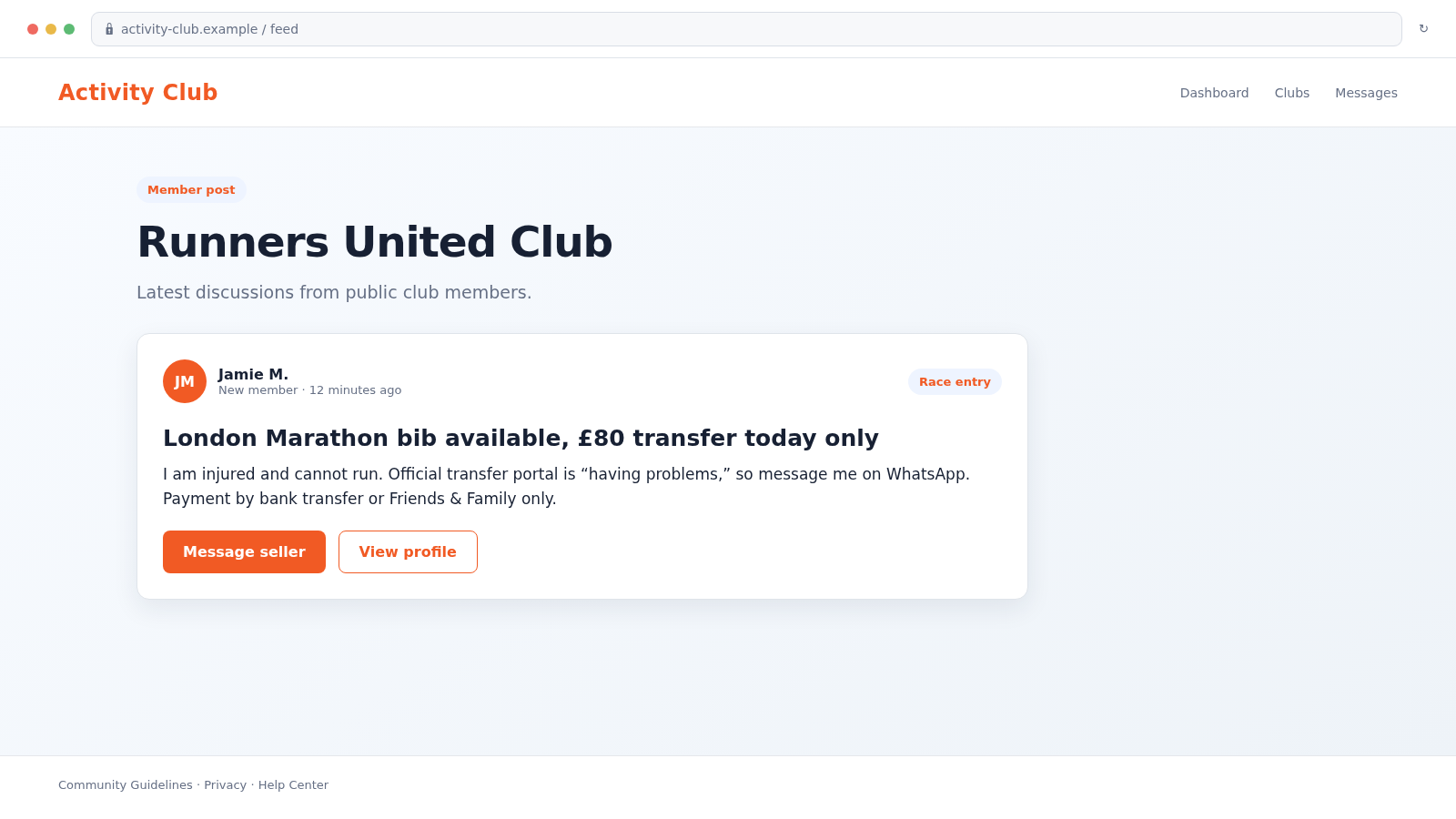
Sold-out events create urgency before the scammer sends a single message. A runner who trained for months may be willing to act quickly when a supposed participant says an injury has opened a place.
The seller often explains that the official transfer portal is closed, temporarily broken, or unnecessary. They may display a registration screenshot with a real event logo and a name that matches the profile.
A screenshot can be edited, borrowed from another runner, or reused for multiple victims. The only meaningful transfer is one confirmed through the organizer’s official procedure.
Many events restrict, prohibit, or tightly control bib transfers for safety, insurance, and medical-identification reasons. Paying a stranger does not guarantee that the registration can legally be moved to your name.
Scammers prefer bank transfers, cryptocurrency, or payment options intended for friends and family because buyer protections may be limited. Once payment arrives, the account disappears or invents another transfer charge.
The Free Gear and Sorrowful Story Version
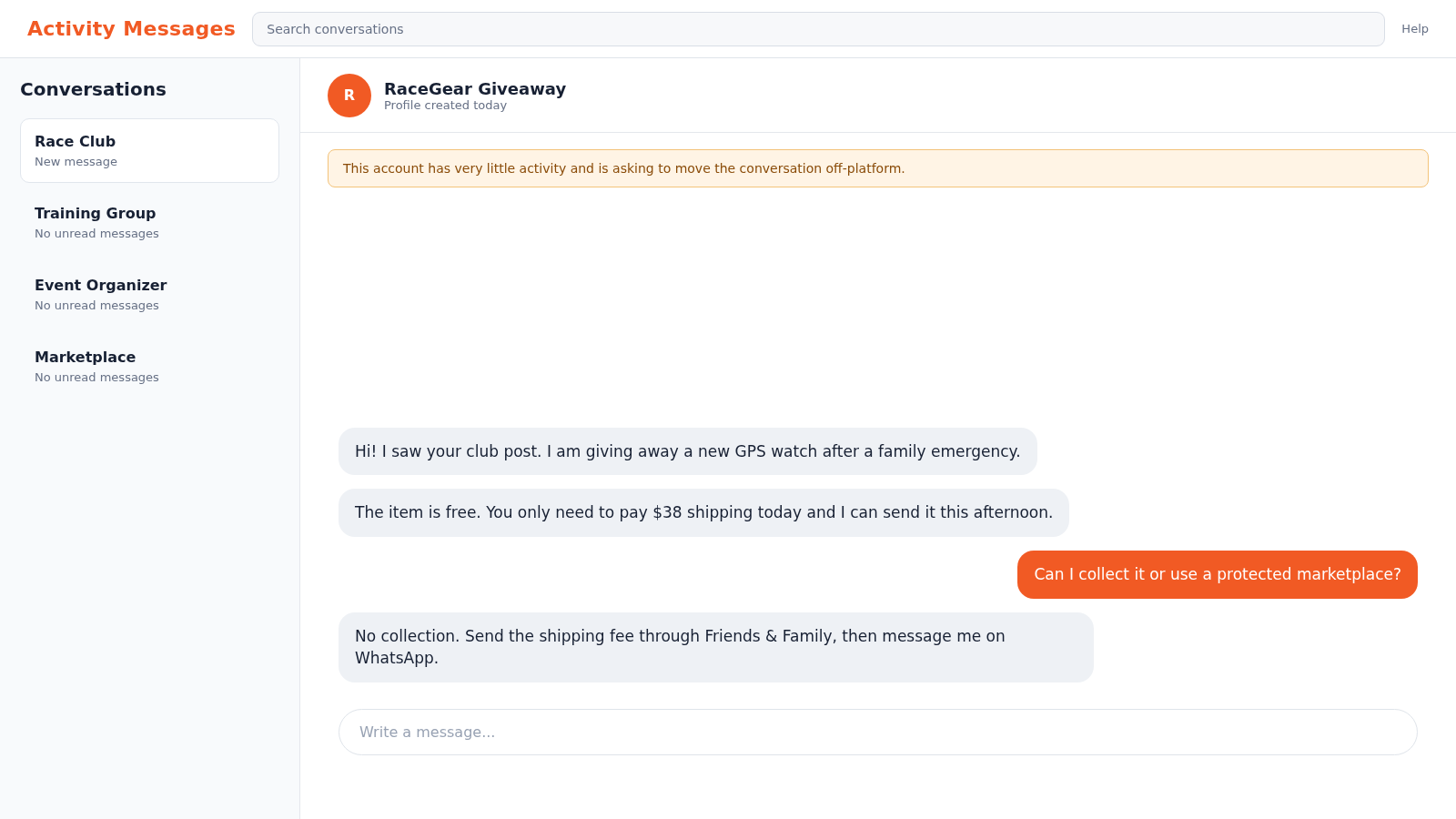
A public-club post may offer an expensive item for free because of a move, breakup, injury, or family tragedy. The emotional explanation discourages questions and makes the recipient feel rude for requesting verification.
The item is free, but shipping is not. The scammer asks for $25, $38, or another modest amount through a payment method that is difficult to reverse.
After the first payment, a new cost may appear for insurance, packaging, customs, or courier release. The amounts remain small enough that the victim may continue rather than accept the original loss.
Photos do not prove possession. Reverse-image search may reveal that the same product and story were posted in multiple groups, cities, or platforms.
A genuine local giver should normally accept safe collection or a protected transaction. Refusal of every verifiable option is a strong warning.
How Strava Scams Work
Step 1: The scammer enters a public club or follows many athletes
Public clubs provide a concentrated audience with shared interests. A new account can join conversations about races, equipment, injuries, and travel without looking completely out of place.
The profile may follow hundreds of athletes while receiving little genuine engagement. Activities may be manually entered, repeated, or inconsistent with the person’s story.
Step 2: A relevant offer creates instant rapport
The scammer comments on a real event, recent activity, or club topic. The message may praise your pace, ask about a route, or say they can no longer attend the race shown in your training title.
This personalization is often assembled from public information. It should not be mistaken for a real-world connection.
Step 3: The conversation moves away from Strava
WhatsApp, Telegram, text, or email gives the scammer more control and separates the conversation from platform reporting. It also exposes another contact detail.
The move may be presented as convenient because Strava messaging is “unreliable” or because photos and documents are easier to send elsewhere.
Step 4: Screenshots replace verifiable proof
A fake seller sends registration confirmations, delivery receipts, identity cards, or payment screenshots. The documents may contain real event and courier details copied from the internet.
When asked to verify through the organizer or meet safely, the person invents a reason that verification cannot happen until money is sent.
Step 5: An irreversible or unprotected payment is demanded
The seller asks for a bank transfer, cryptocurrency, gift card, or friends-and-family payment. A countdown, second interested buyer, or shipping cutoff is used to stop comparison shopping.
A race transfer may be priced attractively, while a “free” product uses a small delivery charge. Both rely on the victim deciding that the possible reward is worth the risk.
Step 6: Additional fees or a new fraud appear
A courier fee, insurance deposit, name-change charge, or customs payment may follow. Romance and investment versions take longer, with the scammer first building daily contact and emotional trust.
Phishing versions send a fake sign-in page and request the email address, password, or verification code needed to take over the account.
Step 7: The account disappears or targets the victim’s contacts
After payment, the seller blocks the buyer or deletes the profile. A compromised account may instead remain active and message club members who recognize the owner’s name.
Stolen route information and contacts can support later impersonation, burglary-related reconnaissance, or personalized social engineering.
Company, Address, and Fulfillment Checks
A display name is not a verified seller identity
A Strava name, photo, and activity history are not equivalent to a legal identity. Ask whether the payment account, registration name, and person communicating all match.
Do not accept a photograph of an ID as proof. Stolen identification is frequently reused in marketplace fraud, and sending your own ID gives the scammer material for the next victim.
Location data should be controlled, not volunteered
Review who can see your activities, followers, clubs, and complete route maps. Hide sensitive start and end points and avoid titles that announce an empty home or exact travel schedule.
A public route can reveal a home, workplace, school, or regular meeting point even when the written profile contains no address.
Off-platform support removes useful protections
Keep initial conversations on the platform. A scammer who insists on WhatsApp or email may be trying to avoid moderation, create a new attack channel, or send a link more freely.
For race entries, contact the event through the organizer’s official website. For platform issues, use Strava’s real help center rather than a number or link supplied by another user.
The item, entry, and payment trail must be traceable
Confirm that the race permits transfers and that the organizer processes the change. For physical goods, use local inspection or a marketplace with appropriate payment and dispute protections.
A shipping label created online does not prove that a parcel was handed to the carrier. Fulfillment is real only when the correct item moves through a verifiable service to you.
Warning Signs in a Strava Profile or Message
- The profile is new and follows far more people than follow it
- Activities are manual, repetitive, or inconsistent with the story
- The person immediately requests WhatsApp, Telegram, or email
- A sold-out entry must be paid outside the official transfer system
- The seller refuses safe collection or a protected marketplace
- A free high-value item requires shipping, insurance, or customs fees
- Payment must use friends-and-family, cryptocurrency, wire, or gift card
- The same story appears in several clubs under different names
- A link asks for Strava, email, or payment credentials
- A friendly conversation quickly becomes a crypto or investment pitch
How to Use Strava More Privately
Set profile and activity visibility according to what you actually want strangers to see. A public club post can reveal more than an activity shared only with approved followers.
Use map-visibility controls to hide sensitive sections near home, work, and other private locations. Remember that repeated routes can still reveal patterns even when a small section is hidden.
Review follower requests instead of approving every athlete-looking profile. Search suspicious wording and product photos before replying to a sale or giveaway.
Do not publish screenshots that expose race barcodes, booking references, email addresses, or other transferable credentials. Those details can be copied into convincing fake listings.
Talk to the event organizer before paying for any entry. A legitimate seller should welcome a transfer method that protects both parties.
What to Do if You Have Fallen Victim to This Scam
- Stop paying and end the conversation. Do not send an additional transfer fee, shipping charge, or recovery payment. Save the profile and messages before blocking the account.
- Preserve evidence. Capture the profile URL, club post, messages, payment username, account details, product photos, phone numbers, and transaction references. Record the timeline while it is fresh.
- Contact the payment provider immediately. Explain that the transaction was induced by fraud. Ask whether a transfer can be recalled, a card charge disputed, or the receiving account investigated.
- Notify your bank. If you sent a wire, bank transfer, or exposed card details, ask the fraud team to protect the account and attempt recovery. Speed matters.
- Secure compromised accounts. If you entered credentials, change the password from a clean device, sign out other sessions, enable multifactor authentication, and secure the associated email account.
- Scan after opening files. If a supposed registration, shipping document, or training tool installed software, run a full scan with Malwarebytes. Remove unknown browser extensions and remote-access apps.
- Review location exposure. Change Strava privacy and map settings, remove suspicious followers, and consider hiding older activities that disclose sensitive routines.
- Report the account and post. Use Strava’s reporting tools, notify the club administrator, and contact the race organizer if a real event or registration was impersonated.
- Block malicious destinations. A content blocker such as AdGuard can reduce access to known phishing and scam domains, although it cannot replace careful payment verification.
- File official reports. Report financial losses to the FTC or your national fraud service, and use the FBI’s IC3 portal for serious online payment or account fraud in the United States.
- Warn relevant contacts carefully. Tell club members that the account or listing was fraudulent without reposting an active malicious link or exposing your own private data.
Frequently Asked Questions
Is Strava itself a scam?
No. Strava is a legitimate fitness platform. Scammers may create accounts, compromise real profiles, or misuse public clubs and messages, just as they do on other social networks.
Can I safely buy a race bib from another runner?
Only when the event permits transfers and the organizer completes the change through its official system. A screenshot and private payment do not make a bib valid or transferable.
Why do scammers want to move to WhatsApp?
Moving off-platform reduces moderation and gives the scammer your phone number. It also makes it easier to send payment instructions, phishing links, and reused documents.
Is a long activity history proof that a seller is real?
No. The account may be compromised, activities may be copied or manually entered, and a real athlete can still make a dishonest offer. Verify the transaction itself.
What should I do about a free-item shipping request?
Do not pay merely because the fee seems small. Request safe collection or a protected marketplace and reverse-search the images and story. Refusal of verifiable options is a strong warning.
Can strangers see where I live through Strava?
Public routes and repeated start points can reveal sensitive locations. Review profile, activity, follower, and map-visibility settings and avoid publishing predictable routines to everyone.
The Bottom Line
Strava scams blend into normal athlete conversations. A race goal, club membership, or shared route gives the stranger a believable opening before money, credentials, or personal contact details are requested.
Keep transactions verifiable, use official event transfers, control route visibility, and refuse pressure to pay outside protected systems. Community trust is valuable, but it should never replace proof.

Join the discussion
0 commentsShare your experience or ask a question about this article.
Discussion
Start the conversation
Have a question or something useful to share? Add the first comment.