

An Oregon DMV text warns that an unpaid traffic matter could interfere with your license. For anyone who drives daily, that is hard to brush aside.
The quickest-looking solution is right there in the message. Before taking it, check whether the request fits anything you actually started with DMV.
Overview
The payment warning impersonates Oregon DMV or ODOT
The Oregon DMV text scam turns an alleged ticket, toll, or license problem into a reason to open an unverified payment website.
An official Oregon Department of Transportation warning describes urgent messages leading to fake pages intended to collect personal and financial information.
These messages misuse public-agency identities. They do not establish that DMV recorded a violation or that your license status changed.
Some genuine DMV messages exist, but they follow your own request
Oregon’s official scam guidance distinguishes unsolicited demands from messages connected to actions you initiated, including appointment notifications and DMV2U verification codes.
That distinction is more useful than assuming every DMV text is fake. Ask what you requested before the message arrived.
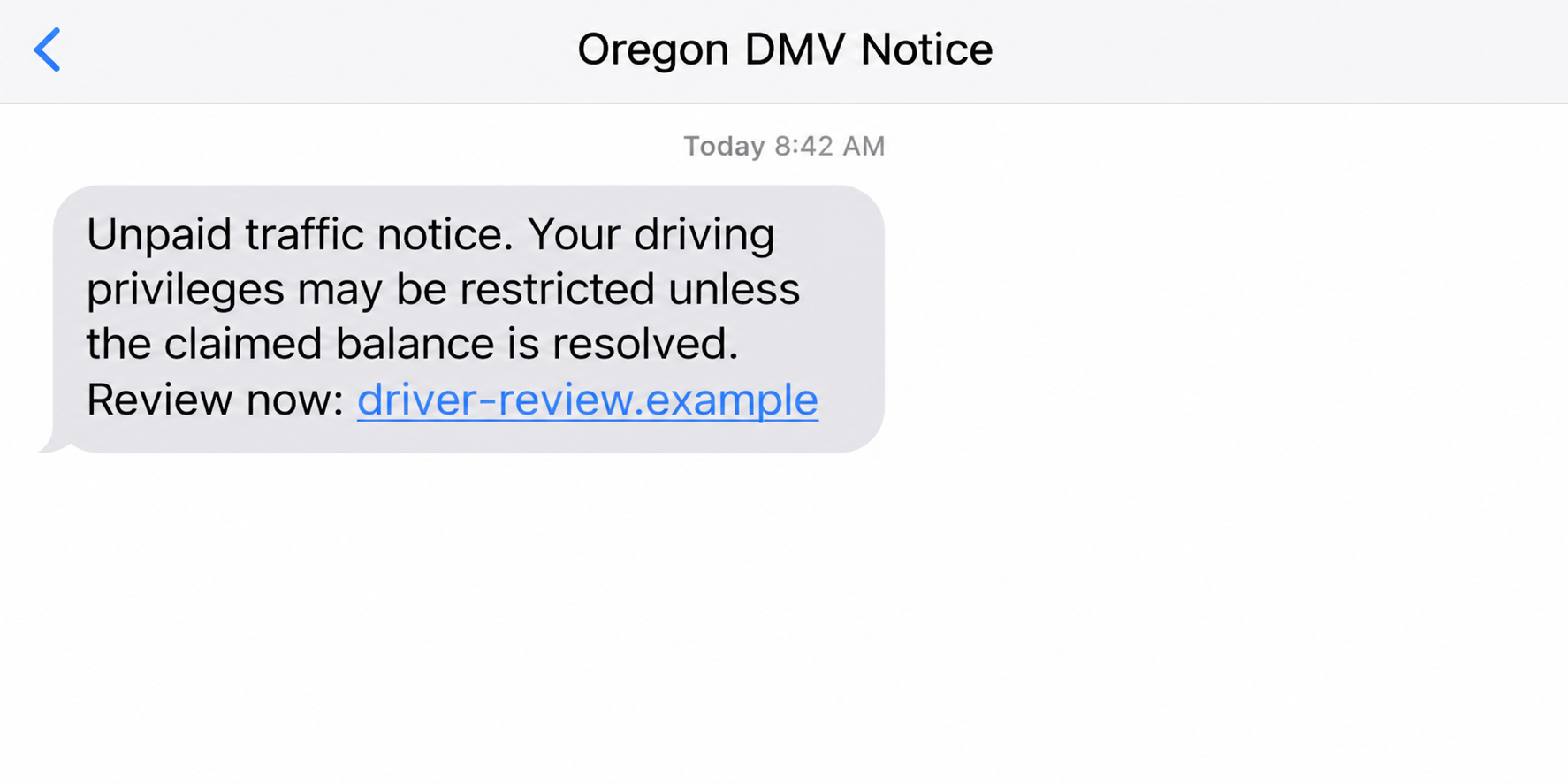
The lead image is a fictional interface illustration. Its wording and example address are not an original recipient’s message or evidence of a particular payment page.
A claimed consequence does not authenticate the collection route
Common warning signs in this approach include:
- A sudden allegation about money owed to DMV or ODOT.
- A threat concerning driving privileges or registration.
- An unfamiliar link presented as the way to prevent the consequence.
- A request for personal details that you did not initiate through DMV2U.
Do not use the message to settle the claim. Check any genuine concern through Oregon’s independently reached services and protect information you already disclosed.
Why the Oregon Details Matter
ODOT’s toll-program statement is narrower than a claim about every bridge
In its warning about unpaid toll and traffic messages, ODOT states that it does not have a toll program.
Do not stretch that into a claim that every bridge or toll-related charge anywhere in Oregon is impossible. Check the actual operator when a real journey raises questions.
A text borrowing ODOT’s name should not substitute for a record from the organization that actually handled a trip.
For a rental or employer-owned vehicle, use the established rental or fleet contact. Don’t send vehicle documents to an unknown collector to ask whether you owe anything.
DMV2U is a service you can reach without the text
The Oregon DMV homepage links to DMV2U online services and information about driver-license standing.
Start there if the allegation makes you worry about a genuine administrative issue. You don’t need the sender’s address to find the state’s services.
A correct agency name in a web address isn’t sufficient on its own. Read the actual host rather than stopping at familiar words near the beginning.
Similarly, an unexpected code is not an invitation to give it to someone else. If you didn’t start the related action, don’t help another person complete it.
How the Oregon DMV Text Scam Works
Step 1: The text presents a driving problem as already established
The opening does not ask whether anything happened. It speaks as though an unpaid matter already exists and you are simply receiving the final instruction.
You’re already trying to fix the problem before asking whether there is one. That is an easy place to arrive when the message sounds official.
For someone with a renewal approaching, the timing may feel convincing. A coincidental real task does not give an unrelated message access to your trust.
Look for the action you initiated and the records you already hold. Do not invent a missing step that makes the unsolicited demand fit.
Step 2: The threat makes delay feel more expensive than payment
A restriction on driving privileges sounds disruptive, especially if work, family care, or medical appointments depend on a vehicle.
The message uses that concern to narrow your choices. The supplied payment link starts to look like the only way to prevent inconvenience.
But paying an unknown recipient cannot establish that the alleged restriction was real or that the genuine agency received anything.
Give yourself room to check. An unfamiliar sender should not decide which verification steps you are allowed to take before disclosing financial information.
A real unresolved issue should be handled through the appropriate verified office. Don’t confuse that responsibility with obeying the text.
Step 3: Familiar wording conceals an unfamiliar destination
The linked page may resemble the sort of service portal you expected. Official-sounding headings can make the transition from text to website feel routine.
Once there, the original uncertainty can fade. You’re looking at buttons and instructions rather than asking how you arrived.
Stop at that boundary. A convincing page design does not supply the missing connection between the website and Oregon DMV.
Don’t trust a customer-service link on the same suspect page to settle the question. It may simply return you to the operator who created the request.
Step 4: Information is requested under the label of resolving the notice
The payment or lookup process may ask for personal identifiers, billing information, or credentials. What matters is who receives those entries.
A request for a license number can feel relevant to a DMV issue. Relevance does not establish that the recipient is authorized to collect it.
A small alleged balance also doesn’t limit the potential harm of exposing a reusable card number or account password.
If the website asks for a one-time banking code, don’t treat it as a harmless receipt check. Review the bank’s own wording and contact the bank yourself.
The specific data fields can change between versions. Keep your own exposure assessment tied to the information you actually supplied.
Step 5: An error or confirmation can obscure what was disclosed
A failed screen doesn’t prove that earlier form entries were never transmitted. Avoid trying several cards to make an unverified payment succeed.
A success screen is no more conclusive about the genuine obligation. It tells you what that website displayed, not what DMV recorded.
If a charge appears, save the details through your bank rather than revisiting the suspected page for clarification.
If no charge appears, exposed payment details may still warrant a call to the issuer. Ask about precautions without claiming losses that haven’t occurred.
Step 6: Another request can exploit the information already shared
After an exchange, be careful with callers who seem unusually informed. They may repeat facts you supplied and use them to claim a legitimate role.
A supposed investigator, refund desk, or account specialist should be verified through the institution’s real contact route.
Don’t transfer funds to a new account for safekeeping or install remote-access software because someone says the traffic payment caused a security problem.
These are possible follow-up risks, not a claim that every Oregon DMV phishing attempt includes them. Your bank can assess any specific new instruction.
How to Tell an Expected DMV Message From an Unsolicited Demand
Match the message to something you did
If you booked an appointment, check the date against your own confirmation. If you started account verification, use the code only in the genuine session you opened.
A message about an unrelated balance shouldn’t borrow credibility from a legitimate appointment reminder that arrived earlier.
Don’t rely exclusively on a conversation thread either. Read what the new request asks you to do and whether it matches the transaction you initiated.
For a family member who needs help, ask which service they used before touching any link. Their existing confirmation is a better starting point than a stranger’s deadline.
Keep lookup, payment, and reporting separate
Use the official agency site to understand a genuine DMV issue. A court citation may instead require the relevant court’s independently verified service.
A fraud report concerns the deceptive message. It does not automatically clear a real ticket, change license standing, or reverse a card charge.
Likewise, a bank can protect a payment method without deciding whether a traffic matter exists. Let each organization handle the part it actually controls.
If you’re uncertain, write down three separate questions: what is alleged, what information was disclosed, and what money moved?
That short record helps you act in the right order instead of asking one unfamiliar help desk to resolve everything.
Save confirmation of your genuine DMV inquiry somewhere you can find it. A later message should be compared against that record, not allowed to restart the panic.
If you share a vehicle, check who normally receives its official paperwork. One household member’s uncertainty should not turn into several separate attempts to pay a stranger.
For a work vehicle, let the normal fleet contact check the allegation. Don’t send company documents or use a business card simply to clear an unexpected text.
What to Do if You Have Fallen Victim to This Scam
-
Leave the conversation and record the exposure. Save the text and any available address or transaction details without reopening the suspected destination.
Make a brief list of what you submitted. Distinguish a page you merely viewed from a form you completed or software you installed.
Keep the original records privately. If you warn others, obscure your contact details, account numbers, and any information identifying someone else’s vehicle.
-
Speak to your issuer about payment information. Use a contact from your genuine bank app or physical card if you entered financial details.
Explain that the website claimed to resolve an Oregon DMV matter. Ask whether the card should be restricted or replaced and which transactions need review.
For a transfer, give the provider the recipient and timing. Ask about recovery options promptly, while understanding that availability and outcomes vary.
-
Secure accounts whose credentials were supplied. Replace exposed passwords on the real sites. Check other accounts only where the same password was reused.
Review active sessions and account-recovery settings. If you shared a bank code, tell the provider exactly which action the genuine notification described.
You don’t have to change unrelated passwords because a text arrived. Concentrate on credentials that were actually entered, shared, or otherwise exposed.
-
Escalate identity exposure when the information warrants it. A license image or Social Security number deserves a different response from simply opening a webpage.
Use the federal identity-recovery service for sensitive disclosures or evidence of misuse. Ask the relevant document issuer about any necessary precautions.
Keep an eye on genuine account and credit notices. Report unexplained activity through official channels rather than trusting a caller who offers to investigate it.
-
Inspect browser or software changes if they happened. Remove notification permission granted to an unfamiliar site and review downloads associated with the interaction.
If an installation occurred or suspicious behavior persists, a supported-device scan with Malwarebytes can help identify unwanted software.
AdGuard provides an optional filtering layer against some risky web content. It does not erase information from a phishing form or reverse a charge.
Don’t accept a text’s claim that malware is present as a diagnosis. Merely receiving this warning does not establish device compromise.
-
Report through genuine services and block the sender. Submit the message to ReportFraud.ftc.gov and use your carrier’s spam-reporting process.
Forward to 7726 if supported. Retain the bank’s reference number and your original message so later questions can be answered from one clear record.
If you remain concerned about a real DMV issue, return independently to Oregon DMV’s homepage. Keep that inquiry separate from the fraud report.
-
Do not pay for a promised recovery. An unexpected caller cannot guarantee that an advance fee will release your money or erase a supposed violation.
Check any claimed bank or agency representative by initiating contact yourself. A genuine reference number should be assessed through the organization, not through the incoming caller.
If you’re embarrassed, tell someone you trust. Getting practical help with the next call is more useful than trying to manage every alarming follow-up alone.
Frequently Asked Questions
Does Oregon DMV ever send a genuine text?
Yes. Its guidance describes messages linked to requested transactions, such as appointment notifications and DMV2U account verification. That is different from an unsolicited collection demand.
Is an unpaid ODOT toll text a valid payment notice?
ODOT warns about these impersonations and says it has no toll program. Check any actual trip-related concern with the relevant operator, not through the text.
Where can I reach Oregon’s DMV online services?
The official Oregon DMV homepage links to DMV2U. Open the state page independently rather than using an address provided by the unexpected message.
Does the text prove my driving privileges were suspended?
No. A sender’s statement is not an official status check. Use the agency’s genuine services for any real concern about your driving record.
What if I provided details but never pressed the last button?
Tell the relevant provider what you typed and where. Don’t assume that abandoning the final screen guarantees earlier information remained private.
Should I install a cleaner because I opened the text?
No installation is justified by the message alone. Review actual downloads, granted permissions, or suspicious device behavior before deciding whether software checks are needed.
The Bottom Line
Do not settle an Oregon DMV text demand through its supplied address. Use the real DMV service to check your concern without accepting the sender’s payment route.
If you shared financial details, contact the bank directly. Protect the exposed account first, then handle any genuine vehicle or court matter through its own verified office.

Join the discussion
0 commentsShare your experience or ask a question about this article.
Community experiences
Did this happen to you?
Your experience could help someone recognize the same scam. Submit a private report for our team to review.
I experienced this tooReports are reviewed before publication. Sharing publicly is always your choice.
Discussion
Start the conversation
Have a question or something useful to share? Add the first comment.