


Bleeding gums can make a simple dental routine feel worrying. An oil rinse promising a gentler answer is an easy advertisement to stop and read.
Holy Mouthwash now leads visitors to Holyswish and its Halo products. Before trying a bottle, understand what the offer actually asks you to accept.
Overview
Holy Mouthwash has become Holyswish
The holymouthwash.com address redirects to holyswish.com. The current store sells Halo Pulling Oil, gum serum, toothpaste, and a measuring spoon.
Older Holy Mouthwash contact details remain in the footer alongside the newer brand. This connection is observable on the merchant’s own pages.
The pulling oil is promoted as a blend of oils used for swishing and spitting. The sales message goes beyond a pleasant taste or fresh-mouth feeling.
Dental claims sit beside automatic refills
The product page makes claims about bleeding, soreness, bacteria, and access below the gum line. It also offers automatic refills on a four-week schedule.
It tells buyers to continue brushing, flossing, and checkups. The concern is whether its additional gum-treatment promises are justified, not that it explicitly says to abandon brushing.
A recurring option is not automatically an unauthorized subscription. Buyers still need to distinguish trying one bottle from authorizing later shipments and charges.
- Ingredient research is not a trial of the finished Halo formula.
- The satisfaction guarantee requires substantial documentation.
- Repeat and subscription orders are excluded from that guarantee’s stated scope.
- Cancellation must precede the next billing date by at least 48 hours.
Our verdict on buying for gum problems
Do not buy Halo Pulling Oil as a replacement for dental assessment or established oral care. The treatment-style promises run ahead of the evidence presented.
Do not assume the guarantee makes experimenting effortless either. Its photo, usage-log, timing, and first-order restrictions materially affect the offer.
If you already ordered, check whether your receipt includes refills and preserve the version of the promise you relied on.
What the Oil-Pulling Research Really Shows
Holyswish publishes a science page with research links. Looking at the actual studies is more useful than simply counting citations or treating them as decorative badges.
One cited source is a 2024 systematic review of oil pulling, combining trials involving different oils and oral-care comparisons.
The review included 25 trials and 1,184 participants. It found a possible gum-health benefit, while rating the overall certainty of the evidence very low.
It also found chlorhexidine more effective for reducing plaque. That is a more limited conclusion than suggesting an oil rinse reliably outperforms conventional care.
Holyswish summarizes that review as showing comparable plaque and gingivitis results. The stronger plaque-control finding and very-low-certainty rating should not disappear from the comparison.
The research was about oil-pulling interventions, not a clinical test establishing every benefit advertised for the finished Halo blend.
Different ingredients, concentrations, schedules, and patient groups matter. Results from one intervention cannot simply be transferred to a bottle with a proprietary combination.
The American Dental Association’s oil-pulling guidance does not recommend the practice as a dental-hygiene method.
That guidance emphasizes brushing with fluoride toothpaste and cleaning between teeth. A seller’s fluoride-free message should not displace advice tailored to your dental needs.
The science page explicitly says the product does not treat periodontal disease or replace professional treatment. Read its stronger benefit claims alongside that important limitation.
If your gums bleed, remain sore, or appear to be receding, arrange a dental assessment. Do not wait for an advertised bottle schedule to identify the cause.
How the Holyswish Offer Works
Step 1: A familiar symptom becomes a product-specific explanation
The sales page connects bleeding, soreness, and bad breath with bacteria below the gum line. It presents the oil blend as reaching places ordinary care misses.
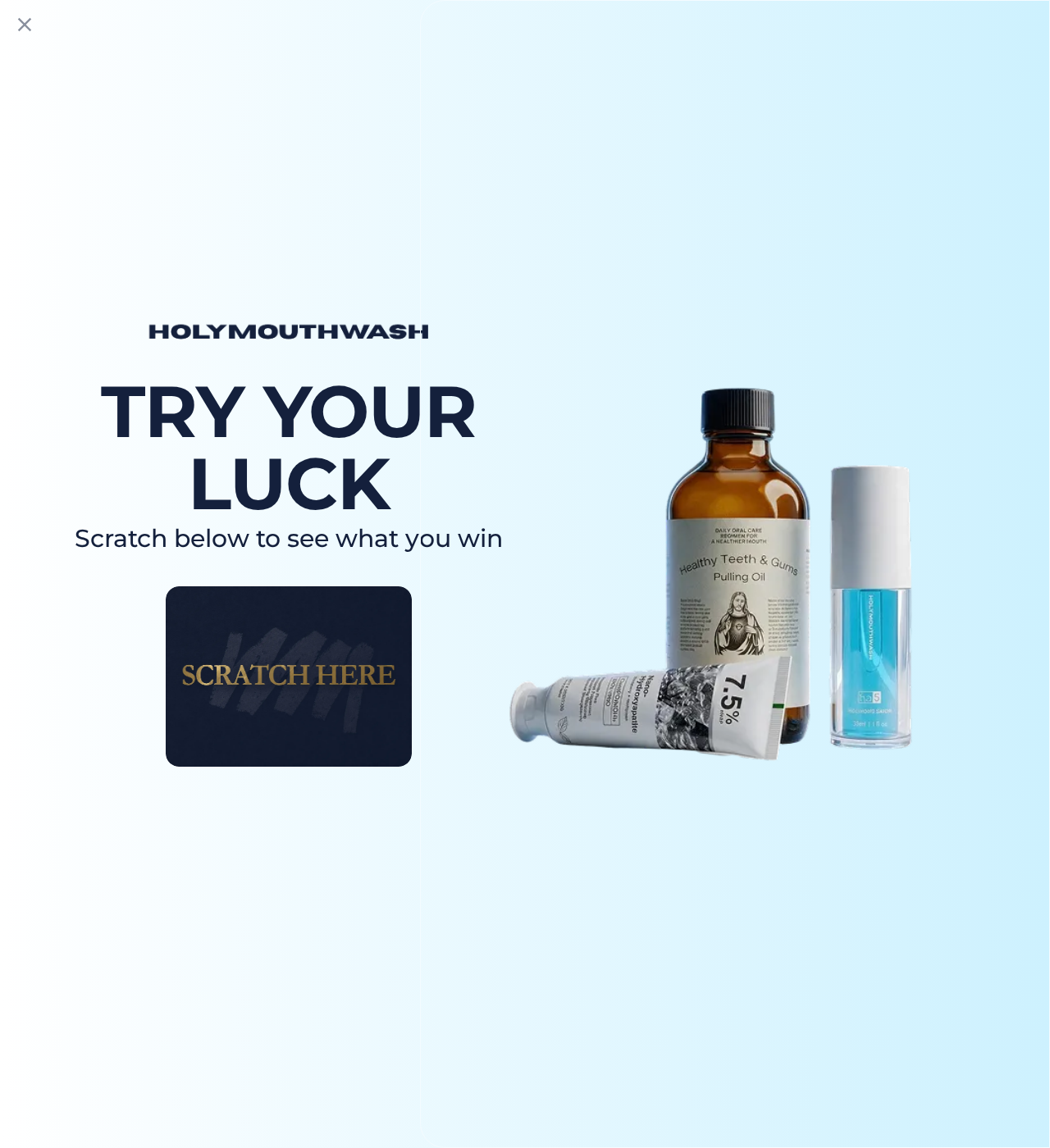
A scratch-card promotion still uses Holy Mouthwash branding and product imagery. That sales incentive adds another reason to engage, but says nothing about dental effectiveness.
That story gives a worried reader a clear cause and a convenient action. The simplicity is persuasive precisely because dental problems can feel complicated.
But symptoms can need professional assessment, and a retailer cannot diagnose your mouth through a general sales page.
Ask what finished-product evidence supports the precise claim being made. A mechanism described in confident language is still not proof of a clinical outcome.
Step 2: Research and authority language reinforce the promise
The science page presents studies in approachable language, while the product page includes a named dental-professional endorsement.
A reader should distinguish three questions: is the research real, does it test this formula, and does it support the specific advertised benefit?
Real research can be summarized too broadly. The very-low-certainty qualification in the cited review matters when deciding how much confidence to place in the offer.
The same applies to a professional name and credentials. They do not replace a transparent study showing what this product achieved and in whom.
Step 3: Bottle bundles and refill savings change the commitment
The page presents one-, two-, and three-bottle packages, with lower per-bottle figures for larger quantities. The total price rises even when the unit price falls.
It also advertises a discount for automatic refills every four weeks. That is a separate decision from how many bottles to receive initially.
Check both selections. A buyer wanting to test one bottle should not accidentally accept a larger package or an ongoing delivery arrangement.
Some reviewers report unwanted recurring charges. Those accounts justify careful consent checks, but they do not prove that every new customer is enrolled without permission.
Step 4: The satisfaction promise comes with a 30-day evidence project
The refund policy requires consistent use for at least 30 days before a satisfaction claim. For pulling oil, it specifies at least eight uses over that period.
A four-week refill can arrive before that minimum trial is complete. Check the next charge now rather than waiting to see whether the first bottle helps.
It asks for dated product photographs at the beginning, middle, and end, plus a written log of usage dates.
It also requires three sets of dated photographs of the customer’s teeth and gum line, a routine description, and order and delivery details.
Someone who notices these requirements only after finishing the bottle may no longer have the day-one evidence the merchant demands.
This burden should be understood before purchase. It is not equivalent to simply saying the product did not help and receiving an immediate refund.
Step 5: The guarantee’s scope is narrower than the banner
The sales page presents the guarantee as a simple email without forms. Its fuller policy demands usage records and three stages of dated photographs.
Sitewide every-order wording also conflicts with first-order-only satisfaction coverage. The detailed policy excludes repeats, additional kits, and subscription orders.
That distinction is especially important beside a refill offer. Continuing the routine can mean continuing payments without continuing satisfaction protection.
Unused goods have a separate 30-day return process. Opened products cannot simply be shifted into that route when the satisfaction documentation is missing.
Defective, damaged, or materially incorrect products have another provision. Keep your request in the category that actually describes the problem.
Step 6: Cancellation and refund requests follow different clocks
The cancellation policy permits stopping subscriptions through the account or support, but requires action at least 48 hours before the next scheduled bill.
Canceling prevents future renewals when completed in time. It does not automatically reverse an order already processed or shipped.
A refund request may need to be made separately, with the documentation appropriate to the reason. Do not assume one message accomplishes both tasks.
Record the cancellation confirmation and the next billing date. These are more useful than a vague assurance that support has received your email.
Company, Contact, and Billing Checks
The operator name appears in the footer
The website names Zero Point One LLC. That is the seller’s disclosure, not independent certification of its operations or every product claim.
Compare the name with your receipt and payment descriptor. Keep any different transaction name so your bank can identify the actual charge.
The redirect and retained mailbox explain the Holy Mouthwash and Holyswish connection. Similar names elsewhere should not be treated as the same merchant without equivalent evidence.
Two brand mailboxes appear on current pages
The newer support route is help@holyswish.com. The footer also shows support@holymouthwash.com and phone number +1 307-449-2386.
For the current policies, use the newer address and retain your original order correspondence. No call or support test was performed for this article.
If you call about billing, follow up in writing with the cancellation or refund request. Keep dates and any promised resolution.
The return location is not the business address
The refund policy says return routing depends on the delivery country and tells customers to obtain instructions from support.
It specifically warns against sending goods to the business address. Do not infer a usable returns destination from a company registration or shipping label.
For an ordinary unused return, the customer pays postage. The policy says seller-caused defects or incorrect items are remedied without that cost to the buyer.
Check the label rather than guessing the supply chain
The sales material names oils and vitamins, but a marketing list is not a substitute for the label on the item actually delivered.
Retain the ingredient panel, batch information, package, and any safety directions. Show those details to your dentist if you have sensitivities or other concerns.
This investigation did not test the contents or establish universal manufacturing origin. Ingredient complaints from reviewers are not laboratory findings.
What to Do if You Ordered Holy Mouthwash or Holyswish
- Check the purchase confirmation for ongoing billing.
Identify the initial quantity, total, refill interval, and next charge date. Look in the customer portal as well as the receipt.
If you wanted only a trial bottle, request cancellation of any unwanted future deliveries explicitly. Do not describe the entire purchase as unauthorized if you approved it.
- Cancel before the next billing cutoff.
The published requirement is at least 48 hours before renewal. Use the account route or write to help@holyswish.com now rather than waiting for another reminder.
Save a screenshot of the canceled status and written confirmation. If the account route fails, document the error and send a dated support request.
- Choose the refund route that fits.
An unopened change-of-mind return, a satisfaction claim after use, and a damaged or wrong product have different conditions.
State the actual reason and ask support to confirm eligibility. Preserve the every-order promise if it influenced your decision to accept refills.
- Do not continue an unsuitable routine just to qualify.
If the product irritates your mouth or symptoms worsen, stop using it and obtain appropriate dental advice. A refund policy is not a medical instruction.
Explain the adverse experience to the seller. Do not manufacture a usage log or recreate dated photographs that were never taken.
- Protect the dental photographs the policy asks for.
Send sensitive images only through a confirmed merchant contact route if you decide to provide them. Avoid including unrelated identifying details or posting them publicly.
If you lack required evidence, say so honestly and ask what remedy remains available. Do not let repeated document requests run out a payment-dispute deadline.
- Escalate disputed charges with the right records.
Give the payment provider your receipt, consent information, cancellation request, relevant policy, and any later charge. Explain whether the issue is renewal or purchase fulfillment.
Ask about the applicable deadline and what further action is needed. A bank dispute should not be treated as a substitute for canceling the merchant’s subscription.
Frequently Asked Questions
Are Holy Mouthwash and Holyswish connected?
The old holymouthwash.com address redirects to holyswish.com, and current pages retain the older support mailbox. That is a direct website-level connection.
Keep your own receipt when seeking help, since it identifies the product and terms attached to your transaction.
Is Halo Pulling Oil a proven treatment for gum disease?
The cited research does not establish the finished Halo formula as a gum-disease treatment. A possible benefit from oil pulling is not equivalent to reliable product-specific results.
Do not replace dental assessment, brushing, or interdental cleaning with the sales page’s treatment-style promises.
Does buying a bottle automatically mean a subscription?
The page offers automatic refills, but that alone does not establish the billing choice accepted in your order. Check the receipt and portal.
Reported unwanted renewals are a reason to inspect consent carefully, not a basis for claiming every transaction contains unauthorized charges.
What does the 60-day guarantee require?
The policy requires 30 days of consistent use, dated product and oral photographs across three stages, a usage log, routine details, and order information.
Complete documentation must be submitted within 60 days of delivery. The stated satisfaction coverage excludes repeat and subscription orders.
Can I cancel after the next bottle ships?
You can still request cancellation of future renewals, but the policy does not automatically refund an already shipped order.
Ask separately about the current shipment and the ongoing schedule. Obtain confirmation that no further charges will be created.
Do good customer reviews establish the dental claims?
No. Enjoying the taste, freshness, or shopping experience is different from proving a treatment effect. The visible review profile includes both favorable reports and billing complaints.
Use reviews to investigate service patterns. Use appropriate clinical evidence and professional advice for health decisions.
The Bottom Line
Do not order Holyswish on the strength of its easy-refund pitch. The detailed guarantee is substantially more demanding, and refill orders have narrower protection.
Already ordered? Check refills, cancel unwanted renewals in time, and request the correct remedy. Keep professional care separate from the merchant’s refund requirements.

Join the discussion
0 commentsShare your experience or ask a question about this article.
Discussion
Start the conversation
Have a question or something useful to share? Add the first comment.