


A check from a business you left years ago can be more confusing than welcome. You remember the name, but you don’t remember expecting any money.
That’s the situation some former AdvoCare distributors are in now. Start by establishing which payment you received before you decide what to do with it.
Overview
The FTC’s second AdvoCare payment is real
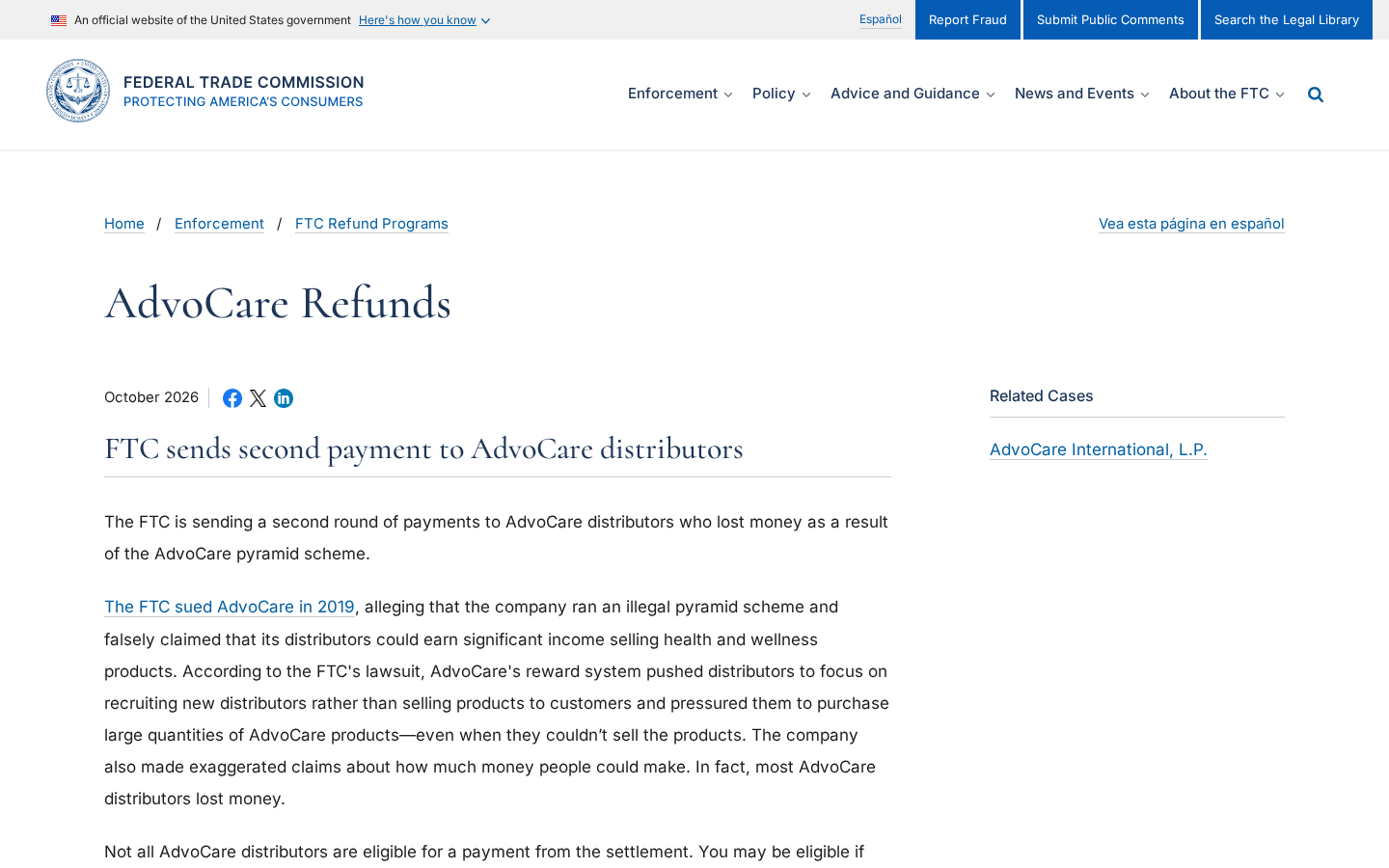
The FTC’s official AdvoCare refund page says it is issuing a second round of payments from money remaining in the settlement fund. The notice is dated October 2026.
The agency says 170,571 payments totaling more than $11.4 million are going to first-round recipients who accepted their payments. It does not announce a new application.
The first round went out in May 2022. The current page says that round resulted in more than $137.8 million in refunds.
Some headlines from 2022 described amounts being sent, not the amount eventually returned in that first round. Use the current notice when comparing rounds.
Did you buy products, become a distributor or get paid in 2022?
These three experiences can sound similar in a conversation about the settlement. For eligibility, they are not the same thing.
The FTC says you may qualify if you reached the Advisor level, spent substantially more on products than you received in rewards, and met other requirements.
The second round has another important limit: it goes to people who accepted their first payment. Merely getting an email in 2022 is not necessarily the same as accepting it.
Use these questions to identify what you can actually show:
- Were you buying products as a customer, or were you enrolled in the old business opportunity?
- If you were a distributor, what rank and payment history do your old records show?
- If a first payment was issued, did it clear at your bank or get accepted in PayPal?
The settlement addressed the old business model, not the contents of a bottle
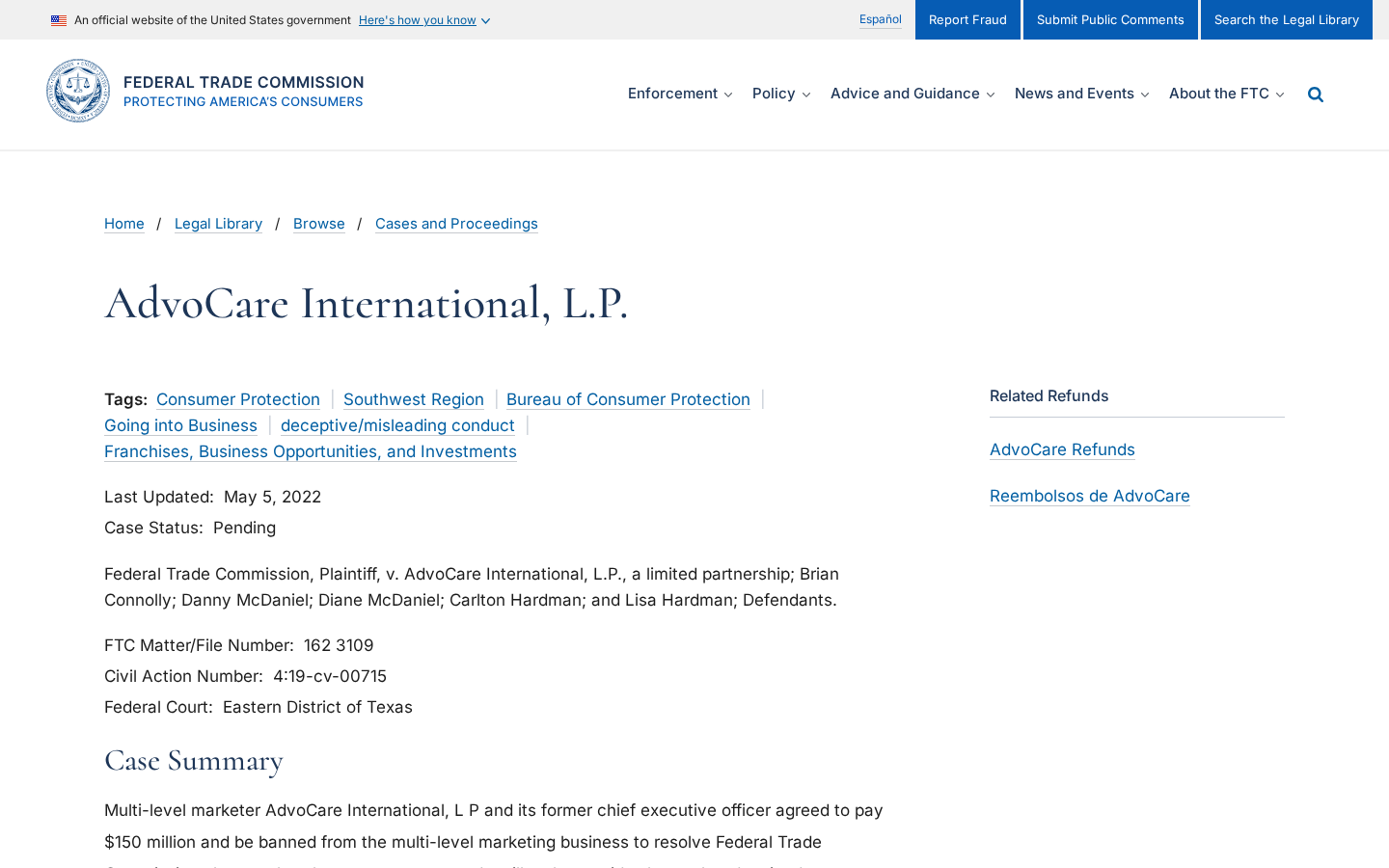
The FTC sued AdvoCare in 2019. It alleged that the company pushed distributors toward recruiting and large purchases while making exaggerated claims about what participants could earn.
The company and its former chief executive agreed to a $150 million settlement and a ban on multilevel marketing. The court order says the allegations were not admitted or denied.
That distinction leaves no doubt about the ban or the refund program. It also means the civil agreement should not be described as a criminal conviction.
A present-day shopper buying a health product is not joining the old compensation plan by virtue of the name on the label. This guide is about that settlement.
Why the Old AdvoCare Compensation Plan Drew FTC Action
Buying inventory and making a sale were different events
A distributor could spend money on products before anyone outside the program agreed to buy them. The FTC argued that the compensation structure made those purchases especially attractive to recruits.
From a participant’s point of view, an order could feel like progress toward a rank even if that order created only an expense.
A retail sale produces revenue when a customer actually pays for the item. A distributor’s purchase for qualification does not automatically produce that revenue.
That matters when someone shows a growing team or large product volume as evidence of success. Ask who bought the products and whether anyone counted the cost.
Recruiting made a difference to the rewards the FTC challenged
The FTC’s complaint described rewards tied to the purchasing activity of distributors in a recruiter’s network. It said the design encouraged people to recruit as well as buy products.
The products were real; the complaint concerned what participants were induced to do for the chance to make money.
The regulator reported that 72.3% of distributors received no compensation from AdvoCare in 2016. The figure describes that year and the compensation measured, not every participant’s retail earnings.
For a former distributor, a rank, award or recognition post does not document profit. Bank statements, inventory receipts and actual payments answer a different set of questions.
What changed under the civil order
Read the FTC case record if you want to confirm the scope of the case. It separates the lawsuit, orders and later refund announcements.
The order ended the ability to compensate a distributor based on activity in a distributor downline. It did not prohibit ordinary product purchases simply because somebody received a retail discount.
Do not use a contemporary product receipt by itself to infer eligibility for the old program. If you participated before the settlement, locate records from that period first.
If somebody now offers to revive a legacy account for a fee, do not connect that offer to the FTC payment without independent confirmation.
How the Second AdvoCare Payment Works
Step 1: Check the case and the payment method
Open the FTC refund page independently. Find its October 2026 notice and administrator number before relying on a check insert, search ad or unexpected email.
Once you know which office handles the payment, compare what you received with the information it publishes. The second round uses checks or PayPal, not cryptocurrency.
Keep the envelope or message, payment date, amount and any reference visible to you. Use those items for verification, not as something to share with strangers.
If payment details differ from your own records, call the published administrator. It is better to ask about a mismatch before acting on it.
Step 2: Use the deadline for the kind of payment you got
For a check, the FTC says to cash it within 90 days. Use the date or void instruction on the actual check, not the date of a news post.
For PayPal, the FTC says to accept the payment within 30 days. An October announcement does not give everyone the same personal deadline.
Open PayPal directly and find the incoming item in your activity. Compare the details with the payment the verified administrator says was issued to you.
If you find a verified payment with an acceptance option, follow the instructions shown inside the service. If you don’t find it, contact the administrator instead of following email links.
Step 3: Check that the money arrived or get help from the administrator
For a verified check that has not expired, use your normal bank deposit route. Check the resulting transaction in your bank account before treating it as settled.
If you ever need to ask for a reissue, do not mail the original instrument to a new address from a message. Get the instructions from the published number.
For PayPal, compare the payment status with your account activity after accepting it. An email alone does not show that you received funds.
If the check is expired, the email address changed or the payment never arrived, explain that exact issue. The remedy for a typo may differ from an unaccepted payment.
What to Do If You Got an AdvoCare Refund Notice or Nothing Arrived
- Start with the FTC’s own AdvoCare listing and copy the number for Analytics Consulting from that page, rather than trusting a number somebody sent you.
- Pull your 2022 bank or PayPal record if you have it. Determine whether you accepted the first payment or only remember receiving a notification.
- If you received a check, verify the case and deadline first, then cash or deposit it through your bank while the check remains usable.
- If the payment was sent through PayPal, open your own account independently and handle a verified incoming payment before its acceptance deadline.
- Call the listed administrator if the record is missing, expired or addressed incorrectly, and ask how to resolve that particular issue.
- Do not pay a processing fee or give a private caller account information. If you already sent money, contact the payment service immediately.
The contact that can check the payment is not a distributor
The FTC names Analytics Consulting and gives 1-855-744-1802. Find the same entry on the FTC site before calling if anything about the notice seems off.
Say that the question concerns the October 2026 AdvoCare distribution. Explain whether you got a check, got a PayPal notice or have no payment showing.
Have the dates and reference ready, but do not read account passwords or one-time codes to someone on a call. Ask what the case actually requires.
If you moved after the first round, explain that rather than guessing the check was lost. Ask whether a reissue is available and how to request it safely.
The FTC refund FAQ says a reissue may be possible if money remains. It does not guarantee a replacement after every deadline.
How to tell a payment from a request to pay
An email that mentions PayPal can be completely accurate about the case and still be false about your payment. Open your own PayPal account before doing anything else.
Make sure the entry is money coming to you. An invoice or request for you to send money is not the FTC sending you a refund.
If an apparent refund asks you to pay shipping, buy a gift card or move cryptocurrency, stop. None of those actions appear in the FTC procedure.
If you already paid a third party, contact the service that moved the money through its regular app or number. Identify the exact charge and keep the message.
You can report a suspected impersonator through ReportFraud.ftc.gov. Use the published administrator separately for questions about the real check or digital payment.
If the payment is in the wrong name
A mailed check may still use the name on a record from years ago. Do not alter the name on the check yourself or endorse it for somebody else.
The FTC’s refund FAQ says a reissue for a death, legal name change or spelling correction requires a written request. Call the administrator first for case-specific directions.
Explain which name appears and why it needs to change. Ask what proof to provide and where to send it, using the address the administrator confirms.
Keep a copy of your request and any reference number. If you receive a replacement, verify which check is valid before trying to deposit it.
If a relative received a check addressed to someone who died, ask the administrator what an authorized representative must provide. Possessing the envelope is not authorization.
Why a different amount is not necessarily a billing error
A second payment comes from what remains after the first round. Do not expect a repeat of the first amount simply because the same case appears on both payments.
The FTC’s general FAQ says many programs distribute money in proportion to losses. The AdvoCare notice does not publish an individual calculation you can apply to your account.
For example, two former distributors who bought the same amount could have accepted different rewards before the settlement. Matching inventory receipts would not establish matching losses.
If the amount concerns you, locate the amount you actually received in the first round and the amount on the new payment. Ask the administrator to explain the difference.
Frequently Asked Questions
Is the October AdvoCare refund actually from the FTC?
The FTC lists a genuine second distribution dated October 2026. That listing does not authenticate a particular email, check or person calling from a different number.
Verify your specific payment through your bank or PayPal and the listed administrator. Do not rely on somebody knowing the name of the case.
Is there a new application for everyone who used AdvoCare?
The October announcement describes the recipients as people who accepted their first payment. It does not advertise an open enrollment process for everyone who bought products.
If you are not sure what happened to your first payment, ask Analytics Consulting. Do not pay a third party to apply on your behalf.
How long do I have to cash an AdvoCare refund check?
The FTC says to cash checks within 90 days. Check the date or void wording on your own check and ask the administrator if it is unclear.
If it already expired, contact the administrator rather than assuming a bank will accept it. Reissue depends on the program and remaining funds.
Can an AdvoCare refund really come through PayPal?
Yes, the FTC lists PayPal as an actual method for this round and says to accept within 30 days. Open PayPal through your usual account route.
If you cannot find a verified incoming item, call the administrator for clarification. Do not send money to a person whose message tells you to accept a refund.
Does receiving the payment mean all my losses were covered?
No, the notice describes a distribution from the settlement fund. The amount in a particular payment does not necessarily match the money an individual spent.
Compare what cleared with your own old records. Ask the administrator about the payment rather than using the total fund to calculate a personal entitlement.
Does the settlement mean current AdvoCare products are counterfeit?
No, the legal case concerns the former business opportunity and the earnings and purchasing incentives challenged by the FTC. It does not test or classify current products.
A product purchase and a business-opportunity refund are separate questions. Verify any communication that tries to tie the two together.
The Bottom Line
Don’t pay anyone to claim an AdvoCare refund. Verify the payment through the FTC’s own case listing, then use the applicable check or PayPal deadline.
If the payment is missing, expired or points to the wrong account, call Analytics Consulting at the number published by the FTC. Ask about your record, not a new application.

Join the discussion
0 commentsShare your experience or ask a question about this article.
Community experiences
Did this happen to you?
Your experience could help someone recognize the same scam. Submit a private report for our team to review.
I experienced this tooReports are reviewed before publication. Sharing publicly is always your choice.
Discussion
Start the conversation
Have a question or something useful to share? Add the first comment.