

Posts promoting an “Ahura Mazda Occult Society” are appearing online with extraordinary promises of wealth, power, protection, and spiritual success. The messages invite people from virtually anywhere in the world to contact a supposed “Temple Grandmaster” through WhatsApp at +2348100295088.
The language may sound bizarre, but the underlying setup is familiar. It combines unsolicited spam, impossible guarantees, emotional manipulation, secret-society mystique, and an attempt to move the target into a private conversation where there is far less scrutiny.
Here is what you should know before contacting the number or sending any money.
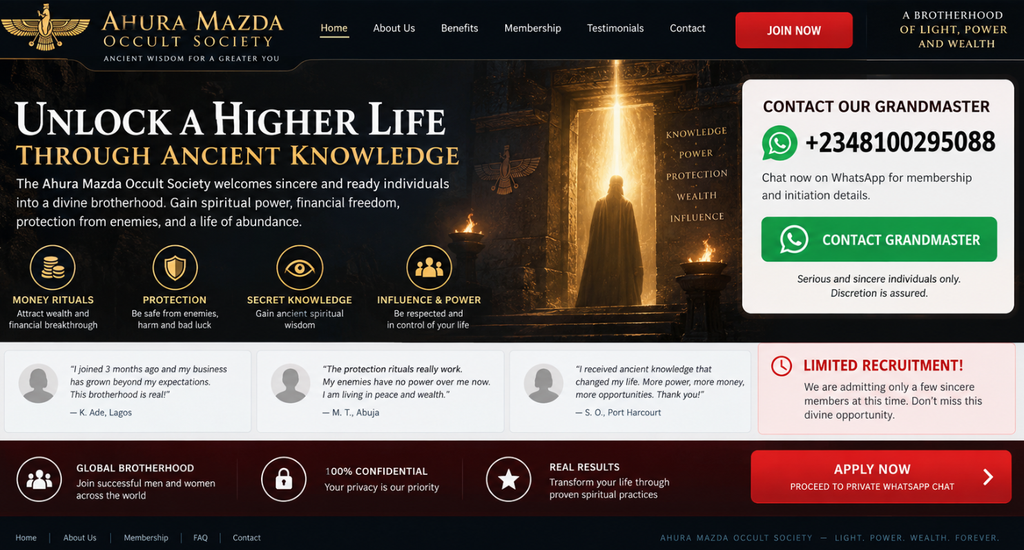
What Is the Ahura Mazda Occult Society Scam?
The Ahura Mazda Occult Society promotion is a suspicious online recruitment campaign that claims people can obtain riches, power, protection, fame, spiritual knowledge, and other life-changing benefits by joining an occult brotherhood.
In the post we reviewed, the promoter claims membership can provide “instant spiritual solutions” and help people achieve wealth and protection. The message targets an unusually broad audience, including business owners, politicians, civil servants, job seekers, security officers, entrepreneurs, and people struggling financially.
The supposed organization presents itself as a rare and powerful spiritual society with access to secret knowledge unavailable to ordinary people. Readers are repeatedly instructed to contact a “Temple Grandmaster” directly through phone or WhatsApp using +2348100295088.
The post also introduces increasingly dramatic language about black magic, ritual materials, sacrifice, spiritual guardians, wealth, luxury, and the consequences of failing to follow instructions correctly.
This is important because the public post does not actually provide a verifiable service. Its main purpose is to generate enough curiosity, hope, fear, or desperation that a reader initiates private contact.
Once the conversation moves to WhatsApp, the operator controls the interaction.
Ahura Mazda Occult Society Scam: The Verdict
The promotion should not be trusted.
There is no credible evidence in the material reviewed that the person behind +2348100295088 can provide supernatural wealth, guaranteed success, spiritual protection, power, or any of the other extraordinary outcomes being advertised.
Instead, the campaign displays several characteristics associated with confidence scams and advance-fee fraud:
- unsolicited promotional spam
- promises of extraordinary wealth and success
- guaranteed or near-guaranteed outcomes
- claims of secret knowledge available only to insiders
- emotional targeting of people experiencing financial or personal problems
- a supposed authority figure called a “Temple Grandmaster”
- pressure to move the conversation to WhatsApp
- vague references to expensive ritual requirements and sacrifice
- no transparent business structure or verifiable service
- no meaningful explanation of how the promised results could be proven
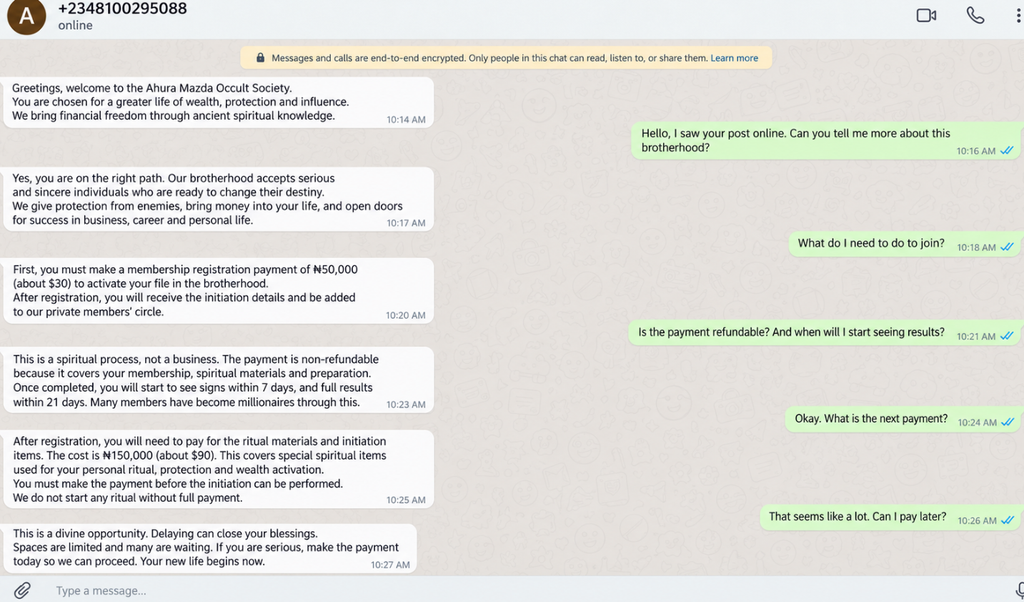
The original post does not show what the operator says after someone contacts the number, so it would be inaccurate to claim that we observed a specific payment request or fee schedule.
However, the setup provides an obvious path toward an advance-fee scam. A victim can first be promised extraordinary benefits and then told that money is required for registration, initiation, spiritual materials, ritual preparation, sacrifices, transportation, special objects, certificates, or another supposedly unavoidable step.
Once the first payment is made, additional requirements can easily follow.
How the Ahura Mazda Occult Society Scam Works
Step 1: Spam Places the Offer in Front of Potential Victims
The campaign begins with a long promotional message posted somewhere it does not naturally belong.
Rather than building trust through an established organization, verifiable membership information, or a transparent website, the promoter uses attention-grabbing posts advertising wealth, rituals, protection, and occult membership.
The headline itself is designed for search exposure. It combines phrases such as “join occult brotherhood,” “money ritual,” “protection,” “power,” and lists of countries or cities where potential recruits might be searching for similar information.
This allows one piece of promotional copy to target many different audiences.
Someone searching for financial help may notice the promise of riches. Someone worried about personal safety may notice protection. Another person may be drawn to secret societies, power, spiritual practices, fame, or supernatural claims.
Different motivations lead to the same destination: the WhatsApp number.
Step 2: The Message Promises a Dramatic Transformation
Ordinary services offer limited, measurable outcomes. This promotion does the opposite.
It suggests the supposed brotherhood can fundamentally transform someone’s life by delivering wealth, power, protection, success, happiness, status, and spiritual advantages.
The scope of these promises is a warning sign.
There is no realistic service that can guarantee a job seeker financial success, protect a politician through supernatural means, make a business owner wealthy, and provide every member with a luxurious life simply through secret rituals.
Yet broad promises are useful to a scammer because they allow almost anyone to see something personally attractive in the pitch.
The offer is not selling one specific result. It is selling the idea that whatever is wrong with your life can be fixed.
Step 3: “Secret Knowledge” Makes Verification Difficult
The promotion repeatedly emphasizes secrecy, rare spiritual knowledge, guarded rituals, hidden powers, and membership in an exclusive society.
This framing serves an important psychological purpose.
If the alleged process were ordinary, a potential recruit could ask for evidence. They could compare prices, read independent reviews, verify qualifications, inspect company records, or determine whether the service actually works.
Calling something secret provides a convenient explanation for why reliable evidence is unavailable.
A person asking for proof can simply be told that outsiders do not understand the process, that spiritual matters cannot be publicly demonstrated, or that only initiated members are allowed to see the evidence.
The lack of verification is therefore transformed from a problem into part of the story.
Step 4: The “Grandmaster” Creates an Authority Figure
The promotion does not simply say to contact a salesperson.
It repeatedly directs potential recruits to a “Temple Grandmaster.”
Titles like this create authority without requiring independently verifiable credentials. The person receiving the WhatsApp message can present themselves as someone with extraordinary spiritual knowledge and access to powerful rituals.
That dynamic can become especially persuasive once the conversation turns personal.
A scammer may ask about the victim’s finances, relationships, career problems, fears, ambitions, family, or other difficulties. Those details can then be incorporated into later messages to make generic claims appear personalized.
The more information a victim provides, the easier it becomes to construct a convincing story around their situation.
Step 5: The Conversation Moves to WhatsApp
This is one of the most important parts of the funnel.
The public post is primarily an advertisement. WhatsApp is where the real persuasion can happen.
Moving a potential victim into private messaging gives the operator several advantages. There are no public replies warning other readers, no moderators watching the conversation, and no independent person challenging increasingly unusual claims.
The scammer can also adapt the story to each victim.
Someone who wants money can be sold a wealth ritual. Someone worried about enemies can be sold protection. Someone seeking influence can be promised power or status.
WhatsApp also makes communication feel more personal than a public forum post. A one-to-one conversation with a supposed spiritual leader can create the impression that the victim has received privileged access.
Step 6: A Financial Requirement Can Be Introduced
The public spam does not document a specific payment request. However, its wording prepares the victim for one.
The post repeatedly discusses ritual requirements, special materials, sacrifice, and the idea that successful spiritual proceedings require significant commitment. At one point, it essentially argues that achieving the desired result requires a substantial sacrifice.
That narrative provides a ready-made explanation for future expenses.
A person who has already been persuaded that a ritual could make them wealthy may be told that a comparatively small payment is necessary to begin.
Possible explanations could include:
- membership or registration fees
- initiation expenses
- ritual materials
- ceremonial clothing or objects
- animal sacrifices
- spiritual cleansing
- offerings
- transportation
- administrative certificates
- temple donations
- protection rituals
- special materials supposedly obtainable only by the “Grandmaster”
The precise explanation matters less than the structure.
The victim pays money today because they believe a much larger reward will arrive later.
That is the central logic behind an advance-fee scam.
Step 7: The First Payment Can Lead to Another
One of the most dangerous moments in any advance-fee fraud occurs after the victim sends the first payment.
At that point, walking away means accepting that the money may already be lost. Continuing offers the hope that the original payment can still produce the promised result.
A scammer can exploit that pressure by inventing another obstacle.
Perhaps the ritual supposedly revealed an unexpected spiritual blockage. Another material may be required. An additional ceremony may need to be performed. A second payment may be described as the final step before wealth is released.
After that payment, another complication can appear.
This process can continue as long as the victim remains willing or able to send money.
The promised reward always remains close enough to encourage another payment but vague enough that its failure can be explained away.
Step 8: Fear Can Replace Hope
The original promotion contains another concerning element: warnings about the alleged dangers of rituals and the consequences of failing to follow instructions.
At the beginning, supernatural claims are used to offer hope. Later, similar claims could potentially be used to create fear.
A victim who becomes skeptical may worry that abandoning a ritual will cause bad luck, spiritual consequences, financial failure, illness, or retaliation.
There is no reason to accept such threats as evidence of supernatural danger.
However, fear can still be psychologically powerful, especially after someone has shared personal information and spent money.
If anyone claiming to be a spiritual leader tells you that you will be harmed unless you send additional money, treat it as coercion rather than proof that the threat is real.
Why the “No Human Sacrifice” Language Is a Red Flag
One unusual feature of the promotion is how frequently it discusses sacrifice.
The message attempts to reassure readers that human sacrifice is supposedly unnecessary, while elsewhere referring to ritual materials, significant sacrifice, and even animal blood.
This does not make the offer more credible.
It has the opposite effect.
A legitimate service should not need to reassure potential customers that they will not be required to participate in human sacrifice while advertising wealth and luxury.
The language also normalizes progressively more extreme ideas. Once someone has accepted the general premise that supernatural rituals are necessary for wealth, a demand for money to purchase unusual ritual materials may no longer seem as unreasonable as it would have at the beginning.
This gradual escalation is useful in manipulation. The target is not asked to accept everything at once.
Major Red Flags
Several features of the Ahura Mazda Occult Society promotion should make readers extremely cautious.
Guaranteed Wealth and Success
No legitimate person can guarantee that a spiritual ritual will make someone rich, powerful, famous, protected, or successful.
An Extraordinary Solution for Almost Every Problem
The same organization supposedly offers benefits to job seekers, entrepreneurs, politicians, business owners, civil servants, wealthy individuals, and poor individuals.
That is marketing designed to appeal to everyone, not evidence of a specific verifiable service.
Secret Knowledge
Claims that evidence cannot be provided because knowledge is hidden, sacred, spiritual, or available only to members make independent verification nearly impossible.
A Mysterious Authority Figure
The operator is presented as a “Temple Grandmaster,” yet the advertisement provides no meaningful way to independently establish that person’s identity, qualifications, or authority.
WhatsApp as the Main Contact Method
WhatsApp itself is legitimate, but scammers frequently prefer private messaging because conversations can be personalized and moved away from public scrutiny.
Heavy Emotional Manipulation
The promotion speaks directly to people who feel unsuccessful, poor, hopeless, unfulfilled, or disappointed with life.
People in difficult situations are being offered an extraordinary shortcut precisely when they may be most vulnerable to one.
Vague Financial Language
The message talks about expensive ritual requirements and the need for significant sacrifice without clearly stating what joining actually costs.
A legitimate organization should be able to explain its fees before someone begins the process.
Impossible Claims
Wealth, spiritual protection, power, destiny changes, and guaranteed success are not benefits that can be objectively guaranteed by someone contacting strangers through forum spam.
Is +2348100295088 Safe to Contact?
We recommend not contacting +2348100295088 in response to these occult recruitment advertisements.
The number is being promoted alongside unsupported claims of instant wealth, power, protection, secret rituals, and membership in an alleged occult brotherhood.
Even sending a harmless introductory WhatsApp message confirms that your number is active and that you showed interest in the promotion.
That can expose you to further persuasion, additional messages, requests for personal information, payment demands, or other scams.
If you have not contacted the number, there is no reason to start.
What Information Could a Scammer Ask For?
A conversation may initially appear harmless. The person might ask your name, country, profession, or what you hope to achieve.
Be cautious if the conversation progresses toward requests for:
- full name
- home address
- date of birth
- photographs
- identification documents
- passport information
- bank account details
- card details
- cryptocurrency
- mobile money transfers
- gift cards
- account passwords
- verification codes
- family information
- employment information
- income or savings
- information about property or investments
Personal details have value beyond the original scam.
They can help scammers create more convincing stories, target the victim again, impersonate them, or share their details with other fraud operations.
What to Do If You Already Contacted the “Grandmaster”
If you only sent a message and did not provide meaningful personal information or money, the safest response is simple: stop communicating.
Block the number and report the conversation through WhatsApp.
Do not continue arguing with the person or try to expose them privately. Continued engagement confirms that your account is active and gives the operator more opportunities to manipulate the conversation.
Review your WhatsApp privacy settings as well. Consider limiting who can see your profile picture, status, last-seen information, and other account details.
Enabling two-step verification on WhatsApp is also worthwhile, particularly if you provided your phone number through another website or received unexpected verification codes.
What to Do If You Sent Money
Act quickly.
Contact the bank, card issuer, payment service, cryptocurrency exchange, or other financial provider involved in the transaction and explain that you believe you were deceived.
Depending on the payment method and transaction status, the provider may be able to stop, reverse, dispute, flag, or investigate the transfer.
Save everything related to the incident, including:
- WhatsApp conversations
- phone numbers
- usernames
- payment instructions
- bank details
- cryptocurrency wallet addresses
- transaction IDs
- receipts
- screenshots
- voice messages
- photographs
- email addresses
- websites or forum posts
Do not delete the conversation simply because it is embarrassing or uncomfortable. The messages may be useful evidence.
If the operator demands additional money to recover your first payment, do not pay.
That is a common continuation of advance-fee fraud.
Beware of Recovery Scams
Victims of one scam are often targeted by another.
After losing money, you may encounter someone claiming to be a hacker, investigator, lawyer, cryptocurrency recovery specialist, spiritual authority, government agent, or financial expert who says they can recover the funds.
They may even appear to know details about the original scam.
The catch usually arrives later: a fee is required before the money can supposedly be recovered.
Be extremely cautious.
Realistically difficult-to-recover payments do not suddenly become recoverable because an anonymous person on Telegram, WhatsApp, Instagram, Facebook, or another platform claims to have special access.
Never send additional money simply because someone promises to retrieve what you already lost.
What If the Scammer Threatens You?
Save the messages and stop engaging.
Threats involving curses, rituals, supernatural retaliation, spiritual attacks, or misfortune should not pressure you into paying.
A scammer may use information you previously shared to make a threat sound personalized. Knowing your name, family members, occupation, or location does not prove supernatural knowledge.
If the threats involve real-world violence, blackmail, stalking, publication of private material, or other credible criminal activity, preserve the evidence and report the matter to local law enforcement.
Do not meet the person in real life.
Did Simply Reading the Post Infect My Device?
No evidence in the material we reviewed suggests that merely reading the forum post installs malware.
The post primarily attempts to move users toward phone or WhatsApp contact.
However, the risk changes if someone later sends you a website, Android APK, executable program, document, QR code, browser extension, or other download.
Do not install software sent by an unknown “Grandmaster” or anyone claiming that an application is required for a ritual, registration, payment, wallet setup, or membership process.
If you already downloaded or opened suspicious files, run a security scan with reputable security software and remove anything you do not recognize.
How to Recognize Similar “Money Ritual” Scams
The organization name can change.
The next campaign may use a different brotherhood, temple, secret order, grand lodge, spiritual master, prophet, occult society, Illuminati-style organization, or ritual specialist.
Focus on the underlying pattern rather than the name.
Be especially cautious when an online stranger:
- promises guaranteed wealth, power, love, protection, fame, or success;
- claims access to secret supernatural knowledge;
- presents themselves as a uniquely powerful spiritual authority;
- says you were destined or specially selected to find them;
- quickly moves the conversation to WhatsApp or Telegram;
- asks for money to begin a ritual or initiation;
- invents additional fees after you have already paid;
- warns that stopping will cause supernatural harm;
- asks you to keep the arrangement secret;
- cannot provide independently verifiable evidence of the promised results.
Changing the name does not change the structure.
Frequently Asked Questions
Is the Ahura Mazda Occult Society legitimate?
The material reviewed provides no credible evidence that the advertised organization can deliver the wealth, power, protection, or other extraordinary benefits it promises. The promotion relies on unsupported supernatural claims and directs users toward private WhatsApp contact.
The use of a religious, spiritual, historical, or occult-sounding name should not be treated as evidence that the advertiser represents a recognized organization or faith.
Is +2348100295088 a scam number?
The number +2348100295088 is being advertised in suspicious occult recruitment spam offering riches, money rituals, power, protection, and other extraordinary benefits.
We recommend avoiding contact and not sending money or personal information to anyone using the number for these claims.
Can an occult ritual really guarantee wealth?
No one can credibly guarantee that paying for an occult ritual will make you wealthy.
Anyone asking for money while promising guaranteed riches should be treated with extreme caution.
Why does the message mention successful people and politicians?
Listing many professions expands the target audience and creates the impression that the alleged society is relevant to influential or successful people.
It can also provide social validation without requiring the promoter to identify any real members whose claims can be independently verified.
Why would a scammer use WhatsApp?
WhatsApp allows direct, private, personalized communication. A scammer can learn about the victim’s problems, adapt the pitch, send payment instructions, use voice messages to create trust, and continue the conversation without public scrutiny.
WhatsApp is a legitimate platform, but its legitimacy does not transfer to everyone using it.
What happens if I already gave them my name and phone number?
That alone does not mean your accounts have been compromised.
Stop communicating, block the number, tighten your privacy settings, and become more cautious about unexpected calls or messages. You may receive additional scams because your number has now been confirmed as active.
Never share verification codes or passwords.
What if I already sent an ID document?
Be more cautious.
Keep copies of the conversation and monitor for suspicious activity involving your identity. Depending on your country and the document involved, consider notifying the issuing authority or following local identity-theft guidance.
They know personal things about me. Does that prove the ritual is real?
No.
Information can come from what you told the scammer, public social media profiles, search engines, data breaches, people-search services, or educated guesses.
Scammers are also skilled at asking broad questions and allowing victims to supply the details themselves.
They say something bad will happen if I stop paying. What should I do?
Do not send more money because of a supernatural threat.
Save the messages and block the sender. If the person makes a credible threat involving physical harm, blackmail, stalking, or another real-world crime, report it to the appropriate authorities.
The Bottom Line
The Ahura Mazda Occult Society promotion associated with +2348100295088 combines extraordinary wealth promises, secret-society claims, spiritual authority, ritual language, and direct WhatsApp recruitment in a way that presents a substantial fraud risk.
The public advertisement promises almost everything a struggling or ambitious person might want—money, power, protection, status, happiness, and a better future—without providing credible evidence that any of those outcomes can actually be delivered.
More importantly, the message prepares potential recruits to accept the idea that valuable results require rituals, materials, sacrifice, and obedience to a supposed spiritual authority. That creates an ideal foundation for escalating payment demands once the conversation moves out of public view.
Do not contact the number because you are curious. Do not pay for rituals intended to generate guaranteed wealth or power. Do not provide identification, financial details, verification codes, cryptocurrency, or sensitive personal information.
If you have already paid, stop sending additional money, preserve the conversation, contact your financial provider immediately, and watch for follow-up recovery scams.
The names, rituals, and supernatural stories may change, but the financial principle is much simpler: when someone promises extraordinary future wealth in exchange for money today, the safest move is to keep your money.

Join the discussion
0 commentsShare your experience or ask a question about this article.
Discussion
Start the conversation
Have a question or something useful to share? Add the first comment.