


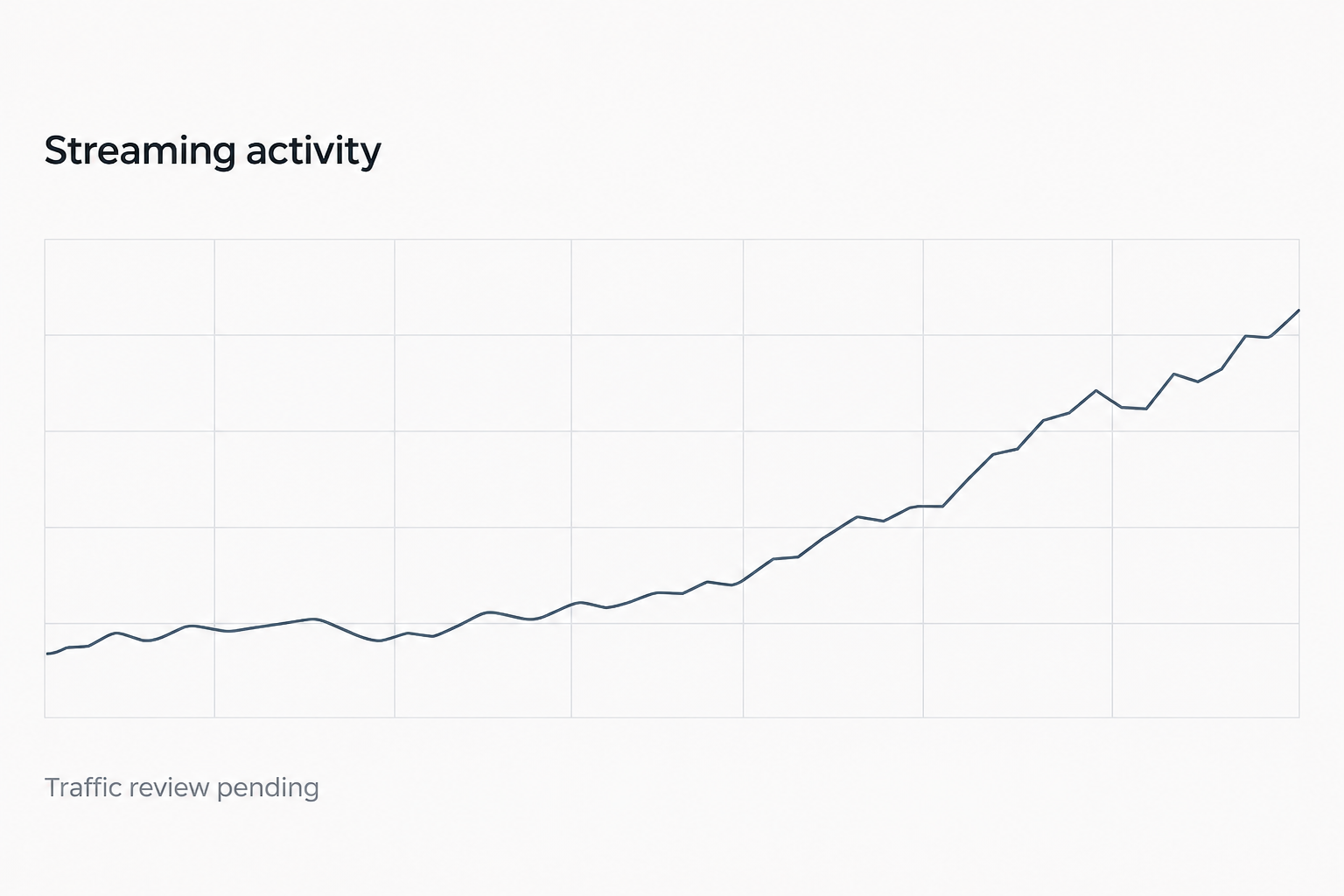
Your play count suddenly climbs, but nobody seems to be talking about the song. Depending on where the plays came from, that jump can mean very different things.
A federal music fraud case shows why the number alone can’t tell you whether you’ve found an audience. It can also tell you what to ask a promoter.
Overview
The case was about fake listening, not a style of music
The Guardian reported that Michael Smith pleaded guilty to conspiracy to commit wire fraud in a case involving streaming royalties.
The Justice Department later announced that Smith was sentenced to 18 months in federal prison in October 2026. The court also ordered $8,091,843.64 in forfeiture.
The scheme used purported songs, generally created with AI, and artificial plays that generated royalty payments. The fraudulent activity was not merely making or releasing music with software.
The $8.09 million figure describes the forfeiture order. It is not a bill sent to artists or a promise that each affected artist will receive compensation.
How a fake play can become a real business problem
Artificial listening can affect money that platforms pay out to rights holders. It can also distort the analytics artists use to decide where to spend their time and budget.
The details vary by service and agreement. A displayed play does not necessarily count toward the same royalty calculation across all services, territories, and reporting periods.
A promoter can sell a reassuring chart without giving an artist any lasting audience. That’s a separate risk from Smith’s conduct, but the case makes the difference easier to see.
No evidence in this case establishes that an artist bought one of his promotion offers. The guidance below is for musicians who encounter suspicious traffic or promotional claims themselves.
What to record before you speak to support
A screenshot might capture something unusual, but it won’t say how it happened. Collect records the platform or distributor can match to its own data:
- Identify the track and release, including the recording identifier if available.
- Note the service, reporting period, and date the change first appeared.
- Save playlist or referral information that your own tools already show.
- Keep the description and timing of any promotion you commissioned.
- Record when you first heard from the distributor or platform about the activity.
Don’t label a listener or playlist fraudulent just because a graph jumps. Use the information to ask for a review rather than to name a culprit.
How the Streaming Royalties Fraud Worked
Step 1: A catalog was presented for normal streaming
Smith’s scheme involved tracks whose rights he claimed and whose plays could generate royalties. Prosecutors said much of the music was created using AI.
Uploading a recording is an ordinary part of music distribution. The presence of a recording in a catalog isn’t what made the reported conduct fraudulent.
If you use synthetic tools to create music, read the rules your distributor and the platform apply. Disclosure, rights, and payments are separate from whether anyone actually chose to listen.
A catalog can contain many recordings without telling you much about an audience. That’s why the case is better understood by looking at the plays and the payments together.
Step 2: Automated plays stood in for audience interest
Prosecutors said fraudulent accounts generated artificial listening activity instead of representing people choosing to hear the tracks. The counts appeared where genuine plays would normally be measured.
A public total does not show how each play was assessed. Platforms and their partners may have more information than the graph available to an artist.
A legitimate audience spike can follow a playlist placement, a live performance, a news story, or a clip that gets shared. A spike alone doesn’t prove manipulation.
If your data looks odd, compare it with what you know happened that week. Give support the dates and the context.
Step 3: Reported activity produced real royalty payments
The government said Smith collected royalties based on the fraudulent plays. That is where the manipulation became a financial fraud, not simply a popularity claim.
It doesn’t follow that every platform pays a fixed amount for each listen. The payment counted in this case and a public stream total are different pieces of evidence.
In your own account, compare the reporting period and source of an adjustment. Artist dashboards, distributor statements, and actual deposits don’t necessarily update on the same schedule.
If something is missing, ask whether the issue concerns eligibility, artificial-stream filtering, late reporting, or your rights agreement. Each would send you toward a different record.
Step 4: A criminal case established what the chart could not
Smith pleaded guilty, and the later sentencing notice records the prison term and forfeiture. Those are findings about a specific person and case.
No independent artist should assume the same thing happened to them simply because their track was flagged. A platform notice calls for a documented inquiry, not an admission.
At the same time, don’t ignore an adjustment because you never wanted artificial plays. Ask the governing service or distributor how to report activity you didn’t order.
Save the exact notice and any deadline it mentions. Ask for clarification through your own account before replying to anyone who claims they can clear the flag for a fee.
How to Protect Your Releases From Fake Promotion
Ask what a campaign actually buys
A promotion service should be able to describe what it does without guaranteeing a number of streams. Ask whether you’re paying for an advertisement, pitching, reporting, or something else.
Spotify’s artist guidance warns against services that guarantee streams or placement in return for money. Check the equivalent rules for the platform and distributor you use.
Ask where an ad will appear and how you can confirm it ran. Seeing placement or billing records is different from accepting a screenshot of a play total.
Don’t share your artist-login credentials with someone to approve a routine campaign. Use official permissions where relevant and keep control of your own account.
Separate a strange spike from the reason it happened
Keep a small record of legitimate activity around a release: tour dates, ad periods, playlists you know about, and posts you shared. This helps you account for expected traffic.
If two platforms show different trends, don’t decide that one must be wrong. Audiences, reporting windows, and the availability of particular tracks can differ.
Check the date interval before comparing screenshots. A short burst grouped into one month can look different from a daily graph of the same activity.
Don’t remove a release just to see whether the problem goes away. Ask your distributor how it wants you to preserve the evidence and what a removal would affect.
Don’t let an unusually good report substitute for an audience
Check whether listeners return, save tracks, or show up in other channels you can observe. Those signs cannot rule out fraud, but they can help you ask better questions.
A campaign can be legitimate and still perform poorly. If a vendor won’t explain what it purchased or how it billed you, a rising graph doesn’t resolve that problem.
Ask for copies of the campaign terms and any changes. A promise to find listeners and a promise to manufacture a fixed count are not the same service.
If the vendor changes the offer after you raise a concern, save both versions. Your distributor or payment provider may ask what you originally authorized.
Match the release, the account, and the notice
A notice may identify the track by its recording code rather than the display title. Check that it matches the version in your distributor’s account.
Artists sometimes put out a live version, a remix, and a studio version under related titles. Make sure your report identifies the one the notice is actually about.
If you changed distributors, note when each one managed the recording. That information can help explain where an older statement or adjustment should appear.
Ask which document you should use to track a deduction or reversal. If a distributor issues a later correction, keep it beside the original rather than replacing the first record.
Some artists share a release with several rightsholders. Agree who will contact the distributor and preserve the reference so the others don’t have to reconstruct the timeline.
Check the relationship before paying for more work
Ask a promoter whether its invoice names the company you contacted. If it differs, find out why and decide whether you understand what you are being sold.
Don’t buy a second service that says it can move your traffic to another platform. First ask whether anything needs to change on the release you are actually disputing.
If you have manager access for a collaborator, ask who approved the campaign and what permissions were granted. Check those details without assuming somebody acted in bad faith.
Decide what a campaign report should contain before your next release. Keep the dates and placement records so you can compare them with later activity.
What to Do If Your Release Gets Suspicious Streams
Pause any promotion you can control
Stop a suspect campaign using the provider or account you control. Preserve the original agreement, schedule, communications, and invoices before closing out the work.
Don’t pay another service to replace flagged streams or change the appearance of the dashboard. Address the original records with your distributor first.
Open a case with a verified support route
Contact the platform or distributor through your known account. Give the track name, recording identifier, affected dates, and what your dashboard shows.
If you did not order the activity, say so. Distinguish between activity you didn’t expect and a contractor you can identify.
Keep payment records separate from traffic metrics
Download the royalty statement and any notice about deductions or penalties. Note which payment period and tracks the notice identifies.
Ask whether the issue applies to a track, a reporting period, or your account generally. Save the answer rather than filling in gaps from the chart.
Secure access if somebody else had permissions
If you shared a password or granted an unfamiliar tool access, use the official service to change credentials or revoke access as appropriate.
Check recovery email, other authorized users, and payout details. Report anything unfamiliar through the same verified channel rather than contacting a number in a message.
Review the promotion purchase through your payment provider
If you believe an outside service misrepresented what it sold, preserve the written offer and explain what you authorized. Ask what dispute route applies to that purchase.
Don’t describe a charge you approved as an unauthorized transaction. Keep the campaign dispute apart from the platform’s royalty or account review.
Follow up without publishing accusations you can’t substantiate
Ask for the case reference, next step, and any deadline. Keep originals and redact private details if you seek general advice from other artists.
Do not publicly name a listener, playlist, or vendor solely because you saw a spike. Let the relevant service assess the records you can provide.
Frequently Asked Questions
Was Smith convicted for using AI to make songs?
The case concerned wire fraud through artificial listening and the associated royalties. The use of generated material does not mean that every AI-assisted recording is fraudulent.
Check the rights and disclosure rules for your own releases. Separately, avoid trying to influence how plays are counted through artificial traffic.
How much money was covered by the court’s order?
The sentencing release says the court ordered forfeiture of $8,091,843.64. That figure belongs to Smith’s case, not to the market as a whole.
It also doesn’t tell a specific artist what they can recover. Ask your distributor or an independent advisor about your own records and agreement.
Does a sudden spike always mean someone bought plays?
Listeners can arrive quickly for many legitimate reasons. A chart alone doesn’t indicate who caused the increase or whether the platform classifies it as artificial.
Note when the increase began and what else happened around the release. Submit those details through a verified support route if you’re concerned.
Is every paid campaign a streaming scam?
Buying an advertisement is not the same as buying a guaranteed stream count. The campaign terms and the platform’s rules matter.
Ask what the vendor will deliver and how it can be verified. Stop if the offer depends on a result the platform prohibits.
What if I didn’t pay for promotion at all?
Tell the platform or distributor that when you report the activity. Include the relevant tracks and dates, and ask what further information they need.
Keep the original notices in case the service adjusts your royalties later. A record of when you first raised the issue can help with follow-up.
Can someone remove a flag for a fee?
Don’t pay an unsolicited person who claims they can clear it. Only the service handling the review can tell you which procedures apply.
Use the case number to check progress independently. A person who knows your artist name or track title doesn’t necessarily have a relationship with the platform.
The Bottom Line
Don’t treat a play count as proof you bought real promotion. Find out what a vendor actually does before you pay, and don’t buy guaranteed streams.
If your release gets suspicious traffic, preserve the records and contact the service through your own account. Let it assess the evidence rather than guessing from the graph.

Join the discussion
0 commentsShare your experience or ask a question about this article.
Community experiences
Did this happen to you?
Your experience could help someone recognize the same scam. Submit a private report for our team to review.
I experienced this tooReports are reviewed before publication. Sharing publicly is always your choice.
Discussion
Start the conversation
Have a question or something useful to share? Add the first comment.