


The seller says the print came from a respected foundation. There’s an invoice to back it up, and someone at an auction company has apparently vouched for it.
Those sound like two good reasons to trust the sale. In one Miami case, neither source was what the buyers were led to believe.
Overview
The fake Warhols came with a reassuring ownership story
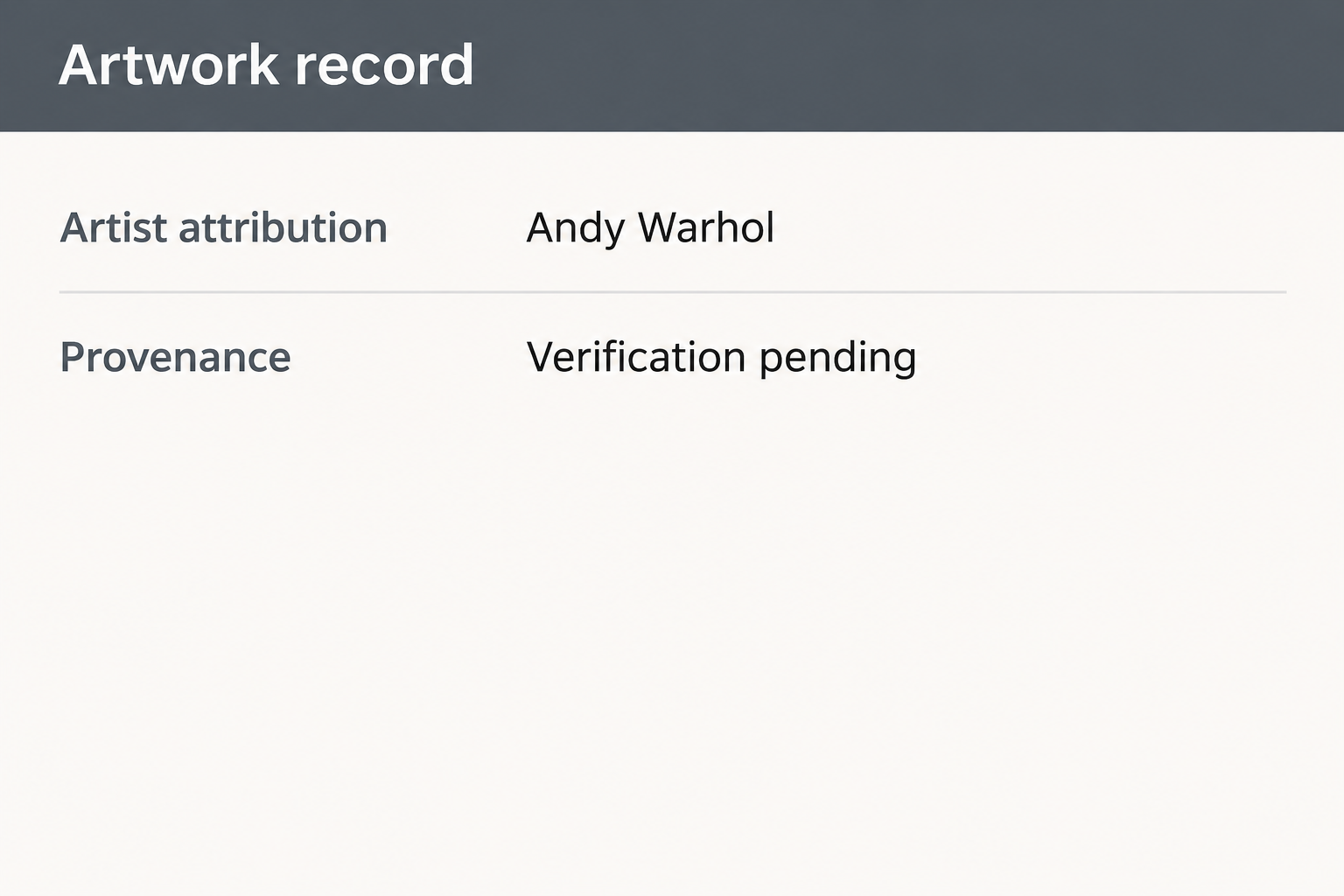
Miami art dealer Leslie Roberts pleaded guilty to conspiring to commit wire fraud in a case involving artworks he falsely represented as original works by Andy Warhol.
The Guardian reported that Roberts received a sentence of three years and ten months in October 2026. The works were sold through his Miami gallery.
Federal prosecutors said Roberts told buyers the artwork came directly from the Andy Warhol Foundation for the Visual Arts. The invoices appearing to come from the foundation were fraudulent.
This was not a case in which the foundation certified a fake. Its name was used to give the seller’s story an appearance of authority.
The apparent second opinion wasn’t independent
According to prosecutors, another man, Carlos Rodriguez Melendez, posed as an employee of a New York auction company and falsely verified artwork. He also pleaded guilty to conspiracy.
An apparent expert can sound independent even when the seller arranged the contact and controls what reaches you.
This wasn’t merely a disagreement about how much an artwork was worth. The case involved false representations about origin and authenticity, supported by fraudulent documents.
If you’re buying a work attributed to an artist, you don’t have to decide whether a document looks forged. First establish who can actually verify it.
Three questions for any important art purchase
Provenance is the history of a work’s ownership and movement. It can help explain where the seller got the work, but it’s not the same as an authentication opinion.
Before committing money, break a strong sales story into separate checks:
- Which exact work is being offered, and what is the stated attribution?
- Can the claimed source independently verify the records attributed to it?
- Did the expert assess this specific work, and can you contact them independently?
- What will the written agreement say if attribution or provenance is wrong?
- Who receives the money and who is responsible for resolving a dispute?
A seller may have good answers to some of those questions and not others. Don’t pay for certainty you haven’t actually obtained.
How the Warhol Art Fraud Worked
Step 1: A gallery provided the setting for a credible sale
A buyer dealing through a gallery may encounter familiar steps, including a description, an invoice, and someone available to answer questions. Those steps are common in legitimate sales.
The Miami case involved representations made through an existing gallery. An established setting did not make the specific works or documents authentic.
Ask who the contracting seller is before making a purchase. The gallery, a consignor, and an outside agent may have different roles even when they appear in one conversation.
Write down what the seller claims about the work itself. The fact that a gallery has sold genuine pieces doesn’t settle the attribution of the one in front of you.
Step 2: The dealer supplied a plausible source for the work
The dealer said he had obtained the pieces directly from the foundation. A recognizably authoritative name makes the gap between the seller and the artist seem smaller.
The question is whether that organization recognizes the exact contact and records. A name in the document’s heading isn’t enough to establish that it issued the document.
If a seller says a piece came from a particular organization, ask which record can substantiate that claim. Then seek confirmation outside the seller’s email chain.
It may be legitimate for some ownership details to remain private. That doesn’t require you to accept a specific claim without evidence.
Step 3: Documents appeared to back up the attribution
Prosecutors described false invoices and authentication documents. The documents made different parts of the story appear to support one another.
A genuine invoice can help explain a sale but doesn’t always establish artistic authorship. An expert’s opinion can address attribution without identifying every previous owner.
Compare the statements with the exact work for sale. A document about another impression, edition, or version may not answer anything about the specific item you’re considering.
If a seller gives you only an image of a document, ask how it can be verified. Keep the original image and any later explanation separately.
Step 4: The buyer heard what sounded like independent confirmation
The person posing as an auction-company employee was not independent. His reassurance came from someone who prosecutors said helped the dealer mislead buyers.
Contact the auction company using a number or address you found separately. Ask whether it recognizes the individual, the review and the work described.
A real employee’s name on a message does not authenticate the message either. The company should have a way to confirm whether that person sent it.
If the seller objects to independent verification, stop. Saving time for the seller isn’t a reasonable reason to accept an expensive uncertainty.
Step 5: The sales record mattered when the claims fell apart
A buyer may have a payment record long after an online listing or gallery message disappears. That’s why the description and the seller’s statements matter as much as the receipt.
Ask for the written terms before paying. You want the item description, the attributed artist, and any promises about origin in the record that governs the sale.
If you already own the work, preserve the materials you received with it. Don’t discard an envelope, attached record, or earlier version because someone sends a cleaner copy.
How to Verify an Artwork Before Buying It
Make sure everyone is describing the same item
Record the work’s title or description, dimensions, medium, and edition details if applicable. If a specialist uses a reference number, ask what it identifies.
An original work, an estate-authorized edition, and a later reproduction can be very different purchases. The name of the artist doesn’t tell you which one is being sold.
If you are buying a print, confirm that the description applies to that impression. Evidence about a related image is not necessarily evidence about the sheet you will receive.
Get the seller to state any uncertainty plainly. There is a difference between a listing that guarantees authorship and one that offers an attribution without that assurance.
Ask whether the description identifies the original artwork or a later edition. A familiar image can appear in more than one legitimate format with different prices.
If you receive photographs, record which ones the seller says show the item you will receive. Don’t assume a stock image depicts the specific piece.
Ask what the foundation or specialist actually does
The Andy Warhol Foundation’s FAQ explains its role and directs readers to relevant resources. Don’t assume a foundation provides on-demand authentication or vouches for a dealer.
Ask an independent specialist what kind of assessment they can provide. A condition report, a valuation, and an opinion about authorship do not mean the same thing.
Find out whether that person was able to review the work or only photographs. If their opinion has limits, ask that those limits appear in writing.
Ask who pays the specialist and whether they have a stake in the sale. A disclosed relationship doesn’t settle the reliability of the opinion, but it lets you evaluate it.
When a report discusses a piece by title alone, ask the expert how they matched it to the object. A title can be shared across related works.
If a catalogue entry is offered as evidence, find out what the entry covers. The fact that an edition exists doesn’t tell you whose copy you are buying.
An expert may conclude there isn’t enough information to decide. That is a useful result if it keeps you from paying a price premised on certainty.
Get the price and promises in writing
Make sure the invoice names the work, the seller, and the buyer accurately. Keep the agreement and the seller’s description together rather than relying on a short payment memo.
Ask what the process is if the sale description turns out to be inaccurate. A vague promise to make things right is harder to use than a written procedure.
Know whether the purchase is final, conditional on review, or subject to return terms. If you can’t get the agreement in a form you understand, hold off.
If a representative accepts money on the seller’s behalf, ask where that authority is recorded. Keep the written payment instructions with the agreement and proof of payment.
For a work that must be shipped, check who handles delivery and insurance. A shipping claim is separate from a dispute about what you agreed to buy.
What to Do If You Think You Bought a Forged Artwork
Preserve the artwork and everything that came with it
Keep invoices, correspondence, photographs, delivery records, and payment details. Do not remove labels or markings to see what is underneath them.
Save the exact seller description and any claimed endorsements. Record which statements were written and which you remember from conversations.
Arrange an independent review of the item
Use an expert who does not work for the seller and does not stand to gain from a resale. Explain precisely how the item was described.
Ask for a written opinion with its limits. The expert may distinguish condition, authorship, printing method, and provenance instead of giving one answer to all four.
Verify the paperwork through the alleged source
Use public contact details for the organization the paperwork names. Ask which details it can confirm without sending documents to an unverified address.
Keep the reply alongside the original files. If the issuer can’t confirm the document, that doesn’t mean you should accept a replacement from the seller without checking it.
Ask the payment provider what options apply
Explain how you paid, what the seller represented, and why you now dispute it. Ask about evidence requirements and deadlines before sending original materials anywhere.
If you paid in several installments, identify each transaction. Don’t assume the seller’s willingness to discuss it pauses a provider’s deadline.
Report suspected fraud and keep the case reference
If the case is in the United States, see the FBI’s art crime guidance. Use local authorities and verified reporting routes where you live.
For a significant dispute, consider independent legal advice before returning or reselling the work. A report doesn’t automatically resolve ownership or return your payment.
Avoid follow-up authentication and recovery pitches
Don’t pay someone who promises to restore the item’s value or obtain a refund. Verify who actually referred them to you.
If the seller offers a resolution, keep it in writing. Ask your advisor or payment provider before accepting a transfer, a replacement item, or a new agreement.
Frequently Asked Questions
Did the Warhol Foundation authenticate these works?
Federal prosecutors said the dealer used invoices falsely attributed to the foundation. Its name on those documents was part of the false representation, not a genuine endorsement.
If you receive similar paperwork in another purchase, ask what can be verified through the actual organization. Don’t rely on a seller’s preferred contact.
Does a certificate prove an artwork is genuine?
Only if you can assess who issued it, what they actually reviewed, and whether it refers to the work being sold. A certificate is a piece of evidence.
Check its origin independently and ask what kind of conclusion it expresses. A certificate for an edition doesn’t necessarily identify a particular impression.
Can an auction-house employee verify a private sale?
An employee’s real job doesn’t establish that they evaluated a particular work or were acting on the company’s behalf. Ask the auction company what it can confirm.
Use a contact route you found separately. A name and phone number offered by the seller are not an independent referral.
Is a forged work the same as a permitted reproduction?
A reproduction can be sold openly as a reproduction. The problem is when a seller represents a work as something it is not.
Read the buyer agreement, not just the title of an ad. The description should reflect what you are actually purchasing.
Should I return the work immediately if I suspect fraud?
Confirm who would receive it and how the return fits your dispute. Preserve records and seek relevant advice before shipping something that may matter as evidence.
Do not send original paperwork to a stranger promising to help. Share copies through a channel you can verify when copies are sufficient.
Can I rely on a past sale price for the work?
A price can give context if it concerns the same work and an independently documented sale. It doesn’t authenticate the work or its accompanying documents.
Start with what the work is and how its history can be checked. Price comparisons are more useful once those questions have sensible answers.
The Bottom Line
Don’t buy an artwork based only on paperwork and an expert supplied by the seller. Verify the stated source and the specific work independently before paying.
If you already bought it, keep the artwork and transaction records. Arrange an independent review and ask the payment provider what evidence it needs.

Join the discussion
0 commentsShare your experience or ask a question about this article.
Community experiences
Did this happen to you?
Your experience could help someone recognize the same scam. Submit a private report for our team to review.
I experienced this tooReports are reviewed before publication. Sharing publicly is always your choice.
Discussion
Start the conversation
Have a question or something useful to share? Add the first comment.