


A trading bot handles the difficult decisions, while your account keeps showing profits. Someone you trust has already withdrawn money and wants you involved.
BitConnect made that story travel around the world. Understanding what happened requires looking past the account balance and following the money behind it.
Overview
The investment story behind the name
BitConnect promoted a cryptocurrency lending program built around supposed automated trading expertise. Investors were told proprietary technology could turn market volatility into substantial, guaranteed returns.
The technical names helped sell that promise: the BitConnect Trading Bot and Volatility Software sounded like an explanation for profits outsiders could not independently see.
For someone watching cryptocurrency prices rise, the offer seemed to remove the hardest part: choosing trades while accepting the risk of losing money.
What established the fraud
US promoter Glenn Arcaro pleaded guilty to conspiracy to commit wire fraud in September 2021. His admission established deliberate deception, rather than disappointing investment performance.
The Justice Department describes the underlying Ponzi scheme: payments to earlier investors came from later investors, while money also benefited owners and promoters.
That distinction matters if someone presents an old withdrawal receipt as proof that the advertised trading system worked. A successful payment cannot establish its source.
- The lending program promised returns tied to supposed proprietary trading technology.
- Earlier participants received money supplied by people who invested after them.
- A promoter admitted the fraud through a criminal guilty plea.
- Restitution proceedings concern losses from that scheme, rather than a renewed investment opportunity.
Why recovery messages need separate scrutiny
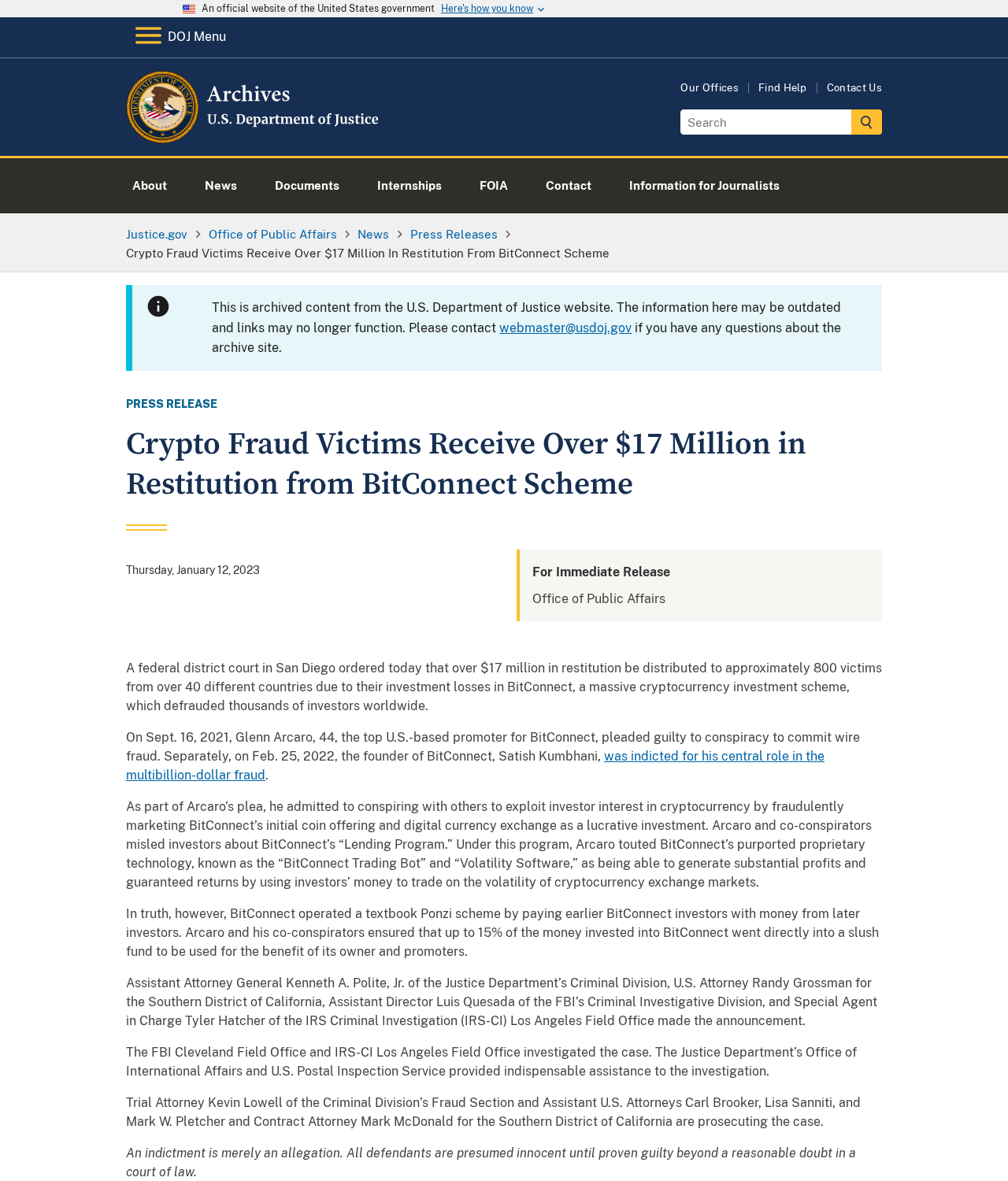
In January 2023, a federal court ordered more than $17 million in restitution distributed to approximately 800 victims across more than 40 countries.
That was a specific court order concerning identified victims. It does not establish an open application window today or authorize strangers to collect release fees.
If someone contacts you about BitConnect money, verify the particular proceeding before sharing documents. A real historic recovery announcement can be copied into a fraudulent message.
Why a Trading Bot Was Such a Persuasive Explanation
Most people cannot inspect an investment firm’s trading infrastructure. BitConnect used that information gap to put a technical explanation between investors and their questions.
Ordinary market volatility became part of the sales pitch. Price swings that should have prompted caution were presented as the very conditions the software could exploit.
That made the promise feel different from simply hoping Bitcoin would rise. Supposed expertise appeared to turn an unpredictable market into a dependable income source.
A named algorithm, however, tells you nothing about who controls the funds, whether trades occur, or whether reported results match money held outside the platform.
The missing connection was between the profits displayed to investors and independently verifiable trading gains. Technical terminology could not supply that connection.
Nor could another participant’s enthusiasm establish it. Someone may sincerely recommend an investment after receiving payments without knowing those payments came from subsequent deposits.
That is one reason the scheme could spread through personal relationships. Familiar people carried the recommendation, while the operator controlled the information needed to evaluate it.
How the BitConnect Scam Works
Step 1: Offer a shortcut around investment uncertainty
The starting point was the lending program’s promise of substantial returns. Investors were encouraged to believe specialized technology could handle the market on their behalf.
Instead of asking whether they could tolerate a loss, prospective participants were drawn toward the income they might receive while the system supposedly traded.
That changes the decision being made. The reader starts comparing expected earnings with everyday expenses before establishing whether the earnings have a real source.
Any investment can describe a strategy, but a strategy description is not evidence of execution. BitConnect’s bot story supplied confidence without supplying reliable underlying profits.
The guaranteed-return element should also be understood precisely. Cryptocurrency trading risk did not disappear because promotional material assigned the difficult decisions to software.
Step 2: Give the technology story a human advocate
Promoters connected that investment promise with potential participants. Arcaro admitted conspiring with others to exploit investor interest in cryptocurrency through fraudulent marketing.
A promoter’s confidence can feel like an answer to questions that remain unresolved. Personal conviction does not reveal the operator’s bank records or trading activity.
The risk becomes particularly difficult to assess when an invitation comes through a friend. Challenging the offer can feel like challenging that person’s judgment.
Separate those issues when considering a similar pitch. You can respect the person making an introduction while declining to send money into an unexplained arrangement.
Responsibility also needs evidence about each individual. Arcaro’s guilty plea does not mean every person who discussed BitConnect understood its finances or participated in criminal conduct.
Step 3: Use later deposits to fund earlier payments
The central deception concerned where the money came from. Earlier BitConnect investors were paid with funds supplied by later investors, rather than the advertised trading profits.
Imagine an account showing a $100 return. Receiving that $100 proves only that someone transferred it, unless the business can establish how it was earned.
That example explains the weakness in payment screenshots. They can document a transfer without documenting the supposed profitable activity that justified it.
A Ponzi scheme can therefore produce genuine receipts and genuinely pleased early participants. Those features help attract the additional money needed to continue payments.
The operator benefits when people interpret an early withdrawal as a completed test of the entire business. It tests access to one payment, not economic sustainability.
Step 4: Divert money while confidence grows
The Justice Department says Arcaro and his co-conspirators ensured that up to 15% of invested money entered a fund benefiting BitConnect’s owner and promoters.
For investors, that meant the money available was already being used differently from the trading story they had been sold.
Promotional success and investor protection were pulling in different directions. More participation could benefit the people selling the program without creating genuine trading earnings.
The important question was never simply whether the website looked active. Investors needed truthful information about custody, use of funds, and the origin of payments.
When those explanations are false, increasing deposits cannot fix the underlying problem. It only increases the amount exposed to the same deceptive arrangement.
Step 5: Leave investors sorting actual losses from displayed profits
After a scheme fails, an account screenshot may be emotionally important but financially incomplete. It can mix contributed funds, supposed earnings, and amounts already withdrawn.
That is why recovery records should start with transactions outside the platform: exchange exports, bank transfers, wallet addresses, and payments actually received.
The court’s restitution announcement concerns identifiable losses and victims. It should not be read as a promise that every displayed BitConnect balance will be paid.
Someone offering to unlock that entire balance for a new deposit is asking you to accept another unsupported promise about money.
The response now should focus on preserving accurate records and checking genuine case information, rather than paying to reactivate a supposed profit account.
BitConnect, Its Promoters, and the Court Cases
The program name does not identify every responsible person
Keep the names appearing in your own correspondence, receipts, and introductions. They may identify different participants with different roles in the original transactions.
A BitConnect reference alone does not tell investigators who solicited you, which representations you received, or where your particular payment went.
Record what you personally saw and heard. Distinguish that information from explanations added by other participants after the scheme became public.
A guilty plea and an indictment have different meanings
Arcaro’s guilty plea is an admission of criminal wrongdoing. The Justice Department separately announced founder Satish Kumbhani’s indictment in February 2022.
An indictment states allegations and is not a conviction. The founder’s procedural position must remain separate from the conduct Arcaro admitted.
That precision does not soften the confirmed Ponzi mechanism. It prevents a clear explanation of the scheme from inventing the outcome of another person’s case.
Later promoter proceedings do not restart the investment
Reporting about BitConnect continued in 2026, including an SEC settlement involving promoter Trevon James Brown. A later legal development concerns accountability for earlier conduct.
It does not make the original lending program a functioning opportunity again. Nor does it establish that an unrelated token or present-day offer is fraudulent.
Evaluate any new solicitation on its own evidence. Shared names and past associations deserve scrutiny, but cannot replace proof about the actual offer.
Restitution is administered through the relevant proceeding
The 2023 announcement identifies the court, the case context, and the victims covered by that distribution order. Keep its date attached to those facts.
It is not a current statement of money remaining, a universal eligibility decision, or an instruction to use a recovery agent found through social media.
If you receive case correspondence, retain the complete document and verify its sender independently. Do not use a contact supplied only by the person requesting payment.
What an Investment Receipt Can Actually Tell You
A useful record answers a specific question. A bank statement may prove a payment left your account, while a wallet transaction shows the receiving address.
A platform screenshot can help establish what you were told. It cannot independently prove that the displayed number represented assets available for withdrawal.
Keep those categories separate when calculating your position. Add contributions actually sent, record withdrawals actually received, and list displayed earnings in a different column.
If cryptocurrency was involved, preserve both the quantity and the transaction date. A later price change should not silently rewrite what originally moved.
Also save the messages surrounding each payment. A transfer reference without the associated promise can leave investigators missing the reason you agreed to send funds.
For an old account, use records you already control before trying unfamiliar login pages. A familiar logo does not authenticate a newly circulated website.
You should not need to connect a wallet, reveal a recovery phrase, or send cryptocurrency merely to read a public court announcement.
What to Do if You Have Fallen Victim to This Scam
-
Stop any new payment connected to the old balance. Do not send an activation charge, trading deposit, or supposed tax payment to a stranger promising release.
Keep the demand, receiving address, username, and time it arrived. Those details distinguish a new recovery approach from the original investment loss.
-
Build a transaction timeline before estimating recovery. Download records from the bank or exchange account you already use, and save copies somewhere you control.
For each transfer, record the date, amount, currency, destination, transaction identifier, and explanation you received. Mark missing information rather than filling gaps from memory.
Include withdrawals and previous repayments separately. This produces a record of actual money movement without treating promised earnings as contributed funds.
-
Contact the payment provider about any recent transfer. Use the number on your current statement or the support route inside your established exchange account.
Explain the deceptive investment or recovery demand, provide its transaction reference, and ask whether a pending transfer can be stopped or a recall attempted.
Request a case reference and written instructions. If the provider cannot reverse the transaction, preserve that response rather than paying someone who guarantees reversal.
-
Report the facts through the FBI’s complaint service. Start at IC3.gov, choose File A Complaint, read the terms, and select Accept if you agree.
Enter your contact details, actual losses, transaction information, and the names or accounts involved. Describe the BitConnect investment and any later recovery approach separately.
Review the information, complete the digital signature, and choose Submit Complaint. Save or print the successful-submission page before leaving it.
The IC3 instructions say you will not receive an emailed copy. If no confirmation appears, retain your notes and check the form for errors.
-
Verify any claimed restitution entitlement independently. Compare the proceeding and case details with the Justice Department announcement, then use the responsible office’s official contact route.
Ask whether the message concerns your existing claim, which documents are required, and whether any deadline applies. Do not assume the 2023 announcement opens new applications.
If nobody can authenticate the demand, stop before sending identity documents or money. Reporting a loss and qualifying for a distribution are separate processes.
-
Protect accounts if you disclosed access information. Change an exposed password through the genuine service and review unfamiliar sessions, recovery details, and recent activity.
A stolen wallet recovery phrase requires urgent wallet-provider guidance about securing remaining assets. Never give that phrase to someone offering investment recovery.
An investment loss alone does not establish that your device has malware. Focus additional account actions on information or access you actually exposed.
Frequently Asked Questions
Was BitConnect just a risky cryptocurrency investment?
No, its confirmed deception went beyond market risk. Arcaro admitted fraud, and the Justice Department describes payments funded by later investors rather than advertised trading profits.
Does an early withdrawal prove the bot worked?
A withdrawal proves a payment occurred, not its origin. Ponzi payments can reach real accounts while coming from subsequent participants instead of profitable trading.
Was every BitConnect participant convicted of fraud?
No, legal outcomes belong to particular defendants. Arcaro’s guilty plea must not be transferred to ordinary participants or confused with the founder’s separately announced indictment.
Can everyone apply for the $17 million distribution?
The January 2023 announcement concerned a specific restitution order and identified victims. It does not establish a new application opportunity for everyone reading it today.
What should I preserve if the website disappeared?
Keep bank and exchange exports, wallet transaction identifiers, messages, original promotional claims, and any existing claim correspondence. Missing website access does not erase those records.
Should I pay someone who guarantees recovery?
Do not pay based on a guarantee or copied court announcement. Authenticate the particular proceeding and contact before considering any request involving your money or documents.
The Bottom Line
Do not put money into a revived BitConnect pitch or pay to unlock an old balance. The trading story concealed payments funded by later investors.
If you lost money, organize actual transactions, report any fresh recovery approach, and verify case correspondence independently before sharing sensitive records or taking further action.

Join the discussion
0 commentsShare your experience or ask a question about this article.
Community experiences
Did this happen to you?
Your experience could help someone recognize the same scam. Submit a private report for our team to review.
I experienced this tooReports are reviewed before publication. Sharing publicly is always your choice.
Discussion
Start the conversation
Have a question or something useful to share? Add the first comment.