

An unpaid-ticket warning can make your day stop for a moment. The message says your ability to drive depends on dealing with it right away.
Before reaching for a card, look at the agency named in that warning. In Alabama, that detail deserves more attention than the deadline.
Overview
The text invents an agency to make the fine look official
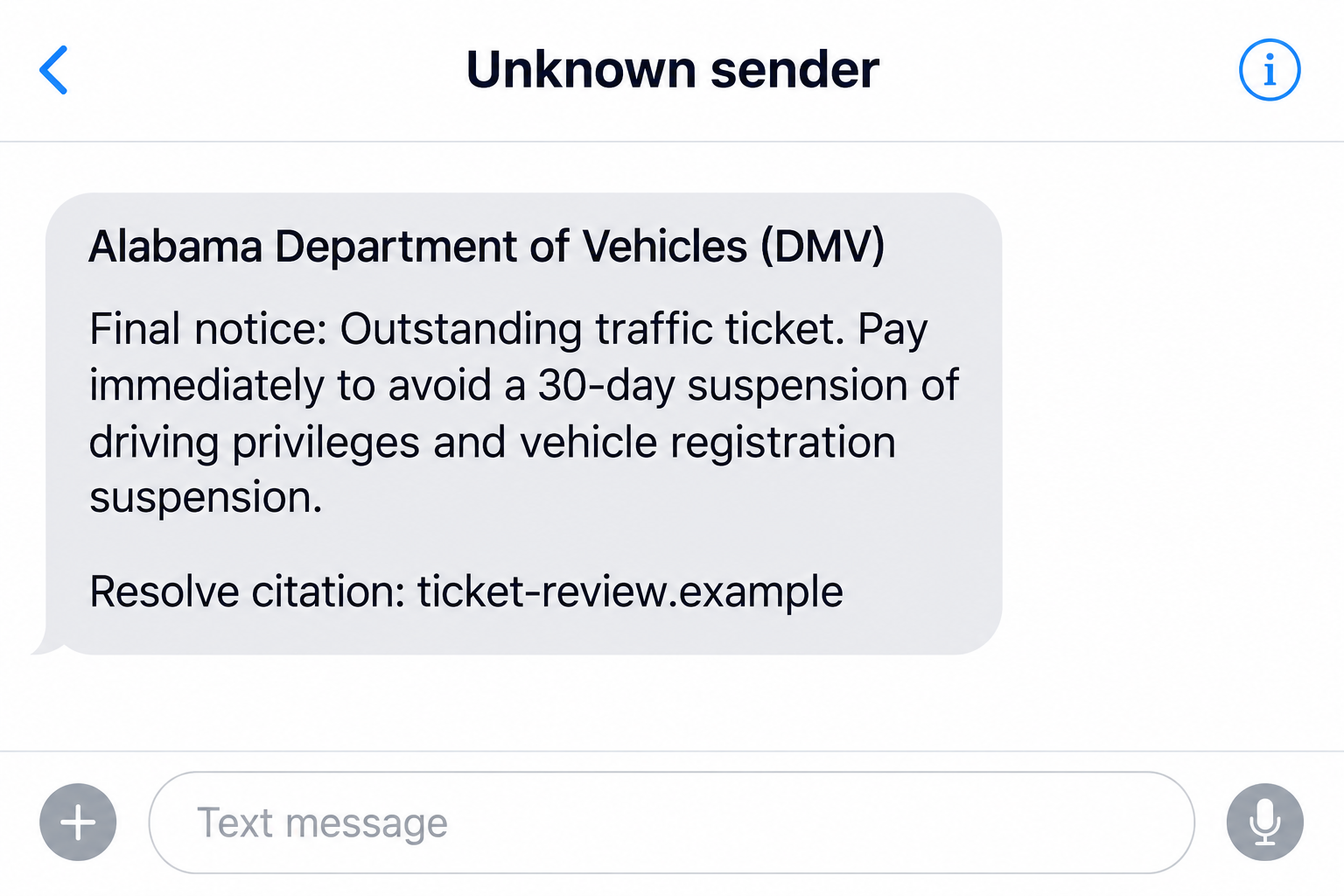
The Alabama DMV text scam claims to represent an Alabama Department of Vehicles. It says an unpaid traffic ticket could lead to suspension unless you act.
There is a basic problem with that claim: ALEA’s official warning says no such state entity exists.
The image is a fictional interface illustration of the documented demand. It isn’t an original received notice, and the example website cannot accept a payment.
The threatened penalties belong to the impostor’s story
The Alabama Law Enforcement Agency identified texts threatening a 30-day loss of driving privileges and suspension of vehicle registration.
The sender directs recipients toward a malicious link or requests personal information. Those instructions are not a verified route for handling an Alabama ticket.
- Claimed sender: A supposed Alabama Department of Vehicles, often shortened to DMV.
- Alleged problem: A traffic ticket the recipient must supposedly resolve.
- Leverage: Threats involving driving privileges and registration.
- Point of risk: Following the supplied route and surrendering money or information.
Alabama’s real services are divided among actual offices
ALEA handles driver licensing. Vehicle registration falls under the Department of Revenue, while local offices handle plate issuance.
A traffic citation is another question again: the responsible court or authority must be identified from genuine records, not from a stranger’s text.
Understanding those separate roles helps you check the right concern without letting an invented agency collect everything in one place.
Why the Alabama DMV Name Is a Useful Warning Sign
A familiar abbreviation can conceal the wrong organization
People use DMV casually when talking about driving paperwork. An impostor can borrow that familiar shorthand even when the official structure in your state is different.
You don’t need to know every department’s full title to protect yourself. The suspicious part is the message claiming authority while demanding immediate action through its own route.
The precise fictitious agency identified by ALEA is the Alabama Department of Vehicles. Its official-sounding name does not create a real government office.
That doesn’t make every website containing DMV fraudulent. Alabama Revenue’s own website links to a genuine MyDMV service, so context and destination still matter.
The message combines consequences from different parts of your life
A license affects whether you may drive. Registration concerns the vehicle. A ticket concerns an alleged incident and the authority handling it.
Putting all three into one urgent paragraph makes the problem feel bigger. You may feel that a single missed payment is about to affect everything.
Don’t try to untangle those threats inside the suspicious conversation. Choose the actual record you’re worried about and approach its responsible office independently.
How the Alabama DMV Text Scam Works
Step 1: An official-looking label introduces a ticket you weren’t checking
The message arrives under a motor-vehicle authority’s supposed identity. Its claim asks you to treat the text as an update to a government record.
You may wonder whether a notice went missing or whether someone else drove the vehicle. Those questions can make an unfamiliar ticket seem plausible.
The sender hasn’t answered them. A state name, abbreviation, or administrative-looking heading is not evidence that the message came from the office responsible for your record.
Start with the paperwork and information you already trust. An unexplained demand should not become your main source of facts about a real citation.
Step 2: Suspension threats turn checking into an emergency
Next, the text links the alleged unpaid ticket to threatened consequences. The documented version invokes a 30-day driving suspension and action against vehicle registration.
You may start worrying about tomorrow’s commute instead of questioning today’s sender. Paying can feel like the fastest way to keep your plans intact.
Read the suspension as a threat the impostor made, not confirmation that a restriction exists. The warning alone does not tell you your current status.
If you have an independent reason to believe a real restriction exists, verify it through the appropriate official service before making decisions about driving.
Step 3: The message supplies a convenient place to resolve its own claim
The sender offers its own shortcut: follow this link or provide the requested information. That keeps you in a process the stranger controls.
A polished page can make that handoff feel routine. A logo, payment label, or government-style heading still doesn’t identify who controls the form.
ALEA warns that these messages use malicious links and seek personal or financial information. There is no need to explore one to see whether its checkout looks convincing.
Leave the alleged balance unresolved in that conversation. You can investigate an actual ticket elsewhere without giving the sender another piece of information.
Step 4: The recipient is asked to trust the process with sensitive details
The risk grows when someone enters payment or identity information because they believe they are satisfying a government requirement.
Disclosure and payment are different events. A form can expose information even when no charge appears, so an unsuccessful payment does not automatically end the concern.
The public warning doesn’t describe every screen or field behind every circulated address. Recovery should therefore follow the specific details a person actually supplied.
Don’t send a second card, another document, or a login code to correct an error reported by an untrusted page.
Step 5: The false process may continue after the first interaction
Someone who follows the instructions may remain focused on whether the alleged suspension has been avoided. That can delay contacting the actual financial provider.
A receipt from an unverified site is not proof a court or state office received money. Check the transaction and any real record through separate channels.
If a later contact offers to finish the payment or resolve the account, verify that person independently too. Do not let the original text introduce its own investigator.
Where to Take Each Genuine Alabama Driving Concern
Driver-license questions belong with ALEA’s published services
Use the ALEA Driver License page as an independent starting point. Follow its own service links for the task you actually need.
Don’t search for the invented agency and assume the highest result is official. Use a reliable state-government route before entering private driver information.
If your concern is a restriction rather than a routine renewal, explain that distinction to the appropriate office. A generic payment page cannot answer every licensing question.
Registration and plates need their own verified route
ALEA’s advisory distinguishes Revenue’s registration role from driver licensing. That matters when a message insists the supposed DMV handles both through its payment link.
Start at the actual Alabama Department of Revenue website for vehicle-related information, then follow the official directions for the service or local office involved.
Have genuine renewal paperwork available if you need assistance. Don’t send a photograph of it to the unsolicited sender just to learn what the message means.
An official online vehicle service can legitimately ask for relevant details. The safeguard is reaching that service independently, not declaring all online requests fraudulent.
A real ticket must match an actual issuing authority
If you possess a genuine citation, identify the court or office named on it. Locate that authority through an established government website or official contact directory.
Ask about the citation reference and the next required action. Do not read out payment instructions from the text as though the authority supplied them.
If the official record differs from the message, deal with the real record. Keep any legitimate receipt or confirmation distinct from the suspicious interaction.
Finding a fake collection demand does not excuse ignoring authentic paperwork. Equally, authentic paperwork does not authorize an unknown person to collect a payment from you.
Helping a Relative Who Is About to Pay
Offer a practical pause instead of an argument
Ask them to stop before entering anything else and show you the message. Focus on identifying the responsible office together, not on whether they should have noticed sooner.
If they’re worried about losing transportation, acknowledge that concern. Offer to help locate the official licensing or court route so the question gets a real answer.
Don’t forward their full license image or account details to other relatives for opinions. Share only what is needed to explain the warning.
If they already shared information, move to the relevant provider
Help them find the genuine bank app or account-recovery page. Explain what happened plainly and let the provider assess the information exposed.
If a caller is still directing the process, end that conversation. Assistance from someone they know can make it easier to leave a frightening interaction.
Keep a brief record of actions taken so another family member doesn’t accidentally restart contact with the impersonator while trying to help.
What to Do if You Have Fallen Victim to This Scam
Start at the level of contact that actually occurred. A text you deleted unopened does not require the same financial response as a completed payment form.
- Write down the interaction before taking further instructions.
Note whether you only saw the text, visited the link, submitted a form, transferred money, or installed something. Keep existing message screenshots and transaction references.
Don’t revisit a suspicious address for a more complete record. Your current evidence can still help explain the incident without repeating the exposure.
- Report exposed payment details to the financial institution.
Use an established contact method to tell the issuer or bank which details you disclosed. Ask what restrictions or replacement steps fit that exposure.
If you paid, identify the transaction separately from any later activity you did not authorize. The provider needs an accurate description to evaluate possible recovery.
Keep its instructions and reporting reference. A promised reversal from the suspicious sender is not a reason to delay contacting your institution.
- Recover any account access the page may have collected.
Where you entered a password, replace it at the actual service and address reuse on other accounts. Review recovery contacts and sign-in activity when available.
Add available multifactor protection. If a code or approval was also supplied, tell the service so its response isn’t limited to a password change.
- Get guidance for identification information you disclosed.
If you provided a license image, license number, Social Security number, or other sensitive record, explain that exposure through the relevant agency’s verified channel.
The FTC’s identity-recovery service can help you plan appropriate next steps. Don’t assume that every kind of data requires an identical response.
Receiving a text is not evidence that your official record was breached. Base the report on what you actually shared or discovered.
- Separate device checks from financial protection.
If the page led you to install an application or accept unusual access, stop following its guidance. Seek reliable help to review the change.
Malwarebytes may help examine supported devices for malicious software. AdGuard provides ad and tracker filtering for supported browsing setups.
Neither service can validate a ticket, cancel a bank transfer, or replace account recovery. If you only read the text, don’t assume your device needs wiping.
- Use official reporting and payment-recovery channels.
Make a fraud report through ReportFraud.ftc.gov and report the unwanted text using your provider’s supported method, including 7726 where available.
For money sent, follow the FTC’s payment-method guidance and contact the actual provider promptly. Getting funds back is not assured.
After saving necessary evidence, delete the text. Decline later demands for a fee to remove the alleged suspension or recover a payment.
Frequently Asked Questions
Is there an Alabama Department of Vehicles that sends ticket texts?
ALEA says that named state entity does not exist. The documented text uses its supposed identity to demand money or information over a nonexistent ticket.
Does that mean Alabama has no genuine online DMV services?
No. Revenue’s official website provides a MyDMV route, and ALEA has driver-license services. Those genuine services don’t authenticate the unsolicited collection text.
Is the threatened 30-day suspension already on my record?
The message does not establish that. Check a real licensing concern with ALEA rather than taking the impostor’s claim as a statement of your status.
What if my vehicle registration really is due?
Use the official registration process and your genuine renewal information. A real renewal date doesn’t make the text’s sender an authorized collector.
Can I pay a small amount just to avoid trouble?
Don’t use a payment as a test. It can expose financial details without resolving any actual obligation. Check the relevant authority first.
Should I ignore a genuine court letter after receiving this scam?
No. Verify the letter through the court’s independently located contact route. Handle authentic requirements separately from the fake DMV demand.
The Bottom Line
Refuse the Alabama DMV text’s payment instructions. The named Department of Vehicles is not a real state agency, and ALEA has warned about the impersonation.
Take licensing questions to ALEA, registration concerns through Revenue’s official services, and real citations to the responsible authority. Don’t let the message combine them into an invented collection process.
If you already provided money or sensitive details, contact the relevant institution and begin recovery. Waiting for the alleged ticket to disappear leaves the actual exposure unaddressed.

Join the discussion
0 commentsShare your experience or ask a question about this article.
Discussion
Start the conversation
Have a question or something useful to share? Add the first comment.