

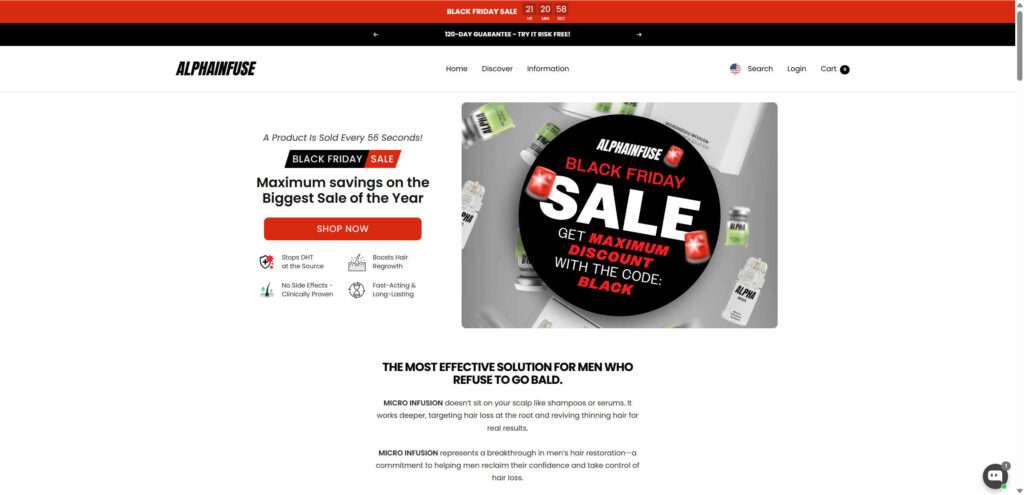
If you’ve been scrolling through social media lately, chances are you’ve seen an ad for AlphaInfuse, a “microneedle hair regrowth solution” that claims to stop hair loss, boost regrowth, and deliver “clinical-level results without side effects.”
The ads are hard to miss — sleek packaging, dramatic before-and-after photos, and promises of thicker hair in just a few weeks. Some influencers even call it a “breakthrough treatment that stops DHT at the source.”
But does AlphaInfuse really deliver on these claims? Or is it just another online marketing operation built on bold promises and borrowed photos?
This review takes a detailed look at the company, its claims, ingredients, sourcing, and customer feedback — to help you decide if AlphaInfuse is worth your money or best avoided.
What Is AlphaInfuse?
According to its official website, AlphaInfuse is a “microneedle infusion hair regrowth system” designed to reverse hair loss by stimulating follicles, improving scalp circulation, and blocking DHT — a hormone linked to pattern baldness.
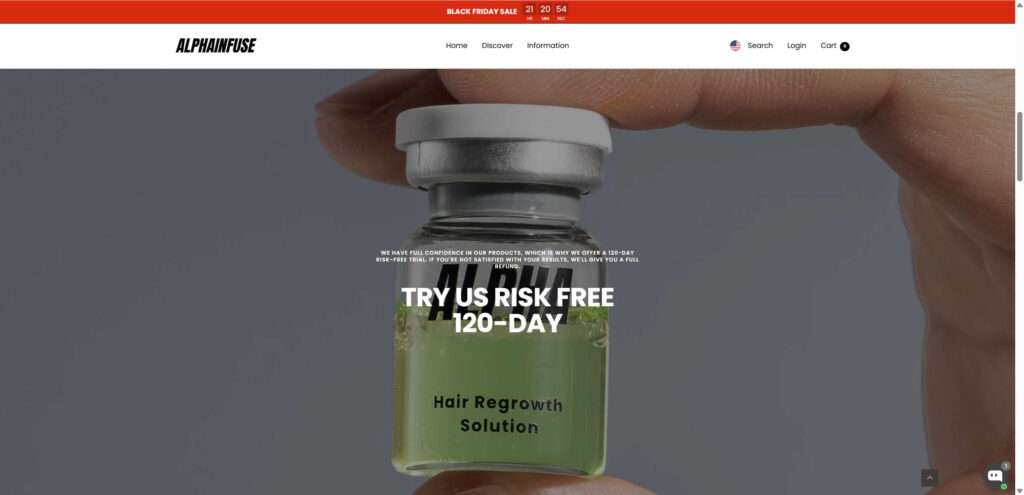
The system consists of:
- A microneedle applicator
- Vials of “Hair Regrowth Solution” containing a green serum
- Instructions to use it once or twice a week for best results
The product is marketed toward men experiencing thinning hair, receding hairlines, or early-stage baldness. It claims to:
- Regrow visible hair within 4–8 weeks
- Strengthen existing hair and prevent shedding
- Be safe for all hair types and ages
- Provide “no-side-effect” results comparable to prescription treatments
The official site even lists features like:
“Clinically proven,” “Fast-acting,” and “No scars, no surgery.”
The presentation looks professional — but that’s where the red flags start to appear.
Red Flags in AlphaInfuse’s Marketing
1. Recently Registered Website
A WHOIS check reveals that the alphainfuse.com domain was registered only a few months ago.
Despite this, the site claims:
“A product is sold every 56 seconds”
and
“Trusted by 95,000+ customers.”
Such claims are impossible for a newly launched company unless they’re inflated or fabricated for marketing impact. There’s also no evidence of any real business registration or verified address.
2. No Transparency About the Brand
Legitimate cosmetic or wellness brands list a physical office, contact details, and company registration.
AlphaInfuse does not.
There’s no corporate address, founder information, or third-party lab verification — only a contact form.
The lack of traceability means customers have no idea who actually makes the product or where it’s being shipped from.
3. Over-the-Top Clinical Claims
The site suggests AlphaInfuse is “clinically proven to stop DHT and regrow hair” — yet it provides no medical references, studies, or certificates.
Terms like “clinically proven” are often used loosely in advertising.
In this case, there’s no citation, trial data, or dermatologist endorsement anywhere to back it up.
4. Recycled Before-and-After Photos
Perhaps the biggest red flag comes from the images used on the site.
When one of the “real customer transformations” is reverse-searched on Google, it matches Reddit posts from 2–4 years ago from users who were actually documenting their results using Minoxidil and microneedling, not AlphaInfuse.
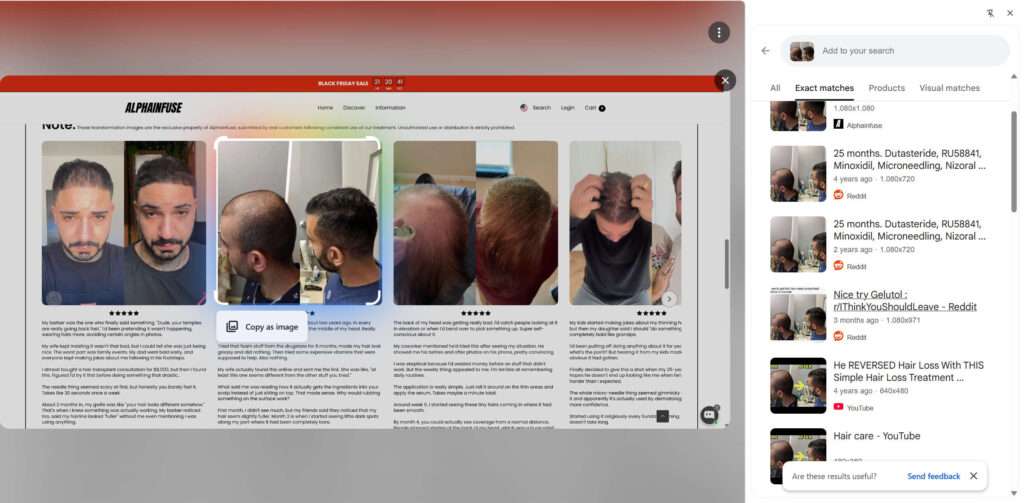
In other words, AlphaInfuse used unrelated photos from Reddit hair-loss forums as fake testimonials.
That’s a clear indicator of deceptive advertising — a common tactic among short-term dropshipping operations.
5. The Same Product Exists on Alibaba
Identical microneedle hair regrowth kits — with the same packaging and green serum vials — are available on Alibaba and AliExpress for as little as $4.90–$5.50 per set, under generic names like “Microneedle Hair Regrowth Solution” or “Herbal Hair Thickening Serum.”
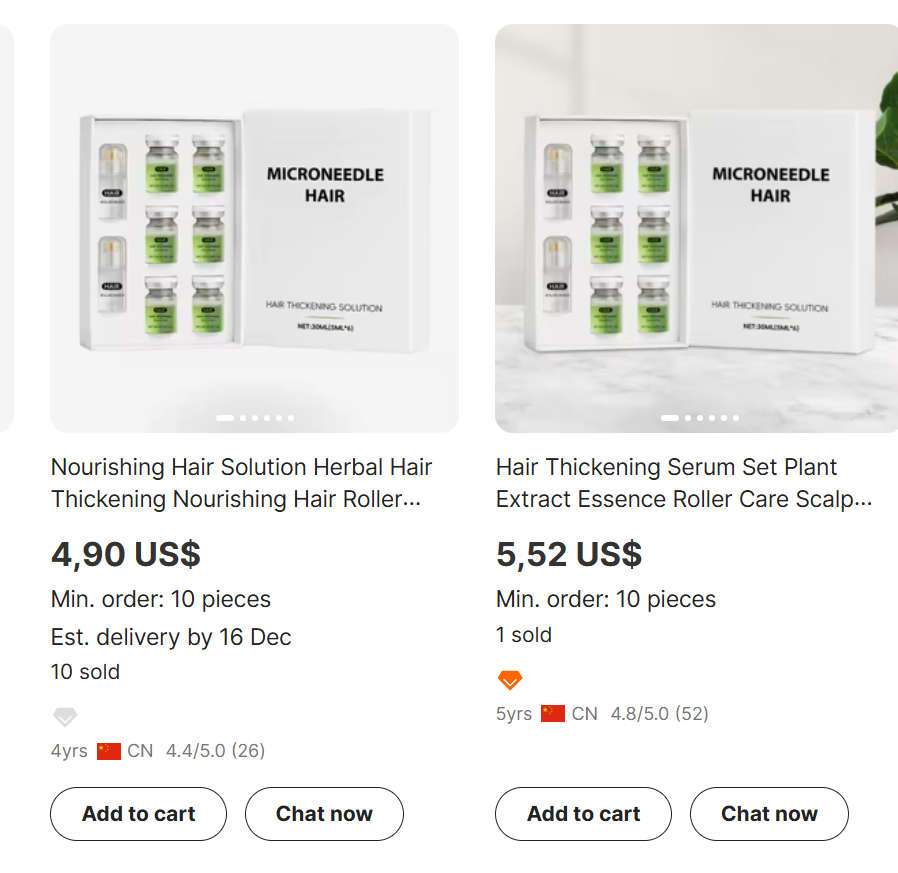
These are unbranded OEM kits manufactured in China that can be privately labeled by anyone.
AlphaInfuse’s version appears to be the same imported product, rebranded and resold at a huge markup, typically around $100–$250 per box.
While there’s nothing illegal about private labeling, the problem arises when sellers market the same low-cost formula as a “clinical breakthrough.”
How the AlphaInfuse Operation Works
Based on available evidence, AlphaInfuse fits the model of a high-markup dropshipping skincare and wellness brand. Here’s how it typically works:
Step 1 – Import Generic Hair Serum Kits
Suppliers on Alibaba sell “microneedle hair serum” kits for under $6.
These products have no FDA or EMA approval, and ingredient quality can vary widely.
Buyers (the dropshippers) order these in bulk or list them directly on their own site using supplier photos.
Step 2 – Create a Premium-Looking Brand
A polished Shopify storefront is built with:
- Professional stock photography
- Black-and-white “science” visuals
- “Clinically proven” and “120-day guarantee” claims
- AI-generated or copied customer reviews
The design mimics premium brands like Keeps or Nutrafol to gain instant trust.
Step 3 – Use Fake Before-and-After Photos
They scrape real transformation photos from Reddit or YouTube videos of Minoxidil users — then repackage them as AlphaInfuse results.
In one case, a before-and-after image on the AlphaInfuse website was a direct copy of a Reddit thread titled “25 months on Minoxidil, RU58841, and Microneedling.”
Step 4 – Launch Aggressive Ads
The brand runs paid ads on TikTok, Instagram, and YouTube Shorts promising “clinical hair regrowth without side effects.”
Limited-time deals and countdown timers push urgency to “buy now.”
Step 5 – Short-Term Operation
Once complaints or refund requests build up, many of these brands quietly rebrand under a new name or domain, repeating the cycle.
What to Do If You Ordered AlphaInfuse
If you’ve already purchased the product and are concerned:
1. Save All Documentation
Keep screenshots of:
- Order confirmation
- Payment receipt
- Website pages and ads
- Any correspondence with customer support
2. Request a Refund
Use the site’s contact form and clearly state:
“I am requesting a full refund due to misleading product claims and unverified brand information.”
If you don’t receive a response within 7 days, escalate to your payment provider.
3. File a Chargeback
- If you paid via credit card: contact your bank and open a chargeback claim for “product misrepresentation.”
- If you used PayPal: file under “Item Not as Described.”
Attach screenshots showing identical $5 Alibaba kits and reused images from Reddit — these help prove deception.
4. Report the Site
You can submit reports to:
- FTC (reportfraud.ftc.gov)
- Better Business Bureau (bbb.org)
- Consumer protection agencies in your country
5. Warn Others
Leave honest reviews on Trustpilot, Reddit, or social media to help others avoid the same issue.
Should You Buy AlphaInfuse?
Based on all available evidence, AlphaInfuse appears to be a rebranded version of a generic microneedle hair serum kit sold through dropshipping channels, not a scientifically tested hair-growth solution.
While microneedling itself can support regrowth when done correctly, there’s no proof that AlphaInfuse’s serum contains any clinically effective ingredients — or that it’s made under safe conditions.
The lack of company transparency, fake images, and exaggerated claims make this product a high-risk purchase for consumers.
Safer, Proven Alternatives
If you’re serious about addressing hair loss, consider verified solutions that have medical or clinical backing:
- Minoxidil (Rogaine, Kirkland, Regaine)
– FDA-approved for both men and women.
– Available in foam or liquid. - Finasteride (Keeps, Hims, Roman)
– Clinically proven to block DHT at the root cause.
– Available via licensed telehealth providers. - Derma-rolling (Under Dermatologist Supervision)
– Real microneedling can help — but only with sterile tools and trusted topicals. - Low-Level Laser Therapy (LLLT)
– Safe, clinically tested technology for stimulating follicles.
Each of these has verifiable data, proper labeling, and professional oversight — unlike AlphaInfuse.
Bottom Line
AlphaInfuse markets itself as a cutting-edge microneedle hair-growth breakthrough, but evidence suggests it’s a generic, re-labeled serum kit being resold at a massive markup.
There’s no transparency about who manufactures it, what ingredients it contains, or how the company verifies safety claims.
While the branding and website look professional, the use of unrelated before-and-after photos, unrealistic marketing language, and missing business details are serious warning signs.
Verdict: Buyer Beware
AlphaInfuse is not recommended for anyone seeking real, medically supported hair-regrowth solutions.
Stick to proven treatments or consult a dermatologist for personalized options.

Reviews & discussion
0 commentsShare a firsthand experience, or ask a question.
Community reviews
AlphaInfuse Hair Serum
Moderated reader experiences, not an editorial verdict.
Start the conversation
Have a question or something useful to share? Add the first comment.