

A stranger asks whether an ATM Visa card works in your country. A few lines later, the conversation involves $9.5 million and a share for you.
The question sounds practical. The arrangement behind it needs a much closer look before you send anything back.
Overview
An unsolicited card offer promises half of a fortune
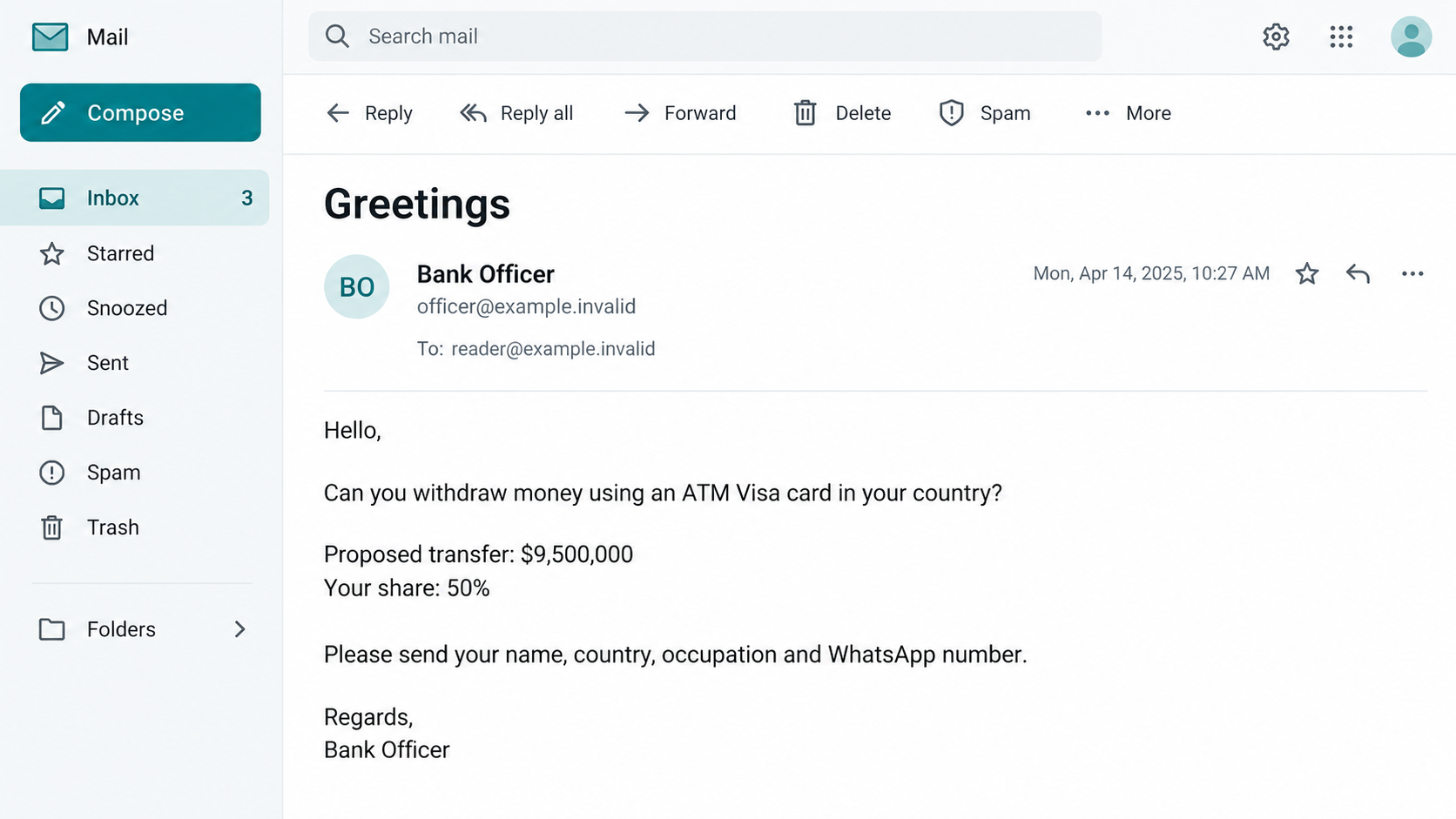
The ATM Visa card email scam claims that a bank employee can arrange access to $9.5 million. The recipient is offered a 50% share.
The sender says a bank account and card would be placed in the recipient’s name. Withdrawals supposedly would be divided between the recipient and the sender.
The reported message claims an association with United Bank for Africa. That is an impersonation claim, not evidence that the bank or Visa authorized the arrangement.
No transferred funds, approved account or usable card is established. The offer is an advance-fee and personal-information lure, not a legitimate financial opportunity.
The first request is for a profile, not a payment
The email asks for personal details to continue. A WhatsApp number would also give the sender a more direct way to maintain contact.
- The supposed pool is $9.5 million.
- The promised split is 50% for each party.
- The request includes name, age, sex, country and occupation.
- The sender also asks for a WhatsApp contact number.
Administrative or transaction fees could follow once a recipient engages. The initial message does not establish that a particular fee was demanded or paid.
That distinction matters. You can reject the arrangement without inventing later events, and assess your exposure accurately if you already replied.
Why the card story does not verify the money
A promise to send a card is not a bank balance. Nor does an account supposedly being opened in your name establish your lawful entitlement to someone else’s funds.
The sender describes the money as connected to a former politician. That narrative is unverified and should not be repeated as a factual accusation about a real person.
The illustration uses fictional email details and a simplified message. Its date and appearance are not recovered evidence from a recipient’s account.
Do not reply with more information or pay to continue. If money or identity documents have already changed hands, deal with that specific exposure through real providers.
Why an ATM Card Makes the Fortune Seem Reachable
A huge international transfer is difficult to picture. Withdrawing a little money from an ATM is familiar, so the card turns an implausible story into an everyday task.
The sender begins by asking whether such a card would work locally. Answering that question may feel harmless compared with accepting the full financial arrangement.
Once the conversation starts, the recipient can be treated as a participant rather than someone still evaluating an unsolicited pitch.
The 50% share supplies the motivation to keep listening. Against a promised fortune, an eventual small processing charge may look inexpensive.
That comparison uses money that has not been established to exist. The sender’s numbers should not determine how much you are willing to risk.
A photo of a card, a payment certificate or an online balance could be added later. None would independently prove that the promised funds belong to you.
You do not need to ask for those documents to test the sender. Continuing the exchange gives the person another chance to tailor the story.
A genuine banking relationship can be established through the bank itself. A stranger offering secret access to someone else’s money is not that relationship.
How the ATM Visa Card Email Scam Works
Step 1: Present an Insider Who Claims to Control the Funds
The sender says they work for a bank and can change account details. This supposed insider access explains why the money is available to an unknown recipient.
It also discourages independent verification. If the arrangement depends on special access, checking with the actual bank may be portrayed as unnecessary or inconvenient.
Do not accept that framing. A claimed job title is not proof of employment, and employment would not validate the proposed use of funds.
The mention of a politician adds drama and an apparent origin story. It does not provide an account record, ownership proof or a legitimate reason you were selected.
United Bank for Africa is a real institution with an official public website. Its name being copied into an email does not make the sender its representative.
Keep the impersonation separate from the institution. There is no evidence here that a named real employee or the bank organized this campaign.
Step 2: Ask for Details That Make the Recipient Part of the Story
The initial questionnaire collects a basic personal profile. The sender says this information will be used to arrange the account and card.
A person who submits it may expect the next message to contain progress. That expectation makes further questions feel like completing an application rather than entering a new risk.
Name, country and occupation are not the same as a password or identity document. Their disclosure does not automatically give someone control of your bank account.
They can still improve later impersonation and persuasion. A sender who knows your circumstances can make a follow-up sound more relevant.
A WhatsApp number creates another contact route. The conversation may move away from the original email while retaining the same unverified financial story.
Do not respond with invented details as a test. It keeps the conversation active and provides no reliable way to establish the sender’s authority.
Step 3: Make Costs Seem Like Obstacles to Money Already Promised
Advance-fee schemes commonly introduce a charge before releasing the supposed benefit. The explanation may involve administration, delivery, transfer or approval.
The exact charge is not documented in the opening email here. Treat any later payment demand as an additional request, not as a step already verified by this article.
The pressure comes from the comparison: a modest fee beside a promised 50% share of millions. But the large figure remains a claim controlled by the sender.
Paying once can make another demand harder to refuse. You may believe stopping would waste the first payment or abandon money that is nearly within reach.
That feeling does not establish a release process. A legitimate provider should be able to explain a real account and fee independently of the person seeking your payment.
Do not send card details, cryptocurrency or gift-card codes to prove your seriousness. Those payments would not authenticate the proposed card or its balance.
Step 4: Keep the Recipient Paying, Supplying Information or Moving Money
The promised card can remain just beyond the next step. Additional forms or explanations may keep the recipient engaged without producing any verified funds.
If the sender asks for identity documents, a bank login or a verification code, the exposure becomes more serious than the original basic questionnaire.
If a deposit actually appears in your account, do not assume it validates the arrangement. Ask your bank about the source before withdrawing or sending anything onward.
The email’s proposed split specifically asks the recipient to forward a share. Do not act as a transfer intermediary for a stranger’s unexplained funds.
A visible deposit and final, legitimate ownership are not interchangeable. Your bank can assess an unexpected transaction; the sender cannot provide an independent assurance.
Do not keep a commission while forwarding the rest, and do not return funds to a different destination on the stranger’s instructions. Involve the bank instead.
What Would Actually Verify a Banking Arrangement?
The institution must confirm the relationship itself
Use the bank’s own public contact routes if verification is necessary. Do not ask the email sender for a supervisor or an alternative support address.
Explain the unsolicited offer and ask whether the purported account or representative can be verified. Do not submit sensitive documents merely to investigate a suspicious invitation.
No contact test with the bank was performed for this guide. A public website lookup should not be confused with confirmation of an individual sender.
A card image is not an account statement
An image can reproduce a logo, card number and name. It cannot show that a bank issued the card or that it contains the promised money.
A PIN supplied by a stranger also does not establish entitlement to funds. Avoid entering unknown card details into websites presented as activation services.
If an item arrives unexpectedly, ask the issuer how to handle it. Do not activate it or pay a courier because the sender says the fortune depends on it.
A stranger’s paperwork cannot replace independent entitlement
Stamped letters and certificates may make an arrangement look official. Their appearance is not an explanation of why the money would belong to you.
The FTC’s warning about unexpected fortune offers describes a related pattern: invented large sums used to obtain money or personal information.
The practical decision does not require proving every document forged. The unsolicited arrangement has not supplied a trustworthy basis for your participation.
Assess What You Shared Without Assuming the Worst
Start with a simple list: basic profile details, identity documents, account information, passwords, codes, payments or software access. Mark only what actually occurred.
If you supplied a name and contact number, focus on stopping contact and recognizing personalized follow-ups. Do not assume that the bank account has been emptied.
If identity documents were sent, keep copies of what was disclosed and seek the relevant identity-protection guidance for your country.
If credentials or banking details were provided, contact the affected provider promptly. Give the type of information disclosed without sending the secret again in ordinary email.
If you paid, retain the transaction method and reference. Your payment provider needs those facts to assess any cancellation, dispute or recall possibility.
Do not allow embarrassment to delay the report. Providers handle deception cases regularly, and an accurate account of what happened is more useful than an invented explanation.
What to Do if You Have Fallen Victim to This Scam
End the conversation. Do not send another questionnaire, confirm your WhatsApp account or negotiate the proposed split.
Save messages and payment instructions first if needed for reporting. Then block the relevant contacts and use your email or messaging service’s reporting tools.
Contact the payment provider if you sent money. Ask about the options for that specific transfer, card payment or other payment method.
The FTC’s recovery guidance explains practical actions by payment type. It does not promise that every completed payment can be recovered.
Protect exposed accounts and identity details. Reset disclosed passwords through genuine services, replace reused passwords and tell the bank if account information or codes were shared.
For document exposure, use official identity-theft support in your jurisdiction. Basic contact details and a full identity-document disclosure should not be treated as the same event.
Do not move unexpected money. If an unfamiliar deposit arrives, notify your bank and explain the arrangement proposed in the email.
Do not withdraw, forward or return it according to the stranger’s instructions. Let the bank determine the correct handling of the transaction.
Investigate software exposure only if it happened. If later messages led you to run a file, install an app or allow remote access, address that separately.
Malwarebytes can help inspect unwanted software. AdGuard may reduce risky advertising, but neither tool recovers a transfer or makes shared personal details private again.
Simply replying with a name does not establish infection. Use the scan block below only when the interaction created an actual device concern.
Report the offer and reject a second recovery pitch. Keep the claimed bank identity, sender details, messages and transaction references together.
Report financial loss to the appropriate authorities. Do not pay someone who claims the original fortune or your lost fee can be released through another special payment.
Is Your Device Infected? Run a Free Malware Scan
Slow performance, constant pop-ups, or strange behavior? These are classic signs of a malware infection. The fastest way to find out is to scan your device with Malwarebytes Free — one of the most trusted malware removal tools available.
The free version detects and removes the most common threats, including:
- Adware — the cause of those annoying pop-ups
- Browser hijackers — unwanted redirects and changed homepages
- Trojans and spyware — hidden programs stealing your data
- Potentially unwanted programs (PUPs) — software you never asked for
👉 Select your device below — Windows, Mac, or Android — then follow the simple steps to download Malwarebytes, scan your system, and remove any threats it finds. The scan usually takes 5 to 20 minutes.
Run a Malware Scan with Malwarebytes for Windows
Malwarebytes is one of the most popular and trusted anti-malware tools for Windows — and it’s completely free for removing infections. It catches threats that many antivirus programs miss, including adware, browser hijackers, and trojans. Follow the steps below to scan and clean your PC in just a few minutes.
Download Malwarebytes
Click the button below to download the latest version of Malwarebytes for Windows from the official source. The free version is all you need — it will scan your computer and remove adware, browser hijackers, and other malicious software at no cost.
Download MalwarebytesOfficial installer for Windows 11 and 10. Your download starts right away.Want real-time protection? See Malwarebytes Premium Malwarebytes Free for WindowsScans and removes malware at no cost
-
Install Malwarebytes
When the download finishes, open your Downloads folder and double-click the MBSetup file. If Windows shows a User Account Control pop-up, click “Yes” to allow the installation.

Follow the On-Screen Prompts to Install Malwarebytes
The setup wizard will walk you through a few quick screens:
-
Choose where you’re installing the program — “Personal Computer” or “Work Computer” — then click Next.

-
Malwarebytes will now install on your device. This usually takes under a minute.

-
When installation is complete, the “Welcome to Malwarebytes” screen will open automatically.

-
On the final screen, click Open Malwarebytes to launch the program.

-
Enable “Scan for Rootkits”
Before scanning, turn on rootkit detection so Malwarebytes can find even the most hidden threats. Click the Settings gear icon on the left side of the screen.

In the settings menu, find “Scan for rootkits” and click the toggle so it turns blue.

Done? Click “Dashboard” in the left pane to return to the main screen.
Start the Scan
Click the blue Scan button. Malwarebytes will automatically update its virus database and start checking your computer for malware.

-
Wait for the Scan to Finish
The scan checks your entire system for browser hijackers and other malicious programs, so it can take 5 to 20 minutes depending on your computer. Feel free to do something else — just check back occasionally to see the progress.

-
Quarantine the Detected Threats
When the scan is done, you’ll see a list of everything Malwarebytes found — malware, adware, and potentially unwanted programs. Click the “Quarantine” button to remove all of them at once.

Malwarebytes will now remove the malicious files and registry entries and move them safely into quarantine.

-
Restart Your Computer
Some threats can only be fully removed after a reboot. If Malwarebytes asks you to restart, click Yes. Once you’re logged back in, Malwarebytes has finished removing the threats it found.

That’s it — your Windows PC is now clean of trojans, adware, and other malware, and should be back to running smoothly.
If you are still having problems with your computer after completing these instructions, then please follow one of the steps:
- Run a computer scan with ESET Online Scanner
- Ask for help in our Windows Malware Removal Help & Support forum.
Run a Malware Scan with Malwarebytes for Mac
Malwarebytes for Mac is a free on-demand scanner that removes the malware other security software tends to miss — adware, browser hijackers, and unwanted programs included. Cleaning an infected Mac with Malwarebytes has always been completely free, and it’s our go-to recommendation. Follow the steps below to scan and clean your Mac in just a few minutes.
-
Download Malwarebytes for Mac
Click the button below to download the latest version of Malwarebytes for Mac.
Download MalwarebytesOfficial installer for macOS. Your download starts right away.Want real-time protection? See Malwarebytes PremiumMalwarebytes Free for MacScans and removes malware at no cost -
Open the Malwarebytes setup file
When the download finishes, open your Downloads folder and double-click the setup file to begin the installation.

-
Follow the On-Screen Prompts to Install Malwarebytes
The Malwarebytes for Mac Installer will guide you through a few quick screens. Click “Continue” and keep following the prompts until the installation completes.



When the installation is complete, Malwarebytes opens to the Welcome to Malwarebytes screen. Click “Get started“.
-
Select “Personal Computer” or “Work Computer”
Malwarebytes will ask what type of computer you’re installing it on. Click either Personal Computer or Work Computer, whichever applies.

-
Start the Scan
Click the “Scan” button. Malwarebytes will automatically update its detection database and begin checking your Mac for malware.

-
Wait for the Scan to Finish
Malwarebytes will scan your Mac for adware, browser hijackers, and other malicious programs. This can take a few minutes, so feel free to do something else — just check back occasionally to see the progress.

-
Quarantine the Detected Threats
When the scan is done, you’ll see a list of everything Malwarebytes found. Click the “Quarantine” button to remove all the threats at once.

-
Restart Your Mac
Malwarebytes will now remove all the malicious files it found. Some threats can only be fully removed after a reboot — if Malwarebytes asks you to restart, allow it. Once you’re logged back in, your Mac is clean.

That’s it — your Mac is now free of adware, rogue browser extensions, and other potentially harmful software.
If you are still experiencing problems while trying to remove a malicious program from your computer, please ask for help in our Mac Malware Removal Help & Support forum.
Run a Malware Scan with Malwarebytes for Android
Malwarebytes for Android automatically detects and removes dangerous threats like malware and ransomware so you don’t have to worry about your most-used device being compromised. Aggressive detection of adware and potentially unwanted programs keeps your Android phone or tablet running smooth.
-
Download Malwarebytes for Android.
You can download Malwarebytes for Android by clicking the link below.
Get Malwarebytes for AndroidOpens Google Play in a new tab.Want real-time protection? See Malwarebytes Premium for AndroidMalwarebytes for AndroidScans your phone and removes malware at no cost -
Install Malwarebytes for Android on your phone.
In the Google Play Store, tap “Install” to install Malwarebytes for Android on your device.

When the installation process has finished, tap “Open” to begin using Malwarebytes for Android. You can also open Malwarebytes by tapping on its icon in your phone menu or home screen.

-
Follow the on-screen prompts to complete the setup process
When Malwarebytes will open, you will see the Malwarebytes Setup Wizard which will guide you through a series of permissions and other setup options.
This is the first of two screens that explain the difference between the Premium and Free versions. Swipe this screen to continue.
Tap on “Got it” to proceed to the next step.
Malwarebytes for Android will now ask for a set of permissions that are required to scan your device and protect it from malware. Tap on “Give permission” to continue.
Tap on “Allow” to permit Malwarebytes to access the files on your phone.
-
Update database and run a scan with Malwarebytes for Android
You will now be prompted to update the Malwarebytes database and run a full system scan.

Click on “Update database” to update the Malwarebytes for Android definitions to the latest version, then click on “Run full scan” to perform a system scan.

-
Wait for the Malwarebytes scan to complete.
Malwarebytes will now start scanning your phone for adware and other malicious apps. This process can take a few minutes, so we suggest you do something else and periodically check on the status of the scan to see when it is finished.

-
Click on “Remove Selected”.
When the scan has been completed, you will be presented with a screen showing the malware infections that Malwarebytes for Android has detected. To remove the malicious apps that Malwarebytes has found, tap on the “Remove Selected” button.

-
Restart your phone.
Malwarebytes for Android will now remove all the malicious apps that it has found. To complete the malware removal process, Malwarebytes may ask you to restart your device.
That’s it — your Android phone is now clean — no more malicious apps, adware, or browser redirects.
If you are still having problems with your phone after completing these instructions, then please follow one of the steps:
- Restore your phone to factory settings by going to Settings > General management > Reset > Factory data reset.
- Ask for help in our Mobile Malware Removal Help & Support forum.
Stay Protected: Block Ads and Malicious Sites
Now that your device is clean, keep it that way. Most infections start with a malicious ad or a fake download button — so blocking them at the source is your best defense.
We recommend AdGuard, which blocks malicious ads, phishing pages, and dangerous redirects before they can reach you.
👉 Download AdGuard and browse safely
Frequently Asked Questions
Is the $9.5 million ATM Visa card offer legitimate?
No. The described unsolicited offer is a scam. It supplies no verified funds, issued card or legitimate basis for paying a stranger half the withdrawals.
Is United Bank for Africa responsible for this email?
The sender claims a bank association, but that does not authenticate employment or bank approval. Treat the institution as impersonated, not as the proven operator.
Does giving my name mean my bank account is compromised?
Not automatically. Basic details can assist later scams, but account access depends on further information or authorization. Respond according to what you actually disclosed.
Was a processing fee already demanded in this sample?
The opening message requests personal information. Later fees are a possible advance-fee escalation, not a completed payment established by the initial email.
What if the sender shows a card with my name?
A picture does not prove issuance or a spendable balance. Do not activate it through the sender’s links or pay to receive it.
Can I keep a deposit if one really arrives?
Ask your bank to investigate before using it. Do not accept the stranger’s explanation as proof of ownership or forward a share on their instructions.
The Bottom Line
Do not join this ATM Visa card arrangement, send further details or pay to receive a share of $9.5 million. The promised card does not verify the fortune.
If you already responded, match your recovery steps to the information or money exposed. Contact the actual provider and refuse any follow-up request to transfer funds.

Join the discussion
0 commentsShare your experience or ask a question about this article.
Discussion
Start the conversation
Have a question or something useful to share? Add the first comment.