

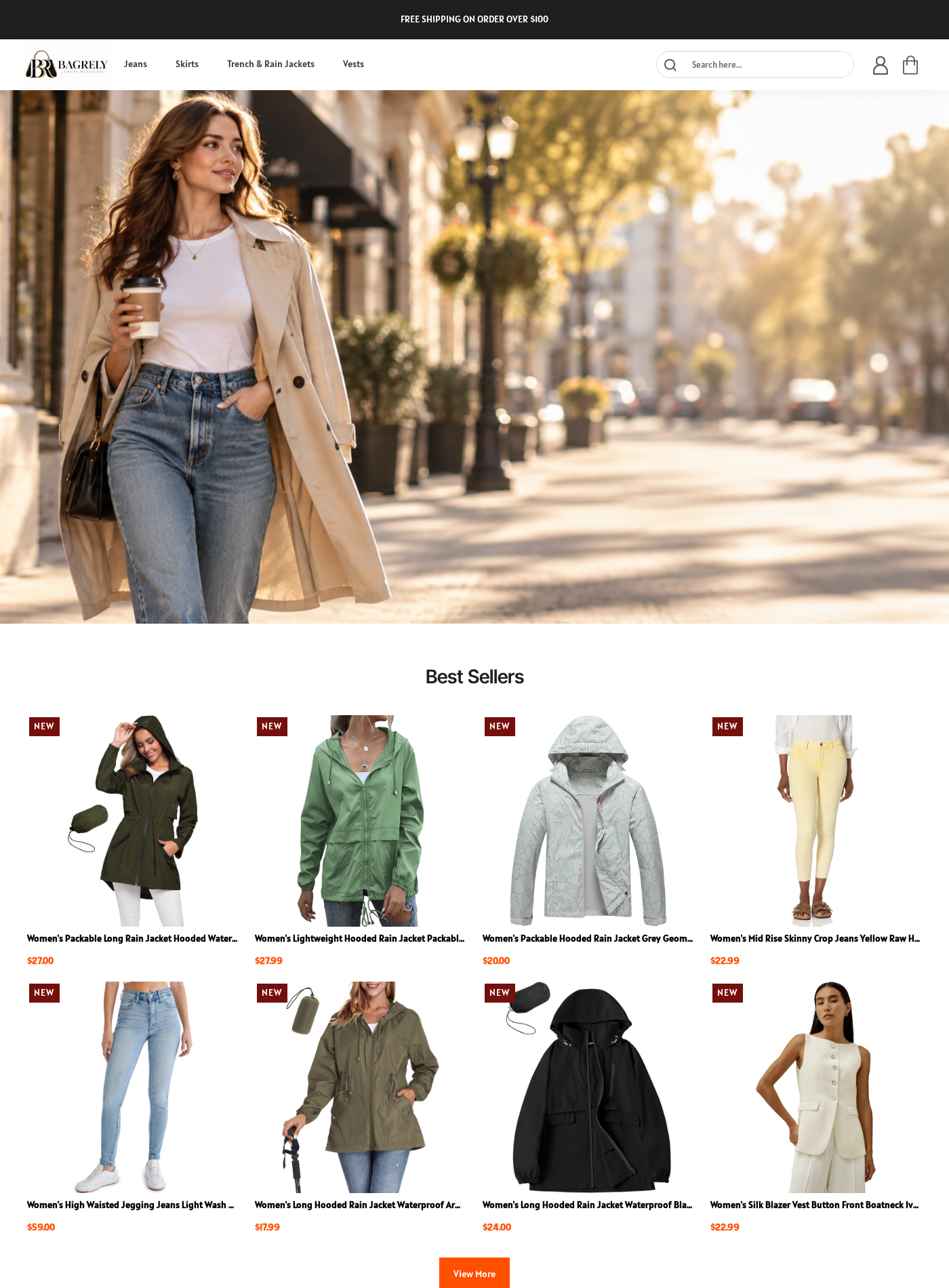
Bagrely greets shoppers with a glossy fashion image, inexpensive jackets and jeans, free-shipping language, and the familiar rhythm of a complete online retailer.
Behind that presentation sits a brand-new operation with a fragile website and very little history. Those details matter before any card information changes hands.
Overview
Bagrely appeared online only seventeen days before our review
Public registration records show Bagrely.com was created on September 10, 2026. We investigated the store on September 27, 2026.
That short interval provides almost no time for ordinary buyers to receive parcels, test products, complete returns, and publish reliable long-term feedback.
The site nevertheless presents a fully developed catalog, customer testimonials, best sellers, guarantees, policies, and international checkout features.
A rapid launch is technically easy with a commercial theme and supplier data. It is not evidence of dependable fulfillment or customer service.
Newness becomes important when combined with technical errors, generic inventory, and few independently verifiable business records.
The operator identifies itself as a Chinese company
The footer names 太和县龙瑞商贸有限公司, commonly rendered as Taihe County Longrui Trading Co., Ltd., and provides an address in Anhui, China.
It also lists service@bagrely.com as the customer contact. Publishing these details is better than offering only an anonymous form.
However, the store does not provide English registration information, a company number, named representative, telephone line, or independently verified fulfillment location.
International shoppers must determine whether the address is an office, warehouse, registered location, factory, or merely a correspondence point.
A Chinese operator is not automatically suspicious. The question is whether the retailer explains international delivery, returns, duties, and legal responsibility honestly.
The website exposed serious quality-control problems
The homepage source rendered a broken template fragment resembling “language->get error_message_title” near its navigation during automated examination.
Several familiar path variants for policies, contact, and about pages returned raw database errors instead of normal content.
Those pages disclosed missing-table messages and internal server paths, showing that routing and error handling were not configured safely.
The footer’s own policy links used different query-style addresses that worked during our screenshot review, making navigation dependent on exact URL structure.
A retailer handling payments should correct exposed backend failures before asking unfamiliar customers to trust its checkout and support systems.
- Bagrely.com was registered on September 10, 2026.
- The seller names a company and address in Anhui, China.
- The catalog contains generic low-cost fashion across several categories.
- The homepage exposed an unfinished template fragment.
- Common policy and contact paths produced raw database errors.
- Independent customer history was extremely limited during our review.
How the Bagrely Fashion Store Sales Funnel Works
Step 1: Search and social promotions make a new store appear established
Bagrely can reach shoppers through product ads showing a rain jacket, skirt, jeans, or vest rather than the unfamiliar business name.
The product image does the persuasive work while the retailer remains secondary, especially when the price looks lower than recognized alternatives.
A visitor arriving directly on a listing may never search the domain creation date or translate the Chinese company information in the footer.
Retargeting can display the same product repeatedly, creating familiarity with an operation that has existed for only a few weeks.
The store can also publish search-oriented content or testimonials before any meaningful independent reputation develops.
Buyers should separate “I have seen this advertisement before” from “this company has served customers reliably over time.”
Step 2: A complete-looking theme borrows trust from familiar retail conventions
The homepage includes a logo, search field, account icon, shopping cart, best-seller grid, promotional banner, product categories, and customer-looking reviews.
Each element resembles an established store, so shoppers may assume the legal and technical foundation is equally mature.
Modern themes can generate that appearance rapidly. Their presence does not show that staff, inventory, warehouse procedures, or refund systems have been tested.
Bagrely’s visible template fragment and raw database errors expose the difference between surface polish and operational readiness.
A technical failure on an information page can prevent customers from reading rights or reaching support during a deadline.
It also suggests that routine quality assurance did not cover basic navigation before launch.
Step 3: Low prices and shipping thresholds encourage a larger experiment
Many homepage products are priced between roughly $17.99 and $59, amounts low enough to feel disposable or worth testing.
The banner offers free shipping on orders above $100, encouraging customers to add several unrelated garments to cross the threshold.
That changes a small trial into a larger international transaction before the buyer has inspected one Bagrely item.
If quality or sizing disappoints, the customer must document and potentially return multiple products rather than one.
A shipping discount can be outweighed by tracked return postage, customs forms, original fees, and time spent resolving the order.
The safest test remains one protected, low-value purchase only after the return route is confirmed in writing.

Step 4: Generic supplier imagery obscures the actual product source
Bagrely’s catalog uses varied model photography, isolated garment images, different crops, and several visual styles across its product grid.
That inconsistency is common when a store imports listings from manufacturers, wholesalers, or marketplace feeds.
The practice is not automatically fraudulent, but it can leave the retailer dependent on descriptions and photographs it did not create.
Customers may receive garments differing in fabric, color, proportions, lining, waterproofing, or fit from the page.
Image search can reveal identical products elsewhere, providing alternative prices, buyer photographs, and clues about the actual supplier.
A premium-sounding brand label should not be used to infer proprietary design or exclusive manufacturing without evidence.
Step 5: Cross-border fulfillment begins after the easiest part is complete
Once payment succeeds, the order may pass from the storefront to a separate warehouse, consolidator, international carrier, and local delivery service.
The Chinese company address does not establish which location holds the exact item or how soon it leaves that warehouse.
Tracking can remain limited during export processing and handoffs, while the customer has already lost the ability to inspect before paying.
A parcel may eventually arrive even when delivery takes much longer than the shopping page suggested.
The label’s return address may belong to a logistics partner and cannot safely be treated as Bagrely’s authorized returns department.
Customers should retain tracking events and outer packaging because they help reconstruct the supply chain during a dispute.
Step 6: Refund success depends on policies and systems that already look fragile
The store advertises a thirty-day return concept and provides policy pages through query-style links in its footer.
Yet common human-readable paths triggered database failures during our testing, exposing internal error details instead of customer guidance.
A buyer using an old bookmark, search result, copied link, or support message could therefore encounter a broken page at a critical moment.
Support at service@bagrely.com may still respond, but the young domain provides no long record demonstrating consistent refund handling.
International return authorization can add destination, postage, customs, condition, and inspection requirements beyond the headline promise.
The customer bears greater risk when policy access and technical reliability depend on navigating the site exactly as its theme expects.
What Our Bagrely Investigation Found
The company disclosure is useful but incomplete
Bagrely’s footer supplies a Chinese legal name and a detailed Anhui address, which creates a starting point for verification.
The site does not provide a registration identifier that overseas customers can match easily in an official database.
It also does not explain whether this entity owns inventory, operates the website, processes payments, or only participates in trading and export.
The English-facing policies should state the company relationship, governing jurisdiction, and address used for legal notices clearly.
Customers should compare the Chinese entity with the invoice and card descriptor rather than assuming every document names the same party.
The technical errors reveal internal details unnecessarily
Broken routes exposed a missing database table called oc_seo_url2 and filesystem paths under /www/wwwroot/bagrely.com.
Such messages are normally hidden from visitors and logged privately so developers can repair the underlying configuration.
They do not prove payment data has been stolen or that the checkout itself is compromised.
They do demonstrate immature deployment, weak error handling, and failure to test predictable policy and contact URLs.
A merchant entrusted with customer information should treat this as a security and professionalism issue requiring immediate correction.
The catalog does not substantiate a distinct fashion brand
The product selection centers on common garments such as packable rain jackets, skinny jeans, satin skirts, and inexpensive vests.
Descriptions and images appear designed for broad catalog coverage rather than a coherent designer collection or named manufacturing line.
Nothing prevents a reseller from offering ordinary goods, provided photographs, prices, materials, origin, and delivery are represented accurately.
The risk is paying a branded markup or accepting difficult returns for merchandise available more transparently elsewhere.
Buyers should compare distinctive image details across established marketplaces before believing Bagrely offers unique stock.
Available reputation is too immature to resolve uncertainty
Automated website checkers have issued low or cautionary trust scores, largely reflecting age, ownership, traffic, and other technical factors.
Another scanner did not show broad malware consensus, demonstrating why no single automated label should decide whether a store is fraudulent.
We found little meaningful independent customer history because the domain had existed for only seventeen days.
The direct evidence is already sufficient: young age, generic inventory, China-based operation, exposed errors, and untested after-sales service.
Those findings justify waiting for a real track record rather than volunteering to become an early test customer.
How To Verify Bagrely Before Any Purchase
Translate and verify the legal entity
Copy the exact Chinese company name from the footer and search it through appropriate Chinese corporate-information sources.
Confirm registration status, unified social credit code, registered scope, legal representative, formation date, and whether the address matches.
Ask Bagrely to provide those details in English and explain which entity appears on receipts and card statements.
Do not treat a Chinese-language name as suspicious by itself. Treat unverifiable or inconsistent ownership as the warning.
Test policy and support access before checkout
Open return, terms, shipping, privacy, and contact pages directly, then save working copies with the date visible.
Email service@bagrely.com with a specific question about the return country and whether discounted items remain eligible.
Wait for a substantive answer rather than an automatic acknowledgment before submitting payment details.
Broken pages or silence are pre-sale evidence of how a time-sensitive complaint may be handled later.
Compare the exact merchandise elsewhere
Use reverse-image search on the hero photograph and product pictures, then match pockets, closures, stitching, hoods, prints, and model poses.
Search distinctive description fragments in quotation marks to find supplier feeds or duplicate listings.
Prefer a merchant with ordinary buyer photographs, established delivery records, and a domestic return label when the goods are identical.
A lower Bagrely price is not a saving when remedy costs and uncertainty erase the difference.
Company, Address, and Fulfillment Checks
The named operator is Taihe County Longrui Trading Co., Ltd.
Bagrely publishes the Chinese name 太和县龙瑞商贸有限公司 in its footer alongside service@bagrely.com.
An English transliteration commonly reads Taihe County Longrui Trading Co., Ltd., although official translations can vary.
The website should also provide the company’s formal registration number and clearly explain its role in processing international orders.
Customers need that identity on invoices, policy documents, receipts, and dispute correspondence, not only in small footer text.
If a different merchant appears during payment, ask for the contractual relationship before proceeding.
The published address is in Taihe County, Anhui, China
The footer gives an address at number 66 in an industrial park in Chengguan Town, Taihe County, Fuyang, Anhui.
An industrial location could be a legitimate office, warehouse, factory, shared complex, registration address, or unrelated mailing point.
We have not independently confirmed the exact unit, occupancy, or whether consumer returns are accepted there.
Mailing an unsolicited parcel internationally can result in refusal, customs delay, loss, or a delivery that the merchant does not recognize.
Obtain a complete return authorization and translated address label from support before shipping anything.
The support route relies on a single young-domain mailbox
Bagrely publishes service@bagrely.com but no obvious customer-service telephone number in the captured footer.
That email depends on the same newly registered domain used by the store and could become unreachable if hosting or domain service ends.
Save all correspondence outside the website and include complete message headers when documenting delivery or response times.
Ask support to identify a named department, company registration, return destination, and expected response window.
A reply that repeats marketing language without answering concrete logistical questions should not be treated as successful verification.
Chinese fulfillment can be legitimate but still impractical for returns
China supports sophisticated manufacturing and export networks used by reputable international brands as well as temporary online stores.
Product origin does not determine honesty. Transparent description, testing, delivery, communication, and enforceable remedies determine transaction quality.
Cheap fashion can become uneconomical to return once tracking, customs forms, duties, and delivery confirmation are required.
Mass-produced garments may also vary in fabric composition, sizing, color, or construction between production runs.
Inspect goods promptly and stop using any item showing dangerous hardware, severe dye transfer, chemical odor, irritation, or inaccurate safety labeling.
What to Do if You Have Fallen Victim to This Scam
- Archive the complete storefront. Save the product listing, images, description, price, shipping banner, policies, company footer, checkout, receipt, tracking, and any technical errors you encountered.
- Confirm the responsible merchant. Compare Bagrely, the Chinese company name, payment descriptor, invoice entity, sender, and support signature. Record every unexplained difference.
- Request cancellation before fulfillment. Email service@bagrely.com immediately with the order number and ask for written confirmation of a full refund and stopped shipment.
- Document each delivered item. Film sealed labels, package condition, quantities, measurements, material labels, defects, and visible differences from the advertisement before normal use.
- Keep products returnable. Preserve tags and packaging. Avoid washing, wearing, modifying, or discarding merchandise while the seller or card issuer reviews the case.
- Obtain precise international instructions. Require the authorized address, recipient, reference, customs declaration, deadline, tracked-postage responsibility, and refund schedule before sending anything.
- Use a merchandise dispute when justified. Explain whether goods never arrived, were unauthorized, differed materially, or were defective. Attach objective evidence and attempted resolution.
- Watch statements and identity exposure. Report unknown debits promptly. Replace the card if the issuer advises it after suspicious activity, but keep monitoring recurring merchant tokens.
- Scan and filter the shopping device. Use Malwarebytes to check for unwanted software and AdGuard to block malicious redirects and aggressive advertisements from similar temporary stores.
How To Recognize Another Technically Fragile Store
The homepage works while basic information routes fail
A merchant may test the sales page carefully while leaving policy, contact, account, search, and error pages unfinished.
Open those areas before buying because they become critical only after a problem starts.
Raw database warnings and server paths should never replace a customer-friendly error page.
Technical neglect does not prove fraud, but it reduces confidence that payments, support, and refunds receive stronger quality control.
The catalog appears complete before reputation exists
Supplier feeds can populate hundreds of products, descriptions, prices, photographs, and categories immediately after domain registration.
The resulting store looks older and larger than its actual service history.
Check the domain date, independent reviews, corporate formation, social history, and archived versions instead of counting product pages.
A large catalog is evidence of data import, not evidence of successful deliveries.
The company appears only where shoppers rarely look
Some stores place the legal operator in small footer text while advertisements and checkout emphasize only a memorable brand.
Translate the entity, verify it, and compare it with the payment recipient before assuming the names connect correctly.
Request the actual return location, because a registered address and a processing warehouse may be entirely different places.
A transparent seller makes this chain understandable without requiring detective work from every customer.
Frequently Asked Questions
Is Bagrely a scam?
We cannot prove that every Bagrely order fails or that the Chinese company never ships merchandise. We did not complete a test transaction.
The seventeen-day-old domain, generic catalog, exposed technical errors, limited history, and uncertain international remedies make the store too risky to recommend.
Who owns Bagrely?
The footer names 太和县龙瑞商贸有限公司, commonly transliterated as Taihe County Longrui Trading Co., Ltd.
Customers should request the registration number and verify that entity independently before relying on the disclosure.
Where is Bagrely located?
The website publishes an address in an industrial park in Taihe County, Fuyang, Anhui, China.
We have not confirmed whether that location holds inventory, operates customer support, or accepts authorized consumer returns.
Why do some Bagrely pages show database errors?
Common readable URLs triggered a missing-table error involving oc_seo_url2 and exposed internal server paths during our testing.
The footer’s query-style policy links worked, indicating a routing configuration problem rather than proof that every policy is absent.
Are Bagrely products unique?
The catalog contains common fashion items and varied supplier-style photography. We found no evidence establishing the range as proprietary.
Reverse-image search the exact garment and compare established sellers, buyer photographs, specifications, prices, and returns.
Should I place a small test order?
We would wait until Bagrely fixes its errors and develops verifiable customer history. Similar merchandise is widely available with stronger buyer protection.
If you proceed, use a credit card, avoid the $100 shipping threshold, order one low-value item, and save every representation.
The Bottom Line
Bagrely has built the appearance of an international fashion store faster than it has built an observable record of delivery, support, technical reliability, and refunds.
Its new domain, supplier-style catalog, China-based operator, backend errors, and uncertain cross-border remedies make early customers carry nearly all the risk. Wait or shop elsewhere.

Join the discussion
0 commentsShare your experience or ask a question about this article.
Discussion
Start the conversation
Have a question or something useful to share? Add the first comment.