

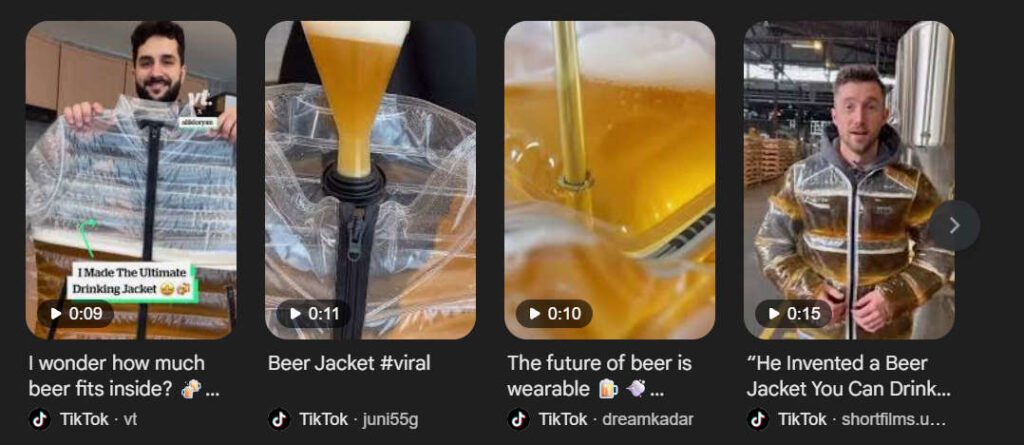
You’ve probably seen the Beer Jacket all over social media — a “jacket for beer lovers” that everyone’s talking about. The clips look futuristic and hilarious at the same time, showing people walking around in transparent puffer jackets filled with what appears to be golden beer. But is this fashion trend actually real, or just another AI-generated viral hoax?
Let’s dig deeper and uncover the truth behind the Beer Jacket craze.
What Is the Beer Jacket?
The Beer Jacket is presented online as a transparent, liquid-filled puffer coat designed for beer lovers. Supposedly, the jacket’s outer chambers are filled with actual beer, making it both a fashion statement and a walking beverage container.
Videos of the jacket, often shared on Instagram, TikTok, and Pinterest, show stylish models confidently strolling through city streets, with golden bubbles sloshing inside the jacket’s panels. It quickly caught attention for its bizarre blend of fashion and humor — a wearable beer mug for the modern age.
However, as viral as these videos are, a closer look raises serious doubts.
The Visual Evidence: Too Perfect to Be Real
When analyzing the footage and images of the Beer Jacket, several red flags appear immediately:
- Unnatural lighting and reflections: The “beer liquid” moves in ways that look simulated, with lighting that doesn’t match the surrounding environment.
- Plastic and motion artifacts: The jacket’s transparency and material behavior look computer-rendered. The reflections and distortions are consistent with AI or CGI rendering, not real-world physics.
- Perfect facial smoothness and movement: The models in these videos show signs of AI video generation — slightly robotic movement, too-smooth faces, and inconsistent shadows.
Many of these clips seem to come from AI design accounts such as luxarts.aii or luxarts.net, which are known for publishing AI-generated fashion concepts that don’t exist in real life.
Found on Design Websites, Not Stores
When investigating where these videos originated, researchers found identical images and descriptions listed on digital design and concept art websites, not real retail stores.
These platforms specialize in 3D modeling, virtual fashion, and AI art showcases. In other words, the Beer Jacket exists as a visual concept, not as a manufactured or purchasable item.
There’s no online shop, no price, and no production details available anywhere — strong signs that this isn’t a real product.
The Buzzword Trap: “Liquid Aesthetics” and “Wearable Storytelling”
The creators behind these viral visuals use marketing buzzwords like “liquid aesthetics,” “futurewear,” and “wearable storytelling.”
While these sound innovative, they don’t describe any actual materials, manufacturing processes, or technologies. There’s no mention of fabric type, insulation, or how “beer” could safely remain inside a jacket without leaking or spoiling.
This style of writing is typical for AI-driven concept marketing, where attention-grabbing language replaces substance.
No Real Customers, No Real Proof
Despite millions of views, the Beer Jacket has zero customer reviews or real-life sightings.
Searches on Google, TikTok, YouTube, and Instagram show only reposts of the same short AI-made videos, often uploaded by different accounts trying to gain followers and engagement.
There are:
- No unboxing videos
- No store listings
- No testers or reviews
- No real photographs taken by independent users
All evidence points to the Beer Jacket being digital art, not a real product.
Why These AI Hoaxes Go Viral
The Beer Jacket phenomenon fits perfectly into the growing wave of AI-generated viral hoaxes. These are realistic-looking videos designed to capture attention, spark discussion, and build large social media followings quickly.
Once these AI-themed accounts accumulate enough followers, some are later repurposed for promoting scams, fake stores, or dropshipping pages.
The Beer Jacket is simply the latest example of this pattern — an amusing but fictional product meant to go viral, not to be sold.
How to Spot AI-Generated Fashion Hoaxes
If you’re unsure whether a “new” viral fashion product is real, here are a few quick ways to check:
- Look for official purchase links — real products always have verified websites or shop listings.
- Search for real reviews or unboxings — if none exist, it’s likely a concept.
- Check the source account — names ending in “.ai” or “.art” often indicate digital creations.
- Observe the motion — AI videos often have stiff, overly smooth model movements.
- Reverse image search — if the same image appears on design portfolios or AI art sites, it’s not real.
The Bottom Line
After reviewing the visuals, sources, and claims surrounding the Beer Jacket, it’s safe to say that it’s not real.
The Beer Jacket is an AI-generated concept created to entertain and attract attention online — not something you can buy, wear, or fill with beer. The lighting inconsistencies, lack of real-world footage, absence of credible sellers, and reliance on marketing buzzwords all confirm it’s part of the AI fashion illusion trend dominating social media.
So next time you see someone wearing a jacket full of beer online — remember: it’s not time to cheers, it’s time to fact-check.

Join the discussion
0 commentsShare your experience or ask a question about this article.
Discussion
Start the conversation
Have a question or something useful to share? Add the first comment.